
The Fallen Ones by K.G. Reuss and J.A. Roles is a dark masked-men college romance advertised as why choose. Consider it if you want several men with existing connections to the heroine, concealed identities and a pursuit that the description deliberately presents as possessive. It is a different invitation from a gentle campus romance or a contest to identify one winning partner. The useful first decision concerns your interest in that specific combination, rather than the striking title alone.
This is a discovery guide based on the authors’ interview, official author pages and newsletters, and a documented audiobook listing. It does not claim a complete reading or listening experience. The premise provides substantial information about the kind of tension on offer while leaving its execution unresolved. Relationship history, a shared plan and hidden faces are established; later events, the full warning list and the exact ending are not independently assessed here.
Identify the authors before following the title
Both K.G. Reuss and J.A. Roles are credited on the documented audio edition. Its subtitle is A Dark Masked Men Romance, and the series designation is A Holloway University Novel, Book 1. These details are more useful than interpreting the words Fallen Ones as a genre description. Search with both authors and Holloway University to keep the result tied to this work.
A shared title can lead to unrelated books, films or other media. A dark cover also cannot establish an angel, demon or paranormal premise. The description checked for this title introduces a university social setting and masked men. Choose it because that advertised situation interests you, rather than because the title sounds like a supernatural story. If a fantasy element is a firm requirement, it needs its own affirmative evidence.
The second author’s name matters beyond finding a shop page. This is a collaboration, not a book that should be attributed solely to the better-known name on a recommendation. In their December 2024 interview, the authors describe a longstanding friendship and an intention to write together. They identify a dark standalone with three masked men as the resulting idea. That is their account of the project’s origin, not evidence for assigning particular chapters to either writer.
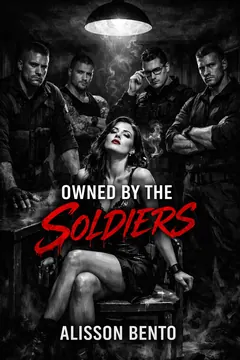
From Alisson Bento’s books
A military romance about a hero who claims her and never lets anyone forget it.
Kindle edition · Check Kindle Unlimited availability on Amazon.
What the advertised setup actually establishes
The audio listing’s publisher description presents a heroine who pulls back when her college relationship becomes serious. Her boyfriend does not share that decision and recruits her best friend and former stepbrother into a plan connected to a party at Satan’s Hollow, a fraternity at Holloway University. The marketing explicitly describes a romance in which she does not choose one man and warns of dark content. That is the verified starting arrangement, without a reconstruction of subsequent scenes.
The important distinction is that these men do not enter as three interchangeable strangers. Each connection carries a different kind of previous access to her life. A former relationship, a friendship and a past family connection do not create the same expectations. The premise invites curiosity about how existing history changes a group pursuit. It does not, by itself, show how fairly or thoughtfully the full novel handles those differences.
Nor should the shared plan be mistaken for proof of an easy, cooperative romance. Agreement among several pursuers and agreement with the person they pursue are different matters. The description’s possessive framing is part of what a reader is choosing. If your ideal group romance depends on transparent negotiations from the outset, that preference deserves attention before you respond to the masks or the college setting.
Three prior connections create three different questions
An ex-partner brings a relationship that has already reached a point where one person wants distance. As a reading interest, that differs from discovering attraction for the first time. The useful question concerns what happens when two people assign different meanings to the same past. You may enjoy unresolved attachment and an insistence on reconnecting. You may instead prefer a book where a request for separation is immediately respected. The advertised setup gives a reason to make that distinction early.
A best friend brings another question: how does an existing form of closeness change when its meaning becomes romantic? Friendship can make familiarity appealing, but familiarity and shared romantic expectations are not identical. For this title, the marketing establishes the prior connection, not every conversation that defines it. If your main interest is the emotional transition from friendship, ask whether that development receives substantial attention rather than assuming it follows automatically from the role.
A former stepbrother introduces a separate family-history consideration. Keep the word former attached to the description; do not silently turn it into a different relationship. Equally, the label does not tell us precisely when the family connection began, how long it lasted or the ages at each relevant point. Readers with a specific boundary around family-linked romance should seek those distinctions for the exact book. The premise supplies a category to investigate, not a complete chronology.
Putting these connections together creates a useful selection question: do you want several established relationships to be reconsidered at once? Some readers enjoy a heroine surrounded by accumulated history. Others prefer a new group whose expectations develop openly with her. Neither preference is answered by counting love interests. Here, prior connection is part of the advertised attraction and pressure, so it should remain central to your choice.
Reluctance is part of the heroine’s starting position
The publisher description connects the heroine’s reluctance about love with her mother’s death. That establishes loss as part of the advertised emotional context. It does not establish a diagnosis, a complete psychological explanation or a clinical account of how grief operates. This guide therefore treats reluctance as a character premise rather than turning it into a claim about real people’s reactions to bereavement.
For a reader, there is a meaningful difference between wanting to discover attraction and wanting to discover whether closeness is worth its perceived cost. The latter question brings a prior fear into a new interaction. You may enjoy a romance in which hesitation has emotional history. You may prefer a lighter story in which the central question is compatibility rather than the risk of attachment. The description provides enough information to distinguish those moods without revealing how the novel resolves them.
Keep the heroine’s starting wish separate from the men’s plan. A discovery guide can explain that the advertised conflict exists without deciding for her what the right response must be. That separation is particularly useful in dark romance, where a marketing voice can make insistence sound seductive. You can find a fictional premise compelling and still want to evaluate the actual handling of a character’s decisions when you read.
Masks change the information available to the reader
The masking premise creates more than a visual motif. In the advertised arrangement, hidden faces coexist with prior connections. That produces an interesting information question: what does the reader know about the setup, and what does the heroine understand at a given moment? The description supplies a broad outline, but it does not establish the exact schedule of recognition or disclosure inside the novel.
If you enjoy concealment, you may want to discover that schedule naturally. Avoid character wikis or detailed summaries that answer when and how identities become clear. A promotional description can disclose the broad roles while a story still has meaningful uncertainty about encounters and recognition. The source of suspense is not necessarily a completely unknown cast. It can also be the gap between familiarity and identification.
Conversely, if concealed identity affects your reading boundaries, a mask label alone is too broad an answer. You may need a narrow clarification about what a character knows, rather than an explanation of every later event. The distinction keeps your request specific to this premise. It also avoids converting general enthusiasm for masked men into an unsupported assurance about the way this novel handles deception or consent.
Why choose is a structure, not a complete content profile
The authors’ marketing explicitly identifies this book as why choose. The central invitation is therefore plural romantic interest, rather than a conventional elimination contest. Our why-choose reading guide explains the wider label. For The Fallen Ones, the actual advertised arrangement matters more than a general expectation about every book using the same term.
The label does not independently confirm relationships between the men, equal attention to every connection or a particular degree of explicitness. It also does not establish an absence of jealousy or coercion. Those are different questions. If one determines whether you want the book, ask it directly instead of trying to infer the answer from the number of men on a cover or the presence of several male narrators.
In their interview, the authors name Lily, Caleb, Jace and Damien and say that intimate scenes helped develop individual connections with Lily. That is an author-reported intention about characterization. It does not let this guide allocate a personality to each man, map each name to a prior role without a supporting source, or grade how successfully the finished novel differentiates them. Keep intention and your eventual reading judgment distinct.
The campus label leaves room for different reading pleasures
The verified party setting points toward a social campus premise. It is different from choosing a college romance specifically for laboratory work, academic rivalry or a disputed scholarship. The description does not make those latter experiences part of this book’s promise. If parties and overlapping personal histories appeal more than academic procedure, that distinction can help narrow your choice.
Our college why-choose guide explores age and authority questions through another title. It is a separate lens, not a complete character dossier for The Fallen Ones. Campus membership does not provide every person’s age or reveal whether an earlier connection appears in the story. For an age-specific request, obtain the actual ages for the relevant periods rather than treating a university address as the answer.
You may also want a setting to be atmospheric without dominating the plot. A university can interest you as a dense social circle rather than a place of detailed study. That is a valid preference to state. Asking how much academic life appears is more informative than arguing whether a book deserves the campus label. The description establishes a location and social event; your preferred balance still needs a sample or a knowledgeable answer.
Standalone and Book 1 can both describe a reading route
The authors’ 2024 interview describes their collaboration as a standalone. The documented audio edition identifies it as the first Holloway University novel. Those statements address different aspects of packaging: a book can have its own advertised story while belonging to a larger setting. Neither phrase alone proves a cliffhanger, and neither should be used to invent an exact ending.
In an April 2026 public newsletter, J.A. Roles describes The Broken Ones as a standalone in the Holloway University world connected to The Fallen Ones. That supports distinguishing a connected work from an automatically required second half. It does not verify the current release date of The Broken Ones or every detail of how the two stories intersect. This guide makes no current preorder or availability claim.
For a first encounter with this particular group, The Fallen Ones is the title to investigate. If you later enjoy the setting, consult the authors’ current pages for connected titles. Do not treat every work mentioned in a long newsletter as a continuation. The same author can announce several different projects in one message, and similar words such as Fallen, Broken or Feral do not establish one sequence.
What is documented about the audio edition
Roles’s August 2025 announcement calls the production full-cast duet and names Jacob Morgan, Corvin King, Joe Arden and Lucy Rivers. The Audible title record credits the same four performers and identifies Blue Nose Publishing in its recording copyright. These facts anchor the guide to a documented production. They are not a listening review or a claim that each voice has been independently evaluated.
The Audible author listing identifies an English, unabridged edition of eight hours and twenty-five minutes, released August 12, 2025. Treat that as an edition record rather than evidence for a current price or subscription benefit. Different marketplaces can display separate product identifiers. Match the authors, subtitle and credited performers before assuming an old recommendation refers to the same recording you are considering.
The official credits consulted do not assign every character to a performer. This guide therefore leaves that map unfilled. A full cast description tells you something about production format, but it does not determine how easily you will follow the voices, whether music or effects occur, or how the performance feels. Those remaining questions are best tested with an official sample of the exact production.
Print, translations and the decision to begin
K.G. Reuss’s own store entry confirms a signed paperback product. The store page does not establish a complete print bibliography or a translated title. No Portuguese, Spanish, French, Italian or German title was verified from the primary material used here, so this guide retains The Fallen Ones. That records the limit of this check and does not claim translations cannot exist.
Choose this book as a possibility when the combination of a dark campus setting, masked pursuit and three different prior connections is what you want to investigate. If you mainly want an openly negotiated, gentle group relationship, do not use the why-choose label as reassurance. If the audio cast is the attraction, sample the identified recording. Each route addresses a real preference without pretending the guide has assessed the entire novel.
For a particular content boundary or ending requirement, obtain a title-specific answer before committing. You can also explore the Alisson Bento catalog for other romance premises in your preferred language. Alisson Bento’s books are separate works; appearing beside a guide to Holloway University creates no shared reading order. The purpose is to make your next choice clearer, while leaving the story’s unrevealed details for the reading itself.