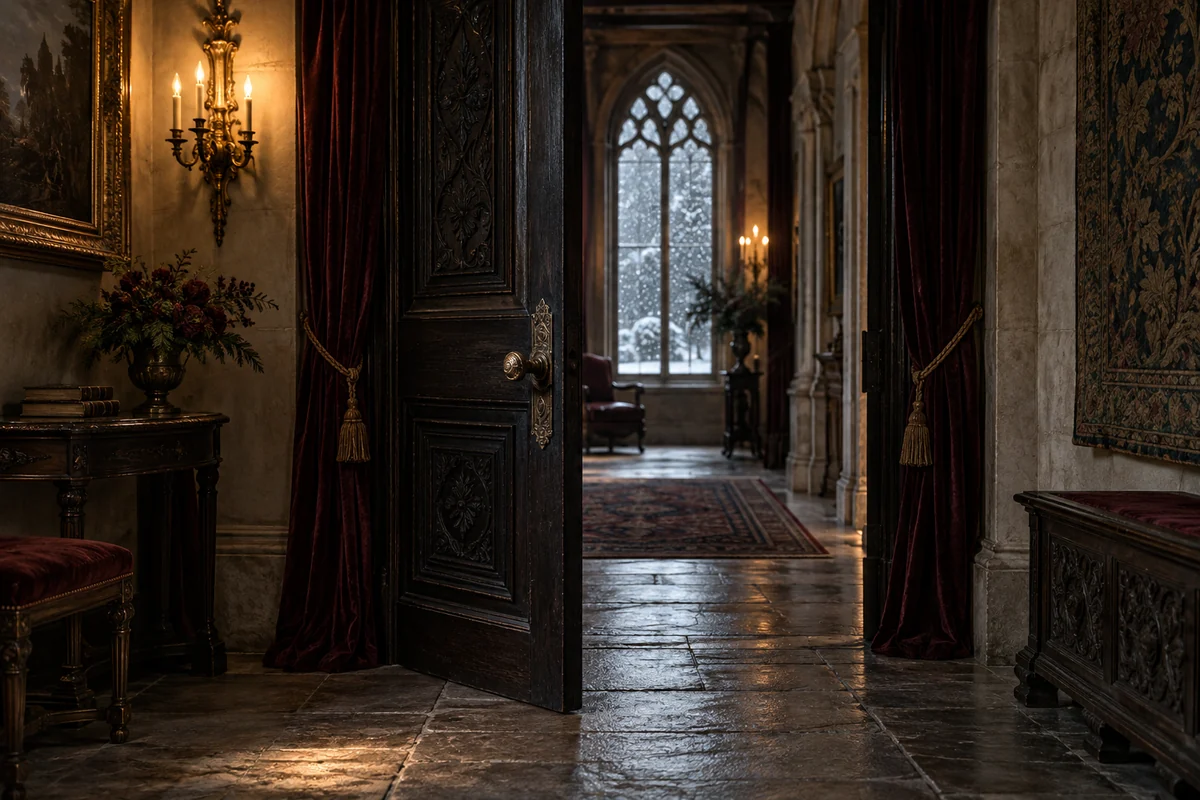
Choose gothic romance for the relationship between atmosphere, hidden history, and uncertainty about another person. Then decide whether you want the frightening question or the romantic question to lead. A sinister house can create gothic tension without proving that a ghost, curse, or other supernatural cause exists.
You may enjoy the unease of arriving somewhere beautiful and discovering that the household understands rules you have never been told. Or you may want a place whose history makes the lovers’ attraction difficult to separate from danger. Those are useful starting preferences.
An unsettling atmosphere does not answer the supernatural question
Wind, dark corridors, portraits, and locked doors can work through entirely human intentions. If a supernatural plot is part of what you want, ask explicitly. If you prefer uncertainty, avoid a recommendation that resolves the explanation before you start.
In Poisoned Intentions, Morwenna enters Tremayne Manor through a blizzard with a poisoned hairpin and a memorized route. The suspicious ease of her entry unsettles her plan. The opening offers a concrete gothic pleasure: access to a threatening house may itself be controlled by the person inside. That premise supports architectural unease and revenge tension, but it does not confirm a supernatural explanation.

From Alisson Bento’s books
A mafia romance about a hero who claims her and never lets anyone forget it.
Kindle edition · Check Kindle Unlimited availability on Amazon.
The place should carry a particular history
A house becomes more than scenery when ownership, family memory, debt, or inheritance affects who may enter and what they can learn. A locked room then matters because of the people connected to it, not simply because locked rooms are ominous.
Morwenna’s route comes from architectural preparation, while her motive is tied to her family’s ruin. That combination gives readers something specific to follow: what she thinks she knows about the building, and why its apparent cooperation feels wrong. If this interests you, look for samples where a character’s knowledge of place meets resistance or contradiction.
Read the threshold as the first question
Entering an unsettling house can be more than a change of scenery. The visitor may think they have secured permission, evaded a guard, or accepted a job, while the household knows something they do not. That uneven knowledge makes an ordinary threshold consequential. If you enjoy gothic tension, ask how access becomes part of the mystery rather than treating every dark corridor as the same atmosphere.
Morwenna’s arrival in Poisoned Intentions is purposeful. She has a concealed poisoned hairpin, bribed access, and memorized plans for Tremayne Manor. Her motive is revenge after creditors stripped her family’s property and her father died. The opening therefore introduces a prepared intruder with a reason to enter, rather than a visitor merely admiring an ominous building.
The suspicious ease of the route then changes what preparation means. Cleared steps, cooperative latches, and a dog that lets her pass contradict the resistance she expects. Orpheus knows the route and bribe because he arranged the entry. Within the opening, the orchestration is confirmed to be human. It does not prove the absence of every supernatural element elsewhere in the novel.
The gothic pleasure comes partly from that reversal of advantage. Knowledge of a plan makes Morwenna feel prepared, then becomes a sign that someone else has anticipated her. Readers who enjoy a capable visitor losing certainty may find this more compelling than darkness alone. Ask for a place whose apparent cooperation is suspicious if that is the tension you want.
Compare a planned intrusion with an inviting commission
The description of Purchased in Blood offers a different opening. Conservator Maren O’Shea accepts a three-week library assignment whose fee exactly matches the debt her sister Rosalind left. She reaches a decaying Newport mansion as a nor’easter approaches. The book’s description identifies a billionaire vampire premise, which makes this a supernatural comparison rather than proof of a human-only explanation.
Maren enters to perform useful work, while Morwenna enters to carry out revenge. Their reasons for crossing the threshold give the houses different meanings. One visitor wants to approach an adversary without being noticed; the other wants to preserve manuscripts while earning enough to answer an obligation. Both encounter signs that access has been shaped around them, but the initial bargains are different.
The tailored fee makes Maren’s welcome uncertain because it suggests knowledge of private need. The neglected books also engage her genuine expertise. A gothic setting can therefore attract the visitor for a real reason while leaving the surrounding conditions troubling. Readers who enjoy useful labor within uneasy hospitality may prefer that starting point to an overt assassination mission.
Morwenna’s opening gives the reader an explicit explanation for the convenient entry. Maren’s leaves the employer’s motives less clear. That distinction helps you choose whether you want immediate awareness of a host’s strategy or a longer period of interpreting clues. A sinister house can create tension through known control as well as unknown causes.
Notice what the building lets the visitor confirm
A place can hold information in its physical details. A maintained lock amid decay, a route cleared in bad weather, or a door behaving differently from expectation gives the character something observable. Readers who enjoy close attention may want those details to affect interpretation. Atmosphere becomes active when a feature changes what the visitor believes or attempts next.
Maren’s room has a window that barely opens, a steep drop, and a newly maintained lock. Those facts create concern about accommodation without settling every rule about leaving. The contrast with the decaying building is useful as a clue: one feature has received care where much else has not. A recommendation can identify that discrepancy while preserving its explanation.
Morwenna’s memorized plans create another form of verification. She knows what she expects from the route, so suspicious cooperation has a baseline. Readers may enjoy a heroine whose knowledge makes the anomaly visible. The setting matters because somebody with a plan is reading it, not because every staircase or latch has an independent ominous meaning.
Compare this with a visitor who has no prior knowledge of the house. They may need to learn routines and discover what is normal before recognizing a change. That can create a slower, more immersive uncertainty. Ask whether you want a newcomer gradually interpreting a household or a prepared visitor discovering that their expertise has been anticipated.
Read hospitality and silence together
A household can offer comfort while withholding an explanation. Genuine warmth from one person need not settle what another intends. Readers drawn to that mixture may enjoy a place where the visitor receives help and still has reasons for caution. If reassuring care is your main preference, ask whether the story makes loyalties clearer than the atmosphere initially suggests.
In Maren’s opening, Thaddeus Finch and Genevieve offer warmth while remaining uneasy and silent about the owner. The description identifies that combination, so the tension is not simply inferred from their employment in a decaying house. It gives the visitor evidence pointing in more than one direction: welcome can be real while information remains incomplete.
Silence can concern several things in a gothic premise. A household may avoid a family history, refuse to explain a room, or discourage a question about the host. Those are possible mechanisms to look for, not additional facts about these books. Ask which unanswered subject interests you: a person’s past, the place’s ownership, or the rules governing the visitor’s stay.
A controlled welcome can also make the visitor question their own interpretation. They may feel rude for asking about something presented as generous. Readers who enjoy that social unease can request hospitality whose conditions become consequential. Readers seeking a more direct adversarial exchange may prefer an opening like Morwenna’s, where the host openly demonstrates knowledge of her intrusion.
Connect place with the history that gives it stakes
Family ruin, inheritance, debt, and ownership can make a house important beyond its appearance. A corridor may lead toward a person blamed for earlier harm; a library may hold work the visitor feels compelled to preserve. The setting then carries a reason to stay or continue even when unease increases. Ask for that attachment if architecture alone does not sustain your interest.
Morwenna’s motive ties the manor encounter to lost family property and her father’s death. The description does not settle every responsibility for those events or the eventual revenge outcome. It makes clear whom she blames and what drives her toward the duke. Preserving that distinction keeps the reader’s question about the past active instead of treating her accusation as a completed judgment.
Maren’s family obligation concerns her sister’s debt, while the manuscript task awakens professional anger and eagerness to preserve damaged materials. Those are two reasons the commission attracts her. A reader may enjoy the conflict between a worthwhile task and an uncertain household. The opening does not prove whether completing the work will settle every personal or supernatural condition.
A place with history can also become a question about who is permitted to know it. Owners, staff, heirs, and visitors may have different access to accounts or objects. If you enjoy that social structure, request secrets tied to permission and possession. The gothic setting becomes more specific when information belongs to somebody rather than simply lying hidden in a convenient room.
Choose the balance of attraction and frightening uncertainty
Romantic suspense may ask what an attractive host intends. Frightening uncertainty may ask what could happen in the next room or outside the house. A gothic romance can braid those questions tightly, yet readers often prefer one to lead. Say whether you want charged dialogue in an ominous setting or a frightening investigation with romance growing beside it.
A known strategy can remain tense even after mystery about it ends. Once the reader knows Orpheus arranged Morwenna’s entry, the question becomes what that knowledge means for their encounter. That is different from withholding every explanation about the house. If you enjoy confrontation after a reveal, ask for secrets that change the relationship rather than only extend an atmospheric puzzle.
A supernatural premise can make different questions active. Readers may want the visitor to discover fictional rules, or may already know the host’s nature while the visitor does not. Maren’s vampire framework sets up a broader genre context, but the opening does not catalogue feeding, daylight, or every power. Request specific supernatural features rather than importing them from familiar conventions.
The related guide to creature premises and dark-romance boundaries separates appearance from behavior. Apply that distinction here: a gothic house’s mood does not determine the relationship’s terms or the amount of explicit horror. Those remain separate reading questions even when the atmosphere is strongly unsettling.
Ask for the secret’s role without asking for its solution
A useful request is “gothic romance where the house has consequential history and the visitor’s knowledge of place affects the conflict.” Add whether you want a human strategy, a confirmed supernatural premise, or uncertainty about the explanation. Ask how much explicit horror appears if that changes your choice, while leaving the eventual secret undisclosed.
You can also name the kind of visitor you enjoy. A prepared intruder brings a plan to test; a skilled worker brings a task to complete; an unfamiliar guest brings a need to learn the household. Those roles shape the opening’s pace and reasons for attention. A recommender can identify them without summarizing the final encounter or explaining every locked space.
When you sample a book, follow one physical detail into a consequence. What did the character expect, what does the house do differently, and what does that difference make them question? Morwenna’s cooperative route and Maren’s maintained lock offer two starting mechanisms that their openings confirm. The pleasure lies in reading the place alongside the visitor, with its emotional and practical meaning still developing.
A final useful distinction concerns the place after it becomes less mysterious. You may want the house to remain central as a working or inherited environment, rather than disappear once a secret is explained. Ask about that continued role if atmosphere is a major part of your reading pleasure. A mystery’s answer and a setting’s importance need not end at the same moment.
Choose which uncertainty you want to keep longest
Romantic uncertainty asks whether attraction can coexist with distrust. Frightening uncertainty asks what threatens the character and how close it is. A gothic romance may intertwine both, but you can still prefer one to occupy more of your attention.
Try: “I want a house with consequential secrets and a strong romantic thread. Is the atmosphere mostly unsettling, or does explicit horror dominate?” Ask separately about content and resolution. The ideal recommendation lets you choose your threshold while preserving the unanswered question that makes walking down the fictional corridor irresistible.
Read another angle: Trauma recovery in romance: finding the emotional focus you want · Alien romance reader guide: communication culture and attraction · Monster romance vs dark romance: choose the creature, the mood, and the boundaries
Explore the wider romance catalogue. The catalogue groups books by genre and trope; it does not confirm every preference discussed in this guide.