Choose gothic romance for the relationship between atmosphere, hidden history, and uncertainty about another person. Then decide whether you want the frightening question or the romantic question to lead. A sinister house can create gothic tension without proving that a ghost, curse, or other supernatural cause exists.
You may enjoy the unease of arriving somewhere beautiful and discovering that the household understands rules you have never been told. Or you may want a place whose history makes the lovers’ attraction difficult to separate from danger. Those are useful starting preferences.
An unsettling atmosphere does not answer the supernatural question
Wind, dark corridors, portraits, and locked doors can work through entirely human intentions. If a supernatural plot is part of what you want, ask explicitly. If you prefer uncertainty, avoid a recommendation that resolves the explanation before you start.
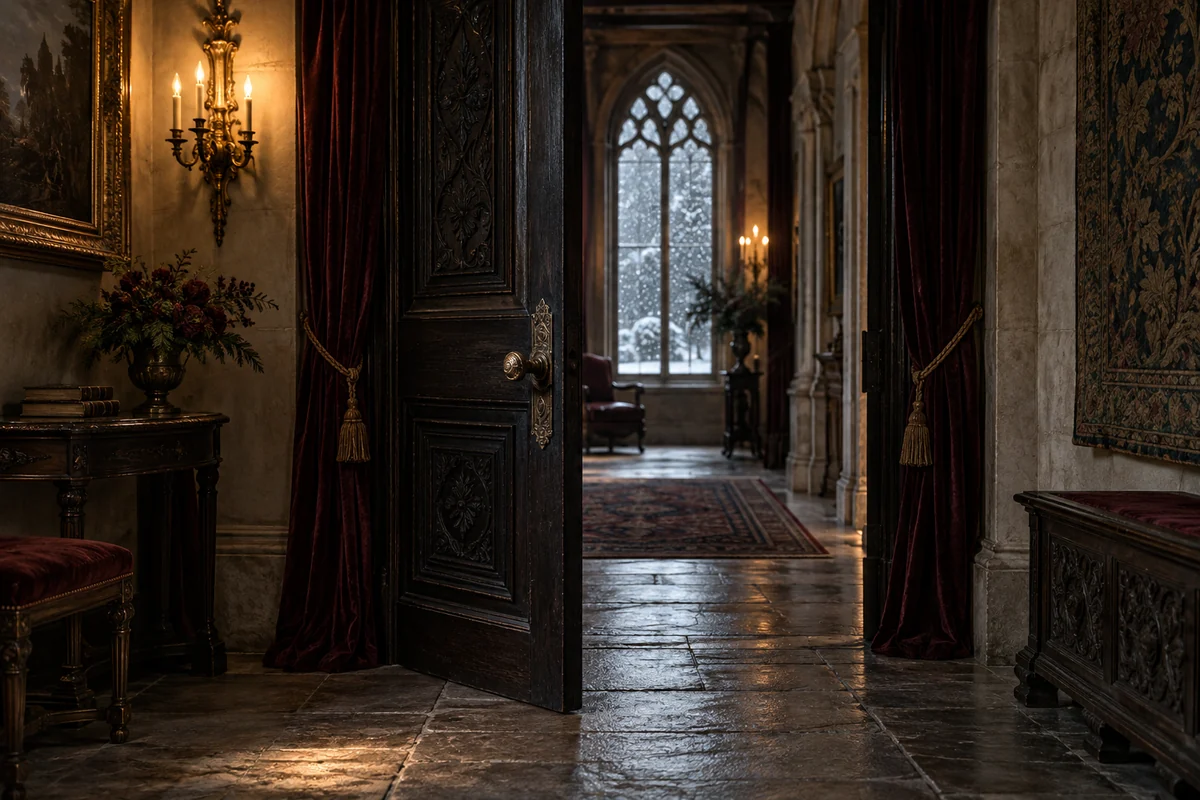
In Poisoned Intentions, Morwenna enters Tremayne Manor through a blizzard with a poisoned hairpin and a memorized route. The suspicious ease of her entry unsettles her plan. The opening provides a concrete gothic pleasure: access to a threatening house may itself be controlled by the person inside. That premise supports architectural unease and revenge tension; it does not establish a supernatural explanation.
The place should carry a particular history
A house becomes more than scenery when ownership, family memory, debt, or inheritance affects who may enter and what they can learn. A locked room then matters because of the people connected to it, not simply because locked rooms are ominous.
Morwenna’s route comes from architectural preparation, while her motive is tied to her family’s ruin. That combination gives readers something specific to follow: what she thinks she knows about the building, and why its apparent cooperation feels wrong. If this interests you, look for samples where a character’s knowledge of place meets resistance or contradiction.
Choose which uncertainty you want to keep longest
Romantic uncertainty asks whether attraction can coexist with distrust. Frightening uncertainty asks what threatens the character and how close it is. A gothic romance may intertwine both, but you can still prefer one to occupy more of your attention.
Try: “I want a house with consequential secrets and a strong romantic thread. Is the atmosphere mostly unsettling, or does explicit horror dominate?” Ask separately about content and resolution. The ideal recommendation lets you choose your threshold while preserving the unanswered question that makes walking down the fictional corridor irresistible.
Read another angle: Trauma recovery in romance: finding the emotional focus you want · Alien romance reader guide: communication culture and attraction · Monster romance vs dark romance: choose the creature, the mood, and the boundaries
Explore the wider romance catalogue. The catalogue groups books by genre and trope; it does not confirm every preference discussed in this guide.