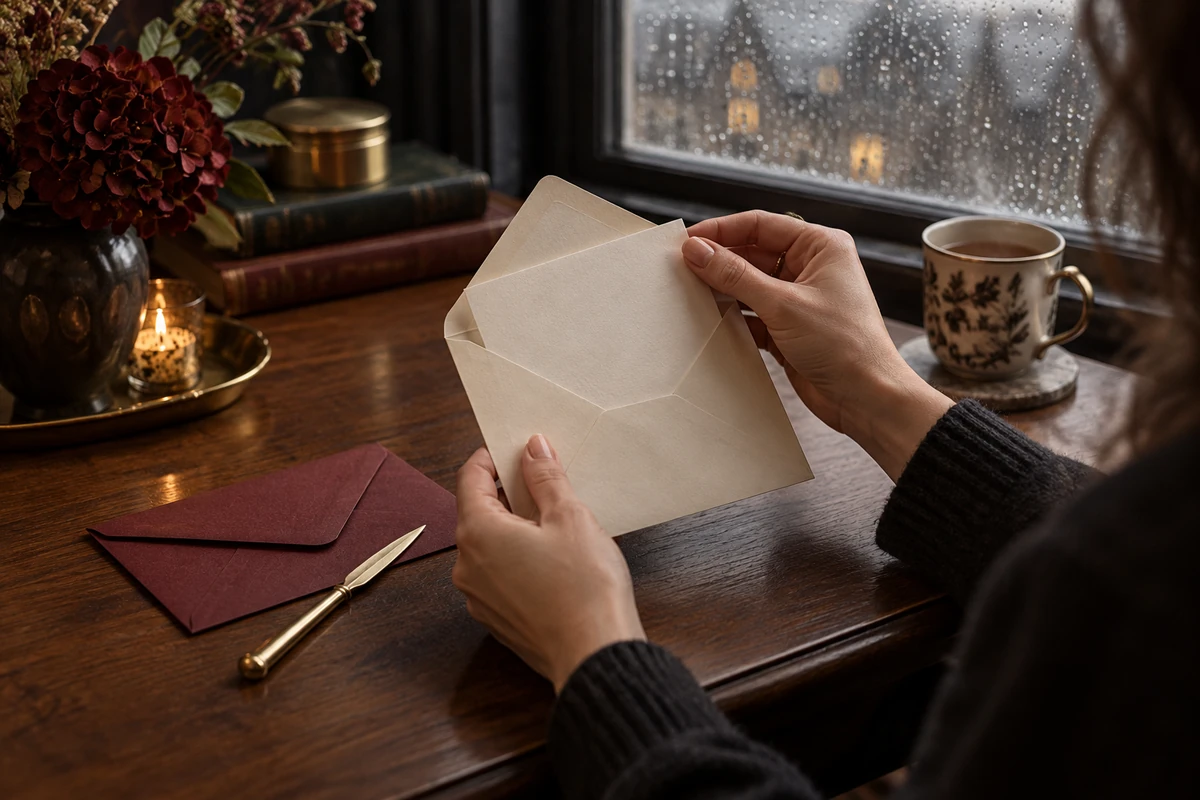
If you want letters or messages in romance, decide whether you want correspondence to tell most of the story or simply to shape the couple’s connection. Occasional texts do not make a novel epistolary. A written exchange can create intimacy, distance, suspense, or all three, depending on what the characters are willing to put into words.
One reader may want the feeling of opening an envelope with the recipient. Another may enjoy ordinary scenes interrupted by a message whose meaning is hard to read. Those are different formats and different pleasures.
The appeal often lies in having two versions of the same moment: the words sent and the feelings surrounding them. A message can look efficient to its recipient while the reader knows how much the sender omitted. Or the story can give you only the document, leaving you to infer the effort from its phrasing. Decide how much of that surrounding knowledge you want.
Distance is not necessarily geographical. Two people can work in the same building and find written communication safer than an unplanned conversation. A note can protect privacy, let somebody finish a difficult thought, or avoid the social pressure of an immediate answer. If that is the intimacy you want, ask about writing as an emotional space rather than requiring a long-distance relationship.
Correspondence can be the structure or an interruption
In a predominantly epistolary story, documents carry events and voices that conventional narration might otherwise explain. In a scene-based novel, a message usually enters an existing situation: someone reads it while tired, at work, or beside another person. The context can change how it lands.
For the latter, Too Stubborn to Love offers a specific opening example. With Hallie’s truck dead, Bowen texts to confirm the departure for her horse delivery. She reports a truck issue and promises an update. These brief messages put scheduling pressure on a problem the reader can already see; the opening does not show that the novel is told mainly through correspondence.
Letters can make a reader aware of delivery itself: when something was written, when it was sent, and when it was read. Messages on a phone can compress those intervals, yet still leave a recipient waiting. The important question is how the book uses the interval. Does waiting let feelings settle, encourage a mistaken conclusion, or create a practical problem that cannot wait for clarity?
In Hallie’s opening, the text exchange is tied to transport rather than presented as a private romantic correspondence. Bowen needs confirmation for a horse delivery. Hallie’s truck has failed, and her reply promises an update instead of explaining every consequence. That makes the exchange an adjacent example of meaningful messages inside conventional narration, rather than a confirmed letters-centered courtship recommendation.
Her brief answer gains significance from the scene around it. She knows lateness can mean a penalty and the loss of another commission. A recipient seeing only the text would not necessarily see the full scale of that worry. Readers who like this layered experience can ask for messages whose apparent simplicity differs from what the viewpoint character is experiencing.
The exchange also creates an obligation to speak again. Promising an update by a particular time gives the next message a job to do. It is a small example of how correspondence can organize a scene’s expectations. Romantic messages can perform a similar structural function in other books, although this opening does not show that pattern in Hallie’s later relationship.
If you want an epistolary novel, look at several pages rather than one displayed message. Do documents continue to carry the action? Are they the main route into the characters’ voices? A novel with frequent texts may still rely on narrated scenes for every significant romantic development. That may suit you perfectly, but it is a different format from a story you mostly assemble through correspondence.
Mixed formats can offer another pleasure: moving between the public account and the private one. A conversation may be followed by an email that revises what somebody was able to say aloud. A diary may reveal an uncertainty omitted from a letter. Ask whether you enjoy multiple kinds of documents or prefer one sustained exchange with a recognizable rhythm.

From Alisson Bento’s books
A cowboy romance about a single dad who never planned to fall again.
Kindle edition · Check Kindle Unlimited availability on Amazon.
What the writer leaves out can be as revealing as what arrives
A written message gives its author time to choose words, yet removes many cues the recipient would have in person. A careful reply might conceal panic, spare someone worry, or preserve a boundary. Readers can enjoy knowing why a short sentence cost more effort than it appears to.
Choose whether you want identities known from the start, a private exchange between familiar people, or correspondence whose authors know little about each other. Hidden identity adds a separate uncertainty; long-distance intimacy does not require it.
Editing is part of the attraction. A character can delete a sentence, soften a request, or delay sending until the words feel right. The final message records the choice, while narration may show the discarded possibilities. Readers who enjoy restrained feeling often value that difference between what could have been said and what finally travels across the distance.
Restraint need not mean emotional evasiveness. A short reply can be caring when the other person is overwhelmed; a long explanation can be generous when clarity is needed. Consider whether the book makes the recipient’s situation relevant to the sender’s choices. The pleasure may come from learning how carefully one person attends to another’s available time and energy.
Conversely, polished words can create uncertainty. Someone who writes beautifully may struggle to make the same commitments in everyday life. Someone whose messages sound abrupt may behave with patience in person. If you enjoy the contrast, ask for a romance that explores the relationship between written voice and ordinary behavior. Do not assume that elegant correspondence proves reliability.
What counts as a revealing message also depends on the established pattern. A long reply from a usually terse correspondent may feel momentous. A routine sign-off disappearing can trouble someone who has learned to expect it. A story earns these small changes by first making the rhythm recognizable. Read for whether the exchange develops habits you can notice, rather than relying entirely on dramatic declarations.
Silence has several possible meanings. A person may be unable to answer, unsure what to say, unwilling to engage, or simply busy. Readers can enjoy uncertainty while still wanting believable reasons for it. If repeated delays frustrate you, identify whether you dislike waiting itself or the feeling that one ordinary question would settle a misunderstanding the plot keeps extending.
Choose how much uncertainty you want to share
Knowing both correspondents’ thoughts changes the suspense. You may understand that each is trying to protect the other while neither understands the other’s wording. A single perspective makes you interpret the reply alongside its recipient. Neither structure is inherently more intimate. One offers the pleasure of shared knowledge; the other gives a stronger experience of wondering what the words mean.
Identity is another independent choice. An anonymous exchange can make the question of who is writing central. Correspondence between known people can focus instead on what they are willing to disclose. If you dislike secret identities but love written intimacy, state both preferences. You do not need to abandon the whole format because one common setup does not appeal to you.
Consider whether the reader knows the hidden identity before the recipient does. When you know, suspense can gather around discovery and the cost of concealment. When you do not, clues may become part of the reading pleasure. Ask for that distinction if it matters, while requesting a description of the information pattern rather than the concealed name.
Written communication can also involve asymmetry without anonymity. One person may disclose more, answer faster, or have more freedom to write. You might enjoy the gradual discovery of those differences, or want both adults to contribute fairly early. A useful sample question is whether each reply changes the conversation, instead of one voice repeatedly carrying all its emotional work.
Read the medium as part of the relationship
A letter offers space for a thought to develop without immediate interruption. A rapid text exchange can resemble dialogue while leaving tone uncertain. An email may mix practical business with a personal sentence that suddenly changes the mood. These are possible uses of the medium, not rules. Choose according to the rhythm you want to spend time reading.
Do you enjoy long passages where a single character develops an idea, or brief exchanges that invite quick interpretation? If you find pages of correspondence tiring, a scene-based romance with a few consequential messages may fit better. If ordinary narration keeps interrupting the exchange you care about, you may want documents to occupy more of the book.
Accessibility of the page matters too. Some readers like visually distinct messages because they can immediately see a shift in voice. Others prefer prose that incorporates their meaning smoothly. A sample helps you discover whether the presentation feels inviting in the edition you will read. The same correspondence premise can create very different reading rhythms through its layout and placement.
Notice whether messages do different work as the relationship changes. A first exchange might be formal, later ones practical, and another unexpectedly personal. If every message simply repeats that attraction exists, the medium may feel ornamental. You may prefer a book where writing creates new knowledge, obligations, jokes, or opportunities for misunderstanding as the connection develops.
Let the meeting be its own event
A meeting can test habits formed at a distance. The adults discover how the other person listens, handles an interruption, or responds when there is no time to compose a careful sentence. Readers may want this transition to occupy substantial space rather than serving as an immediate resolution. Ask whether the story spends time integrating written familiarity with ordinary companionship.
Another reader may prefer a delayed meeting because the correspondence is the heart of the appeal. In that case, ask how much of the relationship develops before shared physical space becomes possible. This is a question about where the narrative spends attention, and can usually be answered without revealing the ultimate romantic outcome.
Meeting is not the only way to change the exchange. A new practical obligation, a difficult disclosure, or a shift in who initiates can also alter its rhythm. You may enjoy correspondence that stays important after the adults meet, because written words remain a way to say something they cannot easily say face to face. Specify that if an early disappearance of the format would disappoint you.
An in-person meeting changes the available evidence
When correspondents meet, pauses, movement, and tone become harder to edit. That can be the part you most anticipate: discovering whether the written ease survives ordinary company. Alternatively, you may want the exchange itself to remain the main space of the romance.
A focused recommendation request is: “Are letters or messages the main storytelling format, and do they build the central relationship?” Add whether you want the meeting delayed. If you enjoy conventional scenes with meaningful texts, ask for that instead. Choosing the role of correspondence gives you a more reliable reading fit than assuming every mention of a letter promises the same kind of closeness.
For a focused reading choice, imagine the part you most want to linger over: composing the message, waiting for the reply, interpreting what arrives, or comparing it with the person you finally meet. Naming that moment is often more helpful than asking for romance “with texting.” It explains why the correspondence should matter to your experience.
A precise request might be: “I want a romance where private letters build the relationship for a substantial part of the book, with known identities and a later in-person meeting. Please describe the format without revealing the final exchange.” Alternatively, ask for conventional scenes with brief texts that change what the characters understand. Both requests preserve the actual pleasure you are seeking.
Read another angle: Choosing a historical romance era: which social world do you want? · First-person vs third-person romance: choosing how close the voice feels · Single POV vs dual POV: whose secrets do you want?
Explore the wider romance catalogue. The catalogue groups books by genre and trope; it does not confirm every preference discussed in this guide.