Witches reappear in shop windows every October, with pointed hats, black cats and bottles of something green. Behind the costume sits one of the oldest figures in storytelling, and romance has turned her from a figure of fear into a heroine with her own point of view. If your reading list has filled with witchy love stories this month, the timing makes sense: Halloween draws on older autumn traditions, and readers who want magic with a seasonal chill often want stories that treat the witch as more than a costume. This guide traces how the witch moved from feared folklore figure to romance heroine, then explains how to choose witchy romance by tone so the book you pick matches the mood you want.
From Circe to the cunning woman: where the witch began
Long before the pointed hat, the witch was a type of person defined by knowledge other people did not have. In Homer’s Odyssey, the sorceress Circe lives on an island, prepares drugged food and drink, and turns Odysseus’s men into swine. A herb given to him by Hermes protects the hero from her enchantments, and he forces Circe to restore his men. She is frightening and uncanny, yet she is also a figure who bargains, advises and eventually helps him. Greek tragedy gave us Medea, whose herbal knowledge makes her both a wronged wife and a dangerous outsider. Hecate, a goddess linked with crossroads, night and magic, sits behind much of this tradition. None of these figures is a witch in the later English sense, but they set a pattern later writers kept: magic as knowledge, and the woman who holds that knowledge as someone her community cannot fully control.
The early modern period changed the meaning. In the 1480s a German manual known as the Malleus Maleficarum, the Hammer of Witches, argued at length that witches had made pacts with the devil, and learned authorities used such ideas to shape courts and sermons. Across Europe and in the English colonies, courts tried people accused of harmful witchcraft from the late Middle Ages into the eighteenth century, with the heaviest pressure in the sixteenth and seventeenth centuries. The Salem trials of 1692 in Massachusetts remain the most familiar American example: nineteen people were hanged and one man was pressed to death. These trials are a real record of injustice, and the accused were often poor women, older women and people already at the edges of their communities. A romance that uses the witch as a figure of power is working with that legacy, and a thoughtful one knows it.
Those trials did not erase everyday practice. In England and elsewhere in Europe, many people consulted local cunning folk, sometimes called wise women, for charms, herbal remedies and help finding stolen goods. The same person could be respected for healing and feared when a neighbour’s misfortune needed an explanation. This double position explains much of the witch’s appeal in fiction: she is useful and feared at once, needed in a crisis and blamed after one. That is the figure romance inherited, and it explains why so many witch heroines are good with herbs and dangerous to cross.
Kindle edition · Check Kindle Unlimited availability on Amazon.
Familiars, covens and spell costs: the details romance borrows
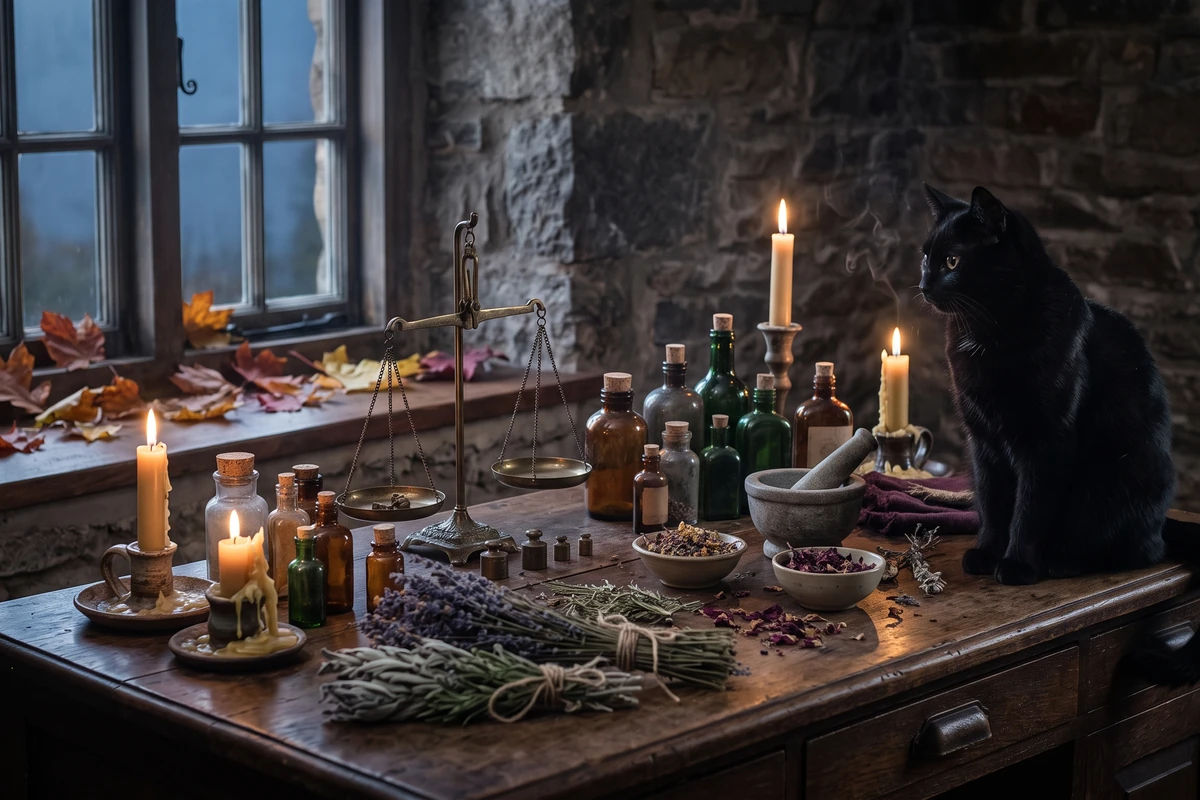
Three details from the old accounts appear again and again in modern witch romance. The first is the familiar, an animal believed to assist or serve a witch. Trial records describe creatures such as cats, dogs and toads that accusers said were in league with the accused. The black cat in modern autumn decorations draws on this tradition, though in the past the animal was more often evidence of suspicion than a sign of comfort. A modern author can make the familiar a companion, a guardian or a betrayer, and each choice reveals how the story sees magic.
The second detail is the coven. Early modern accusations and writings often described gatherings of witches, sometimes linked to a sabbath. These accounts were shaped by fear and by what accusers expected to hear, so they show how people imagined witches rather than what really happened. Romance takes the coven and turns it into a found family: women who share knowledge, protect one another and argue over their own rules. A coven story is usually about belonging, and it often gives the heroine a community the wider town has refused her.
The third detail is the cost of magic. Folklore rarely made power free. Fairy tales, ballads and legends about bargains with the otherworld, including the Faust story, all show power with a price. Modern romance has made the price central. A spell may draw on the caster’s memories, her years, her blood or the people she loves. A well-built spell cost gives every magical act weight, because the reader asks what it took from the heroine and whether she would pay it again. That question keeps witchy romance from becoming a string of convenient miracles.
How modern romance made the witch a heroine
The most important change is point of view. The historical witch was described by people who feared her. The romance witch narrates her own life, decides what to do with her power and sets the terms of her attachments. This is why so many modern magic-wielding heroines arrive with unstable or newly released magic that she must learn to control, and why a protective love interest can become a source of conflict rather than rescue.
Her Four Mates shows this shift clearly, even though its heroine is not drawn from witch lore. Zara wakes in Caden’s forest estate after a confrontation has broken the curse that suppressed her magic, and the layered wards meant to keep her safe provoke her power instead of calming it. When an ordinary glass shatters, her wish to learn collides with Caden’s insistence on containment. The story works because her frustration with confinement carries as much weight as the danger outside. Readers who want a heroine who studies her own magic will find that the spellwork is also a question of autonomy.
Folklore also gives witch stories a rulebook, and the rules can be as romantic as the magic. Her Savage Guardians draws on Fae traditions in which iron, names and binding bargains carry consequences. Violet wants to search for her missing best friend, and her grandfather’s refusal to let her leave, backed by a threat to lock her in the cellar, makes protection sound like captivity. The iron locket he fastened on her as a child shows how a symbol of safety can also restrict. If your favourite part of witch lore is the rules, a story built on bargains and protective charms offers similar pleasure without a coven.
Hidden magic in ordinary towns
Many of the most satisfying witch romances keep their magic out of sight. The town carries on with its bakeries, school runs and council meetings, while a few households know what grows in the back garden and why the old well is never drained. The hidden-magic setting does two things at once. It makes the power feel close, because the reader could walk past it on the high street, and it builds a conflict between the secret and the people who might discover it.
Writers use several tools to make this work. One is the family line: magic passed down through a mother or grandmother, with rules the young witch inherits without fully understanding. Another is the unspoken bargain between a town and its witches, an agreement about what is permitted and what must stay hidden. A third is the outsider who arrives and sees what the locals have stopped noticing. The outsider can be a love interest, a rival or a heroine returning home after years away, and each version lets the reader learn the rules alongside her.
The best of these stories pay attention to how an ordinary community would actually react to hidden power. Gossip, suspicion and old grudges have always been part of the witch’s story, going back to the accusations of earlier centuries. A modern author can use that texture without repeating its cruelty: the town may be curious rather than hostile, or it may have chosen silence for reasons the heroine does not yet understand. When the secrecy has a cost, the romance gains a question the reader wants answered, and that question carries the story forward between the spells.
Choosing witchy romance by tone
Witchy romance ranges from warm, cosy spellwork to gothic dread, and the presence of a broomstick tells you very little. Start with the feeling you want and the amount of darkness you can carry into it. Two questions do most of the work. Is the magic a source of comfort or a threat? Does the story treat the community as a refuge or as a danger? Your answers point towards a subgenre more reliably than the cover art does.
- Cosy and small-town: magic tucked into an ordinary village, gentle rivalries, a slow romance and little physical danger.
- Urban fantasy: a modern city where magic runs beside everyday life, and a plot driven by investigation or a hidden rule.
- Gothic: old houses, inherited secrets and a witch whose power frightens the people closest to her.
- Reverse harem or why-choose: a heroine whose magic draws several protectors, with the tension located in trust, control and loyalty.
If you are still deciding between a paranormal romance and an urban fantasy, Paranormal romance vs urban fantasy: choose the story that leads explains how to choose the story that leads. If the magic system matters more to you than the romance, Romantasy vs fantasy romance: choose the balance you want compares romantasy with fantasy romance so you can judge the balance before you start.
Quick answers for witchy romance readers
Are witches in romance always villains?
No. Historical accusations were real and deadly, but modern romance more often gives the witch a point of view, a motive and a community. Some stories keep the villain role for a rival practitioner or a corrupt authority, while the heroine is the one who has to learn what her power means. Readers who like a clear motive will find a witch’s choices easier to follow when they are rooted in family duty, an old grudge or a debt owed to the community.
What is a familiar, and why does it matter?
A familiar is an animal associated with a witch, rooted in early modern trial records and later folklore. In a novel it can signal how the story treats the heroine: as a sign of hidden loyalty, a source of humour, or a clue that someone is watching her.
How do I check how dark a witch romance will be?
Read the blurb for words that describe the cost of magic, the danger of the setting and the status of the heroine’s freedom. Then check the content notes for violence, captivity, coercion or other dark themes before you begin, especially if the book’s power dynamics are central to its appeal.