With Halloween on Saturday 31 October 2026, ghost stories are in season, and this is a good week to think about what a ghost romance actually promises. The subgenre asks what it means to love someone who is not fully alive, whether that someone is a spirit tied to a house, a memory that will not settle, or an immortal who has outlived everyone. Many of its ideas come from older plays and novels that are now in the public domain. This guide explains the main forms of ghost romance, where they come from and how to pick one that suits you.
What makes a ghost romance different
A ghost romance places a relationship between a living character and someone who has died, or whose presence sits outside ordinary life. The romance may be the centre of the plot, or it may be one thread in a larger mystery about a house, a family or an old wrong. What sets the subgenre apart is that the unfinished business of the dead often becomes the obstacle to the love story. The ghost cannot simply move on, and the living character cannot simply ignore them.
That structure explains why ghost romance sits close to paranormal romance and gothic fiction without being identical to either. In paranormal romance, the supernatural is usually a feature of the couple’s world. In a ghost romance, it often arrives as a question: what does this presence want, and why has it stayed? Readers who want clear rules may prefer a book that states them early. Readers who enjoy uncertainty may prefer one where the explanation changes halfway through.
You’re on the list. Your free stories are waiting in the Reader Vault. The Unchosen Tribute
The gothic roots of the ghost lover
Many ideas in modern ghost romance come from fiction written in the nineteenth century and earlier. Shakespeare’s Hamlet, written around 1600, opens with a ghost seen by sentries on the battlements before it speaks to Hamlet and demands revenge, and the play makes the dead a source of obligation. A Christmas Carol, published by Charles Dickens in 1843, uses visitors from the past, present and future to force a living man to face his choices. Between them, these stories establish that a ghost can be a messenger, a warning or a grieving presence, and that the living are changed by meeting one.
Emily Brontë’s Wuthering Heights, published in 1847, takes the idea further. Early in the novel a ghostly voice begs to be let in at a window, and Heathcliff’s bond with Catherine does not end with her death. The novel is not a romance in the modern sense, and its love is painful and destructive. Even so, it shows how a dead lover can remain the most important person in a living character’s life. Henry James’s The Turn of the Screw, published in 1898, adds ambiguity: a governess believes she sees ghosts, and the reader is never entirely sure what she sees. That uncertainty remains one of the subgenre’s most useful tools.
Three ways ghost romance handles the dead
Most ghost romances can be sorted by the role the spirit plays in the relationship. The categories overlap, but they give you a quick way to decide what kind of book you are looking at.
- The lingering presence. The ghost stays because of a grievance, a promise or a secret. The romance grows as the living character learns what keeps the spirit in place. This is the classic haunted-house structure.
- The ghost as a mystery. The presence is ambiguous, and the investigation and the romance drive each other. Each clue about the past brings the couple closer, and each new fear makes trust harder to give.
- The unfinished grief. The ghost stands for a loss the living character has never fully named. The new relationship asks whether they can love again without betraying the person they lost.
These categories also tell you where to look for conflict. In a lingering-presence story, the tension is practical: what must be done, and in what order. In a mystery, the tension is about knowledge: what is real, and who can be believed. In a grief story, the tension is emotional, and the best scenes ask a character to choose a memory over a fear, or the reverse.
Grief and memory in the quiet details
Grief is the emotional centre of most ghost romance. A character who loved someone and lost them may find the ghost a way to keep speaking, or a reason to stop speaking to the living at all. The strongest books avoid treating grief as a switch that turns off when the romance begins. The new love is measured against the old one, and the character has to decide whether remembering is loyalty or a trap.
Memory is concrete in these stories. Objects, handwriting, routines and rooms carry the lost person’s presence, and those details let a reader feel grief without a long speech. A letter that stops halfway through a word, a kitchen kept exactly as it was, or a room nobody enters can carry more weight than a page of explanation. When a ghost romance works, the reader usually remembers one small object long after the plot has moved on.
The house as a second character
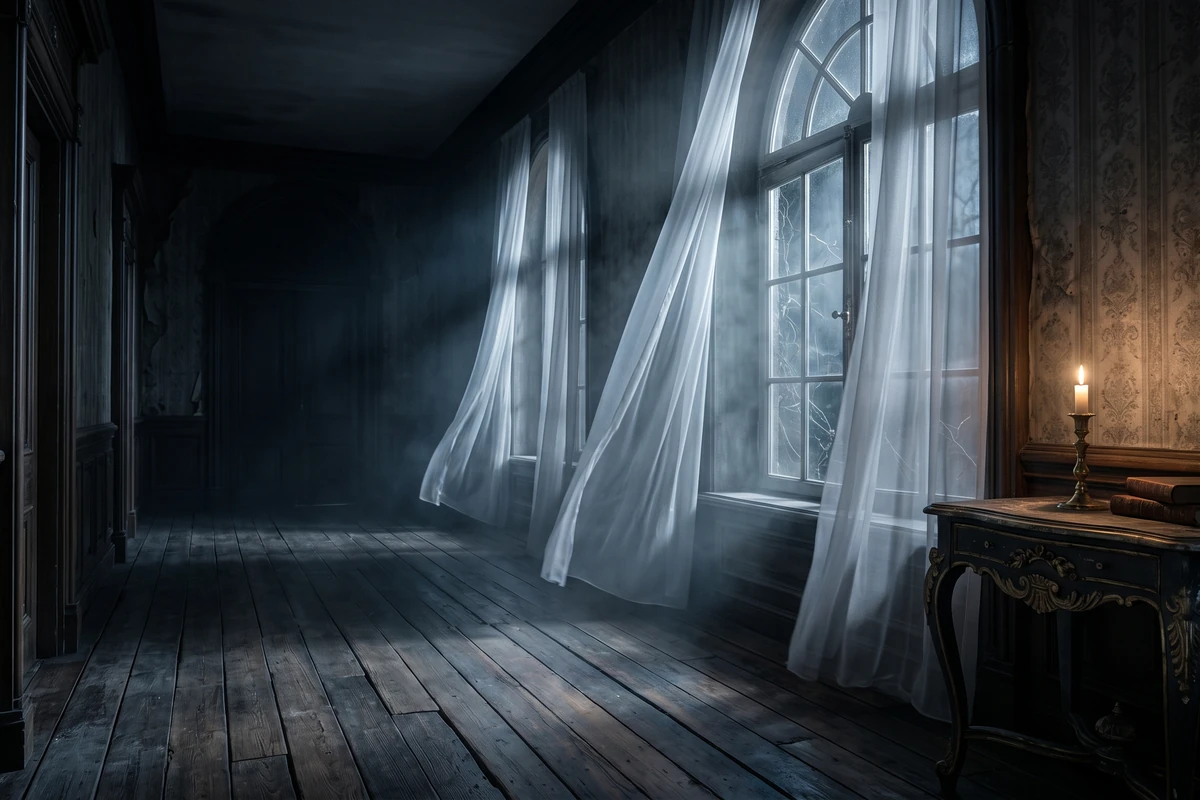
In many ghost romances the setting does as much work as the spirit. A house holds the past in its rooms, its locked doors, its neglected gardens and the objects that nobody has been willing to move. A cold corner that no stove can warm, a window that rattles in still air or a cupboard of old labels can tell the reader that something is wrong long before a character says so. Gothic writers understood this well, which is why their buildings are often as full of history as their people.
That gives the subgenre a practical advantage. A haunted house can be an isolated estate, a village workshop, a rented flat above a shop or a ruin at the edge of town. Each setting limits who can visit, what can be seen and how long a character can stay before the atmosphere changes. A small space reduces the number of suspects and sharpens the romance, because the two leads must keep meeting in rooms where the past is always present. A larger, emptier setting does the reverse, letting the dread spread through corridors and weather.
Pay attention to how a book uses its rooms. If the house is described in precise detail, with a clear sense of which rooms are warm, which are cold and which are forbidden, the setting is probably part of the mystery. If it is only a pretty backdrop, the ghost may serve the romance without the building itself mattering very much. Neither approach is wrong, but the two produce very different reading experiences.
Endings and what the blurb promises
Endings in ghost romance vary widely. A spirit may be released, may remain in some form, or may be understood differently by the living character by the close of the book. Because the supernatural element is so open to interpretation, the ending depends heavily on how the author frames the ghost’s unfinished business. A story about a lingering grievance often ends when the grievance is resolved. A story about grief often ends when the living character changes how they remember.
Do not assume a particular ending from the genre label alone. The blurb, the sample and the description of the romance will tell you more than a tag. Look for words that describe the relationship, such as whether the two leads are both living, and for hints about the conflict that the ghost represents. If you are reading for a particular kind of resolution, the sample is the best place to check whether the book’s tone and promise match what you want.
Three novels that borrow ghost-story ingredients
None of the following is a classic ghost-lover story, and it would be unfair to sell them as one. Each, though, takes a single ingredient from this guide, whether a haunted-feeling house, an unfinished loss or a bond with the past, and builds on it. They are Alisson Bento’s own novels, offered here as comparisons rather than as a promise of spirits.
Secrets of the Still Room is the grief-and-cold option. Maisie Garrow wakes to a killing cold inside the Still Room, though she banked the stove correctly, and frost has blackened the herbs she is preparing for the village’s Wintertide Tea Fair. The village’s Longlight should keep that cold out until the solstice. Her recipe ledger holds an older interruption: her mother’s handwriting stops halfway through a word, eleven years earlier. It is a story of herbal magic and village ritual in which a supernatural chill threatens a home that also keeps a loss Maisie has never finished naming.
Trapped with the Monster approaches a haunted-feeling house from another angle. Justine Franklin, an artist short of money, inherits Blackwood Manor in Vermont from a distant relative who spent his remaining cash on security systems, reinforced doors and internal locks. She must live there for fourteen days before she can sell it, and the executor offers only vague explanations about the estate’s reputation while urging her to keep the doors locked. It is a forced-proximity suspense romance rather than a ghost story, but it shows how much unease an isolated house and an evasive warning can create before anything is explained.
The Vampire’s Forgotten Key is a gaslamp fantasy romance, and its link to this guide is memory rather than a spirit. Ruin-diver Zerya Pendelton casts a holding rune to save her partner when the Glass Basilica begins to collapse, and the magic takes a price: she can still remember standing in the rain but no longer recalls its smell. Her spell draws the vampire cartographer Cyprian Althoff into the ruin and creates matching marks that let her glimpse his past, and his recognition of the connection carries dread. A bond with someone who has outlived his own era is close kin to the ghost lover. For a broader look at how immortality changes memory and time, read Vampire romance immortality trope: time, memory, and a shared future.
How to choose a ghost romance
Start with the kind of haunting you want. If you like a house that feels alive, look for an isolated estate or family home where objects and routines reveal the past. If you want a mystery, look for a book whose opening poses a clear question about the presence. If grief is your interest, look for a book in which the living character’s memories are specific and the new relationship is not a simple replacement for the old one.
Then decide how much the supernatural rules matter to you. Some readers want every haunting explained, while others enjoy the discomfort of not knowing. Paranormal romance vs urban fantasy: choose the story that leads explains how paranormal romance and urban fantasy differ in which element leads the story, and that choice often decides how much the rules matter.
Finally, check the content notes before you commit. Ghost and gothic stories often involve threatening situations, grief, confinement or manipulation, even when the romance itself is tender. The blurb and content notes are a better guide to tone than the cover, which in this subgenre tends to look moody whatever the book inside is like.
Quick answers
Is a ghost romance always a horror story?
No. Some ghost romances are gentle and wistful, while others lean into suspense. The subgenre covers a wide range, so judge a book’s atmosphere from its blurb, sample and content notes rather than from a single word in its tags.
Can the ghost be the romantic lead?
Both patterns exist. In some books the ghost is the love interest, and the central question is whether any shared future is possible. In others the romance is between two living people and the spirit is a force that shapes them. The blurb usually makes clear which kind you are holding.
Which classics should I read first?
Start with Hamlet for the ghost as a messenger, A Christmas Carol for a ghostly lesson in change, and Wuthering Heights for a love that outlasts death. All three are public domain and easy to find, and together they show the range of the form before you turn to modern romance.