Halloween night, Saturday 31 October, overlaps with Samhain, the Gaelic festival that marks the end of the harvest and the turn toward the darker part of the year. Fae and fantasy romance borrows one of the festival’s best-known beliefs, a boundary between worlds that can be crossed, along with the idea that crossing it has a price. This guide explains what Samhain traditionally meant, why the image of a thinning boundary suits romance so well, and how to choose a fae or fantasy romance with a clear sense of its rules.
What Samhain means and where Halloween comes from
Samhain is a Gaelic festival traditionally observed around 31 October and 1 November. It marked the close of the harvest and the beginning of winter, a point in the year when the light was understood to be turning. In Irish, Halloween is still called Oíche Shamhna, Samhain night, and in Scottish Gaelic Oidhche Shamhna. Samhain is also observed today by many modern pagans, for whom it is a living religious occasion rather than a historical reference. It deserves to be read about as a festival with its own meaning, not as a theme for decorations.
Halloween grew from several overlapping traditions, not from Samhain alone. Christian observance added All Saints’ Day on 1 November and All Souls’ Day on 2 November, and the evening before All Saints’ came to be called All Hallows’ Eve. Over the centuries, the autumn customs of Gaelic communities and the practices of the church sat side by side, and the night we now call Halloween carries traces of both. Scholars debate how exactly these traditions connected, so treat any simple explanation with some caution. Samhain and Halloween are related, but they are not the same festival.
When fantasy romance borrows from Gaelic folklore, it helps to notice which elements come from the tradition and which have been invented for the story. Authors are free to build their own courts and their own rules, and many do so well. The care lies in not presenting an invented custom as a historical fact, and in not reducing a living festival to a set of spooky decorations. A book that treats the season as atmosphere is one thing. A book that makes the festival a joke, or borrows its name for a spooky backdrop with no regard for what it means, is another.
You’re on the list. Your free stories are waiting in the Reader Vault. The Unchosen Tribute
The belief in a thinning boundary
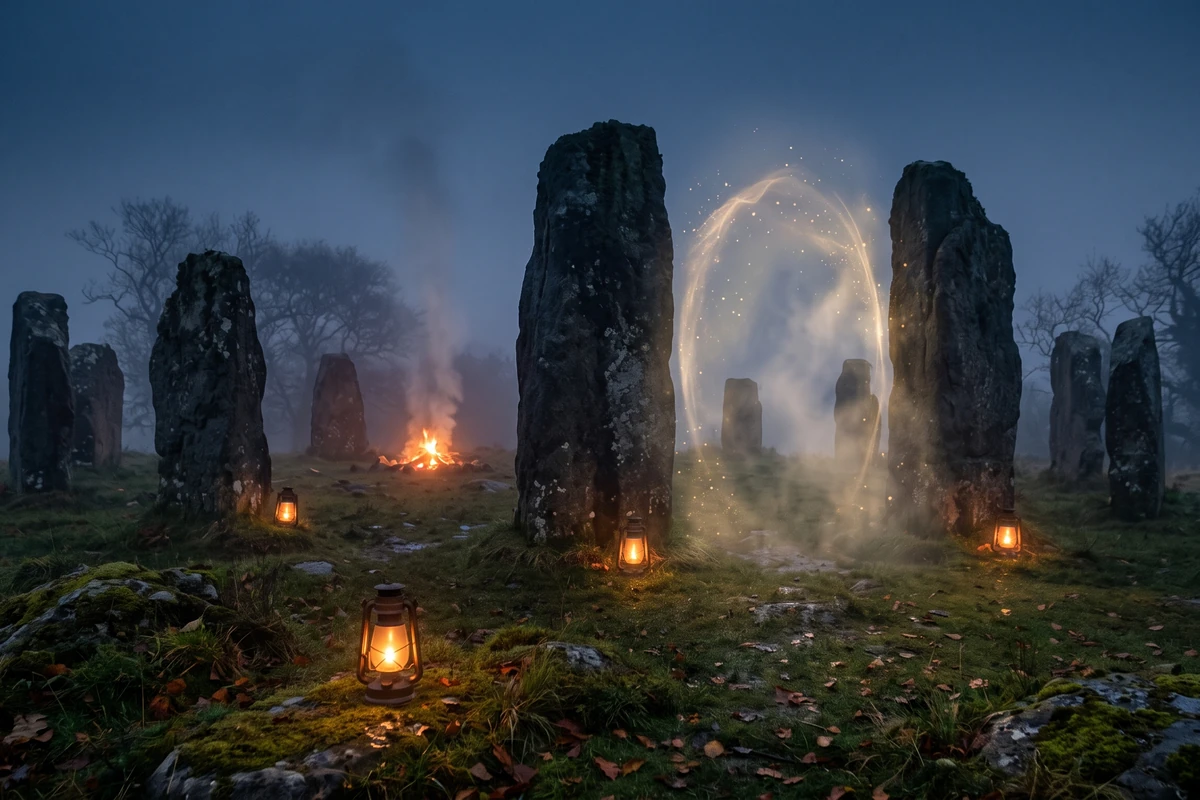
Folklore describes a belief that at this time of year the boundary between the human world and the otherworld grew thin, allowing the dead and the fae to cross into ordinary life. Stories from different regions describe offerings, fires and a general caution about travelling after dark. These practices belong to particular places and periods, and they were not uniform across the Gaelic world. Medieval Irish literature also sets important encounters at Samhain: in the tale known as The Adventure of Nera, a warrior of the court at Cruachan follows a host into a fairy mound on Samhain night and finds a world that runs by its own rules. The phrase a thinning veil is a modern shorthand for this cluster of beliefs, and it is the version most romance readers meet first.
Why does this image suit romance so well? Because a threshold is a story engine. Someone must cross it, someone may guard it, and crossing usually costs something. Fae romance has always borrowed that structure. A mortal crosses into a court, makes a bargain, or discovers that the rules of the otherworld are not the rules she was taught. The seasonal boundary becomes a plot device: the closer the threshold, the closer the danger, and the stronger the pull the other world exerts on the people who live near it.
Portals, courts and bargains in fantasy romance
Fantasy romance uses several kinds of threshold. There is the gate between realms, the court that answers to its own law, the bargain that binds two people together, and the hidden town that sits beside an ordinary one. Each kind shapes the romance differently. A gate creates a clock and a border that must be guarded or breached. A court brings politics, hierarchy and performance. A bargain brings obligations, and obligations are where a romance tests whether trust can survive a contract. Fae romance bargain trope: prices, promises, and romantic trust looks at how bargains set prices, promises and the terms of romantic trust.
Hidden towns and secret communities are another common form. They take a familiar setting, such as an inn, a shop or a village, and show that something ordinary is covering something strange. The romance then depends on concealment: who knows, who is allowed to know, and what it costs to keep the secret. This kind of story often feels closer to home than a court in another world, and it suits readers who like fantasy that begins with a recognisable kitchen table.
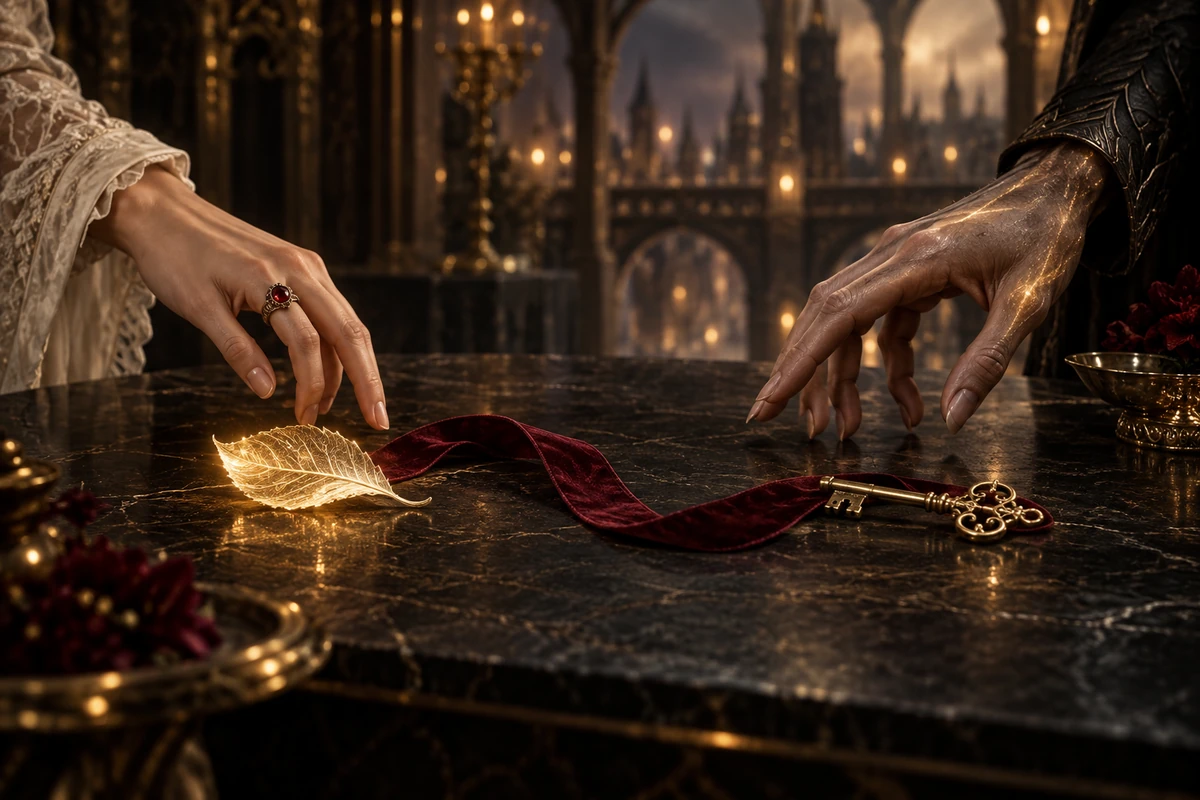
Many fae tales share recurring motifs that fantasy romance then turns into obligations. Gifts can bind the person who accepts them. Names can carry power. A mortal who accepts hospitality in the otherworld may find that the courtesy comes with terms. These motifs are common across folklore, and they are useful to a romance writer because they make every kindness a possible debt. When a fae character offers help, the reader has to ask what the help will cost, and that question keeps the romance honest about power.
Three novels that cross the threshold
Dance of Blades and Secrets is built around a literal gate. Raelith travels with a performing troupe toward the Ashen Court, treating fellow performers as sources of information rather than as friends. She has studied the Gate of Ash through resistance sketches, learning its dimensions, its wards and its guard rotations. But the inspection includes a pale wooden rod that appears in no briefing, and when it passes her, the copper ring on her hand burns. The threshold is where her preparation meets something she was never told about, and the tension lives in that gap.
The Skeptic’s Spell places the threshold inside an ordinary inn. Blythe is struggling to keep the Mistveil Cove inn solvent while a fractured Hearthstone drains her magic and weakens the protective wards. When a skeptical podcaster arrives to investigate the town’s supposed supernatural phenomena, she tries to cancel his stay, but an involuntary burst of magic moves a coffee mug directly in front of him. The hidden world is protected by hospitality and secrecy, and the opening’s tension comes from keeping one side of the boundary out of sight while she needs the rent from a guest who is recording everything on the other.
The Winter King’s Assassin suits the turn toward winter, because its opening is timed to a blizzard. Lyra slips into the Obsidian Spire with starmetal daggers, aiming to kill a tyrant whom her guild holds responsible for slaughtered villages. She has timed every movement to a blizzard outside his study. The attack fails when Caelum anticipates her intent and counters without drawing a weapon. The fight becomes a direct contest between trained assassination and fae authority, and her runic initiation scars react painfully to his magic, so every exchange carries a physical cost. It is a slow-burn enemies-to-lovers romantasy, so expect the hostility to be the starting point rather than a quick misunderstanding.
Read side by side, the three books show how differently a threshold can be used. One makes the gate a matter of preparation and betrayal, one makes it a matter of hospitality and secrecy, and one makes it a matter of rivalry that gradually becomes something else. In two of them a heroine’s careful preparation meets something she was not told about, and in the third the boundary is one the heroine is trying to keep closed. It is worth noticing whether you prefer crossing a threshold or guarding one.
Winter, darkness and the pace of the story
The seasonal setting of a fae romance often controls its pacing. Samhain falls at the point where the light begins to fail, and that shift suits stories built around deadlines: a bargain that must be settled before the year turns, a gate that opens only at certain hours, or a court that gathers only in the dark months. A season gives the author a clock that the characters cannot negotiate with, and it gives the reader a sense of time running out, even when the plot itself moves slowly.
Darkness also changes what a scene can hold. Long nights create room for private conversations, for interrupted plans and for the kind of quiet in which a character reveals what she has been hiding. A blizzard outside a study, or a storm that closes a road, can separate the characters from their usual rules and make a fragile trust visible. Authors who understand this tend to use weather and light as more than scenery. They let the season set the terms on which the characters meet, and the romance then develops within those terms.
Choosing fae and fantasy romance for the night
- Decide what kind of threshold you want: a gate, a court, a bargain or a hidden town. Each one changes the pace and the danger.
- Check whether the fae are dangerous within the story or only decorative. Menace that has real consequences tends to make the romance feel earned.
- Look for clear rules. A book where magic has specific costs is easier to trust than one where any power can solve any problem.
- Read the content notes for violence, captivity and bargains with binding consequences, since these are common in fae romance and can carry more weight than the blurb suggests.
- If you are still weighing how much fantasy you want compared with how much romance, Romantasy vs fantasy romance: choose the balance you want helps you find the balance that suits you.
For the night itself, pick the book whose threshold you most want to cross. A gate-and-court story suits a reader who enjoys politics and infiltration. A hidden-town story suits one who prefers the mundane and the magical side by side. A slow-burn assassin romance suits someone who likes a relationship that begins in open hostility.
Quick answers for Halloween night
Is Samhain the same as Halloween?
No. Samhain is a Gaelic festival with its own history and customs. Halloween developed partly from Samhain and partly from Christian observances such as All Saints’ Day and All Souls’ Day. Treat the two as related traditions rather than as one festival under two names.
Do I need folklore knowledge to enjoy fae romance?
No. Each book introduces its own rules and its own otherworld. Knowing the general idea of a thinning boundary helps you recognise the pattern, but the book itself will explain what matters for its story.
Why do so many fae romances use bargains and boundaries?
Because a threshold creates cost, and cost creates choice. A bargain or a gate forces the characters to decide what they will give and what they will risk, and that is the kind of decision romance is built to examine.