Dual-timeline romance asks you to hold two love stories in your mind at once—often one set in the past, one in the present—and trust that they will illuminate each other. The structure is not simple parallel plotting; it is a deliberate architecture where what happened then reshapes what is happening now, and what characters discover in the present rewrites how they understand their own history. If you have felt lost while reading between centuries, decades, or even years, you are not reading carelessly. You are learning the specific skill that this trope requires: attention to time anchors, meaningful objects that survive across years, and the small details that tell you whether you are following one couple growing older or two different couples whose stories are braided together.
A note before we begin: this guide is about the dual-timeline trope itself, and the books featured below are not presented as dual-timeline novels. They are second-chance and returning-home stories whose premises offer excellent practice material for the kinds of attention—to objects, places, memory, and time—that a true dual-timeline romance also rewards. If you are warming up for a dual-timeline read, or deciding whether that structure appeals to you, these titles let you practice the habits of reading without committing to a specific structural claim about them.
Identify your time anchors before you settle in
Every dual-timeline romance plants signals that tell you when you are. These are not always dates on a chapter heading, though many books use them. A time anchor might be the season—early fall versus late spring, ten years apart. It might be an object: a letter with a postmark, a photograph with a specific year printed on the back, a piece of jewelry with an inscription and a date. It might be a building in different states of repair, a person who ages visibly, or a news event that belongs to one era and not another.
Before you start reading, flip through the book and note what signals you find. Some authors bold chapter dates. Others name seasons or write them into the first sentence of a section. Look for repeated objects that appear in both timelines—a house, a ring, a recipe written in someone’s handwriting, a scar with a specific origin story. Note whether the chapters alternate in a predictable pattern (one past, one present, one past, one present) or shift more freely. When you know what signals to watch for, you stop feeling like you are guessing and start feeling like you are solving a deliberate puzzle that the author has laid out for you.
Even single-timeline books train these muscles. Consider the opening of The House With Two Gardens: Marina enters a quiet old house in early fall and begins taking inventory of what previous lives have left behind. The season, the paperwork on the table, the hedge dividing the garden into formal and wild halves—these are the kinds of details a dual-timeline reader learns to notice. Marina’s story is told in one time, but the attention she pays to objects and seasons is precisely the attention a dual-timeline novel will ask you to practice across more than one.
Kindle edition · Check Kindle Unlimited availability on Amazon.
Learn to spot one couple at different ages versus two separate couples
This distinction matters because it changes how you read emotional resonance. If you are following one person in their thirties remembering themselves at twenty-two, the timeline shift is about perspective and growth. The same conflict viewed from different ages feels different. If you are following two entirely separate couples—one in a mid-century decade and one in the present—you are reading parallel stories that eventually connect thematically, through inheritance, through shared space, or through a mystery that both couples are solving from opposite ends of time.
How do you tell the difference early? Pay attention to the names and voices in the opening chapters of each timeline. Are you hearing the same narrator at different ages, or two different people? Does the present-day timeline reference specific memories of events you will later see unfold in the past timeline, or does it reference events that will remain off-page? If a present-day character thinks, “I have never told anyone what happened at the lake,” and then the next section shows you the lake scene decades earlier, you are reading one person’s story broken across time. If a present-day character discovers an old diary and begins reading about a stranger’s love affair, you are reading two separate stories that share a space or an object.
Second-chance romances told in a single timeline, like A Recipe for Forever, can prepare you for this reading muscle in a gentler form. Callie returns to Magnolia Creek after years in New York, and her story is shaped by the tea room she left, the person she hurt, and the recipes her grandmother prepared. The past is not shown in full flashback scenes but emerges through memory, inheritance, and conversation. Reading a book like this with careful attention to what is remembered, what is withheld, and what is physically left behind is a good warm-up before a dual-timeline novel asks you to hold two full narratives in parallel.
Track meaningful objects across both timelines
In dual-timeline romance, objects often carry more weight than exposition. A letter, a piece of furniture, a scar, a recipe written in fading ink—these items connect the two timelines and give readers concrete things to hold onto. When you notice an object mentioned in the past timeline, mark it mentally. Then watch for it again in the present. Has it survived? Been hidden? Repaired? The condition of the object often mirrors the condition of the relationship or the character’s emotional state.
Consider the difference between a family ring that has been worn continuously for forty years and a ring that was buried in a drawer, removed, hidden, or lost and found. The physical object is the same, but its history—where it has been, who has touched it, how it has been treated—tells you something about what the characters value and what they have decided to keep or release.
This method of reading transforms dual-timeline romance from a puzzle you might solve incorrectly into a treasure hunt where the author is handing you clues in the form of things. A house with two gardens, each tended differently. A veterinary clinic in disrepair. A tea room with a leaking roof. A bench beneath a humming station light. These objects anchor time and emotion at once in any romance that uses them, and dual-timeline novels push the technique further by letting such objects appear in two different eras.
Read chapter dates and section headers as navigation tools
Some dual-timeline romances use explicit dates. Some use seasons, times of day, or location names. Others use alternating character names or point-of-view markers. All of these are navigation tools, and they work best if you use them deliberately rather than ignoring them.
At the start of each chapter or section, read the header or date twice. Do not skip it. If it says a specific year, or “Now,” or a character name paired with a time of day, or a town name paired with “After,” these markers are telling you which timeline you are in and sometimes which character is speaking. Some readers develop the habit of reading these quickly and pushing into the prose. But in dual-timeline romance, the header is part of the story. It is the author saying: “Here is when we are. Here is who we are following. Pay attention to what this timeline will show you that the other one cannot.”
If you find yourself confused about which timeline you are reading, stop and reread the header. Write it down if it helps. Notice whether the header changes every chapter or every few chapters. Notice whether some chapters have dates and others do not. These patterns are intentional. The author is controlling how often you shift, and that rhythm shapes how disoriented or grounded you feel.
Track what each timeline knows and does not know
One of the pleasures of dual-timeline romance is dramatic irony: you know something that the characters in one timeline do not know yet, because you have already seen it happen in the other timeline. This creates tension and deepens emotional payoff. But it only works if you are tracking what information belongs to which timeline.
In the past timeline, the characters do not know how their choices will ripple forward. They do not know whether the relationship will survive, whether the house will stand, whether the separation will be permanent. In the present timeline, those questions have already been answered—or are being answered—and the character is often dealing with the consequences or the mysteries of what happened in the years between.
As you read, notice what each timeline is asking. The past might ask: “Will they choose each other?” The present might ask: “Why did they part? Can they come back?” Or the past might ask: “Can I trust this person?” and the present might show you the answer playing out in an unexpected way. When you track these questions separately, you are reading the architecture of the story, not just the plot. You are seeing how the author has built suspense by fragmenting knowledge.
Even in a single-timeline reunion story, you can practice reading for withheld knowledge. In Sunset at Walker Ranch, June Calloway returns to Bitter Creek, Montana, after ten years, and Nash Walker’s anger about her departure has had a decade to settle. The reader learns the shape of what happened gradually—through fence lines, through Arthur’s confusion, through a developer’s pressure, through conversations that circle old wounds before naming them. A dual-timeline novel would show you that past in its own chapters; a reunion novel like this holds the past in the air of the present. Both techniques reward the same habit of attention.
Assess the balance between timelines for pacing and satisfaction
Not every dual-timeline romance splits the page count equally. Some lean heavily toward the present, with the past revealed in memory, conversation, and discovered letters. Others alternate chapters so evenly that both timelines feel equally important. Neither approach is wrong, but knowing which one a book uses helps you adjust your expectations.
If a book devotes most pages to the present day and uses the past as explanation, you are reading a mystery where the main plot unfolds in the now and the past provides answers. This can feel like a page-turner; you chase revelation. If a book alternates chapters more evenly, you are reading two parallel stories meant to comment on each other equally. Both are satisfying, but they create different reading experiences.
You can gauge the balance in the first fifty pages. Count the chapters set in each timeline. Note the length of chapters. Notice whether past-timeline chapters reveal new plot information or mainly show you scenes you already understood from the present-day characters’ memories. If the past timeline answers questions the present-day timeline raises, the book is using the past to solve a mystery. If the past timeline raises new questions that the present-day timeline must reckon with, the book is using two timelines to show you different aspects of the same truth.
Neither balance is better than the other. But if you prefer racing forward, a book weighted toward the present will satisfy you more than one that alternates perfectly. If you love sitting in a character’s shoes at different ages or following two separate people who matter equally, you will want more even distribution. Noticing the balance early helps you decide whether to continue or choose something else.
Avoid spoiler searches that collapse both timelines
The internet is full of reviews that mention how timelines connect, which couple is “really” the main couple, or what object from the past reappears in the present. These details are not small spoilers; they are the entire architecture of surprise that the book has carefully built. A review that says, “In the past timeline, they get married, but she leaves him in the present,” has just handed you the entire emotional journey compressed into one sentence.
If you are unsure whether to start a dual-timeline romance, read only the publisher’s description and the opening chapter. Do not search for reviews that discuss plot structure. Do not ask other readers, “Do they end up together?” because that question collapses both timelines into one flat answer. Instead, ask: “Does the book have themes I should know about going in?” or “Is this more mystery or more romance?” or “Does it alternate chapters or lean toward one timeline?”
Save spoiler-heavy reviews for after you finish. The pleasure of dual-timeline romance lives in not knowing, until the moment of discovery, how the two stories will meet, what will be revealed, and what choice the character makes when they stand in both timelines at once.
Choose a warm-up based on the reading habit you want to practice
When you are selecting your next romance, do not choose based only on whether you like second-chance stories or small-town settings or cowboys. Choose based on the kind of reading attention you want to practice right now. Several of the books in this guide are single-timeline romances whose structures lean on memory, inheritance, and place—exactly the elements a dual-timeline novel would split across two eras.
If you want to practice following one person who is reckoning with a past that has been shaping them from a distance, A Cowboy’s Way Home offers a focused example. Beck Calhoun returns to Cedar Gulch after ten years, and his mother’s death, a bridge wreck that injured Wyatt, his father’s condemnation, and a sudden medical emergency are all held in the present through the pressure of memory. The story is told in one time, but Beck’s inability to turn toward the ranch is entirely about what the past has done to him. Read this with attention to how the author uses present-tense pressure to show the shape of history.
If you want to practice reading a present-day character uncovering meaning through inherited space and objects, The House With Two Gardens places you in Marina’s inventory of a house and its garden. Empty shelves, worn enamel, sewing supplies, and letters she hesitates to open make absence tangible. The paperwork on the table carries a yearlong obligation to maintain the garden. These are the kinds of details a dual-timeline novel would use to connect two eras; here, you can watch them do their quieter work in one.
If you are drawn to returning-home stories specifically, Sunset at Walker Ranch and A Recipe for Forever both use homecoming as the catalyst that forces a character to reckon with time. June returns to her father’s failing veterinary clinic and faces Nash across a boundary that has held them apart for ten years. Callie returns to inherit her grandmother’s tea room and must decide whether she is staying or leaving again. In both cases, the present-day conflict is rooted in place and in what time has done to the buildings and relationships the character left behind.
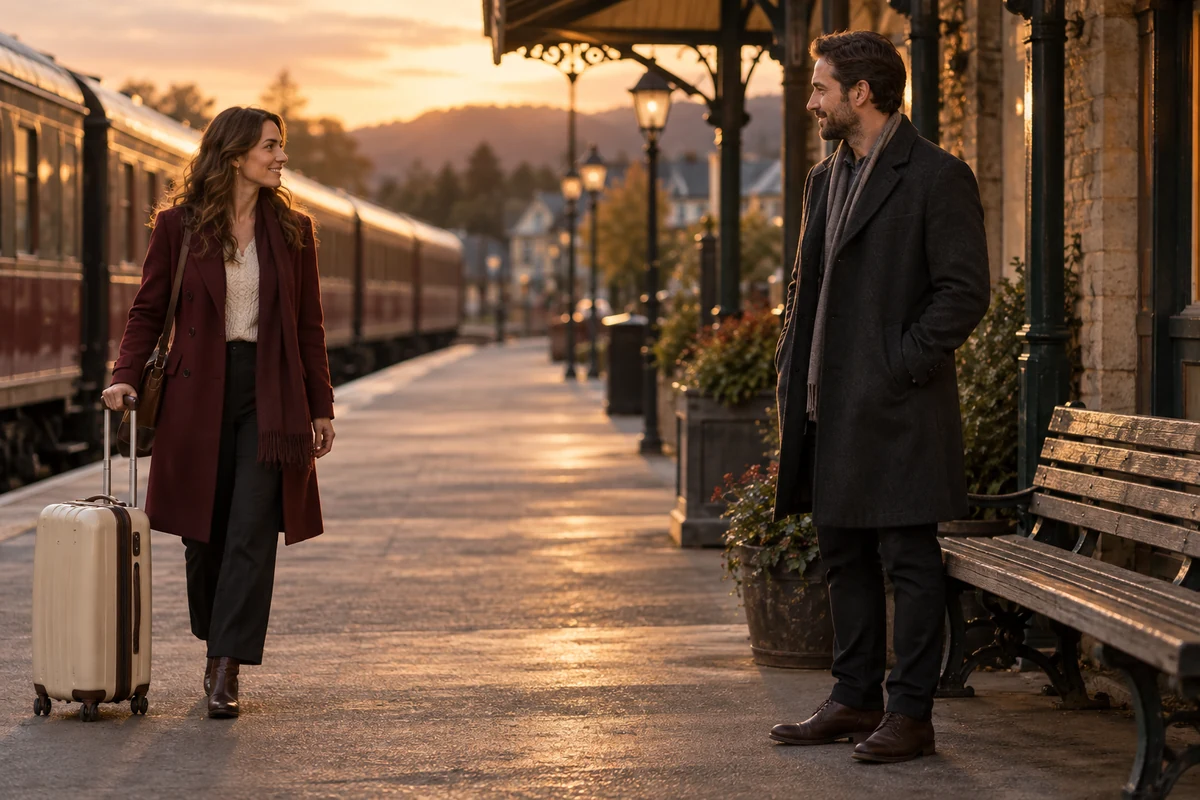
If you want something less grounded in inheritance and more grounded in a single compressed stretch of time, Hold the Minute offers a tightly focused premise: Aria plays violin on Platform Twelve while Jonah announces trains, and their first real conversation unfolds in an unusually attentive midnight hour under a humming light. The scale is small—one bench, one hour—but the attention to minutes, to a brass token, to the pressure of a citywide plan for prerecorded announcements, is close kin to the attention a dual-timeline novel asks you to pay to larger stretches of time.
For adjacent perspectives on how time, trust, and returning history work in romance, see Enemies to lovers vs rivals to lovers: competition, distrust, and the turn toward love, Friends to lovers vs childhood friends romance: current trust or adult rediscovery?, and Return-to-hometown romance vs second chance: which history is coming back?, which discuss distinctions between rivalry and enmity, between current friendship and adult rediscovery, and between returning home and a true second chance.
Read the opening pages actively, not passively
The first five to ten pages of a dual-timeline romance are doing heavy work. They are establishing your first timeline, introducing the time anchor system, and showing you the narrative voice or voices you will be hearing. Do not skim these pages. Read them as slowly and carefully as you would read a poem.
Notice the season, the weather, the time of day. Notice what object or building is described first. Notice whether the narrator is reflective or action-oriented, whether they are remembering something or discovering something, whether they are at peace or in crisis. Notice what they do not say—what questions they avoid, what they do not explain, what they seem to be keeping private. All of this is setting up the dual-timeline structure. The opening pages are telling you not just what is happening now, but what kind of story is going to unfold across time.
Many readers want to rush through opening pages to reach “the romance” or “the main plot.” In dual-timeline romance, the opening pages are the main plot. They are showing you the architecture you will be following for three hundred pages. Slow down here, and the rest of the book will click into place.
Use objects as reading checkpoints
Every time you finish a chapter or a section, ask yourself: What object appeared here? Was it new, or did I see it before? Did its condition change? Was it cared for or neglected? These checkpoints keep you anchored in the structure without requiring you to write notes or mark the page (though you can, if that helps).
The house with two gardens. The veterinary clinic with its unpaid bills. The tea room with its leaking roof. The fence between two ranches. The bench at the train station. Any of these objects can serve as the skeleton of a story, dual-timeline or not. They do not move; time moves around them, and characters move through them, and their condition tells you a great deal about what time has done.
Finish the book before you assess whether it worked for you
Dual-timeline romance often asks you to trust the author through moments of confusion or fragmentation. You might feel lost in chapter four. You might not understand why a scene from decades earlier is shown when you want to know what happens next in the present. You might feel frustrated by alternating timelines. But these moments are part of the designed experience. The payoff comes when both timelines meet, when information from the past reshapes what you understood about the present, or when a character makes a choice that only makes sense because you have watched them in both timelines.
Give the book at least halfway through before you decide whether the structure is working for you. Notice whether your confusion is intentional (the author is withholding information for a reason) or whether it is accidental (the timeline shifts are unclear or contradictory). Intentional confusion resolves into understanding. Accidental confusion just feels sloppy. By the halfway point, you should be able to feel the difference.
When you finish, look back at the opening pages. You will see how much you were told there without knowing it—how the first timeline contained seeds of the second timeline, how the time anchors were already in place, how the author was already showing you everything you needed to understand. That backward glance is when dual-timeline romance often clicks into satisfaction. The structure was not confusing. It was containing. It was holding two stories in careful balance, waiting for you to see how they fit together.
A seasonal note for both hemispheres
If you are reading in the Northern Hemisphere this October, the Halloween season suits dual-timeline romance well: short afternoons, long evenings, and a cultural mood already attuned to the past pressing on the present. If you are reading in the Southern Hemisphere, where the season turns toward spring and carnival-adjacent festivities, the same trope can feel different—more about how an older story blooms inside a new one than about ghosts returning. Either way, the habits in this guide travel. Time anchors, meaningful objects, chapter headers, and the discipline of avoiding spoilers do not care which direction the daylight is moving. They only ask that you read actively, let the architecture reveal itself, and trust that two stories, carefully braided, will carry you somewhere a single thread could not.