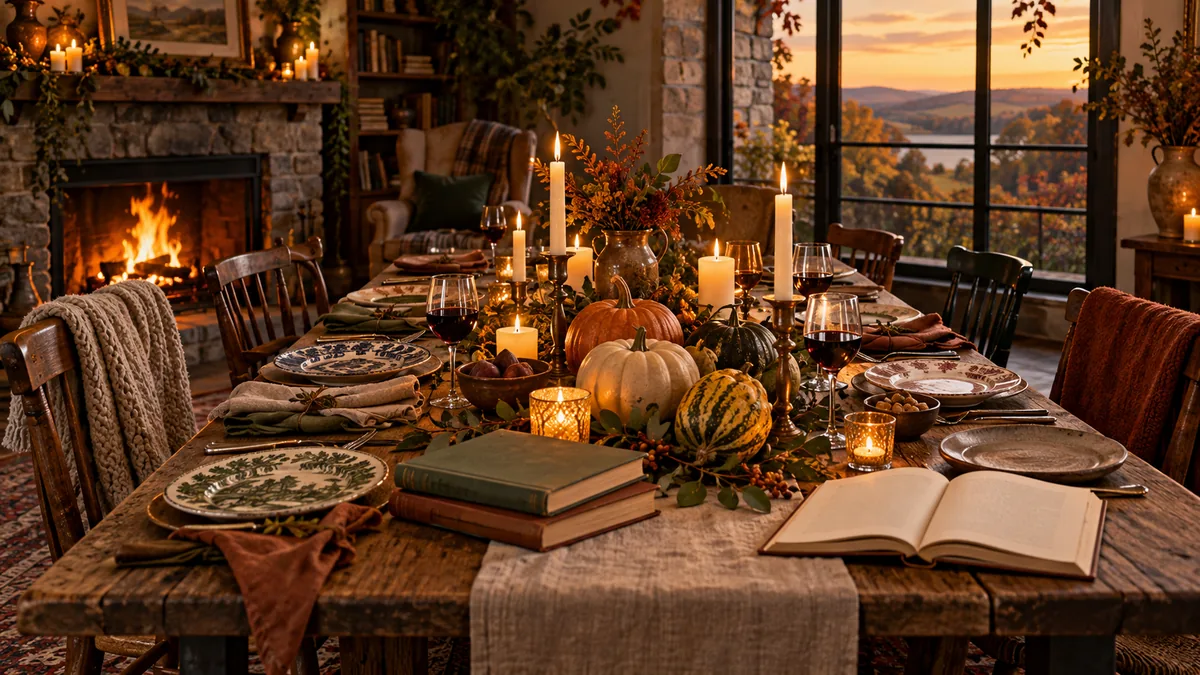
Friendsgiving appears in romance as a story shape rather than a holiday requirement. When a gathering brings together people who have chosen each other—chosen family, not blood relation—the dinner table becomes a place where romance can develop through vulnerability, small kindnesses, and the particular friction that emerges when someone new sits down at a table where everyone else already belongs. For US readers in late November, Friendsgiving plots feel immediately relevant; for readers elsewhere, the structure translates to any chosen-family meal that carries emotional weight. This guide explores how Friendsgiving romance works on the page, how to recognize it in sample chapters, and what makes it distinct from family-obligation plots.
What distinguishes a Friendsgiving plot from a family-Thanksgiving plot
Thanksgiving in romance often carries the weight of family obligation: estrangement to repair, disappointment to navigate, in-laws to manage. Friendsgiving strips away that inherited weight. The people around the table have chosen to be there. No one is obligated; no one attends because they have to. This shifts the emotional stakes. Conflict cannot rest on “family drama” or “they never understood me.” Instead, tension arises from misalignment within the chosen circle itself—disagreements about values, newcomer anxiety, or the way a relationship change threatens the group’s equilibrium.
A Friendsgiving romance often hinges on someone who does not yet belong trying to find a place at that table. That outsider status is not permanent exile; it is invitation-pending. The story asks: Will this person be welcomed into the circle? Will their presence change the existing bonds, and is that change welcome or threatening? Unlike family-obligation plots, which excavate old wounds, Friendsgiving plots build new belonging from scratch. The meal itself becomes ceremonial—not because tradition demands it, but because the group has created its own tradition together.
You’re on the list. Your free stories are waiting in the Reader Vault. The Taste of a Lie
Chosen family dynamics on the page
Chosen family in romance operates differently than nuclear family. Members have opted into their relationships; they are not bound by law or blood. This means trust is actively constructed rather than assumed, and betrayal cuts differently. When a Friendsgiving plot centers chosen family, the romance often explores what it means to let someone new into that carefully built circle.
A character who hosts Friendsgiving has likely invested years in maintaining these bonds. They know each person’s dietary needs, their sense of humor, the topics that will spark conversation. They have created safety for a group of people who, perhaps, had nowhere else to be. When a romantic interest enters, the host must balance the new relationship with loyalty to the existing family. This creates a specific kind of tension: not jealousy exactly, but the anxiety that romance might fracture something irreplaceable.
Conversely, a character invited to a Friendsgiving for the first time experiences acute awareness of being outside the loop. Everyone else has history, in-jokes, comfortable silences. Belonging to this group is not automatic; it must be earned. That vulnerability is powerful material for romance. A romantic partner who shows genuine interest in understanding the group, who makes effort without demanding recognition, who finds their own place rather than trying to displace someone else—that character becomes attractive not despite their outsider status, but partly because they navigate it with grace.
The host character trope
The Friendsgiving host carries particular weight in romance. This character has organized a meal, coordinated schedules, planned a menu, cleaned the space, and done the invisible labor that makes an evening feel effortless. They are often caretaking by nature—the person who remembers that someone has a shellfish allergy, who knows when a friend is quiet because something is wrong. This generosity is attractive, but it can also create an imbalance in romance.
A compelling host character often struggles to receive care in return. They are used to giving; they define themselves through generosity. A romantic partner who recognizes this pattern and gently resists playing the role of “person being taken care of” creates meaningful friction. The host must learn that intimacy includes vulnerability, that asking for help is not weakness, and that a partner can offer something beyond what the chosen family already provides. The Friendsgiving table itself becomes a symbol of this shift—the host relinquishing control, trusting others to contribute, allowing the meal to be imperfect because the gathering matters more than flawless execution.
The newcomer at the table
A character attending Friendsgiving for the first time—or the first time with a romantic interest—experiences a specific kind of exposure. They are being introduced to the people their partner loves most. They are being evaluated, implicitly or explicitly. They are also seeing their partner in context, understanding how this person operates within their chosen family, what role they play in the group’s dynamic.
The newcomer often arrives with anxiety: Will they fit? Will they say something awkward? Will they eat enough to be polite but not so much as to seem greedy? Will they understand the jokes? This vulnerability is romantic material. A newcomer who approaches the table with genuine curiosity—who asks questions, listens more than they speak, shows interest in the stories already in circulation—reads as someone seeking to understand rather than to impress. That quality is attractive. A romantic interest who notices the newcomer’s anxiety and creates small moments of ease—a laugh that includes them, a story that requires no background knowledge, a gesture that says you belong here—has begun building trust in public.
Conflict can arise when the newcomer’s presence shifts the group’s dynamic in ways that challenge the host or other members. If the newcomer is charming, do they threaten the host’s role as the person everyone gravitates toward? If the newcomer shares a hobby with one group member, does that create new in-groups within the larger circle? If the newcomer has different values or backgrounds, does that expose fault lines that had seemed resolved? A strong Friendsgiving plot does not erase these tensions; it navigates them with honesty and specificity.
Conflict that fits the setting
Conflict in a Friendsgiving plot cannot rely on external obstacles. There is no weather emergency, no family crisis, no workplace emergency forcing the characters apart. The setting is intimate and bounded—a single evening, a single table. Conflict must arise from the emotional dynamics present in the room.
Effective Friendsgiving conflict often centers on misalignment in values or expectations. One character might assume the group will welcome their romantic interest; another member might feel threatened or excluded by the new dynamic. A host might have planned a meal that reflects their aesthetic or dietary philosophy; a guest might bring food that does not align, or suggest changes, creating tension around hospitality and autonomy. A newcomer might inadvertently reveal something about the host that the group has not discussed before, disrupting a comfortable narrative.
The confined space intensifies conflict. There is no escape into another room for the entire evening. Characters must sit with discomfort, navigate it across the table, find resolution or at least truce before the meal ends. This creates pressure for honesty. A character cannot simply withdraw; they must either engage with the issue or let it fester visibly. This pressure often pushes characters toward vulnerability that would take chapters to achieve in other settings.
Food description and its purpose
Food in Friendsgiving romance functions as more than sustenance or setting detail. A meal reflects the host’s care, the group’s preferences, the way tradition and experimentation coexist. A smart Friendsgiving plot uses food to reveal character and relationship.
Excessive food description slows pacing without adding emotional meaning. A reader does not need the recipe for every dish or a detailed account of cooking techniques. What matters is what the food reveals: Does the host cook familiar comfort foods, or do they experiment? Do they accommodate dietary restrictions, and do they do so with grace or resentment? Does the group contribute dishes, suggesting collaboration, or does the host bear all responsibility? Does a newcomer notice details in the meal, asking questions or complimenting effort, or do they treat food as background?
Food becomes meaningful when it connects to character or relationship. A dish that holds significance—made from a family recipe, shared from a character’s cultural background, prepared as a gesture of apology or affection—carries weight. A moment of someone eating, really tasting and appreciating, can convey contentment, belonging, or relief. The physical experience of sharing food—passing dishes, refilling glasses, noting preferences—creates intimate choreography that romance can use effectively without dwelling on flavors or techniques.
Pacing a single-evening set piece
A Friendsgiving story often unfolds across one evening, from guests arriving to the last person leaving. This bounded timeframe creates narrative pressure. A writer must pace the story so that nothing feels rushed, yet everything that matters finds space in the evening.
Effective pacing distributes emotional beats across the gathering. Early arrivals establish tone and introduce any character who needs context. The meal itself slows the pace; people cannot move quickly when eating. The table is a natural gathering point for revelation and conflict. After the meal, energy shifts—some guests may leave, the group may relax, or residual tension may surface. The final moments of the evening offer resolution or a new understanding among the characters.
Dialogue-heavy scenes work well in this setting. People seated at a table talking naturally mirrors how these gatherings actually unfold. A writer can move between conversations, show different pairings, allow characters to reveal themselves through what they choose to discuss and how they listen. Moments of quiet—someone helping the host clear dishes, two people sitting together after others have drifted—break up dialogue and allow for intimacy and observation.
A Friendsgiving plot does not require the entire story to occur at the table. Often, a romantic pair has background history—they met weeks or months before, and Friendsgiving is the moment when their relationship becomes visible to the chosen family. In this case, the pacing might alternate between the evening gathering and flashbacks or parallel scenes that reveal how the romance developed. What matters is that the Friendsgiving scene itself moves at a tempo that lets readers experience the evening as the characters do: marked by specific moments, punctuated by the rhythms of gathering and eating and talking together.
When chosen family and romance collide
One of the most compelling aspects of a Friendsgiving romance is the collision between two kinds of intimacy: the deep familiarity of chosen family and the new vulnerability of romantic connection. A character who has built a chosen family has invested years in those bonds. They know how to show up for this group; they have a role, a place, an identity within it.
A romantic partner threatens that equilibrium. Not because romance is bad or unwelcome, but because romance adds a new layer of stakes. If the relationship fails, the character must navigate the chosen family differently. If the relationship succeeds and deepens, the chosen family must adapt to include a permanent new member. The Friendsgiving gathering becomes a crucible where these dynamics surface.
A strong Friendsgiving romance acknowledges that chosen family can feel as essential as blood family, and sometimes more so. The story does not dismiss the group’s concerns or accelerate the romantic relationship to override existing bonds. Instead, it shows a character learning to hold both: to love the chosen family deeply and to open to romantic connection, to trust that love for one group does not diminish capacity for another.
Questions to ask when evaluating a Friendsgiving romance sample
When you encounter a Friendsgiving scene in a sample chapter, consider whether the story uses the setting intentionally. Does the gathering reveal character through how each person relates to the host, the meal, and the group? Is there a clear romantic tension that the Friendsgiving context heightens or complicates? Does the story acknowledge the emotional stakes of chosen family, or does it treat the group as background?
Pay attention to whether conflict feels organic to the setting or imported from elsewhere. A Friendsgiving plot is not improved by sudden external drama—a car accident, a medical emergency, a work crisis calling someone away. The most effective Friendsgiving romances create tension from the emotions and dynamics present in the room: the newcomer’s anxiety, the host’s vulnerability, the group’s concern about change, the romantic partner’s desire to belong.
Notice too whether the chosen family feels real. Are the individual members distinct, with their own relationships and priorities, or are they interchangeable background? Does the host have genuine relationships with each person, or do they exist primarily to validate the host’s generosity? A compelling Friendsgiving romance gives the chosen family enough specificity that their approval or acceptance carries real weight.
Friendsgiving romance as belonging narrative
At its heart, a Friendsgiving romance is a story about belonging. A character—sometimes the romantic protagonist, sometimes both partners together—seeks to find or secure their place in a chosen family. The meal is ritual marking that belonging, or the potential for it. The evening becomes a test: Can this person be trusted with the group’s intimacy? Will they honor what has been built? Can they add something new without disrupting what already exists?
This makes Friendsgiving romance particularly resonant for readers who have chosen family themselves, who have experienced the specific vulnerability of being invited into someone else’s established circle, or who have learned to build family from friendship rather than blood. The Friendsgiving table becomes a symbol of that hard work and intentional love.
A Friendsgiving romance does not require readers to celebrate the holiday itself. The story shape works wherever chosen family gathers for a shared meal—a birthday dinner, a holiday that the group has created for themselves, a seasonal celebration that has meaning only within the friend group. What matters is the emotional architecture: a gathering that represents safety and belonging, a new person being introduced to that space, and romance unfolding within and through that introduction. The respect, vulnerability, and intention required to join a chosen family are the same regardless of season or location.