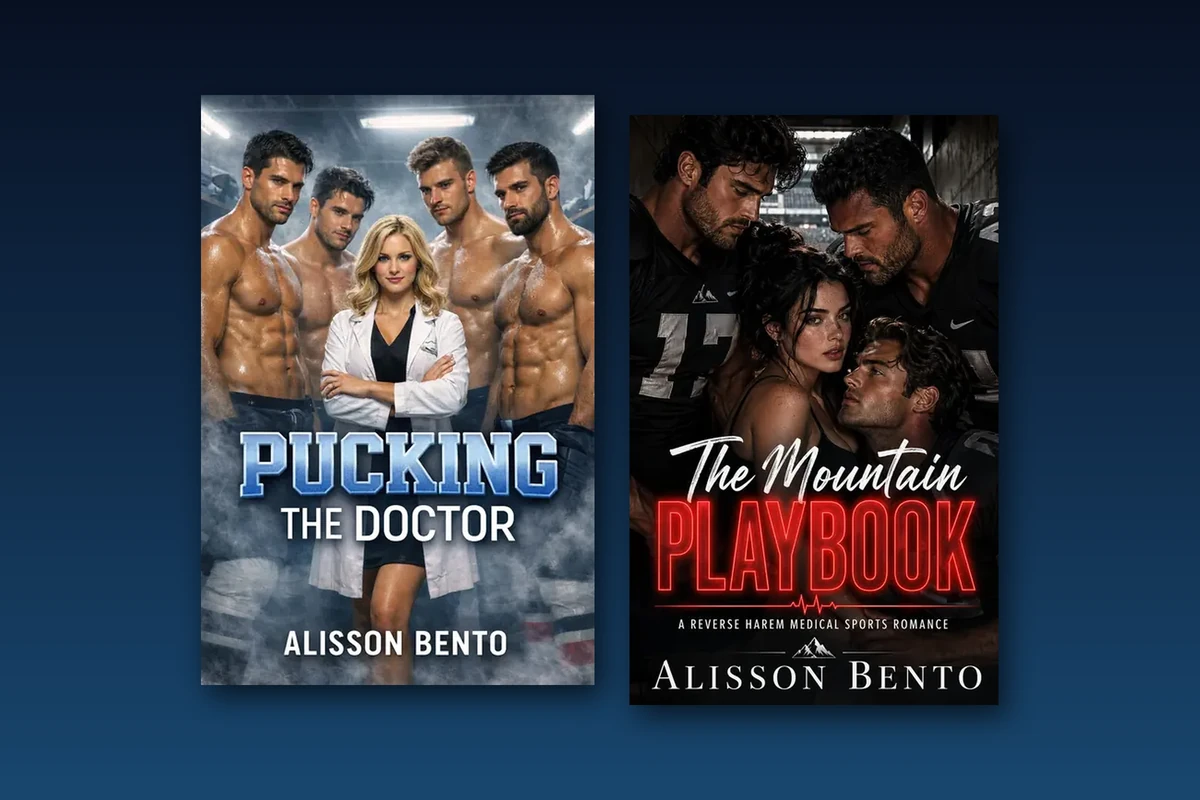
Hockey season is under way, and readers who have finished Emily Rath’s Pucking Around often go looking for another why choose sports romance to read next. Pucking Around is a why choose hockey romance in which the heroine ends up with several partners from one team, and that single sentence holds most of what those readers are trying to find again. This guide breaks the appeal down into its parts, shows how to spot each one in a blurb, and suggests two of Alisson Bento’s sports why choose romances that share some of them.
Five elements to look for after Pucking Around
When readers say they want something like a book they loved, they rarely mean the same plot. They usually mean a particular combination of shape, setting and feeling. For a why choose hockey romance, that combination tends to break down into five parts, and it is worth deciding which of them matter most to you before you start browsing.
- A why choose ending. The heroine does not have to pick one man, and nobody in the group is left out when the story closes.
- Team dynamics. The love interests share a team, a locker room and a set of loyalties that existed before she arrived.
- A heroine at the centre. The group forms around her, and her decisions drive the story rather than simply reacting to it.
- Humour alongside heat. Banter, teasing and group chaos sit next to the romantic and sensual scenes.
- Possible MM relationships. Some readers also want romance between the heroes themselves, and this varies widely from book to book.
Few books will match all five in the same proportions, and that is fine. A book that gets the two elements you care about most exactly right will usually feel closer to what you want than one that touches every element lightly. The sections below take each one in turn and explain what to look for in a description.
You’re on the list. Your free stories are waiting in the Reader Vault. On the House
A why choose ending means no one is left out, and the label usually tells you
The defining promise of why choose is in the name: the heroine is not asked to choose between her love interests. That is what separates it from a love triangle, where the tension comes from the knowledge that someone will lose. In a why choose romance, the tension comes from how the group forms and whether it can hold together under pressure, not from which man will be sent away.
The quickest way to recognise this in a blurb is the label. Subtitles and descriptions often use ‘why choose’ or ‘reverse harem’, and both point to a heroine with several partners. The two terms overlap, but they are not used identically by every reader, and Why choose vs reverse harem: what the labels tell romance readers explains what each one tends to signal. If neither appears, look at how the blurb introduces the men. A description that names three or four love interests with equal weight, rather than one hero and a rival, is usually signalling a group romance.
Watch, too, for wording that suggests a contest. Phrases about the heroine choosing between the men, or about one of them winning her, often point to a love triangle wearing a team jersey. If an ending where no one is left out is the main thing you loved, that kind of wording is a reason to read more closely before you commit.
Team dynamics and locker-room loyalty give the group a shared history
Sports why choose has a built-in advantage: the men already know each other. They share a dressing room, a schedule, injuries and old arguments. That shared history means the group has its own culture before the heroine walks in, and part of the pleasure is watching her find a place within it, or change it.
Locker-room loyalty is also a natural source of conflict. Teammates protect one another, sometimes against outsiders who seem to threaten their place on the roster. A heroine whose job gives her authority over the players, or whose arrival appears to put one of them at risk, creates friction that grows out of the setting rather than out of a contrived misunderstanding.
In a blurb, look for signs that the men are a unit: a shared team name, a captain, references to the season or the roster, and a sense that the group will react to her together. Then check whether each man is introduced with his own role and personality. A cast in which every hero is distinct is easier to follow and easier to root for, and a blurb that gives each man a sentence of his own is a good sign.
The heroine stays at the centre of the group
In a satisfying why choose romance, the group is built around the heroine rather than around the team. She is the reason the men’s lives intersect in a new way, and the story pays attention to what she wants, what she risks and how she sets boundaries with several people at once.
This element is easy to check. Read the first lines of the blurb and ask whose problem the story is about. If the description opens with her job, her goal or her dilemma, she is likely to be the driving force. If it opens with the men and mentions her only as the woman who arrives among them, the book may still be enjoyable, but the balance may feel different from the one you enjoyed.
A heroine with a clear professional role is especially useful in sports romance. A physiotherapist, a team doctor, a coach or a member of staff has reasons to be in the building, reasons to clash with the players and an authority of her own. That gives her standing in the group that does not depend on attraction alone.
Humour alongside heat: how to read tone before you start
Many readers who enjoy hockey romance want laughter as much as longing: teammates teasing one another, group conversations that spiral out of control, and a heroine who gives as good as she gets. Tone is harder to judge from a blurb than plot, but there are clues worth noticing.
- Playful titles and puns can hint at a lighter tone, but the blurb is a better guide, and neither reliably tells you the heat level.
- A blurb written with jokes and quick asides usually reflects the voice of the book itself.
- Words such as negligence, agenda or injury suggest a more serious professional conflict running underneath the romance.
- Content notes, where they are provided, are the most reliable guide to heat and to darker themes.
Heat varies widely within why choose. Some books are open-door, others are more restrained, and the description or the content notes are the only honest guide. Do not assume that a sports setting means a particular spice level in either direction.
Possible MM relationships between the heroes: check the description
Some readers come to why choose hoping for romance between the heroes as well as with the heroine. Others prefer the men to be close friends and teammates without a romantic bond among themselves. Both preferences are common, the subgenre includes books of both kinds, and it is never safe to assume which kind you are holding.
The answer is usually in the description, the subtitle, the content notes or the series information. Look for a clear statement about relationships between the men, or for a label that indicates them. If the description is silent, that tells you nothing either way. If this element is a deal-breaker for you in either direction, check further before you start.
Pucking the Doctor puts a physiotherapist in a hockey locker room
If the hockey setting is what you want to keep, Pucking the Doctor is the closer match of the two picks here. It is a standalone reverse harem hockey romance. Dr. Brinley Hart enters the Seattle Sentinels’ locker room as the new Head of Physiotherapy and Rehabilitation, after the previous trainer’s dismissal for negligence. Ownership wants her to document the physical failures that could justify cutting four players, which makes her work ethically complicated from the first pages.
The four men are captain Jaxon Steele, Maddox O’Connell, Kieran Park and Soren Lindstrom, and they meet her arrival with differing degrees of resistance and scrutiny. Brinley uses their injury histories to defend her authority, and she identifies the guarded stride and swelling that Jaxon insists he can manage himself. All the while, she struggles to keep the men behind her clinical categories at a distance.
Measured against the five elements, this book leans hardest on team dynamics and on the heroine at the centre. The conflict between medical authority and team loyalty is built into the premise, and Brinley’s competence drives the opening. Choose it if you want a rehabilitation specialist, four professional hockey players and a heroine whose job puts her at odds with the team before anything else happens.
The Mountain Playbook takes the same medical angle to American football
If you would happily follow the why choose structure into another sport, The Mountain Playbook is a standalone reverse harem medical sports romance set around a professional American football team. Delaney Hollis is the team’s lead physical therapist, and she has built her work around reading injuries that athletes refuse to admit.
When an off-season collision sends franchise quarterback Barrett Lawson into her recovery wing, he demands a brace and a painkiller instead of an examination. With mini-camp only three weeks away, he wants a timetable his damaged knee cannot support. Delaney directs him onto the treatment table and insists that the body’s evidence outweigh his pride and the franchise’s expectations. Attraction interrupts her assessment, but she keeps the clinical work central.
The opening concentrates on one player’s resistance to care, so it suits readers who enjoy a heroine with direct professional authority and a hero whose own body has stopped cooperating. Swapping the ice for a football field changes the sport detail, but the core shape stays recognisable: a capable woman inside a team, a sports why choose framework and a conflict that grows out of her expertise.
What the two picks share, and what to check before you start
Both books are standalones, both are framed as reverse harem sports romances, and both place a rehabilitation specialist at the heart of a professional team. In each, the heroine’s authority comes from her skill, and the first conflict is about whether athletes will let her do her job. That makes them good choices if the heroine at the centre was the element you valued most.
They differ in sport and in focus. The hockey story introduces four players and an owner’s agenda from the outset, so the team as a group is visible early. The football story opens on a single player and a single injury, with the professional stakes set by the calendar. Neither description tells you the heat level or whether there are relationships between the men, so read the content notes and the full descriptions for both before you decide.
How to choose your next read by group size, heat and sport detail
Once you know which elements you are chasing, choosing becomes a matter of a few quick checks.
- Group size. Count the love interests named in the blurb. A larger group usually means more ensemble scenes and less page time for each man on his own, while a smaller one leaves more room for each individual bond. If you liked a full team ensemble, look for blurbs that introduce several men by name.
- Heat. Read the content notes and any heat indicators in the description. Do not rely on the cover, the title or the sport.
- Sport detail. Decide whether you want the game itself on the page or prefer the team as a backdrop. Sports romance for non-sports fans: do you need to know the game? looks at how much you need to know about a sport to enjoy a romance set around it.
- Tone. Use the voice of the blurb as a guide to whether humour or professional conflict leads.
- Relationships between the heroes. If this matters to you, confirm it in the description rather than assuming.
It also helps to write down, in your own words, what you loved about Pucking Around. Team banter and an ending where no one is left out point to different searches, and a short note makes the next blurb much easier to judge.
Quick answers
Do I have to stick with hockey to find books like Pucking Around?
No. The why choose structure, the team setting and a heroine at the centre can all travel to other sports. If hockey itself is the draw, start with a hockey title; if the shape of the group is the draw, a football team can work just as well.
Are reverse harem and why choose the same thing?
They overlap heavily, and both describe a heroine with several partners. Some readers use them interchangeably, while others draw distinctions about tone or about relationships between the men. Treat either label as a sign of a group romance, then read the description for the details.
How do I know whether the heroes are involved with each other?
Check the description, the content notes and any series information. If none of them mentions it, do not assume either way, and look for a clearer statement before you begin.