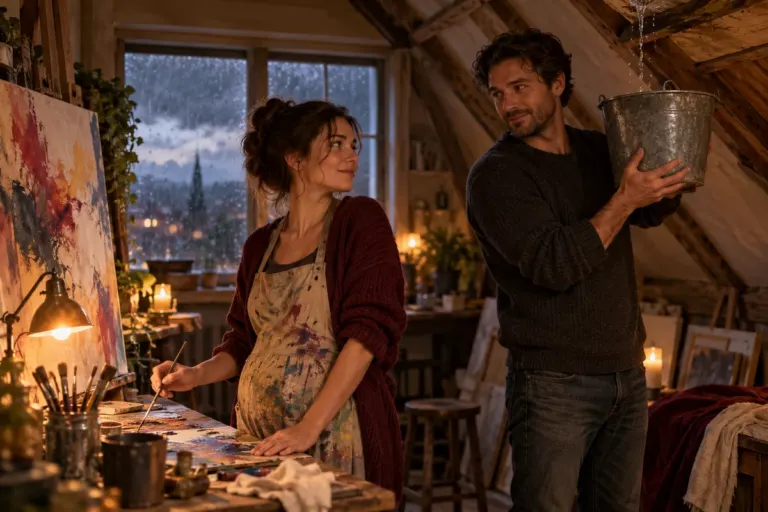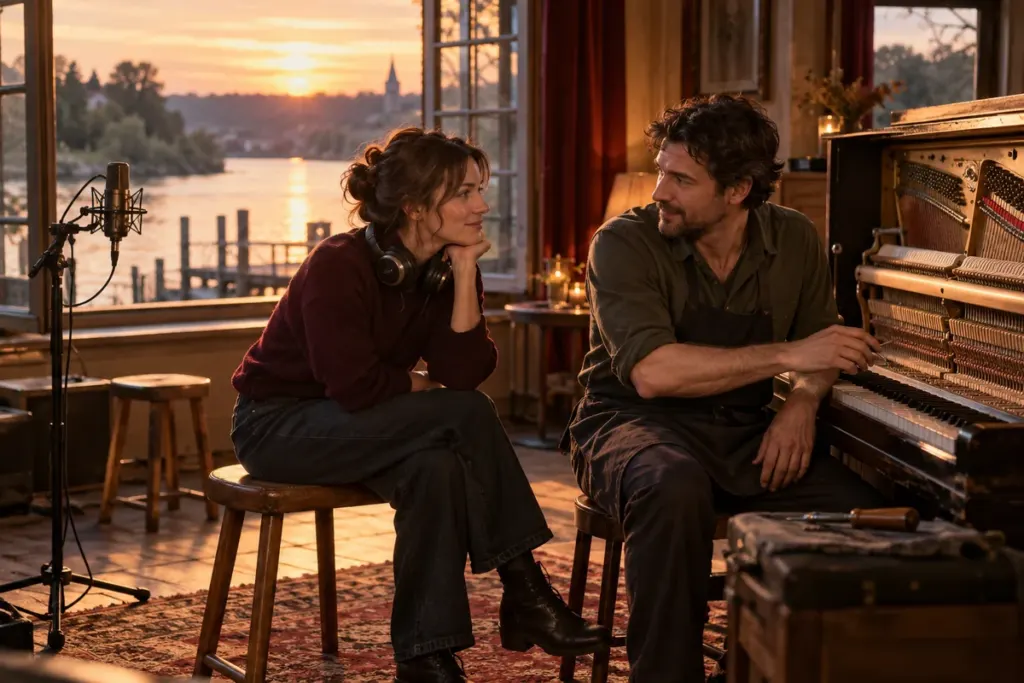
A musician romance does not need a stadium, a tour bus or a camera outside the bedroom. Sometimes its most charged question is whether a beautiful thing may stay between the people who made it. If you are looking for a single-dad musician small-town romance, that distinction can help you choose between a story about public attention and one about the intimacy of being trusted to listen.
In When the Last Song Starts, audio producer Nora Keene returns to Magnolia Creek with a six-week commission. Piano technician Eli Turner is a single father, and the story’s promise brings them together through creative work, a private duet and a rehearsal that reaches the wrong audience. The appeal is not simply that she notices his talent. Her professional instinct to capture something valuable must coexist with his right to decide what becomes public.
This is an adult contemporary romance with sensual attraction, kisses and intimacy behind a closed door. Its quieter scale matters. If you want celebrity spectacle or graphic sexual detail, those are different reading moods. Here the enticing possibility is that two people can make something together without making every part of themselves available to the town.
The first audience is only three people
The opening gives that promise a small, funny test. Nine-year-old Tess wants to know whether Nora’s microphone can make her sound like a criminal. Her father, Eli, is working on the upright piano nearby. Before the adults become a romantic possibility, the scene has a practical question to settle: who gets to hear a child trying out a ridiculous voice?
Nora offers a private experiment, with permission and a way to stop. Tess hears the playback and chooses to delete it. That choice could have been treated as a cute interruption before the real story began. Instead, it establishes a language the romance will need. Being pleased with a recording does not automatically mean wanting to keep it. Enjoying an experience does not make its audience unlimited.
Notice what the moment lets you enjoy as a reader. There is room for Tess’s humor, Eli’s quiet amusement and Nora’s competence. Nobody has to become a villain for privacy to matter. The scene is attractive because Nora can join the joke while also treating the child’s decision as consequential. She is not only demonstrating that she is good with equipment; she is showing what kind of listener she might be.
That is a useful opening test for this particular romance mood. Does the story make attention feel responsive, or does attention become a reason to keep pushing? A character can be charmed by a voice and still put down the microphone. The pause can carry more romantic promise than an immediate declaration about understanding someone completely.
You’re on the list. Your free stories are waiting in the Reader Vault. When the Last Song Starts
Listening and recording are different kinds of intimacy
Nora’s work depends on hearing things other people might miss. In a romance, that can be a lovely strength. A producer may notice the shape of a hesitation, the atmosphere of a room or the way a person comes alive while making music. Those details can make attraction feel specific. Eli is not interchangeable with any appealing man who happens to be standing beside a piano.
But recording adds another possibility to listening: the moment can travel. A private exchange can outlast its setting and acquire an audience neither participant imagined. That makes creative partnership a particularly useful source of tension. The same skill that draws Nora toward Eli can create a problem if she confuses recognizing value with having permission to share it.
For a reader, the difference is emotional rather than a technical lesson about equipment. A song may be generous because it was offered to one person. Expanding the audience can change the meaning of that gift, even if the sound itself remains identical. The question is not whether the performance deserves admiration. It is whether admiration leaves the performer any choice.
The story’s premise says a rehearsal reaches the wrong audience. That tells us where the pressure will come from without revealing the route of the mistake or its resolution. I would read for what the couple must renegotiate afterward: not merely whether they still desire each other, but whether their work can become a place where both people have a say. A grand gesture would only be satisfying if it answered that particular wound.
The piano work gives attraction something concrete to notice
Eli first appears doing a task. Nora sees him working with felt at the piano, and her awareness of his hands belongs to a scene with an actual purpose. That is a different pleasure from being repeatedly told that a musician is irresistible. Skill gives desire an object: patience, attention and the ability to hear when something is not quite right.
His work also keeps the musician promise grounded in a local life. Piano maintenance is not the same fantasy as international fame. A room has to be available. Another person has an appointment. An instrument needs care before anyone can use it beautifully. If you enjoy creative partners, these ordinary constraints can be part of the attraction because they show how people behave when neither has unlimited space or time.
The opening’s room-booking confusion is a good example. Kit Dawson has put two uses into the same space, and the solution requires an apology and revised expectations. The story does not need to turn an administrative muddle into destiny. It can let Nora and Eli become aware of each other while they are also trying to get through a working morning.
When choosing a musician romance, ask which activity you want to spend time around. Do you want the sensation of a crowd watching a star, the solitude of composing, the friction of rehearsing together or the small adjustments that let an instrument sound right? None is inherently a better love story. They offer different kinds of proximity. This opening suggests the pleasure of observing craft at close range.
A single father’s child should have her own wishes
Tess adds something more interesting than proof that Eli is an eligible romantic hero. She has a comic imagination and a preference about what happens to her own voice. Later in the opening, she can enjoy singing while still declining to sing for River Day. Her father accepts that distinction. Private pleasure does not have to graduate into a public performance to become real.
That independence matters to the reading promise. A child in a single-parent romance can easily become a convenient endorsement of the couple, as though her job were to identify the correct adult partner and bring them together. Here the opening gives you another way to assess the family dynamic: do the adults remain interested in what Tess wants when it does not advance their project?
You do not need a custody dispute, an absent-parent mystery or an invented tragedy to find that situation emotionally rich. The opening gives us enough: a father working, a child making choices and a newcomer whose professional plans must make room for both. Speculating beyond that would replace a particular family with a familiar trope package.
If your favorite single-dad romances include children who feel like people rather than relationship tests, watch for moments in which a child’s preference changes what the adults actually do. Warm dialogue is appealing. Follow-through makes it believable. Tess’s deletion of a file and her refusal of a public singing role are small enough to feel ordinary, and concrete enough to matter.
A town archive is full of voices, not automatic invitations
Nora’s commission expands the same problem beyond the couple. There are old recordings, photographs and handwritten lists to consider for a listening project. A donated box is appealing material for an audio producer. It also contains people whose relationship to being heard may differ from the donor’s enthusiasm.
The opening shows Nora sorting material into private, discussion and public possibilities, with nothing public yet. As fiction, that is a strong way to make restraint visible. Rather than assuring us that she respects boundaries, the scene gives her something tempting to organize and makes her leave some possibilities undecided. There can be narrative energy in a folder that does not get filled immediately.
This is also where the small town becomes more than a pleasant backdrop. Familiar voices carry memories, obligations and assumptions. Someone may be proud to recognize a neighbor; the neighbor may have complicated feelings about being recognized. A communal project can be affectionate and still require more than general enthusiasm to make each participant comfortable.
Those observations are about the story’s emotional design, not instructions for running an archive or clearing a recording. For the reader, the interesting question is whether the book lets community be made of distinct people. If the town speaks with one unanimous voice, a private hesitation may look unreasonable. If individuals keep their own wishes, Nora’s work can become a real encounter rather than a montage of local charm.
The most revealing refusal comes from someone Nora knows
Returning home gives Nora a second, less comfortable audience. She stays in her mother Lila’s back bedroom for the commission and insists on paying rent. Lila has a musical history of her own, but when Nora raises the listening project, her mother’s answer is not yet. That answer lands differently from the same hesitation offered by a stranger.
This is a particularly good complication for a returning-home romance. Professional courtesy can be easier when the person declining has no claim on your heart. A parent’s refusal may feel like a judgment of the work, or a refusal to welcome the person you have become. The scene allows Nora’s feelings to exist without making those feelings proof that Lila owes her participation.
At the end of the opening, Nora hears her mother humming downstairs. Her instinct is to reach for the recorder. Then she stops and sets it down. Nothing spectacular needs to happen for the choice to register. The sound can reach her without becoming material. She can be a daughter hearing her mother rather than a producer collecting a useful piece of home.
For readers wary of small-town stories in which returning means surrendering every adult boundary, that is a promising distinction. Home can offer access to memories without offering ownership of the people who made them. The existing guide to small-town found family and chosen belonging explores the wider community version of that question. Nora’s recording project makes it unusually audible.
The countdown tests work as well as desire
The two time spans in the premise are worth separating: Nora has six weeks for her commission, but River Day is only three weeks away. A developing relationship therefore sits inside a project with its own approaching demand. Wanting more time together cannot simply erase the work that brought her back.
That arrangement can make creative partnership especially satisfying. The lovers have something to accomplish besides recognizing attraction, and accomplishment has limits other people can see. A concert date does not wait for two adults to resolve their feelings. At the same time, urgency can make a private hesitation inconvenient, which is precisely when a boundary becomes meaningful.
Read for whether both careers remain legible. Nora should not have to become ashamed of making audio to deserve affection, and Eli should not have to become public property to prove he supports her. The interesting romantic possibility lies in a version of collaboration neither could have designed alone. Their differences can change the work without making one person disappear into the other’s ambition.
If the balance of a heroine’s skill and a single father’s responsibilities is what attracts you most, the related single-dad cowboy romance guide offers a different setting for that reading decision. It is a thematic next read, not another part of Nora and Eli’s life. Here, the distinctive pressure is the possibility that making something heard may expose more than either partner meant to offer.
For a different return-home tension, the second-chance pregnancy romance guide considers home and trust in another story. That premise involves different characters and circumstances; it is not a pregnancy promise for Nora and Eli. Choose between the articles by the conflict you want to explore: a previous relationship and a new responsibility, or the boundaries of making and sharing music together.
Choose the quiet room if that is the romance you want
When the Last Song Starts is a fit for the mood in which careful attention feels romantic: a repaired instrument, a shared room, a child allowed to change her mind, a familiar voice heard without being captured. Those are not substitutes for attraction. They are the circumstances that make attraction particular to these people.
Its setting connection is specific, too. This is an independent original couple in Magnolia Creek during the summer before A Recipe for Forever. Mabel Bennett and Mabel’s Magnolia Tea Room connect the place. You do not need to assume that every book in the thematic Modern Love Stories collection shares a cast, or read Nora and Eli as a disclosure of the source couple’s outcome.
Start with the opening of When the Last Song Starts and decide whether its humor and quiet negotiations are the kind of intimacy you want. Read the opening free in your browser, then confirm your email to continue the story. The free-story collection is the broader place to look for another mood. For this one, the invitation is simple: come close enough to hear, and notice who still gets to choose the audience.