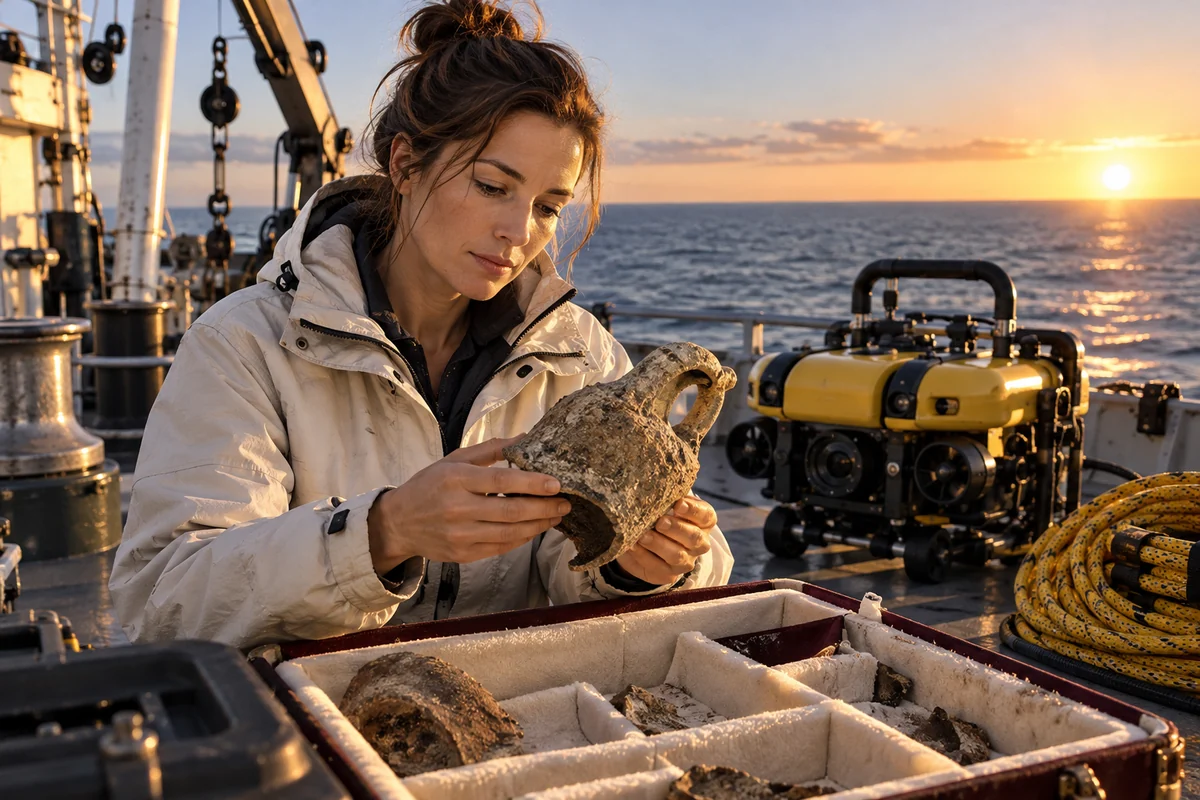
For maritime archaeology romance, look for an actual research objective as well as danger at sea. In Alisson Bento’s Guarded at Sea, Lila negotiates a Pacific wreck survey with explicitly stated archaeological value. Protectors of the Deep provides an adjacent maritime research premise involving concealed cargo; its public description does not identify archaeology. That distinction helps you choose the expedition you want.
The key distinction is what the expedition is trying to learn or preserve. A maritime setting can support many kinds of work, and an underwater discovery is not automatically archaeology. Guarded at Sea explicitly gives the wreck archaeological value. Protectors of the Deep offers research diving and concealed cargo, making it a useful adjacent comparison rather than a second exact archaeology recommendation.
The descriptions set out starting objectives and pressures, not final discoveries, complete rescue sequences, or romantic outcomes. Their fictional contracts and diving circumstances are story details rather than practical legal or safety guidance. The reading choice concerns how professional purpose meets the people, equipment, and communication the voyage requires.
A wreck survey comes with a deadline
Guarded at Sea gives Lila Córdova twenty-four days to survey a wreck before commercial permits turn its archaeological value into inventory for someone else. Fortress Six can provide the vessel and remotely operated vehicle she needs. Access to equipment is therefore part of preserving the site, not simply a way of traveling to an attractive setting.
The opening suits readers who want a researcher with an urgent professional objective. Lila must arrange the voyage in time and evaluate the terms offered by the company that can make it possible. The deadline brings scientific purpose into direct contact with the people controlling transport and resources.
Lila’s twenty-four-day charter requirement gives the voyage a defined scope before it begins. She needs to reach the wreck and survey it before commercial permits change what happens to its archaeological value. Readers who enjoy preservation stakes can follow a researcher trying to secure a particular opportunity, rather than simply seeking adventure at sea.
The vessel and remotely operated vehicle also have a concrete function. Fortress Six can supply what her work requires, so the company controls resources relevant to the objective. The opening’s relationship pressure begins partly through that dependence. A reader interested in professional negotiation can ask how the heroine evaluates an offer she has practical reasons to need.
That resource problem differs from a mystery already unfolding on a boat. Guarded at Sea starts with the terms under which the expedition can happen. The central immediate question is how to obtain access without leaving essential survival provisions vague. If you like planning and negotiation before action, this is a reason the opening itself supports for choosing it.
Archaeological value is the explicit criterion that makes this the exact example for the article’s search. A wreck, a diver, or a remotely operated vehicle would not alone prove it. The description names the value at risk and the survey’s purpose, so readers can select the premise without guessing from equipment or ocean imagery.
Ask separately about how much archaeological work appears later. You may want substantial survey scenes, interpretation of the site, or preservation decisions. The opening confirms the objective and urgency, but not every method or the eventual finding. A full-book reader can discuss ongoing emphasis without revealing what the wreck ultimately yields.

From Alisson Bento’s books
A mafia romance about a wedding she did not choose to a man she cannot escape.
Kindle edition · Check Kindle Unlimited availability on Amazon.
Safety terms are something the heroine negotiates
Lila examines the rescue provisions before agreeing. Lawyer Soren Hael accepts her demand that safety carry no reimbursement liability, and she requests measured rescue lines in memory of her drowned father. Company CEO Hollis Garreth and dive chief Roman Vantor also shape the coming voyage.
A penciled warning beneath the signature line creates a further uncertainty. Choose this protector reverse harem opening if you want the heroine to negotiate what help will mean before the expedition begins. Her past loss and present expertise both inform the terms she seeks, making rescue access a personal and professional concern.
Rescue provisions matter to Lila before she signs. That order makes safety part of the agreement rather than something first considered after danger arrives. Readers who enjoy a heroine defining the conditions of help can follow her demands as an action within the professional premise. The description does not say those provisions eliminate every later risk.
Soren accepts her demand: safety will carry no reimbursement liability. This is a particular negotiated term in the fictional contract, not a general rule about maritime rescue. Its narrative function is to make assistance’s potential cost explicit. Readers can appreciate the distinction between help being available and help creating another obligation.
The measured rescue lines connect the request to Lila’s drowned father. Her past loss informs a present condition without the description supplying a complete psychological account. If you enjoy personal history expressed through a practical demand, this detail gives you a concrete example. It does not require inventing a diagnosis or a specific later trauma scene.
The company figures also occupy different stated roles. Hollis is the CEO, Soren the lawyer, and Roman the dive chief. Those roles connect the coming voyage to resources, terms, and operation. The description identifies them without confirming every later romantic interaction, so a reader interested in the reverse-harem framework should ask about individual development separately.
The agreement already contains meaningful details, and the penciled warning makes it more complicated. Its author is unknown, which gives Lila another piece of information she cannot yet attribute. A reader may enjoy a contract scene ending with unexplained caution rather than complete reassurance. The description does not reveal who wrote it or whether every possible suspicion it creates is justified.
Choose this premise if the negotiation itself is part of your reading pleasure. The researcher has a defined objective and asks what rescue will mean before relying on the company. A promise of protection becomes something to examine, while the anonymous warning keeps the agreement from closing every question at the threshold.
Let the discovery change the expedition’s purpose
Protectors of the Deep begins after the research task is underway. Lila expects to survey a shipping container and record what she finds. Agricultural markings suggest one account of the cargo, while concealed weapons provide another. The opening therefore makes observation reveal a discrepancy inside an apparently routine dive.
The protected case adds evidence with a possible audience beyond the expedition. The description does not disclose all of its contents, but it shows that someone has reason to prevent reporting. Readers who like a discovery to change the stakes can follow the movement from documentation to danger without needing a complete explanation of the larger operation first.
Back aboard the Sedna, the threat changes location. An unidentified vessel approaches, and attempts to reach help do not work as they should. What was found underwater now affects the people on deck. This sequence can appeal to readers who enjoy an ordinary professional task becoming an immediate survival problem.
Observation and documentation are described as survival tools in that transition. Lila’s working habits remain relevant even though the task has changed. The description does not provide a complete escape procedure; the literary interest is that the abilities used to build a record now matter to assessing danger.
Four protectors enter the military why-choose premise under those conditions. The description emphasizes reliance on a team, open water, and compromised communication. It does not identify this cargo survey as archaeological work, and repeating Lila’s name does not turn it into a continuation of the wreck-charter story.
Compare negotiating help with needing help immediately
The timing of dependence differs. In Guarded at Sea, Lila scrutinizes rescue conditions before the voyage. In Protectors of the Deep, an approaching threat and failed communication make help urgent after a discovery. Readers may enjoy either, but one offers more introductory attention to terms while the other offers an immediate change in circumstances.
The evidence also has different meanings. Archaeological value explains why the first expedition needs to happen in a limited window. Concealed weapons and a recovered case explain why reporting on the second expedition may be dangerous. The shared sea setting should not obscure that difference between preserving a site and carrying evidence of a threat.
A reader interested in professional independence might prefer the opening where conditions are discussed explicitly. Another drawn to uncertain teamwork might prefer the one where assistance becomes necessary before communication works reliably. These are choices about the starting pressure, not guarantees that one complete relationship has more freedom or more care than the other.
Ask how rescue and protection remain involved after the first scene. You may want planning to stay consequential, or prefer a faster suspense plot where the team must respond to changing danger. Someone who has finished can discuss that distribution without identifying the warning’s author, the case’s ultimate significance, or a final rescue outcome.
Choose what isolation should contribute
Open water changes the convenience of leaving and reaching help. Protectors of the Deep explicitly makes distance part of the threat, with safety neither a quick trip ashore nor a simple trust decision. If that material isolation is part of your reading mood, the description gives you more than an attractive ocean backdrop.
In the charter premise, distance makes advance provision important. Lila’s need for a vessel, specialized equipment, and rescue terms brings the voyage’s practical dependencies into the first conversation. Readers may enjoy understanding those dependencies before the expedition begins. The description does not spell out every later condition at sea, so broader environmental expectations remain open.
A boat can also create a limited social environment, but the precise living arrangements matter. You may want close quarters, private conversations, or ensemble teamwork. The descriptions here set out maritime assignments and protector frameworks without a complete layout or count of personal scenes. Ask about the kind of proximity you want rather than assuming all ocean romances feel alike.
Weather is another independent preference. Sea settings invite expectations of storms, but these descriptions’ confirmed pressures are a survey window, contract provisions, concealed cargo, an approaching vessel, and communication trouble. If a storm or shipwreck is the main attraction, confirm it separately. The actual premises have sufficient danger without adding an unsupported event.
Ask for archaeological work directly
For a precise request, try: “Maritime archaeology romance with an explicit wreck-survey objective, a deadline affecting preservation, and a researcher who negotiates access and rescue terms. Please say how much survey work stays on the page without revealing the discoveries.” That request preserves the archaeological requirement rather than letting any underwater mission substitute for it.
If cargo discovery is what interests you, use different wording: “Ocean-set research-diver romance where a routine survey uncovers dangerous evidence and failed communication makes protection urgent.” You can welcome the adjacent premise for its own pleasures without calling it an exact match for an occupation or research field not identified in the description.
Keep content, relationship configuration, and ending preferences separate. A protector reverse-harem or military why-choose premise does not confirm every arrangement among the adults or a final romantic outcome. Ask for the specific conditions you need while leaving the expedition’s solutions and intimate turning points unspoiled.
Within this catalogue, begin with Guarded at Sea for confirmed archaeological purpose and negotiated charter conditions. Choose Protectors of the Deep for an adjacent research dive whose discovery turns evidence into danger. The repeated heroine name does not set a reading order. Each opening gives a distinct professional task and a distinct reason why relying on other people becomes consequential.
Read another angle: Marriage-advertisement Western romance: the journey and the household she finds · Choosing mafia romance with a capable heroine · Bodyguard romance vs a protective hero: when care becomes duty
Explore the wider romance catalogue. The catalogue groups books by genre and trope; it does not confirm every preference discussed in this guide.