Día de Muertos is observed today and tomorrow, 1 and 2 November, when many families in Mexico and in Mexican communities abroad remember their dead with home altars, food and visits to graves. Because it sits so close to Halloween, it is often misread as a spooky theme, so it is worth understanding the holiday on its own terms before reading fiction that touches similar themes of memory and family. This guide explains the tradition, shows how romance can treat remembrance with care, and points to two novels from Alisson Bento’s catalogue in which family keepsakes carry weight.
What Día de Muertos is, and what it is not
Día de Muertos is observed mainly on 1 and 2 November. Its roots lie in pre-Hispanic Mesoamerican customs that treated the dead as part of an ongoing relationship with the living. After the Spanish conquest, those practices were gradually woven together with the Catholic feasts of All Saints’ Day on 1 November and All Souls’ Day on 2 November. The result is a holiday that is Indigenous in its roots and Catholic in its calendar, and it is kept differently from region to region and from family to family. UNESCO lists the Indigenous festivity dedicated to the dead in Mexico as part of the Intangible Cultural Heritage of Humanity, a recognition of how much it means to the communities that keep it.
It is not Halloween. The two holidays fall close together on the calendar, but Día de Muertos is not a festival of fear and it is not a costume party. Its mood is often warm as well as sad, closer to a reunion than a scare: the dead are spoken of fondly, remembered, welcomed and, for a short time, invited back into the home. Treating it as a theme for parties or as a spooky aesthetic misses what it means to the people who keep it.
Many families also distinguish between the two days. In a common pattern, the first day is set aside for children who have died and the second for adults, although customs vary a great deal. Some households mark the whole period in their own way, and a reader should not assume that one family’s practice describes all of them.
You’re on the list. Your free stories are waiting in the Reader Vault. The Taste of a Lie
The ofrenda: an altar built from memory
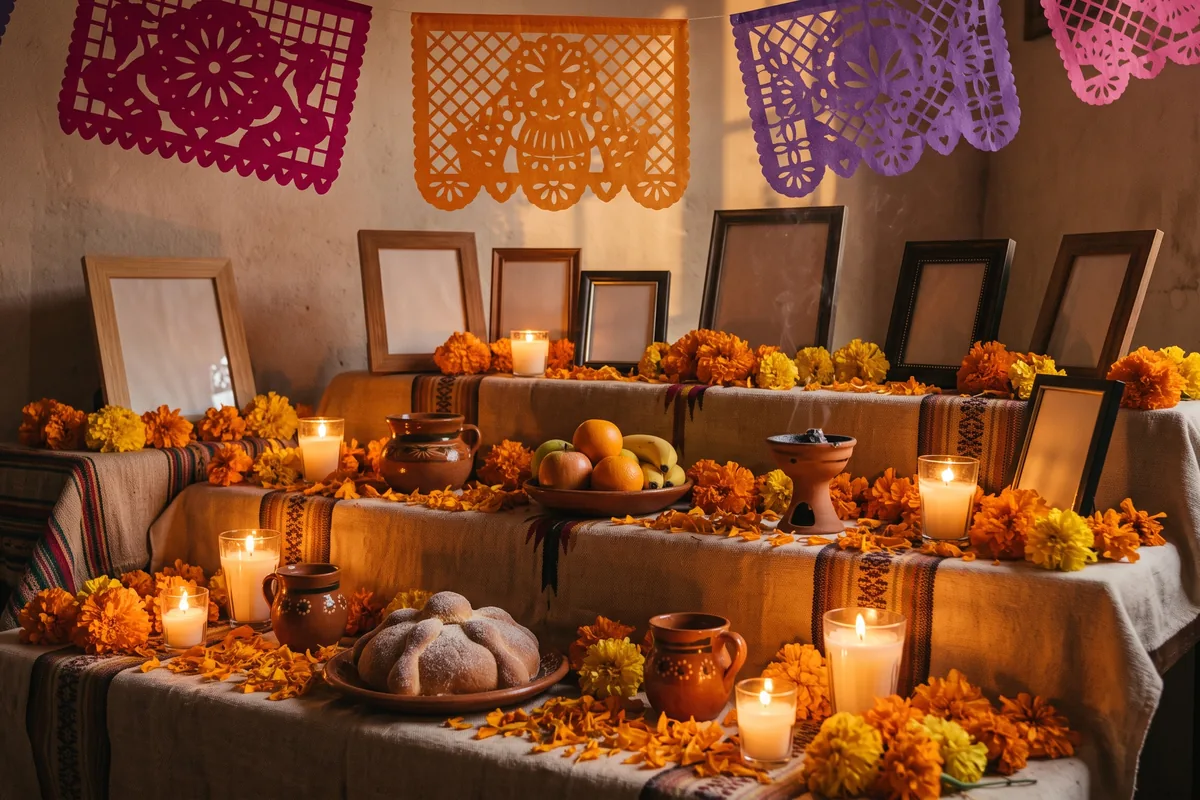
The central custom is the ofrenda, a home altar prepared for the dead. Families often place photographs of the people they are remembering on it, together with candles, the favourite foods and drinks of those who have died, water, salt and bread. Orange marigolds, known as cempasúchil, are widely used, and families say their colour and scent help guide the dead home. Cut-paper banners known as papel picado are common, many altars include copal incense, and bread baked for the season, pan de muerto, often sits beside the photographs.
An ofrenda is personal. Two families may build very different altars, and both can be correct. The items reflect what the family knew and loved, such as a particular dish or a familiar object from a daily routine. This is the point to keep in mind when you meet the holiday in fiction. A well-written portrayal shows a family choosing what goes on the altar and explaining why. A weak one uses the altar as a set piece, with the objects standing in for a culture rather than for a person who mattered to someone.
Families also visit cemeteries, and many clean and decorate graves. In some places people spend time at the grave through the night. These visits are part of the same act of remembrance. The dead are not kept at a distance; they are visited where they rest, and the living spend time with them in a way that is social as well as solemn.
Storytelling is part of the holiday too. Families often talk about the people they are remembering, recalling what they were like, what they cooked, how they laughed and what they taught. The remembering is shared out loud, which means the dead are kept present through conversation as well as through objects. For a novelist, this is a valuable detail, because it shows that memory in this tradition is communal. It belongs to a family and a neighbourhood, not only to the person who is grieving.
Cultural care: how to tell respect from decoration
Culture becomes costume when a detail is lifted from its meaning and used as decoration. In romance, that usually looks like a holiday used only for mood: a setting with candles and paper flowers but no family in it, a costume that turns grief into a visual theme, or a character who speaks about the dead in a way that makes the tradition seem exotic. The remedy is not silence. It is accuracy and context.
If you are writing or choosing a romance that uses this holiday, check whether the family has a place in the story, whether the rituals are explained through the characters’ relationships, and whether the people who keep the tradition are treated as full characters rather than as backdrop. Look for books written by authors with direct knowledge of the tradition, and be wary of any book that presents a whole culture through a few visual symbols. Listen for specific detail: the names of foods, the rhythm of family speech, the way relatives argue about where the altar should stand. Those details come from lived knowledge, and their absence is usually the first sign that a holiday has been borrowed as scenery. Check the content notes for grief, violence or family conflict before you begin, because a remembrance story can carry heavy material even when its tone is quiet.
Memory, inheritance and grief in romance fiction
Romance suits memory because it is about attachment, and attachment is what remembrance is for. A romance that begins with a loss gives the protagonists a reason to look backwards, to ask what a dead person knew, and to decide what they owe to that person’s memory. Family secrets work the same way. A parent’s silence, a sibling’s unfinished business or a grandmother’s keepsake can carry the past into the present.
Two books from Alisson Bento’s catalogue show the keepsake idea at work. Neither is set around Día de Muertos or draws on it, and both are dark novels, so read their content notes first. In Ruthless Professors, a dark academia reverse harem romance, a scholarship student arrives at an isolated academy carrying her sister’s broken pocket watch. Her goal is to reach the archives and the redacted records that might explain her sister’s death. The watch holds her sister’s absence, and it gives the heroine a reason to keep asking questions at an institution that already seems to be tracking her.
In Bound to the Brothers, forensic archivist Alanna Buckley is working a routine night shift when a discrepancy leads her to a concealed financial network. She copies the evidence to an encrypted drive and hides it in her grandmother’s locket, so that a family keepsake becomes a place to keep the truth safe. The connection to remembrance is practical. The object carries meaning beyond itself, and the story uses that meaning to make the stakes personal.
In both openings a family object does more than sit on a shelf: it carries an unanswered question in one book and hidden evidence in the other. That is a useful way to read any romance about loss or inheritance: look for whether the past shapes what the characters do, not only how they feel about it.
Grief in fiction can take several forms, and each affects a romance differently. A loss can be recent and raw, which pushes the characters toward action. It can be long-ago and quiet, which makes the past a source of hesitation. It can also be unfinished, when the dead person left a question behind. Grieving people often keep up some kind of bond with the person they have lost, through rituals, conversations or keepsakes, and romance can use that bond to show who a character is. A partner who respects that bond, rather than asking the grieving character to put it away, often gives the relationship more depth.
How to choose a remembrance-themed romance
- Decide whether grief is central or background. Some books use loss as the motive for the plot, while others use it as emotional texture.
- Check whether the holiday is depicted or only mentioned. A book that names a tradition without showing family life has a different purpose from one that builds its characters around it.
- Read content notes for violence, institutional power and dark themes. Dark romance content warnings without major spoilers: a practical reading check explains how to check warnings without spoilers.
- Look at who holds the memory. Stories that give the grieving character real agency tend to feel more respectful than stories where grief simply sets the scene.
- Notice the emotional tone. Grief can be handled with restraint or with melodrama, and you may prefer one to the other.
When you are unsure, read a sample before you buy. The opening chapters of a remembrance romance usually show how the book will handle the past: whether the dead are spoken of with warmth or only used as a motive, whether the family is present on the page, and whether the tone asks for patience or pushes for drama. A short sample tells you more about these choices than a summary can, and it is the quickest way to decide whether a book has the emotional care you want.
Heroine agency matters especially in stories about grief, because the heroine’s choices show whether the past is driving her or whether she is driving the story forward. Dark romance heroine agency: choices that matter beside a powerful hero looks at how a heroine’s decisions can matter beside a powerful hero, a useful lens for any darker story about loss.
Quick answers about Día de Muertos and romance
Is Día de Muertos the same as Halloween?
No. Día de Muertos is observed on 1 and 2 November and has roots in ancestral remembrance. Halloween has different origins and customs. The two holidays are close on the calendar, but families who keep Día de Muertos usually treat it as a time of remembrance rather than fright.
Can a romance novel use the holiday respectfully?
Yes, if the family, the rituals and the people are treated with knowledge and care, and the holiday serves the story rather than decorating it. A respectful book gives the tradition a meaning inside the characters’ lives, and it avoids turning it into a costume or a mood.
What should I check before buying a book with this holiday in it?
Check the content notes, look at whether the characters’ cultural background is portrayed with specific detail, and read the sample to see whether the holiday shapes the story or only sets its atmosphere. If the answer to the first two is unclear, the book may not be the one you want.