Sarah J. Maas returned to Prythian on October 27 with A Court of Splintered Harmony, the sixth book in A Court of Thorns and Roses. Bloomsbury has dated the seventh, A Court of Forgotten Melody, for January 12, 2027. Readers catching up in November have a welcome choice. They can start the new volume now or use the interval to revisit the books that give the Night Court’s latest troubles their history.
There is a useful distinction in the way Bloomsbury has titled the two books. A Court of Splintered Harmony is also The Valkyrie Cycle, Movement I. A Court of Forgotten Melody contains Movements II and III of that same cycle. Two books carry three movements, and each book keeps its place in the main series. Maas is using the space of a closely connected arc within a world readers already know, with the two publications separated by less than three months.
The confirmed publication dates and what they mean
Splintered Harmony is the current release. Bloomsbury lists the U.S. hardcover as available and gives October 27, 2026, as the date Prythian’s story resumed. The publisher lists the hardcover of Forgotten Melody as a January 12, 2027, preorder, under ISBN 9798260200568. Its product page describes an 896-page U.S. hardback. If you are searching a library catalog or comparing editions, using the full title and ISBN is more reliable than searching for a book number alone.
The publication gap matters if you like to read close to release but also want to plan a reread. The next volume follows on the January calendar, which makes a short recap of earlier books a reasonable option for November readers who remember the series well. If you want to read the new arc without a long interruption, you can also set aside the two volumes for the same reading stretch after January 12. The publisher’s structure makes the trade-off easy to understand.
Bloomsbury’s U.S. hardcover page also advises readers to place separate orders for the two volumes if they want the October book without waiting for the January one. That is worth keeping in mind when using the publisher’s site or comparing other retailers’ delivery terms. A preordered copy of Forgotten Melody and an available copy of Splintered Harmony belong to the same reading plan, but their shipping schedules can depend on how and where you order.
From Alisson Bento’s books
Vampire
A vampire romance about a captive bargain that turns into the only place she wants to be.
Kindle edition · Check Kindle Unlimited availability on Amazon.
Koschei brings old alliances back into the foreground
Bloomsbury’s description of book six begins with Koschei the Deathless. He has long been bound to a mountain lake, and the possibility of his return is drawing allies interested in retaking the human lands. Prythian is still dealing with the consequences of the Hybern War. The Night Court has reason to act against attacks on innocents, and the wider setting has given the people it needs to work with many reasons to be cautious about one another.
This is a promising direction for a series with so much history in its friendships. An enemy gathering power offers a straightforward reason to act. Deciding who can work together is a more interesting problem because it depends on what people remember, what they owe, and what they are prepared to say about earlier choices. The publisher mentions recent betrayals and revelations within the Night Court. That makes the vulnerability of its closest relationships relevant to the dangers outside it.
Maas’s gift for giving friendships and loyalties the scale of political events fits this premise especially well. A court can issue a public commitment and still have to depend on people who disagree about what happened the last time they trusted one another. A relationship can matter to the balance of power even while the people in it are making a personal decision. The book’s announced conflicts give readers several reasons to watch for those points of overlap.
The Valkyrie Cycle subtitle offers a useful clue about form
The word movement suggests a piece with parts that can have different energies while belonging to one composition. Bloomsbury’s labeling establishes the divisions without saying how any particular plot line will be distributed across them. It is a pleasing way to announce a connected stretch of fiction. The titles themselves put the language of sound and composition beside a story about trying to bring people and alliances back into working order.
Splintered Harmony puts a sense of past connection in the same phrase as a break. Forgotten Melody suggests that something worth remembering could have fallen out of reach. Readers can appreciate both titles as clues to the kind of attention the author is inviting. There may be more to notice in a familiar relationship if the people in it have different accounts of what they once shared. A political alliance can have a history that some members know and others have only been told.
The formatting is also practical news for collectors. The same book can appear in a catalog as A Court of Splintered Harmony, as book six of ACOTAR, and with the first Valkyrie Cycle movement as its subtitle. January’s listing uses the second title and the plural Movements II & III. Knowing that relationship makes it easier to compare bookshop results, especially when a listing emphasizes the cycle name or uses an abbreviated series title.
How to catch up with the least amount of confusion
Bloomsbury’s sequence begins with A Court of Thorns and Roses, followed by A Court of Mist and Fury and A Court of Wings and Ruin. A Court of Frost and Starlight comes next, then A Court of Silver Flames. Those are the five titles that precede A Court of Splintered Harmony. The next entry after it is A Court of Forgotten Melody. A reader new to the series will get the most from beginning with the original novel and letting the geography and relationships accumulate.
A returning reader has more flexibility. If you remember the war and the main relationships, looking back at the books immediately preceding the new one can refresh the emotional and political context that interests you most. Readers who came away especially attached to the people introduced or developed in Silver Flames may want that book close at hand. Readers who need a firmer recollection of the consequences of the war may prefer to work forward from Wings and Ruin.
The novella Frost and Starlight belongs in the publisher’s listed sequence. It is easy to overlook when a reader remembers a set of full-length novels and is checking where to resume. The title sequence gives it a clear place between the third novel and Silver Flames. That also makes it a useful point on a spoiler boundary when planning a reread with friends. Saying which named book everyone has finished is easier than deciding how each person counts the shorter entry.
Why November is a good moment for a spoiler-conscious reread
A closely spaced pair of releases can change the experience of discussing a long series. In November, some readers have finished the October book, others have placed it on a holiday reading list, and new readers are discovering the opening volume. A book club can accommodate all three groups by choosing a stopping point before the discussion begins. For an early session, the official description of book six is already enough to talk about the questions Maas has brought back into view.
One useful prompt is to ask what makes a court’s authority feel earned after a war. People who have survived a shared threat can remember their alliances with affection and still find that the same terms no longer work. Another is to consider the gap between reconciliation and agreement. A character may want the same outcome as someone they struggle to forgive. That makes it possible to talk about the series’ commitments to loyalty and intimacy without revealing who does what in the new book.
A discussion of titles can also be a good option for readers avoiding plot details. What kind of harmony is possible when several courts need to retain their identities? Who gets to remember what an old alliance sounded like before it fractured? These are reading questions suggested by the framing, and Maas has given the series enough relationships at different scales for readers to come at them in several ways.
From Alisson Bento’s books
Vampire
A vampire romance about a hero who claims her and never lets anyone forget it.
Kindle edition · Check Kindle Unlimited availability on Amazon.
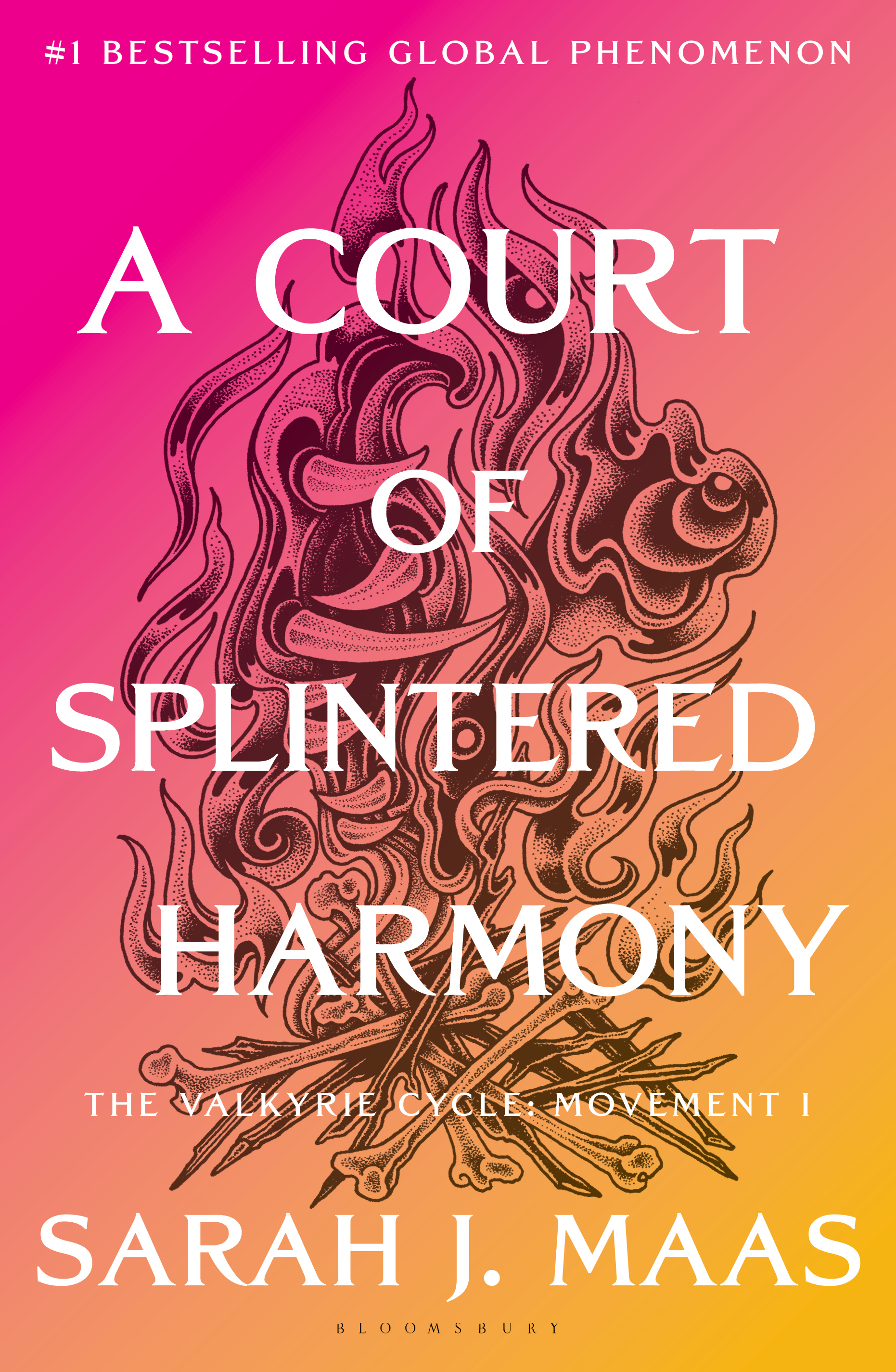
The new cover is bright enough to announce a return
The artwork for Splintered Harmony places a dark, intricately drawn emblem over a field that moves through saturated pink into warm orange and gold. Large white lettering does most of the work of keeping the title legible. The bright palette makes the cover immediately recognizable among November releases, while the symmetry and detail of the emblem invite a longer look.
It is an enjoyable pairing with the announced story. The publisher’s description emphasizes division, uncertainty, and the possibility of rebuilding alliances. The cover offers a strong visual identity without needing to put a particular couple or scene in front of readers. It gives the volume the confidence of a major return and leaves the quieter questions of the new arc to the people inside the book.
The subtitle also has a visible home on the cover. For a series that readers often discuss using abbreviations or book numbers, the combination of the full title, the author name, and the Valkyrie Cycle label is valuable orientation. If you are choosing an edition for a matching shelf, compare the art and format on the relevant product page. The U.S. hardcover listing, the U.S. ebook listing, and editions intended for other markets can have different identifiers.
Reading a long series when you remember its people better than its politics
Some readers come back to Prythian with a clear memory of their favorite friendships and a less precise recollection of the alliances around them. The publisher’s setup offers a useful starting point for that kind of return. Separate what the Night Court wants in the new story from the reasons it may struggle to get support. The threat to human lands is a reason to look outward. The betrayals and disclosures mentioned in the synopsis are reasons the characters may first have work to do close to home.
A brief reread can be shaped around that distinction. You might return to an earlier negotiation or reunion and notice which person was able to speak on behalf of a group and who accepted their authority. Then take a chapter centered on a personal relationship and consider what its participants believed they could safely ask of one another. Those two pieces of memory can do more for your return than trying to recall every name or event in sequence. The new book is interested in what happens when people who are already connected have to decide how to use that connection.
There is also room for different readers to contribute different pieces of the history. Someone who remembers the war may bring a perspective on the alliances. Someone else may remember the choices that mattered most to a person in the Night Court. An early conversation can put those memories beside each other and leave the new plot to unfold in its own time. Maas has given long-time readers enough distinct attachments to make a shared reread feel like more than an exercise in recall.
What to expect from the January installment
The title, series position, subtitle, U.S. hardcover details, and January 12 date for A Court of Forgotten Melody are confirmed by Bloomsbury. For readers who want to preserve as much surprise as possible, that is sufficient information to place an order or request the book. The first movement can be read now, and the two further movements are collected in the next volume. The publisher’s book page is the best place to check the precise edition as January approaches.
The pleasure of having both dates is that readers can choose how they want to experience the anticipation. Finishing book six now leaves time to discuss the decisions it asks of familiar people. Saving it for January keeps the movements close together. A reread can restore the significance of old alliances before either choice. Each approach has an audience in a series that has given readers years to find their own point of attachment to Prythian.
Maas’s return arrives with an appealingly difficult problem for her characters. A shared threat gives them a reason to seek one another out, and their own history gives them reasons to hesitate. That is fertile territory for a writer whose romances and friendships often have consequences beyond the people immediately involved. Splintered Harmony is available now. Forgotten Melody gives that return a second date to circle.
Sources
- Bloomsbury’s U.S. series hub and release calendar
- Bloomsbury’s hardcover listing for A Court of Splintered Harmony
- Bloomsbury’s hardcover listing for A Court of Forgotten Melody
- Sarah J. Maas’s official website
Cover art source: Bloomsbury U.S. hardcover cover, via Walmart. Background is an editorial illustration.