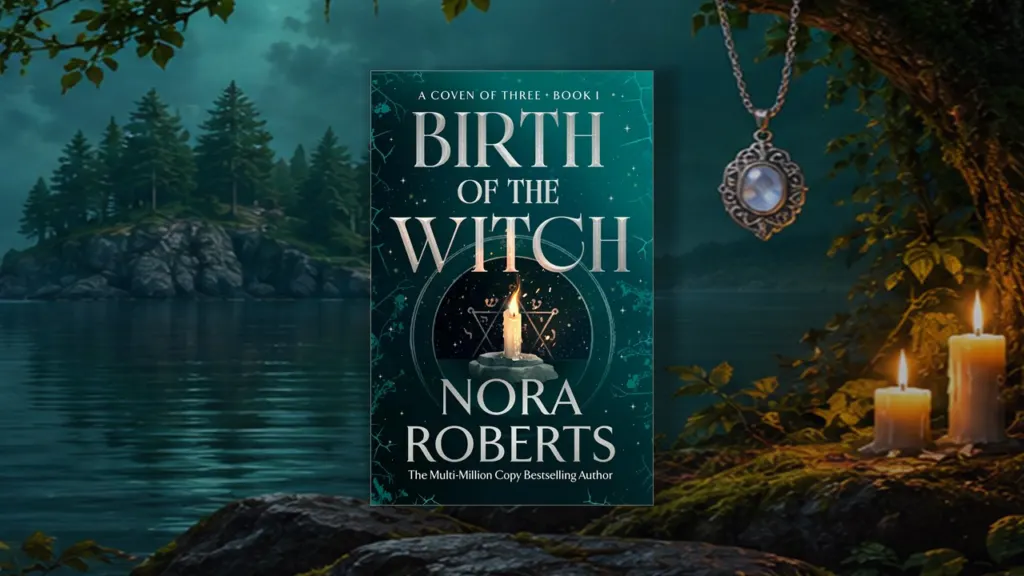
Nora Roberts begins her Coven of Three trilogy on November 17 with Birth of the Witch, a supernatural story set on Piety Island more than three centuries apart. In the historical strand, thirteen-year-old Niamh McShane faces a deadly outbreak of persecution. In the present-day strand, thirteen-year-old Neve McShane receives a pendant from her aunts and learns that the stories they have told her about past lives belong to her own family history. St. Martin’s Press lists the U.S. release for November 17.
The new book is a particularly interesting addition to the November calendar for romance readers who follow Roberts into stories of magic, family, and suspense. The publisher foregrounds Neve’s awakening and the coven across lifetimes. It also gives the book a thread of longing in Neve’s dreams of a young man from Ireland. The unusual balance is part of the news. A writer known to many readers for her romances is beginning a project in which bonds among women and the choices that sustain those bonds are central from the opening description.
Two girls turn thirteen on the same island
Niamh’s part of the premise begins in the era when panic from Salem Town reaches her home on Piety Island. She is imprisoned with women Macmillan describes as weavers, and they share some of their power with her. The summary establishes that Niamh dies at thirteen. Her story opens a question about what can survive an injustice when the person at its center is denied the time she should have had to grow up.
More than three hundred years later, Neve wakes to an ordinary-looking birthday. The list of gifts is memorable for the company the pendant keeps. Her aunts give her sneakers and a phone as well as the antique jewelry. The modern objects tell us what kind of morning Neve expects to have. The pendant gives the same morning a different significance, and Roberts can make the discovery feel intimate because it arrives at a moment already full of family attention.
The shared age makes the structural connection especially clear. At thirteen, both girls are old enough to have a sense of who they might become and young enough for the decisions of the adults around them to shape the lives ahead. The circumstances surrounding Niamh are tragic. The circumstances surrounding Neve allow her to ask questions and learn what her aunts have tried to tell her. One birthday can become a way for the present to make room for the future a girl in the past could never have imagined.
From Alisson Bento’s books
Vampire
A vampire romance about a captive bargain that turns into the only place she wants to be.
Kindle edition · Check Kindle Unlimited availability on Amazon.
The aunts and their shop give the magic an everyday home
Macmillan’s account says Neve’s aunts sell potions in their shop and have abilities beyond the kitchen magic she already knows. That distinction makes for a welcoming opening. Neve has familiarity with certain parts of their lives, and the new information changes her understanding of people she already loves. It also makes their stories of previous lives a different kind of inheritance. She has heard words she can now begin to understand in an unfamiliar way.
A shop is an effective place to put that transition. It gives a family’s unusual knowledge a practical setting and leaves room for readers to imagine how its work fits into the days of people on the island. A business can be a public part of a family’s identity while leaving the relationships that sustain it mostly private. Neve’s discovery gives her a route from the work she has seen to the history her aunts carry.
Roberts’s choice to make the aunts such a conspicuous part of the publisher’s description is another reason the premise stands out. A magical revelation can be thrilling, but it becomes emotionally richer when the character can ask what another person has done with a similar revelation. Neve learns that other people have walked some of the distance ahead of her. The opportunity to watch them teach and be questioned promises to give the coven a lived-in feeling from the start.
What the historical setting contributes
The opening premise uses the atmosphere of the Salem witch trials and sets its fictional events on Piety Island. The historical context involves real people who were accused, jailed, or killed. The Peabody Essex Museum has an accessible overview of the events and their aftermath, with a useful account of how ordinary social relationships and institutions became part of the persecution. It is a worthwhile companion for readers who want to spend more time with the setting’s historical inspiration.
Roberts’s premise makes a deliberate fictional move by giving the women Niamh meets actual magic and an ability to share it. The museum material tells a history of accusations and real harm. The novel’s description imagines what a threatened group could preserve for someone who comes after them. Reading those accounts for their different purposes can sharpen attention to the choice Roberts has made. She builds a fantasy about survival across generations on an opening marked by an injustice that cannot be reversed.
That history gives the present-day storyline a reason to care about memory. The chance to hear a family account and ask what happened can matter as much as the discovery of an ability. A family may pass along a keepsake because of its beauty, because of the person who first owned it, or because it marks an event someone needs to remember. Neve’s pendant puts those possibilities close together. It is a concrete object she can hold while she begins to learn which parts of the past demand her attention.
An island ties the two time periods together
Choosing the same island for both parts of the setup gives the book a point of continuity that readers can picture. People change across centuries. A coastline, a view, or the distance between one home and the next can retain a recognizable relationship to the place where an earlier life unfolded. That can make a supernatural connection feel local and tangible. Neve lives in a place whose past she may be able to encounter through more than a family story.
The island setting can also help the opening novel give its threat a comprehensible scale. Macmillan describes a growing darkness and says that Neve begins to hone her skills and look for clues. There is room for a young person to encounter an urgent problem while still learning what parts of her environment and family life she can depend on. By building a community around the danger, Roberts gives readers a reason to hope the place itself will have a future worth preserving.
One of the pleasures of a series opener is seeing which ordinary features of a place start to acquire meaning. A family shop can become a place of instruction. A gift can become a clue. A dream can make someone look at the same familiar island differently the following morning. The author has given the first book a set of specific details that can reward this kind of attention without requiring a reader to know any of her earlier trilogies.
The romance thread begins with a dream
The publisher says that Neve dreams of a young man from Ireland whose eyes met hers in a decisive moment centuries earlier. It is a restrained detail in a description that has already established the novel’s family and supernatural concerns. The old encounter introduces the possibility of a personal connection across time. The announcement leaves the significance of that connection and the shape of the relationship to the book.
Romance readers may be drawn to the long memory implied by a single shared look. In this setup, an encounter can stay meaningful even though its participants have had very little opportunity to speak. For a writer interested in time and recognition, the pleasure comes from finding a way to make that first impression matter after so much else has changed. The dream can be an invitation to look more carefully at something that seemed small when it happened.
The clearest expectation going in is for a coven-centered supernatural novel with an emerging romantic element. Neve is young at the point where the publisher introduces her, and the announced story gives her an education in family and magic before it promises anything specific about the relationship. Readers can decide whether that balance is what they want from this particular Roberts release. The contrast in kinds of affection is part of the appeal. Her aunts have cared for her over a lifetime, while the dream suggests a connection she is only beginning to know.
From Alisson Bento’s books
Vampire
A vampire romance about a hero who claims her and never lets anyone forget it.
Kindle edition · Check Kindle Unlimited availability on Amazon.
Where this book sits in Roberts’s recent work
Macmillan introduces Roberts as the author of the Lost Bride trilogy and presents this title as the beginning of a new epic. That makes Birth of the Witch an inviting place for readers who enjoy her family-centered supernatural work and want a new setting to get to know. The publisher’s use of a separate trilogy title is also useful when choosing an entry point. The people and the central problem are introduced on the new book’s own terms.
Starting a trilogy at publication gives readers a chance to form an impression of the characters before later installments reveal the shape of the whole story. That can be especially satisfying with an author who has used family attachments and mysteries to sustain interest over several books. Neve’s story offers more than one question to carry forward. Readers may want to see what she learns about the threat, what she understands about her aunts, and what becomes of a memory that has followed her across centuries.
The cover used for this feature comes from Hachette Australia. Its deep teal, candle, and silver lettering suit the night-time atmosphere of the premise, and the trilogy label makes its place in the sequence visible. Readers shopping the U.S. release should consult Macmillan or their bookseller for the relevant edition, since a publisher can offer different artwork or formats in different markets.
Three kinds of inheritance arrive together
Neve’s birthday puts a physical object, a family account, and an emerging responsibility close together. Each asks for a different kind of attention. She can examine a pendant before she knows where it has been. She can ask one of her aunts to explain a story she has heard before. Learning what action the family expects from her may take a much longer conversation. Giving a single morning those layers is an economical way to start a series that plans to work on the scale of centuries.
The different ways of learning also give a reader several details to look for. Notice what Neve can check for herself, what she has to take on trust, and what she may discover by asking someone to tell her more. The growing threat gives those distinctions a practical purpose. A story passed down through a family can matter because of the way it helps someone make a decision in the present. Roberts has put an appealing amount of faith in the moment when a girl listens to something familiar and realizes she finally knows what question to ask.
What to look for when it arrives
Birth of the Witch is scheduled for November 17, 2026, from St. Martin’s Press in the United States. The opening details make it a strong November choice for readers who enjoy a contemporary setting where family stories turn out to carry obligations. Book clubs that like a touch of history alongside a supernatural premise can use the museum overview as a short companion before discussing the novel itself.
A useful opening question is what a family can do to preserve an account of a wrong when the people who experienced it are gone. Another is what Neve’s aunts give her by choosing to share their knowledge now. The pendant makes the second question wonderfully specific. A gift can offer access to a history, introduce a responsibility, or make someone feel trusted enough to ask for more information. Neve has reason to experience all three possibilities in the same morning.
Roberts has chosen a striking beginning for a trilogy about what carries across lifetimes. It takes a birthday present that could have belonged to any family and sets it beside a story that could have been lost. A reader can come for the island, the coven, or the first suggestion of an old connection returning. The book’s invitation is to spend time with a young woman learning what becomes possible when she understands who kept those stories for her.
Sources
- St. Martin’s Press and Macmillan’s book description
- Macmillan’s November 17 U.S. on-sale announcement
- Peabody Essex Museum’s Salem witch trials history
- Hachette Australia’s cover and book listing
Cover art source: Hachette Australia edition cover. Background is an editorial illustration.