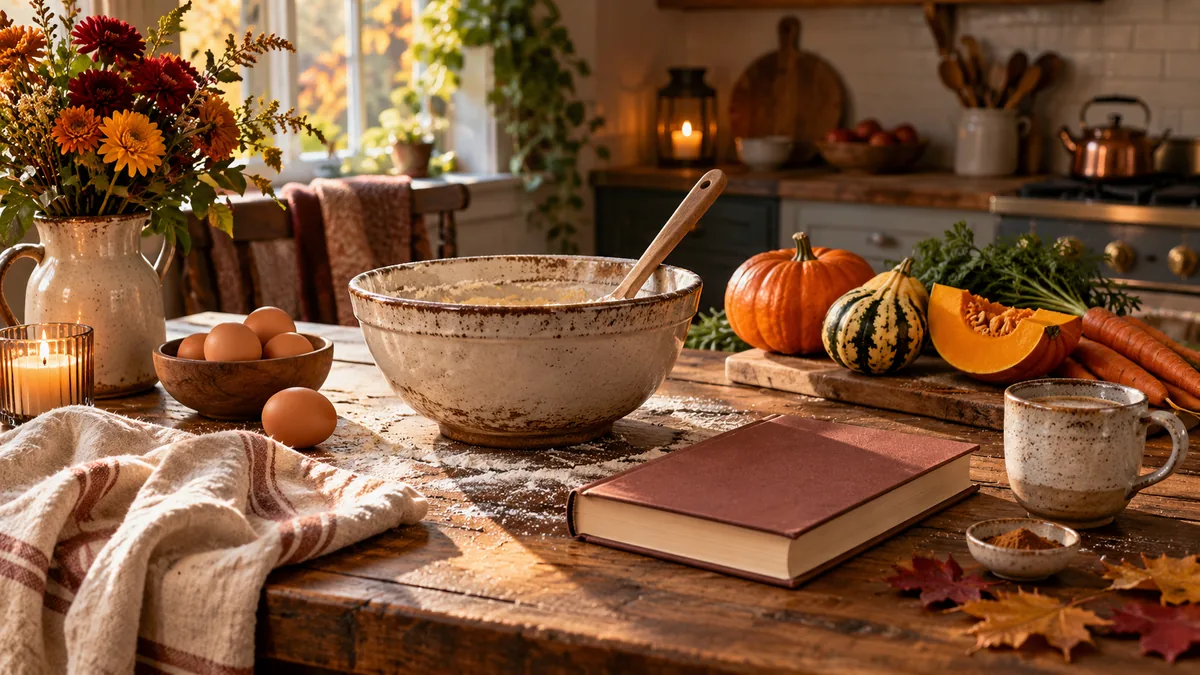
Food-centred romances use cooking, baking, brewing or herbal work as the engine of connection between characters. Unlike books where a meal simply happens, these stories let the labour of feeding others—or the conflict around it—shape how characters know and trust each other. This week, as many readers gather around tables or navigate the logistics of shared meals, a guide to choosing food-centred romance by what kind of kitchen and relationship you want to read about.
What makes a romance food-centred
A food-centred romance is not just a story where characters eat. It is one where the preparation, sharing or protection of food becomes a way characters express care, negotiate power, or discover each other’s values. A heroine who runs a bookstore might appear in a cosy mystery, but if cooking or baking is incidental window-dressing, the story is not primarily food-centred. If instead her daily work involves feeding a community, managing a kitchen garden, or teaching others to cook—or if a hero’s resistance to domesticity collides directly with her need to feed people—then food becomes structural to how the relationship builds.
The distinction matters because it changes what emotional work the story does. In a food-centred romance, a character’s approach to cooking often mirrors how they approach intimacy: whether they are controlling or collaborative, whether they hoard knowledge or share it, whether they cook to nourish or to dominate. A heroine who tends a still room full of medicinal and ceremonial herbs, as Maisie does in Secrets of the Still Room, is not simply decorating her life with plants. She is maintaining knowledge, preparing for seasonal rituals, and using her hands to contain grief through familiar work. When supernatural cold threatens that sanctuary, the threat is not abstract—it endangers the routines and recipes she has used to survive loss.
You’re on the list. Your free stories are waiting in the Reader Vault. The Taste of a Lie
Domestic kitchens versus professional spaces
Food-centred romances often pivot on whether cooking happens in a home, a business, or both. A domestic kitchen is intimate but private; a professional kitchen is public but governed by hierarchy and efficiency. These settings create different emotional stakes and reveal character through spatial choices.
In a domestic setting, cooking can be a love language. One character may cook for another as a way to say what they cannot speak aloud. The act of preparing someone’s preferred dish, remembering their allergies or tastes, showing up with food when they are ill or grieving—these are declarations without words. Disagreement over how to cook, what to cook, or who cooks can expose deeper conflicts about control, care and fairness. If a character resists entering the kitchen, or if one partner refuses to eat what the other prepares, that refusal carries emotional weight. A refusal to eat signals distrust, anger, or rejection; acceptance of food signals vulnerability and beginning trust.
In a professional kitchen—a restaurant, a catering business, a commercial bakery—cooking is labour with financial and reputational stakes. Two characters might clash over technique, cost or creative vision, with the business itself as the arena where their conflict plays out. Professional kitchens also have clear hierarchies: head chef, sous chef, line cook, apprentice. Romance set in this structure often explores whether two people at different ranks can build equal partnership, or whether the power imbalance of the workplace bleeds into their intimate relationship. The question of whether authority in the kitchen translates to authority in love becomes urgent when one character supervises the other by day and wants to share a bed by night.
Some food-centred romances move between both settings, revealing character through the contrast. A professional baker might cook differently at home than in the shop—more playfully, less precisely. A caterer might refuse to cook for family, protecting the boundary between paid work and intimate space. A character might use different techniques, different recipes, different energy in each kitchen. When Fixing Her Heart opens with Clara trying to rescue a stray dog outside her bookstore, the mess she and Wyatt create—muddy paw prints across his spotless garage floor—is a small collision between her compassionate chaos and his ordered precision. The dog becomes the reason they must negotiate, repeatedly, how two people with opposite approaches to care and control can share space. As they continue to encounter each other, their different temperaments around mess, planning and spontaneity become the real friction point. His need for order and her need for flexibility will eventually require translation; the dog is simply the beginning of learning each other’s language.
Labour and who does the work
One of the sharpest ways to choose a food-centred romance is by asking: who does the cooking, and is it seen as work or as pleasure?
If both characters cook, the story might explore whether they cook collaboratively or competitively. Do they share a kitchen easily, or does each have a domain? If one character cooks and the other does not, is the non-cooking character taking the cooking character for granted? Is cooking a source of resentment, or a gift neither party has named honestly? Does the cooking character expect gratitude, or do they cook in silence? Does the non-cooking character feel excluded from this intimate knowledge, or relieved of burden?
Food-centred romances sometimes centre on a character learning to cook, or learning to cook differently. This can be tender—one character teaching another as a way to deepen intimacy, with each small success building confidence and connection—or it can be fraught with power dynamics. Teaching can be generous or controlling. A character who insists on doing things their way, without accepting guidance, might be protecting independence or might be refusing to be vulnerable. A teacher who corrects every step might be ensuring safety and quality or might be using teaching as a way to maintain control. The emotional tenor of the teaching scene reveals much about whether this relationship can balance vulnerability with autonomy.
The question of who cleans up matters too, perhaps more than any other element. Cooking creates mess; who manages that labour shapes how characters feel about the work. A romantic scene of baking together means very little if one person ends the evening scrubbing while the other relaxes. Food-centred romances that take labour seriously acknowledge this imbalance and make characters negotiate it. They show characters choosing to share cleanup, or learning that one person always does it, or discovering that this is the place where resentment accumulates. When Clara and Wyatt navigate the stray dog and the spreading mud, the story is tracking not just attraction but whether they can divide practical work fairly. Each time they encounter the dog, they must renegotiate who cleans, who tolerates mess, who does the invisible work that keeps a space habitable. This is less romantic than a kiss, but it is more honest about what partnership requires.
Hospitality, generosity and boundaries
Food-centred romance often explores hospitality—the impulse to feed others, to welcome them, to create comfort through eating together. Hospitality can be generous and can also be a trap. A character who feeds everyone might be seeking approval, avoiding conflict, or genuinely delighting in nourishment. A character who refuses to cook for others might be protecting boundaries, hoarding resources, or expressing coldness. The story reveals which by showing the character’s internal experience, not just the external choice.
Some food-centred romances ask whether a character’s generosity is sustainable. Can someone feed others while starving themselves—financially, emotionally, spiritually? Can hospitality become a burden if the cooking character is doing the work alone? Can a family or community take advantage of someone’s impulse to nurture? These questions matter especially in small-town or family romance, where the cooking character might feel obligated to feed not just a love interest but an entire network of people with claims on their time and resources.
Other stories explore what it means to accept food from someone. Eating what another person has prepared is an act of trust. You are trusting their cleanliness, their intentions, their knowledge, their care. You are also acknowledging dependence—you cannot feed yourself in this moment, so you rely on another person. Some food-centred romances use this powerfully—a character might refuse to eat what a love interest prepares because they do not yet trust them, or they might be unable to eat because of anxiety or grief. They might eat as a sign that trust is beginning to build, or they might refuse a meal as a way of maintaining independence. The first time a resistant character accepts food from someone becomes a turning point. The first time a generous character allows someone else to cook for them becomes vulnerability.
Sensory atmosphere and comfort
Food-centred romances are often rich in sensory detail. The smell of bread baking, the sound of a knife against a cutting board, the warmth of a kitchen in winter, the taste of salt and fat and acid and heat—these details create atmosphere and emotional resonance. This sensory richness is one of the distinct pleasures of the subgenre. Readers choose food-centred romance partly because they want to inhabit a kitchen through prose, to experience the specific comfort of particular smells and textures.
Comfort is also texture and emotional safety. A character might seek out a particular kitchen because it feels safe, or might find that a kitchen they once loved now feels hostile or full of grief. The smell of a dish might bring back memory—of a parent who cooked it, of a time before loss, of a place left behind. A heroine who enters a professional kitchen for the first time might find it either thrilling or overwhelming; the sensory experience will shape whether she belongs there. A hero who avoids cooking might be avoiding the emotions attached to a kitchen from his past. A story might open with a character unable to enter a particular kitchen, or unable to cook a particular dish, because the sensory memories are too painful. Healing in food-centred romance sometimes means reclaiming that space—learning to cook in the kitchen again, or tasting the dish without drowning in grief.
Sensory detail also helps distinguish character and reveal values. One character might notice the temperature of a room, another the flavour balance of a dish, another the quality of light through a window. One character might remember a meal by the conversation that accompanied it; another by the precise taste of salt. What a character attends to reveals what they value and what they have learned to notice as survival or joy.
Rivalry, stakes and conflict
Food-centred romances can centre on professional or personal rivalry. Two bakers competing for the same market, two chefs fighting over a restaurant concept, two family members each convinced their recipe is the correct one—these conflicts are concrete and emotional at once. Rivalry over food is rarely only about food; it is about identity, legacy, survival, artistic vision.
Rivalry over food can be about ego, about proving their worth against someone they respect or envy. It can be about survival—the stakes are financial, and losing means hunger. It can be about family legacy and honouring someone who taught them to cook. It can be about artistic vision and the question of what food should be. The rivalry can be bitter or playful; the best food-centred romances make clear what the rivalry means to each character. Is it about money and basic security? About proving their worth to someone who doubted them? About honouring someone who taught them to cook? About artistic integrity against commercial pressure? About the right way to do something, when no single right way exists?
Some food-centred romances place food scarcity at the centre. If resources are limited, cooking becomes an act of allocation: who eats, how much, what quality. In scarcity, giving someone the better portion becomes sacrifice. Refusing someone food becomes cruelty or discipline. This can create tension, negotiation, or deep tenderness as characters share what little they have. A character who has known hunger will experience generosity differently than one who has not. A love interest who offers their own plate becomes someone worth knowing in a different way.
Paranormal, magical and fantastical food
Food-centred romance is not limited to contemporary realism. Paranormal and fantasy food-centred stories might feature magical ingredients, rituals around eating, or food with supernatural properties. Secrets of the Still Room opens with Maisie tending her still room—a space where she prepares herbs for Briarwood’s Wintertide Tea Fair, a seasonal village ritual that maintains protection and community connection. The cold that blackens the herbs is not a cooking accident; it is a breach of magical protection. Her work with herbs, her recipe ledger—which stops mid-word where her mother’s handwriting ends—and the seasonal rituals she maintains are all part of how a paranormal small-town community functions. The still room is not simply a place where she works; it is where she processes grief and keeps her mother present through inherited knowledge. Food-centred paranormal romance might explore how characters use cooking or brewing to protect, to heal, to communicate with non-human beings, or to maintain the boundaries between worlds. It might ask whether a character can cook when the familiar protections fail, or whether learning to cook differently might restore what has been lost.
Fantasy food-centred romance can centre on feasts, on ceremonial meals, on food as covenant or as rebellion. A character might cook to remember a lost homeland, or to build community in exile. Food becomes a way to resist occupation, to mourn displacement, or to imagine differently. A fantasy kitchen might include ingredients that do not exist in the real world, or might require magic to prepare. The labour of cooking might itself be magical. Character connection might deepen through teaching another person to cook without industrial tools, or through learning the recipes that survived a war, or through understanding that feeding someone in a dangerous place is an act of rebellion.
Cowboy ranches and small-town meals
Small-town and cowboy romance often includes food-centred elements, though not always as the primary focus. A ranch meal prepared for workers, a potluck that brings the community together, a heroine who cooks for a household or for pay—these appear across the subgenre. Intoxicating Touch centres on Regina arriving at a Montana ranch she must inhabit for thirty days, with the inheritance requiring residency before she can sell. The ranch is labour-intensive; feeding workers becomes part of understanding what the land requires and what her obligations are. Dusthallow Days involves a homecoming where wedding preparations and practical care intersect, with Wren navigating not just her feelings for Colt but whether she can be useful without losing independence or dignity. Crosswind Cowboy opens with survival and rescue rather than cooking, though small-town life often includes the social meals that bind communities and signal belonging.
When food-centred elements appear in cowboy or small-town romance, they often tie to labour, to land, or to the informal networks that hold communities together. Who cooks for the ranch hands, for the crew, for the family? What does that person know about everyone else through the work of feeding them? How does the work of feeding others shape power and connection in a small place? A character who cooks for a working ranch knows details about people’s preferences, their injuries, their moods. That knowledge can be intimate or it can be burdensome. It can build connection or it can trap someone in caretaking that they did not choose.
Choosing by emotional resonance
To choose a food-centred romance, begin by asking what kind of kitchen and what kind of work appeals to you. Do you want to read about a character learning to cook for the first time, discovering confidence through food? Or do you want a character already skilled, perhaps needing to learn collaboration instead? Do you want professional kitchen hierarchy, domestic intimacy, or something between? Do you want the story to celebrate hospitality and generosity, to question it, or to show it as complicated and sometimes costly?
Consider whether you want sensory richness and comfort, or whether you want conflict and high stakes. Consider whether you want paranormal or magical elements, or contemporary realism. Consider whether food is a love language in the story—the way characters express what they cannot say—or whether it is labour that must be fairly shared, or whether it is tradition and ritual that holds a community, or whether it is scarcity and need that creates intimacy through sacrifice.
Consider too whether you want Slow burn vs low spice: choose the tension you want to help you choose between slow-burn tension and low-spice comfort, since food-centred romance often pairs with either slow build or domestic warmth. And if you are uncertain about whether a food-centred romance will end the way you want it to, HEA vs HFN: what a romance ending promises can help you understand what HEA and HFN promise.
Where to start
Food-centred romance ranges widely. If you want paranormal elements with herbal magic and village ritual, Secrets of the Still Room opens with a still room and its protective routines threatened by supernatural cold. Maisie’s work with herbs and her grief-stricken recipe ledger offer both comfort in familiar routine and unease as protection fails. The story promises readers interested in how characters use food work to process loss and maintain community. If you want small-town contemporary romance where practical care and emotional vulnerability intersect, Fixing Her Heart pairs a bookstore heroine with a meticulous mechanic, with a stray dog as the reason they must negotiate how two different temperaments share space and divide labour. Their ongoing collision teaches both characters what it means to make room for someone else’s way of doing things. If you want cowboy ranch romance where inheritance and obligation reshape a character’s life, Intoxicating Touch places a city heroine on a working ranch under a thirty-day residency requirement, creating both practical stakes—she must feed herself and potentially others—and emotional stakes as she confronts what land and labour mean.
Choose what kind of kitchen calls to you, what kind of labour and care you want to witness, and what kind of connection food can build between characters. Food-centred romance lets you watch people nourish each other, resist each other, learn each other through the most intimate work of daily life. It shows you characters’ values not through what they say but through what they cook, who they feed, and what they are willing to do to keep others safe and full.