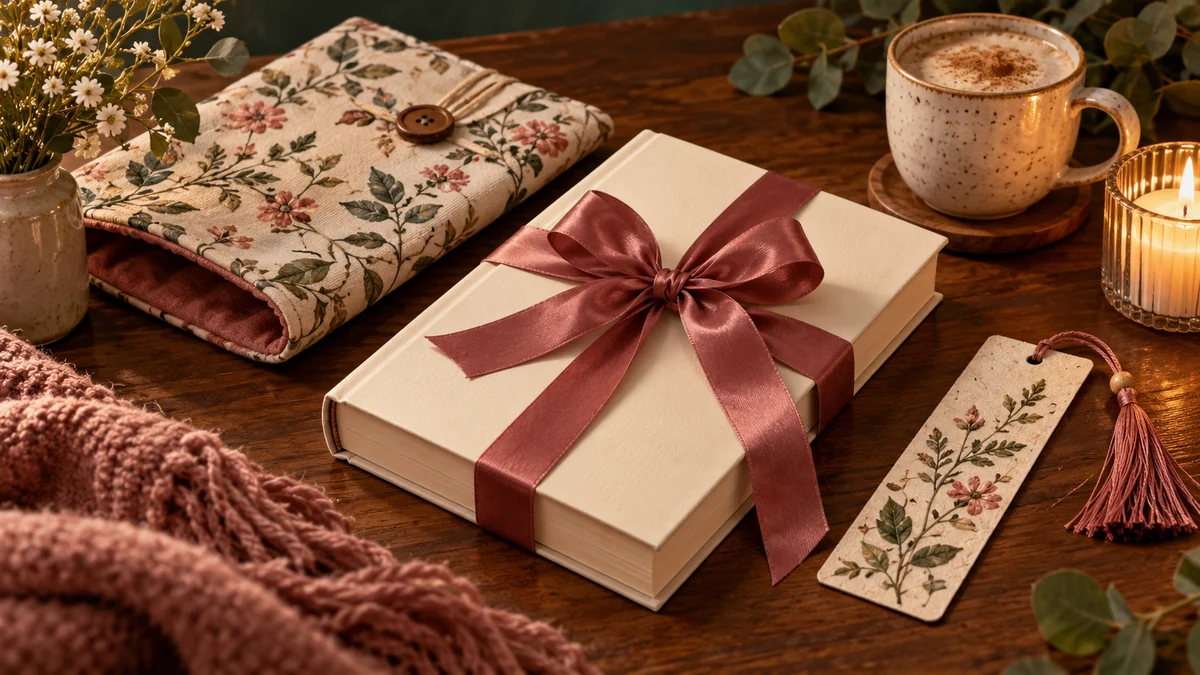
With late November here, gift planning for the romance reader in your life has likely begun. In the Northern Hemisphere, early winter is settling in and reading chairs are being pulled closer to lamps; in the Southern Hemisphere, early summer invites long afternoons on porches and shaded balconies. Either way, the easiest impulse is to buy another novel. If the person you have in mind already receives books regularly, or if you want to honor their reading life in a different way, thoughtful alternatives exist. The best bookish gifts acknowledge how readers actually spend their time: the physical habits around reading, the spaces where they settle in, the ways they organize their collections, and the experiences they share with other readers. These gifts work because they remove friction from reading life or make the ritual itself more enjoyable, rather than adding to a pile that may already feel overwhelming.
This article offers practical categories to consider, questions you can ask without ruining a surprise, and homemade options for anyone whose budget is tight this year. Throughout, we will return to a simple principle: the best gift matches how the person actually reads, not how you imagine a romance reader should read.
Start by observing their reading setup
Before choosing anything, spend a little time noticing where and how this person reads. Do they curl up in a single favorite chair, or do they migrate between the couch, the bed, the kitchen table, and the bathtub? Are their books stacked on surfaces, shelved carefully, or stored in bags and boxes between library trips? Do they read primarily at night, early morning, or during short breaks in the workday? Do they take books on trips, or read only at home? Do they read one at a time or juggle several in different rooms? The answers to these questions guide meaningful gifts far better than genre preferences do.
Someone who reads in bed might treasure a reading pillow that supports their neck and arms without requiring constant adjustment. A person who reads on their commute might love a lightweight book sleeve or small bag that protects pages from coffee spills, rain, and transit wear. If your reader annotates — marking passages, writing questions in margins, starring favorite lines, flagging quotes they want to copy out later — quality pencils, erasable pens, highlighters that will not bleed through paper, or sticky tabs designed for close reading make annotation easier and more enjoyable. These are not frivolous upgrades; they change the physical experience of engaging with a story, and they often outlast dozens of books.
If you want context for the kinds of pacing and tension your reader may be chasing, our note on Slow burn vs low spice: choose the tension you want can help you talk about what they currently enjoy without having to ask directly which titles they want next.
You’re on the list. Your free stories are waiting in the Reader Vault. The Taste of a Lie
Lighting matters more than most readers expect
Inadequate lighting strains eyes and shortens reading sessions. If your reader sits under poor natural light or relies on overhead fixtures that cast shadows across the page, a focused reading light transforms their practice. Clip-on book lights work for those who travel or read in different rooms. Adjustable desk and floor lamps suit readers with a fixed spot. Warm-toned bulbs are generally more comfortable in the evenings than cool white light, especially when many readers settle in with a story before sleep. This is a practical gift that your recipient will use every single time they open a book.
Some readers prefer e-readers or audiobooks, and their accessory needs differ — but a book light designed for e-reader screens, a stand that props a tablet at a comfortable angle, or a pair of comfortable earbuds for audiobook listening address the same principle: removing discomfort from the reading experience. If you know someone who alternates between formats, a reading light or accessory that works across their preferred methods is especially thoughtful. A small USB-rechargeable light, for example, serves equally well for a paperback on a plane and an e-reader in a dark bedroom.
Consider also the time of year. A reader in the Northern Hemisphere right now is reading through long evenings and short days; a reader in the Southern Hemisphere is more likely to be reading outdoors in bright sun, where glare on an e-reader can be a frustration. Matching the lighting gift to the actual conditions your reader faces, rather than to a stock image of a cozy winter chair, makes the present more useful.
Ask strategically without spoiling the surprise
The best way to choose a meaningful gift is often to ask directly, but framed to avoid spoiling the surprise. Instead of asking what book they want, ask how they organize their collection, what their current reading space lacks, or what small frustration interrupts their reading time. You might ask whether they prefer hardcover or paperback, which can hint at future book choices while addressing a physical preference. Ask about their environment: “Does your reading chair have good light?” or “Where do you usually keep books you are actively reading?” or “Do you like reading in bed, or does it hurt your neck?” These questions gather genuine information without naming a specific title.
If your reader keeps a public reading list, a wish list on a bookstore site, or a stack of borrowed books from the library, they have already done some of the preference work for you. But this information serves better when paired with observation of their actual habits. Someone who added a book to their list three months ago might genuinely still want it, or they might have moved on to something else entirely. Asking “I saw you added this a while ago — is it still something you want, or have you cooled on it?” is both considerate and practical. It also signals that you were paying attention, which is often the real gift.
If you want a shared vocabulary for what they are reading, our overview of HEA vs HFN: what a romance ending promises gives you language to ask whether they prefer a definitive happy ending or an open-ended, hopeful one. That single question can tell you a great deal about what kinds of accompanying gifts — a tissue-box cover, a celebratory candle, a journal for processing a finale — might land well.
Storage and organization ease the reading life
Many romance readers accumulate books faster than they can shelve them. Decorative baskets, wooden crates, or fabric storage boxes sized for paperbacks or hardcovers give books a temporary home while new shelving is considered. These are not permanent solutions, but they signal respect for the collection and reduce the visual stress of books stacked on every surface. If your reader has mentioned outgrowing their current shelves, a contribution toward new shelving might be welcome — though this works best if you discuss it directly, since people have strong opinions about the style, size, and material of furniture that will live with them for years.
For those who prefer to keep books organized by color, completion status, series order, or favorite-to-reread, bookends, slim shelf dividers, or label systems help maintain the structures that matter to them. Some readers love keeping a reading journal; a beautiful notebook or a structured reading-log template — whether digital or paper — lets them track what they have read, rate their favorites, and revisit their impressions later. These tools celebrate reading as an active practice, not just consumption. A reader who tracks tropes, heat levels, or emotional beats will appreciate a journal with enough space to record more than just a title and a star rating.
If your reader has a to-be-read pile that has grown into a to-be-read tower, a small side table or shelf dedicated to current-rotation books, rather than long-term storage, can feel like a gift of permission: it is acceptable to have an in-progress stack, and here is a dignified place for it to live.
Portable reading gains value for active readers
If your reader carries books between home, work, a partner’s house, or travel destinations, a book sleeve or carryall protects pages and spines. Fabric sleeves in natural linen, canvas, or quilted cotton work for single books or small stacks. Some designs include pockets for bookmarks, pens, or glasses. For readers who take books on overnight trips, a simple drawstring bag keeps a few novels together and organized in luggage. None of these are expensive, but they prevent dog-eared corners and water damage that can ruin a beloved copy. For a reader who dreads the moment a hardcover slips out of a tote bag onto wet pavement, a well-made sleeve is a small daily reassurance.
For those who read across multiple locations, a bookmark that doubles as a page holder keeps your place without bending the spine. Magnetic bookmarks close gently and work with any book. Thin, flat markers slip into a bag or wallet without snagging. Beaded or ribbon bookmarks add a small aesthetic pleasure each time the reader picks up their current story. These are modest gifts individually, but a set of three or four handmade or artisan bookmarks — perhaps in colors or patterns chosen to match your reader’s taste — shows thought and care.
If your reader travels for the holidays, a small zippered pouch sized for an e-reader, a charging cable, and a pair of earbuds turns a chaotic bag into an organized reading kit. The same principle applies to a daily commute: anything that reduces the small frictions of pulling a book out and putting it away encourages more reading in the margins of a busy day.
Comfort layers make reading time feel like refuge
Reading is often a form of escape and rest. Gifts that enhance the physical comfort of reading time honor this. A soft, washable throw blanket for curling up, a set of cozy socks (especially ones with book-themed patterns), or a heated lap pad for cool rooms all remove small discomforts. A candle in a scent your reader enjoys — unscented if they are sensitive to fragrance, or a simple soy candle if they prefer something mild — creates an ambient ritual around reading time. A mug or insulated water bottle they can keep nearby hydrates them without interrupting their flow.
Some readers love having snacks within arm’s reach while reading; a small tray, caddy, or basket that holds coffee, tea, water, and a light snack keeps their hands free and their focus on the page. If your reader has mentioned specific sensory preferences — always needing background music, preferring silence, preferring white noise, needing cooler air to concentrate — a small speaker, soft earplugs, a white-noise machine, or even a quiet desk fan addresses a real need rather than guessing.
For readers in the Southern Hemisphere entering summer, comfort may look like a light cotton throw rather than a heavy blanket, a chilled water bottle rather than a heated lap pad, and a sunshade or wide-brimmed hat for outdoor reading. The underlying question is the same in both hemispheres: what small physical irritation currently cuts a reading session short, and can a gift remove it?
Accessible formats expand reading possibility
Not all readers can use standard print books comfortably. Large-print editions, e-readers with adjustable text size and contrast, or audiobook subscriptions through a library or a general subscription service might open reading to someone who has struggled with smaller text, hand pain, or long reading sessions. If you know someone who enjoys romance but has visual, cognitive, or physical accessibility needs, asking directly about their preferred format — without assumption about why they might prefer it — is both respectful and practical.
A contribution toward an audiobook subscription of their choice, a large-print copy of a title they have mentioned, or an e-reader with accessibility features are genuine gifts, not compromises. Likewise, a book stand that holds a hardcover open on a table lets a reader with wrist or shoulder pain enjoy long sessions without strain. A pair of reading glasses in the correct strength, chosen with their input, can be more transformative than any novel. Framing these as thoughtful accessibility gifts, rather than as consolation prizes for “not being able to read normally,” matters: there is no normal way to read, only the way that works for the reader in front of you.
Shared experiences create connection
Some of the most meaningful bookish gifts are not physical objects but experiences. Offering to join a local book club (even if just for one meeting), attending a book-signing event together when the opportunity arises, or starting a two-person book club where you and your reader discuss the same story gives you both the same starting point for conversation. Romance reading can be solitary, but it often craves community — a space to discuss why a particular character’s choice felt satisfying, whether a plot twist worked, or what theme stayed with you after finishing.
If your reader has mentioned a favorite author, a signup to that author’s newsletter (free in most cases), a pre-order of an upcoming release that you cover or split, or a small print or bookmark from an artist inspired by a beloved book connects them to the writer’s work in a new way. For someone who loves a particular trope or setting — a snowbound inn, a cathedral at midnight, a bustling coffee shop at dawn — a mug, candle, or small print that evokes that world can celebrate their passion without pretending to predict their next read.
For holiday romance fans specifically, our discussion of Holiday romance vs winter romance: choose the event or the atmosphere can help you decide whether to lean into festive, December-set stories or toward quieter, winter-atmosphere reads when planning a shared experience. And for anyone whose reader loves luxury-tinged holiday romance, Holiday billionaire romance: time together beyond extravagant gifts suggests how emotional presence, rather than extravagance, makes a holiday story land — a useful principle for gift-giving as well.
Homemade alternatives carry personal weight
You do not need to spend money to give a meaningful bookish gift. A handmade bookmark using cardstock, pressed flowers, or fabric ribbon shows effort and thought. A playlist of songs that match a favorite book’s mood, or a handwritten list of book recommendations with a sentence or two on why you think your reader will love each, costs nothing but feels personalized. A letter describing which of your reader’s favorite books has stayed with you and why, or how their reading passion has influenced you, transforms a small piece of paper into something irreplaceable.
If you sew or have access to sewing, a fabric book sleeve in your reader’s favorite color or a pattern that matches their aesthetic is both practical and treasured. A hand-decorated bookmark, a gift box filled with tea bags and a note suggesting a cozy afternoon pairing, or a coupon for “one book of your choice, on me, next time we are at a bookstore together” all offer thoughtfulness without high cost. The romance reading community often treasures handmade gifts because they prove someone paid attention — not to buying power, but to actual preferences and habits.
Other low-cost options include a reading-time coupon (“I will take the kids for two hours on a Saturday so you can finish your book”), a printed and bound list of your reader’s own favorite quotes gathered from their social posts or conversations, or a small zine you make yourself describing books you think they would love. These gifts are impossible to buy and difficult to forget.
Pairing a gift with a specific book your reader already owns
If you know your reader is currently working through, or about to start, a specific title, you can tailor accompanying gifts to the book’s mood. For example, a reader settling into Five Christmases Later — a Christmas story in which an art restorer loses her gallery job on December 23 and dreads facing her family’s holiday gathering — might appreciate a warm throw, a small notebook for jotting down favorite lines about craft and integrity, and a candle in a wintry scent. The gift becomes part of the atmosphere the book is building.
A reader diving into Steamy Negotiations, which opens with a barista calculating rent and culinary school debt while a rude customer named Del tries to skip the line at a Chicago coffee shop, might enjoy a quality travel mug, a bag of specialty coffee or hot chocolate, and a small notebook for keeping track of banter they want to reread. The gift honors the book’s workplace and class-friction setting without spoiling anything that happens later.
For someone starting Corrupting the Novice, a forbidden love dark romance that follows a novice sent after curfew into the lower reserves of a priory in the Adirondacks, a reading gift might lean toward atmosphere: a small reading light for shadowy rooms, a soft shawl, and a bookmark in a muted color. The book’s mood is tense and interior; the accompanying gift can respect that rather than imposing festive cheer.
A reader who has chosen My Christmas Pretender — in which an actress working as a standardized patient at a teaching hospital tries to save her late father’s theater from foreclosure — might appreciate a notebook for jotting down the kinds of scenes she herself might stage, a theatrical bookmark, and a mug they can keep beside their reading chair during a long holiday weekend. In each case, the gift takes its cue from what we already know about the opening of the book, rather than from assumptions about where the story will end up.
Avoiding assumptions that miss the mark
Heat level is personal and not always visible from outside reading choices. Never assume a specific spice preference and buy something framed around it, as this can feel intrusive and might not match what your reader actually enjoys. Similarly, some readers love dark themes and morally complex characters while others prefer lighter stories; neither preference is more valid, and guessing wrong can result in an uncomfortable gift. Budget assumptions also backfire — giving an unexpectedly expensive gift to someone who prefers simplicity, or a very modest gift to someone whose spending you quietly judge, can both feel off-target in ways that are hard to recover from.
Avoid making assumptions about what a person “should” read based on their gender, age, profession, or relationship status. The romance reader in your life knows their own taste better than anyone else. The most gracious approach is to ask, observe, and then choose something that removes friction from their reading life rather than gambling on your prediction of their preferences. If you are uncertain, lean toward neutral comfort gifts — a plain fabric sleeve, a well-made bookmark, a soft blanket in a color they already wear — rather than items branded with slogans or imagery that assume a particular identity around their reading.
It is also worth remembering that romance readers are frequently stereotyped from outside the genre. A gift that gently mocks what someone reads, even in a tone meant to be affectionate, often lands poorly. Treat the gift as you would treat any other hobby: with straightforward respect for the hours and care your reader has invested in it.
Practical steps for late-November and December gift-giving
If you have narrowed your choice, act soon. Handmade items and custom personalization take time; ordering or making them in late November helps ensure arrival by mid-December. Small independent makers often create bookish gifts — bookmarks, sleeves, personalized notebooks — and their shipping windows close earlier than those of large retailers. If you decide on a gift card to a bookstore or audiobook service, pair it with a handwritten note explaining why you chose it: “I know you love browsing, so here is some help finding your own treasures” feels more thoughtful than the card alone.
Consider combining gifts: a reading light with a pair of cozy socks, a book sleeve with a handmade bookmark, a blanket with a mug and a note suggesting a quiet afternoon together. Small combinations create the impression of thought and care without requiring a large budget. If your reader has mentioned a specific book they want, you might pair it with something that enhances the reading experience — a beautiful bookmark if it is a literary favorite they want to savor, or a cozy blanket if they have described wanting to settle in for a long series.
Finally, give yourself permission to keep the gift modest. Readers are, by nature, people who find deep pleasure in small things: a quiet hour, a fresh page, a well-chosen sentence. A gift that respects that scale — a single thoughtful object, a handwritten note, a shared promise of time together — often lands harder than a large, expensive gesture. The goal is not to spend the most or to guess the most obscure preference, but to show that you have been paying attention to how someone you care about spends their time. Romance readers invest emotion and hours in stories; a gift that honors that investment — whether it makes reading more comfortable, more organized, more connected, or more joyful — will be remembered long after the wrapping paper has been cleared away.