A Bratva romance with a curvy craftswoman offers a particular pleasure when the heroine’s work changes what she knows, what she can refuse and where the story goes. Her body is part of the attraction, but her professional life gives that attraction a setting and a cost. If you want more than a powerful man admiring a woman he intends to protect, look at the first problem she has to interpret. Does her skill uncover the danger, or could her occupation disappear without changing the opening?
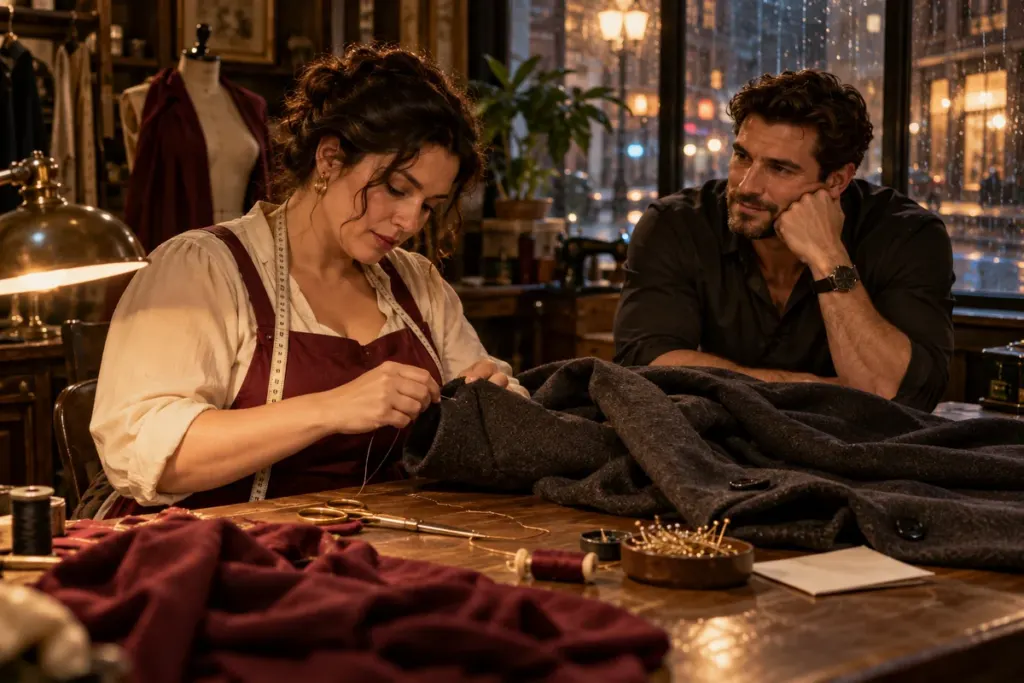
In A Seam for the Wolf, Mara Vale is paid to mend a torn coat. Opening a seam exposes a bloodstained receipt bearing her aunt’s business name. The stranger who then appears at her door, Ilya Sokol, knows something about the people behind the paper. He is a criminal courier, not an all-powerful boss stepping in to solve a stranger’s life. This adult M/F story begins with Mara’s needle, her family knowledge and her choice of where to seek witnesses. Those are good reasons to consider it if you want a heroine-led route into dangerous attraction.
A repair reveals what the coat concealed
The opening of A Seam for the Wolf makes mending an active source of information. Mara has a legitimate reason to open the lining. She does not search a stranger’s belongings because the plot needs a clue, and she does not need a sudden unexplained talent for investigation. The paper catches against her needle while she does the work she was hired to perform. A familiar task produces an unfamiliar responsibility.
That detail changes the reader’s relationship to the clue. We understand why she sees it and why she cannot treat it as an interesting scrap. The receipt says her aunt’s business has received forty-eight hundred dollars. Mara also knows that Aunt Vera has been trying to borrow a smaller sum for a water heater. Neither observation alone explains the whole racket. Together, they make the paper difficult to dismiss. The tension begins in the space between a tidy written claim and a life Mara actually knows.
For readers who enjoy skilled heroines, this is a useful alternative to the fantasy of instant mastery. Mara can read a seam and recognize a false-looking account of her family’s circumstances. She cannot untangle every person behind the document by looking at it. Her expertise gets her into the problem without eliminating uncertainty. The story can therefore keep both the satisfaction of competence and the discomfort of needing information from someone whose occupation makes him difficult to trust.
There is a second kind of labor in the opening: the work of tolerating a customer because rent still has to be paid. Dane’s earlier response to Mara’s price involves looking at her body instead of taking her terms seriously. She does not need a lecture about self-esteem for the scene to have meaning. The exchange puts professional authority and unwanted appraisal in the same room. A reader can immediately understand why being treated as a worker with terms of her own will matter.
You’re on the list. Your free stories are waiting in the Reader Vault. A Seam for the Wolf
Curvy is a description, not the entire emotional plot
A curvy heroine can be witty, financially pressed, suspicious, attracted, irritated and very good at her trade. None of those qualities has to serve as an explanation for her body. In this opening Mara’s physical presence belongs to the scene: reaching to turn the shop sign, placing herself in front of the coat and noticing the way a customer has looked at her. She has a body while she works and thinks. The story does not introduce her only as an object awaiting a hero’s approval.
That is a useful reading preference to name. You might want a heroine who already knows what she can do, even when she dislikes how a customer treats her. You might want sensual attraction without a makeover sequence. Or you might want her humor to come from the pressure of her job rather than a series of jokes against herself. These are different wishes, and the label curvy alone cannot guarantee all of them. An opening can show you which version is actually on the page.
Notice, too, the difference between noticing desire and accepting somebody’s judgment. Mara finds room for attraction while already having reasons to distrust Ilya. The feeling irritates her because the cost arrives before the romance has a chance to look simple. This gives her a position from which to question him. She is not unaware of his appearance, and she is not obligated to decide that handsome means helpful. The coexistence of those responses can make a dangerous romance feel adult without requiring graphic description.
Readers looking specifically for a full story about body-image change should keep that preference separate. The story’s premise centers a curvy mender, a courier, family pressure and chosen trust. It does not promise a weight-loss plot, a named diagnosis, a universal experience of discrimination or a particular history of romantic rejection. Her body is neither a problem the hero must cure nor evidence of every representation feature a reader may want.
A courier occupies a different place from a kingpin
Ilya enters without the claim ticket for the coat. Mara asks for one anyway. The exchange is appealing because his physical presence does not make her working procedure vanish. He has come with knowledge and urgency; she has a shop, a customer’s garment and grounds for asking questions. Their encounter contains unequal dangers, but it is not written as if he possesses every form of authority in the room. A small refusal becomes part of their first conversation.
His role is important to the kind of Bratva story being offered. A courier or occasional debt collector can know how money moves while remaining entangled in someone else’s decisions. He may carry obligations rather than simply impose them. The opening identifies Ilya’s work through his own account, including the admission that he still does things he is not proud of. It gives Mara no easy way to make him harmless merely by catching him in a polite lie.
This can suit readers who want the dangerous hero’s work to remain a problem instead of a decorative source of wealth. The description promises that protection must become partnership over eight dangerous days in Chicago. That does not mean attraction excuses the collection racket, or that an early admission supplies complete accountability. It describes the pressure the relationship will have to address. The reader can be interested in Ilya precisely because the story allows Mara to keep noticing what his work costs other people.
The broader guide to names, rank and story choices in Bratva romance helps distinguish fictional roles without assuming the label always supplies the same hierarchy. For this story, the concrete distinction is courier rather than boss. You do not need to import a real organization’s structure or assume every criminal-romance novel uses identical titles. Follow the obligations the fictional opening actually establishes.
Follow the receipt through a family, not just a mystery
The receipt matters because Vera is already present in Mara’s ordinary thinking. The aunt who has failed to obtain a loan still offers to buy things for her niece. That small contradiction makes their connection specific before a threat is spoken aloud. It also means Mara has a reason to care that does not depend on knowing the document’s full significance. A name on paper can become suspenseful when the reader has been shown why the person behind the name matters.
When Vera calls, the story brings the dispute out of the shop’s private space. Dane is asking about his coat elsewhere, and Mara has to answer while Ilya is watching. The scene does not wait for a full explanation before requiring a decision. Mara names The Velvet Atelier as a destination where she can seek witnesses, drawing on an earlier paid working connection. Her professional relationships become part of her available world. They are not discarded as soon as a dangerous man offers company.
This is where the craftswoman angle becomes different from a general protector story. The heroine has customers, prior work and reasons to know which promises people have kept. The detail that someone paid on time can matter to her assessment of whom to approach. A glamorous venue need not be attractive simply because it is glamorous. It can matter because she has done work there and can ask for a favor with that history behind her.
The document itself also retains limits. An alarming receipt is not an automatic explanation of every payment or every person involved. Ilya names a café owner Mara recognizes, which makes part of his account more concrete without proving all of it. The reader is invited to weigh connections as they arrive. If you enjoy the tension of information moving between people who cannot comfortably trust one another, this kind of opening may be more satisfying than a revelation delivered by an infallible hero.
Shelter, attraction and partnership have different jobs
A protective offer can move a scene forward without completing the romance. Ilya suggests somewhere with witnesses. Mara has already named such a place. When he offers a way to accompany her, she asks what happens if she does not want it. His answer matters because it gives her question an actual consequence. The encounter can contain a potential refuge while leaving her able to disagree about the route into it.
As a reading experience, this creates a useful separation between feeling less alone and deciding to become intimate. A heroine can welcome relevant help and remain angry about the helper’s associations. She can want to kiss him while needing a better explanation. Those combinations do not have to be corrected immediately. They can sustain the story’s tension because each feeling responds to a different part of what she knows.
Partnership asks for something more specific than a declaration that a man will keep a woman safe. It suggests that her information changes the plan and that her priorities remain visible after she accepts company. The premise of A Seam for the Wolf puts that development at the center of its eight-day span. You can look for its beginnings in who names the next location, who keeps hold of the conversation and who is permitted to admit ignorance. These are reading observations, not a real-world strategy for handling threats.
For a useful comparison, the neighboring article on expertise in an art-restorer mafia romance follows a different trade and a separate Piraeus story. Its conservator’s name has been attached to an inspection she did not perform. The shared appeal is professional knowledge that makes a false account visible. The characters, place and criminal connections differ; it is not another case for Mara and Ilya.
Choose this reading mood without guessing the heat
Dark criminal settings and explicit sexual description are separate choices. The intimacy description for this prequel is sensual kisses and closed-door intimacy without graphic sexual detail. That is the useful promise to carry into the opening. Descriptions of other books may use different heat scales, and the word Bratva cannot supply missing information about a particular story. Readers who want explicit scenes or a completely nonsexual narrative should compare those requirements with the actual content description.
The danger still has weight at this heat level. A bloodstained paper, a family-linked collection problem and a hero who admits criminal involvement can produce an intense read without on-page sex. Closed-door does not mean that every other part of the story is gentle. Equally, a curvy heroine and a powerful-looking man do not require a particular kink or an automatic possession narrative. The opening’s mixture is professional friction, defensive humor and attraction that has inconvenient company.
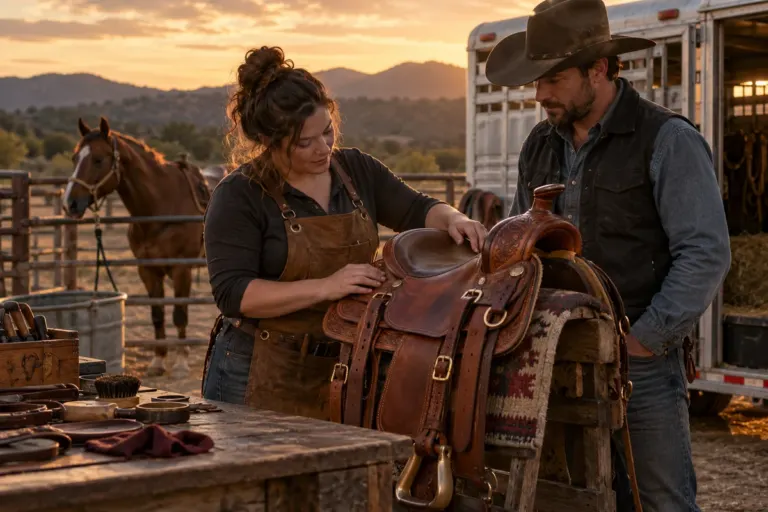
If you want the craftswoman and curvy-heroine elements in a different setting, the guide to a curvy saddlemaker and a quiet cowboy on the road offers an alternative. Its missing horse and stolen patterns belong to a Western romantic-suspense premise. That is a change of world and hero role, not a softer episode in a common Bratva series. Choosing a similarity is more useful when you also know what changes.
Is this a marriage bargain or a why-choose story?
No. The central relationship is an original adult M/F couple, and the opening does not require a wedding agreement to put them together. The bargain concerns help, information and dangerous associations. Readers who specifically want arranged marriage, several romantic partners or a heroine becoming a crime boss should not infer those features from the collection name. Here, the useful expectation is a mender and a courier learning whether protection can become a chosen partnership.
Do I need the paid novel first?
The prequel is presented as an independent story one year before The Bratva’s Velvet Bride, its exact related paid book. Olivia Adkins and The Velvet Atelier provide a bounded source connection, while Mara and Ilya have their own relationship. The collection is thematic; it does not establish common romantic continuity among every listed title. You can use the prequel’s premise to make a reading decision without learning the later book’s turns or outcome.
For another mood, the free-story hub provides broader browsing. Explore A Seam for the Wolf if you want the heroine’s trade to remain part of the action after attraction begins. Read the opening free in your browser, then confirm your email to continue reading. Begin with the coat: a seam that should close a customer’s problem instead opens Mara’s, and the man at her door has to meet someone who knows the difference.