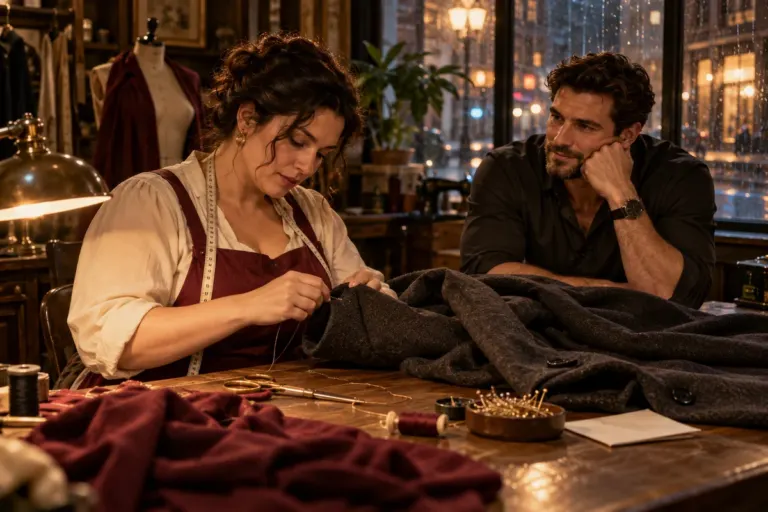
Art-restorer mafia romance is most distinctive when the criminal interest reaches beyond owning a beautiful object. A heroine may be threatened because somebody wants the authority attached to her work: her name on a record, her judgment about a damaged piece, or her silence about a discrepancy. Choose that version when you want professional expertise to create the danger as well as help the heroine understand it.
In Alisson Bento’s The Harbor Before Dawn, paper conservator Mara Vrettou finds her business stamp on an inspection she never performed. The man who comes to assess a damaged shipment, independent cargo surveyor Andreas Rallis, has a connection to the client and a debt of his own. Their adult M/F romance offers close physical care and kisses, with no graphic sexual detail or on-page sex. The reading attraction is an uneasy alliance in which being useful to each other does not settle whom either person can trust.
The copied stamp creates danger before the stranger arrives
Mara is already looking closely when Andreas enters the story. A packing certificate bears an impression matching her stamp, including a small break caused when she once dropped it. The imperfection makes the copied authority personal. She is not simply told that a document exists somewhere with her name on it; she recognizes the mark through a history attached to an object in her own working life.
The claimed inspection date also matters. Mara remembers being elsewhere, working on a wedding veil at her mother’s repair shop, with photographs of that afternoon. The opening gives the reader a specific contradiction instead of a general atmosphere of shady dealings. Someone has used the appearance of professional completion where Mara knows no such completion took place.
This is a different entry into danger from being captured first and later discovering that the captor needs an artist. Mara’s independent work is visible before the threatening arrangement develops. Her magnifying lamp, business address and decision to question the certificate establish what somebody else is trying to borrow. The reader has a reason to care about her professional name before the romantic lead reacts to it.
The opening of The Harbor Before Dawn is a useful sample for this preference. Follow the difference between what the certificate claims and what Mara says she actually did. If that gap makes you want the next conversation, your interest may lie in contested judgment rather than the glamour of the art world alone.
You’re on the list. Your free stories are waiting in the Reader Vault. The Harbor Before Dawn
Separate the object, its condition and the story told about it
A damaged object and an inaccurate account of it create different questions. What happened to the panel? Why does the paperwork describe it differently? Who benefits from having Mara’s name attached? The opening can raise all three without supplying one explanation that answers everything. That separation gives professional observation room to matter.
The crate arrives with water damage. Mara has accepted it for a condition assessment. The accompanying certificate nevertheless claims an earlier completed inspection. Petros Danos describes the discrepancy as a clerical shortcut, but Mara points out that the document is marked completed. The disagreement concerns the meaning of a concrete word, not simply whether she likes his tone.
Notice how this changes the suspense. A client asking for an unusually fast job could be demanding without necessarily misrepresenting work already done. A document that claims a finished assessment attempts to move the story ahead without the professional’s participation. The heroine must confront not only a request but a version of her own conduct that somebody else has placed in circulation.
You do not need technical knowledge of conservation to enjoy that problem. The scene gives you enough to understand why Mara objects. Nor does the fiction need to become a guide to identifying forgery or handling disputed shipments. The pleasure is following a character whose habits of attention reveal a mismatch that powerful people would prefer to call unimportant.
A delivery receipt is not the same narrative object as an inspection
Mara has signed for the delivery. That fact troubles her because the receipt sits in the same folder as the false certificate. The opening carefully keeps the acts separate: receiving a crate is one event, inspecting and approving its condition is another. The physical closeness of the documents creates pressure without making them identical.
For a reader who enjoys paperwork suspense, that distinction is valuable. A signature can be frightening because of what someone wants it to mean, even when the signer understands what she agreed to do. The drama then concerns who gets to tell the story of an ordinary act. This is more specific than a vague warning that the heroine signed something dangerous.
It also gives her response a particular character. She does not claim that she has never touched any related paper. She explains the limit of what she accepted and questions the rest. That precision can be a source of tension: a person trying to blur several events into one convenient account meets someone determined to keep them distinct.
When choosing a similar book, ask whether documents retain clear identities as the plot moves. You need not request the eventual evidence or final culprit. A useful question is whether the heroine’s earlier actions remain legible under pressure, rather than changing meaning whenever the suspense needs a reversal. That is a reading preference about narrative clarity, not a request for legal advice about real signatures.
The surveyor’s care is interesting because his allegiance is uncertain
Andreas arrives as the surveyor Mara has been told to expect. He supplies identifying information, and she records the details before allowing him in. Their exchange has dry humor, but the joke does not remove the reason she is checking. He is associated with a job sent by the same client whose explanation she has just challenged.
Inside, Andreas makes room so the route past the door remains clear. He asks before photographing the damage and works without touching Mara’s tools. These are observable choices. They can make him attractive without settling whether he has told her everything. The story can let courtesy register as pleasure while leaving trust narrower than desire.
His attention to a tide mark also gives the two professionals something to discuss beyond their chemistry. Mara has a written claim that the panel is dry and stable. Andreas interprets the visible water damage differently. Their work puts them beside the same contradiction, but a shared observation does not prove that they share every motive for being there.
This is a useful distinction if you like protective heroes but dislike having to accept a man’s entire account because he handles one object gently. A gesture can be real, reassuring and limited. The reader may enjoy exactly that combination. You can want the heroine to notice his careful hands and still want her to ask who employs him, what he knows and what he cannot freely refuse.
Criminal debt changes the question from knowledge to freedom of action
The premise introduces Andreas as a man with a debt and a history connected to Danos. That adds a second pressure to his professional role. Knowing that something is wrong does not automatically mean he can oppose it without consequence. The suspense comes partly from wondering what his useful knowledge will cost when somebody expects compliance.
There are several different reading experiences hidden inside the phrase dangerous protector. In a hypothetical ownership fantasy, a powerful man might arrange everything because his resources exceed everyone else’s. In a divided-loyalty story, a man may care about the heroine while answering to someone whose interests conflict with hers. A debt-bound ally offers still another uncertainty: help may require him to resist a demand he already knows how to fear.
Mara and Andreas’s premise belongs to that last kind of pressure, rather than establishing him as an all-controlling mafia boss. Calling him a surveyor is not a decorative substitute for calling him a don. His work, client connection and debt are distinct pieces of the setup. Keeping those roles accurate helps you choose the fantasy the story actually offers.
The existing guide to mafia bodyguard romance and divided protection is useful if that conflict of obligation is what interests you. It examines another role, not Andreas’s job. The comparison can clarify whether you want protection supplied by unquestioned power or protection made difficult by the helper’s own restricted options.
Family concern creates urgency without making relatives interchangeable
Leon’s call enters the opening while Mara and Andreas are still trying to understand the crate. He asks whether it arrived and whether she signed, then disconnects before explaining enough. Mara identifies him as her brother and an electrician who installs alarms and repairs shore connections. Her worry is immediate; his knowledge remains incomplete from her perspective.
It would be easy to turn that interruption into a ready-made explanation of his guilt. The opening does not require you to do so. He may have information she needs, but a frightened call is not the same thing as a confirmed account of his involvement. Mara’s defensiveness also tells you about her relationship to him without making everything she fears an established fact.
This creates a different family pressure from an inherited revenge feud. The guide to revenge in mafia romance focuses on responsibility and the target of retaliation. Here, the more immediate question is what someone has attached to Mara’s work and what the people around the shipment are withholding. A worried relative does not automatically turn the premise into revenge.
Choose this sort of opening when you enjoy limited knowledge shared unevenly among people who cannot simply stop caring about one another. You may find Mara’s repeated checking of her phone more compelling than a dramatic threat because the unanswered question belongs to a specific brother. The story does not have to reveal the entire family history before that small action can carry weight.
Read the professional disagreement as part of the attraction
Mara’s banter is pointed. She challenges the idea of a preliminary copy marked completed and questions Andreas’s connection to Danos. He sometimes answers directly and sometimes leaves something unresolved. The opening lets the conversation hold irritation and interest together instead of requiring instant friendliness as proof of chemistry.
A professional disagreement can be romantic when it reveals how someone responds to being questioned. Does he take the actual observation seriously? Can she challenge his account without the scene abandoning her intelligence? Does his reply give her something to think about, rather than merely ending the argument through status? These questions concern the pleasures of the exchange, not a checklist for declaring a fictional man safe.
One telling moment is Mara’s reaction when Andreas admits he came to assess water damage and was not told about the rest. She finds uncertainty harder to place than familiar condescension. That does not prove his account. It does make the emotional movement specific: she has prepared responses to certain kinds of men, and this particular answer does not fit them neatly.
Try following one question across their first exchange instead of counting sharp replies. Mara wants to know how the certificate acquired its claim. Andreas initially arrives to examine damage. When they discover that these are not quite the same assignment, the conversation changes. That small mismatch is part of the courtship’s foundation: each must learn what the other actually knows before deciding what a useful answer would mean. It is a good sample test for readers who like attraction to grow alongside inquiry.
For another craft-centered danger, the related guide to Bratva romance with a curvy craftswoman explores skill, shelter and a bargain. The article on mafia driver romance with a repair-shop heroine shifts attention toward trust affecting the next move. These are separate thematic routes; they do not extend Mara’s family, Andreas’s debt or the same shipment into other stories.
Check which kind of darkness you want to carry through the story
A forged professional mark can threaten more than the price of an object. For Mara, it reaches the business address she painted herself and the work she can truthfully claim. Readers who are drawn to endangered independence may feel that intrusion sharply even before overt violence appears. Other readers may want a more direct captivity or marriage demand as the organizing pressure.
Neither preference is answered by the word mafia alone. Likewise, attraction with care and kisses is not a promise of explicit sex. The stated band here contains no on-page sex or graphic sexual detail. The darker material belongs to criminal leverage, a threatened professional identity and an ally whose past complicates his help. Decide whether that balance suits the evening you have in mind.
The story has its own complete romantic arc. It introduces an original adult couple six years before Beautiful Captive, the related paid novel. The geographical link is the Athens/Piraeus shipping setting; the Hellenic Syndicate remains in the background. This earlier story does not disclose that novel’s central conflict, lead relationship or ending. City of Wolves is collection branding, not a claim that every listed book shares Mara’s history.
The Harbor Before Dawn offers a place to begin with the false stamp and follow how Mara responds. Read the opening free in your browser, then confirm your email to continue the novella. The free-story hub offers other premises if you want a different balance. Start with whether somebody can tell the truth about her work when another person profits from the wrong account, and let the romance complicate that question.