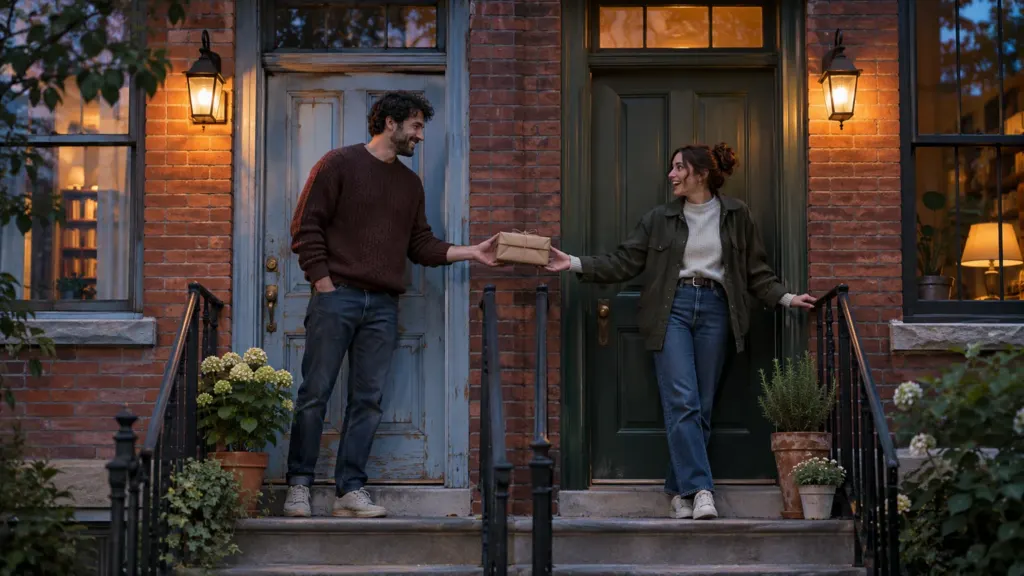
In neighbors-to-lovers romance books, the people falling for each other start out living nearby. They may be next door, down the hall or close enough to share a fence. The real appeal is that they keep seeing each other between the scenes they would bother to call dates. One notices who always brings the bins in. Another finds out who still has laundry downstairs after midnight. A character can learn something they need to know about someone simply by being home more often than they expected.
Try Kristina Forest’s The Neighbor Favor if you want a bookish contemporary romance with an email correspondence that takes on new meaning in the hallway. Start with Annah Conwell’s But He’s My Grumpy Neighbor for a small-town contrast between a reserved new neighbor and a woman who wants to know him. Lynn Painter’s Better Than the Movies takes a familiar childhood irritation and asks what happens when the person who gets on your nerves suddenly becomes the person you want around. Each one lets the attraction grow in a place that matters separately to both people.
What are some popular romance books about neighbors?
Here are six entry points across adult contemporary, young adult and historical romance. The books share a nearby address. The parts they give to private letters, public embarrassment, old memories or a practical favor are what make them feel different. Start with the premise that sounds like the next scene you would want to read. The descriptions below stop at the situations outlined by the authors and publishers.
The Neighbor Favor by Kristina Forest. Lily Greene has been corresponding with a fantasy writer whose books she loves. The messages go quiet, and months later she considers asking Nick Brown, the charming neighbor down the hall, to help her find a date for her sister’s wedding. Nick knows something about those emails that Lily does not. This is the place to start if you like watching a relationship develop in writing and then seeing what the same people can say aloud. Lily’s work in publishing and Nick’s reasons for keeping his writing life private give them both something to pursue even when one apartment door is closed. Penguin Random House
Better Than the Movies by Lynn Painter. Liz Buxbaum wants her old crush Michael to ask her to prom. Her way into his social circle is Wes Bennet, the next-door neighbor who has irritated her since childhood. Pick this if you want a young adult romantic comedy with a heroine who tries to make her own life resemble a favorite movie. It is also a good example of the childhood-neighbor angle. A shared history means Wes remembers the parts of Liz’s life that she doubts would fit her new plan. The book has space to ask why his company feels different now, even if neither the neighbor nor his address has changed. Simon & Schuster Reading guide to Liz, Wes and the next book
But He’s My Grumpy Neighbor by Annah Conwell. Adrian Carter moves in next door to Juliette. He seems determined to keep things to himself, but the occasional smile gives her a reason to pay attention. Conwell describes the book as a cozy small-town romantic comedy and pairs a guarded character with someone willing to be friendly. Read it for a grump whose interest shows up in the way he gradually makes time for another person. The premise gives a reader something more specific to watch for than a general change from cold to affectionate. Which part of the routine does he decide to share? Annah Conwell
Melt for You by J.T. Geissinger. Joellen Bixby has a long-running crush on the chief executive at work. Cameron McGregor, the Scottish rugby captain who has just moved next door, volunteers to help her become more comfortable making her interest known. Cameron’s reasons for helping are part of the changing relationship. Choose this if you like a romance in which the neighbors have an excuse to keep meeting while one thinks the goal lies somewhere else. The author lists the novel as the second book in the Slow Burn series. Look for Joellen and Cameron if the series title sends your search to a different couple. J.T. Geissinger
Love at First by Kate Clayborn. Will Sterling inherits a unit in a building where Nora Clarke has close ties to the people and the place. His plan for the property could alter the home she knows. Try this if you want an apartment building that matters beyond chance meetings between two attractive people. Their interest in one another grows while they have different ideas about what an address means and who gets to decide what happens to it. A shared landing can be intimate, and a decision about a home can affect other people long before the characters call their relationship serious. Kensington Publishing
The Wallflower Wager by Tessa Dare. Gabriel Duke is thinking about what to do with a valuable house. Lady Penelope Campion, who lives nearby, has filled her home with creatures she has taken in. Gabriel wants her to find other homes for them, and Penelope expects him to help. The animals give two people with different priorities a practical reason to go back and forth. Choose this for historical romance if you enjoy somebody discovering that the neighbor’s inconvenient habits make more sense up close. Dare includes the book in the Girl Meets Duke series. Tessa Dare

From Alisson Bento’s books
Vampire
A vampire romance about a captive bargain that turns into the only place she wants to be.
Kindle edition · Check Kindle Unlimited availability on Amazon.
What is the neighbors-to-lovers trope?
The trope puts the romantic leads in separate homes near enough that each becomes part of the other’s normal day. Meeting again is easy. A meaningful conversation still has to be chosen. A character might notice a light on in the next kitchen or briefly stop when the other person sets a package outside the wrong entrance. The next step comes when one of them goes out of their way to return a favor, ask a question or suggest they spend time together. The small difference between accidental and deliberate contact is often where the relationship begins.
A useful test is to imagine moving one of the characters across town. In a story shaped by this trope, the move would change more than the opening. They might no longer overhear how one handles a tense call in a common courtyard, lend a tool at the moment it is needed, or see how the other normally treats the people around them. The place quietly supplies a stream of information that would be difficult to fit into two long dates. It also gives the pair obligations and connections that will still be there after the first kiss.
The tone can change without changing the addresses. In a broad comedy, a stalled delivery can bring both households onto the steps in mismatched pajamas. In a quieter novel, somebody uses the spare key to water plants after being asked and sees which picture is still hanging on a wall. In a darker story, familiar territory becomes uncertain once someone has reason to question a neighbor’s motives. Those are different promises to the reader. The opening pages and the publisher’s description can tell you which one the book makes.
What should you look for in a grumpy neighbor romance?
Notice what the neighbor is protecting. A person who likes a quiet building, a person who has had an exhausting year and a person who wants to keep a difficult history private might all come across as grumpy. Those reasons lead to different books. In one, comedy comes from two conflicting definitions of a normal noise level. In another, the central change is taking enough time to trust somebody. In a good reading sample, you can watch the grumpy character deal with a minor problem before you have to decide how you feel about the later conflict.
Conwell puts the contrast close to the surface. There are occasions for Juliette to see Adrian act reserved and for a more approachable side to become visible. For a different sort of friction, Clayborn gives Will and Nora a practical reason to care about the same space in different ways. A book with tension of this kind can make a single disagreement tell you about both people. One wants quiet before an early shift. The other wants her visiting family to feel welcome. You can understand each position while hoping both will be a little braver about explaining it.
A heroine falling for the man next door is one familiar version of the trope. Which of the two has the plan, the crush or the reason to stay away can change. Look at the first few interactions for what each keeps doing independently. A believable shift in one neighbor’s habits can be more revealing than a large favor. A person who always slips past the shared bench may begin to sit down. The story can let that choice carry weight because you already know what the old routine meant to them.

From Alisson Bento’s books
Vampire
A vampire romance about a hero who claims her and never lets anyone forget it.
Kindle edition · Check Kindle Unlimited availability on Amazon.
Are neighbors-to-lovers and roommates-to-lovers the same kind of romance?
The two tropes are related through everyday proximity. Neighbors have a doorway, wall or shared outdoor space between their homes. Roommates come back to the same kitchen and live with a larger set of shared rules. A neighbor can tell you about a parcel from their own front step and retreat inside. A roommate may still have to talk to you after the parcel is opened because the counter is covered and rent is due. Both situations can produce chemistry. They give the characters different choices about how long to stay in the conversation.
The pair’s access to each other also changes the aftermath of a disagreement. Neighbors might cross paths again when one is collecting mail or the other is repairing a fence. Repeated contact can be likely while both still have a private place to go. In a roommate book the uncomfortable silence may be waiting by the kettle next morning. To choose between them, ask whether you would rather spend more of the reading time crossing a threshold or negotiating a space already shared. Roommates-to-lovers romance books
How can you find a contemporary neighbor romance, a second chance or something like a movie?
Start by choosing how much history you want the neighbors to have. A new arrival creates a reason to ask what a building, street or town is really like. A childhood neighbor has an earlier version of the love interest to think about. A story about a second chance goes a step further if there was already a friendship or a relationship that the characters need to face again. You can read the setup to see whether they merely recognize an old address or have something unfinished to discuss.
Several descriptions can look similar if you search only for contemporary romance. Add a detail that would matter in a scene. A correspondence points toward The Neighbor Favor. A promise to help somebody pursue a crush could lead to Melt for You or Better Than the Movies, which differ in age group, voice and the social worlds of their leads. If you want a movie-like story with playful dialogue and an event that brings the plot into focus, the high-school setting and prom in Painter’s novel fit that mood. Choose Love at First if you want more of the life around a building and the feeling of becoming known there.
Age-gap romance is a distinct preference that can overlap with the premise. Confirm the characters’ ages or life circumstances in the synopsis if that difference is what you came to read. A gap in years makes for different scenes when both neighbors have established careers than when one has just moved out for the first time. It can be the main point of friction, one small part of a wider story, or absent from a book about people on the same street. If searching by age gap, try specifying that both leads are adults and adding the tone you want. If it is the neighbor relationship you care about most, look for descriptions that explain how the two homes bring the leads together more than once.
What makes the place feel like part of the romance?
The details that matter are often repeated with a change. A mail mix-up at the beginning feels routine. When the same neighbors meet over a delivery halfway through, one knows exactly how long the other needs to stand outside before they start to shiver. Later, a knock can become the first contact after a hard conversation. Good use of the setting lets a reader remember those moments and notice the choices inside a routine. Look for a place where each new interaction changes how familiar things feel.
It also helps to see why both want to stay in their own lives. An apartment may put one close to a chosen family, a first steady job or something they can finally afford. The other may need a place that gives them distance from the workday. Those reasons can coexist with wanting the person next door. A strong ending can give the couple a new way to spend time together while leaving each person a recognizable life. The gesture could be as simple as being asked in for a meal that used to be eaten alone.
For a first choice, read until the neighbors meet one more time after their introduction. In that second encounter, look for an action that tells you who lives behind the next door. You may find one lead helping with a practical job, making a bad joke after a long day or quietly honoring a boundary. When you can picture the conversation you hope they will have next, you have a good reading match.