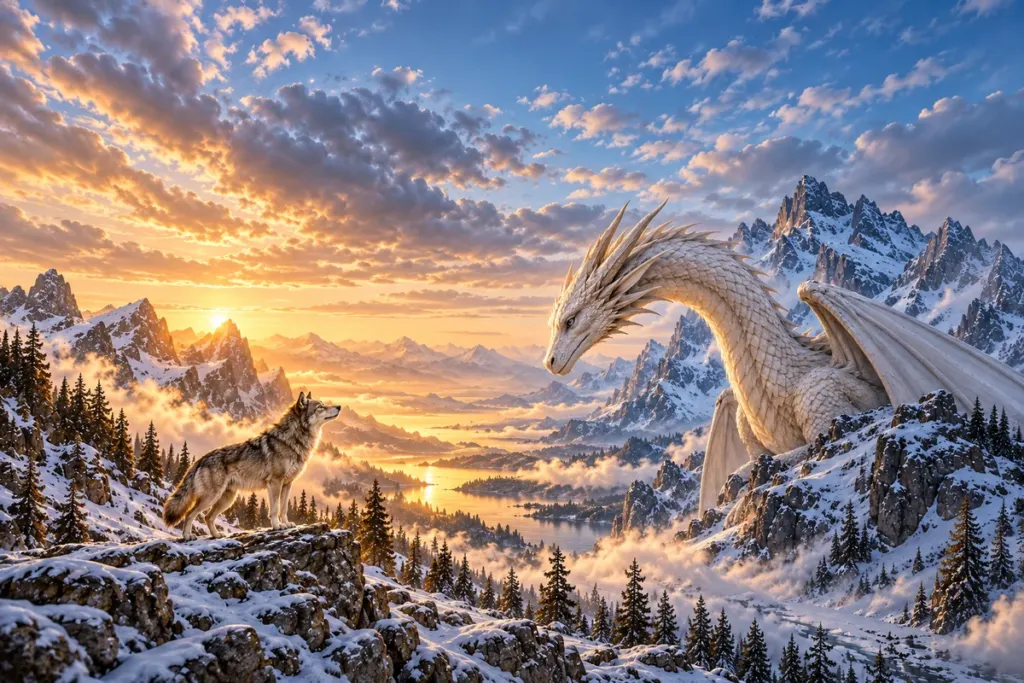
For readers looking for a romance between two already-supernatural leads, Above the Snowline offers one specific example: Ronja Sundqvist, a wolf alpha, and Kaelith Rime, a dragon enforcer. Neither enters the relationship as an ordinary human discovering that magic exists. Their difficulty is learning what they owe someone whose community, body, and understanding of duty differ from their own.
The distinction makes this more interesting than a pairing of contrasting animal forms. The story gives wolves and dragons different territorial positions and different responses to the same weapon. Those differences affect who can act, who needs help, and who gets to decide what protection means. This is a close reading of that single romance, not a multi-title recommendation list or a claim about every mixed-species love story.
Major spoilers ahead: this article discusses all seven chapters, including abduction, captivity, forced transformation, on-page sexual intimacy, the relationship rupture and reconciliation, and the final external-plot development. Read on only if you want those details before choosing the story.
Reading scope: all seven chapters of the complete English source of Above the Snowline were read, through “Below the Snow.” On October 22, 2026, that source was compared with the saved published WordPress story: every narrative paragraph, chapter heading, and viewpoint label matched. This verifies the saved story text, not Reader Vault access or rendering. Separate bonuses, other editions and translations, and a multi-title shortlist remain outside this review.
What establishes the two supernatural identities?
Ronja begins chapter 1 in wolf form, crossing a boundary she understands perfectly. She leads the Sundqvist pack in Larch Hollow and has come to find her abducted brother, Jesper. Her knowledge is practical and inherited: she knows the territorial agreement, recognizes dragon scent, and understands why crossing could bring punishment. Her journey begins with an emergency inside a supernatural world she already inhabits.
Kaelith initially meets her in the shape of a man, but chapter 2 shows him leaving the Aerie by jumping from a balcony and becoming a dragon. His role is equally explicit: he serves the dragon sovereign, Zephyr Silvern, as the mountain’s enforcer. The account of his northern family later supplies a dragon history that precedes Ronja. Neither identity depends on guessing from a name, appearance, or promotional label.
The clearest test comes in chapter 5. Kaelith intercepts a dart intended for Ronja. The narration directly distinguishes his response from the wolves’ experience: the weapon does not force him into another shape, and his blood destroys the poison. He then chooses to become a dragon. This establishes a functional difference between their kinds, rather than asking readers to treat every different animal form as a separate species.
Human shape should therefore not be confused with human identity. Ronja remains a wolf shifter when a weapon traps her on two legs; Kaelith remains a dragon when he speaks, dresses, or sits at a table. The human traffickers are antagonists, and the captive lynx woman, Hedda, is someone they rescue. Neither those humans nor Hedda should be counted as additional romantic leads in this particular relationship.
You’re on the list. Your free stories are waiting in the Reader Vault. Above the Snowline
The snowline is a political boundary before it becomes a romantic one
The opening border divides wolves below from dragons above. Ronja crosses because following the rules would mean abandoning Jesper. Kaelith initially understands the same crossing as an offense requiring enforcement. Their first disagreement is therefore about responsibility. Her duty moves outward toward someone missing; his duty holds a line and protects what the sovereign owns. Each arrives with an established obligation, not an empty life awaiting romance.
That encounter also establishes an uncomfortable power imbalance. Kaelith threatens punishment, restrains Ronja after she lunges, and orders her to change. Her resulting human form leaves her exposed to the cold. He subsequently gives her his cloak and carries her, but the care follows coercion. A reading that remembers only the warmth would erase the circumstances that make his later attention to her choices important.
At the Aerie, Zephyr treats the wolves’ emergency as beneath the mountain’s concern. Ronja challenges him, arguing that the armed humans have already crossed his land and interfered with its power. Kaelith sees her refuse intimidation, while the reader sees the inadequacy of a border that separates responsibilities but fails to contain danger. The political hierarchy is already part of the romantic obstacle.
Ronja is an outsider to the dragon court, but she is not the human outsider of a supernatural-discovery romance. She does need information about the mountain, its ruler, and Kaelith. He needs information about her valley and its people. That reciprocal ignorance gives their encounters a different shape: each knows a world, and each must recognize that the other’s world deserves more than a dismissive label.
Different bodies create unequal risks
Ronja’s escape from the Aerie uses the body that Kaelith’s confinement plan overlooks. The window cannot accommodate a woman, but a determined wolf can squeeze through at a cost. She loses fur and negotiates a dangerous ledge rather than waiting for his permission. Her transformation is a means of action here, which makes the later loss of that ability especially consequential.
When she approaches the traffickers’ camp, a dart forces her into human shape and prevents her from changing back. Its effects extend beyond appearance: she becomes desperately cold and cannot use the wolf’s body to escape. Kaelith later explains that the poison suppresses her transformation and slows her blood. The threat attacks her command of herself, not merely her capacity to win a fight.
His dragon physiology provides a contrasting resource. At the lookout, he can ignite the stove while still in human shape, and he explains that his kind produces considerable heat. Warming Ronja becomes an intimate use of a difference previously associated with threat. The same person whose presence announces danger above the snowline can keep her alive below it, without becoming less dragon in the process.
The contrast should remain precise. Kaelith’s resistance to this dart is demonstrated; universal immunity to weapons or poison is not. He has old scars and returns from the camp with a bruise. Later darts shatter against his dragon scales, but the story still gives him emotional and strategic vulnerabilities. Different supernatural bodies redistribute risk without making one partner incapable of being hurt.
The warming scene separates wanting from being able to choose
Chapter 3 deliberately changes the terms of physical contact. Kaelith removes the dart without asking, then requests Ronja’s permission before using his body heat to warm her. She notices the difference and asks about it. Their exchange puts a boundary into words at the point where necessity could otherwise make every touch seem automatically justified.
Ronja initiates a kiss, and he responds, but he stops the encounter from going further that night. His explanation is specific to her circumstances: she is poisoned, unable to transform, unable to run, and dependent on him for warmth. He wants her to have the practical ability to leave before choosing to stay. Desire is present, yet the available alternatives remain constrained.
This is where the species rules become relationship rules. Losing access to wolf form reduces Ronja’s freedom; regaining it changes the conditions under which intimacy happens. The story does not treat an affirmative answer as detached from captivity, injury, or dependence. It gives the body’s recovery narrative weight before the next sexual encounter, rather than using supernatural attraction to make that recovery irrelevant.
There are limits to what this scene establishes. It shows a particular moment of restraint and a conversation about choice, not a uniformly noncoercive relationship from the beginning. Kaelith has already confined Ronja, and he later makes another unilateral decision. Keeping those actions in view produces a more useful reading than declaring him safe in every context because he handles this encounter thoughtfully.
Shared work makes attraction more than recognition
By chapter 4, Ronja can feel her wolf again and demonstrates that her transformation has returned. The pair then observes the camp together. She identifies Hedda and knows her mother; Kaelith recognizes Morrow Vane and overhears his plans with dragon hearing. Their knowledge is complementary. Ronja supplies the personal consequences of the crime, while Kaelith learns how the same operation threatens the mountain.
Their rescue plan develops through an exchange rather than a command. Kaelith lays out the camp with pieces of kindling, combining his knowledge of armed opponents with her knowledge of the ground. She corrects him twice, and he accepts both corrections. That small scene gives her authority a practical place inside their partnership. Attraction grows alongside evidence that he can listen to her judgment.
Ronja then explicitly returns to the previous night’s condition. She can change, she can run, and she is choosing him. Their intimacy follows that statement. Kaelith’s perspective also describes a powerful dragon recognition associated with old stories, but his internal response is not the only reason the relationship advances. The narrative supplies her stated desire and their demonstrated cooperation as separate evidence.
The camp rescue follows the division of labor they agreed upon. He disables the lights and draws attention; she reaches the cages, frees Jesper, and helps Hedda. His later transformation makes spectacular intervention possible, but her actions are indispensable to the rescue. The romance gives room to his overwhelming force without making her leadership merely something he admires from a distance.
Why protective withdrawal becomes a second loss of agency
After Kaelith takes the dart, Haig escapes and reports that the enforcer has a vulnerability. Kaelith understands that Ronja could be used to gain leverage over him and, through him, the mountain’s defenses. His concern has concrete grounds. Vane studies the supernatural world as something to manipulate, and the connection between the pair has now become information an enemy can use.
Kaelith responds by announcing that he will stay away. Ronja proposes fighting together; he refuses. The hurt arises partly from his reversal of the lookout’s principle. He had wanted her free to choose him, and she had done so. Now he decides that protecting her requires withdrawing from the partnership without allowing her an equal say in its risks.
Chapter 6 gives that choice a history. Kaelith’s family trusted a treaty with humans, who then came with fire and chains. He escaped south alone and built his life around usefulness and controlled attachment. Loving only the mountain seemed to protect him from further loss. His withdrawal repeats that strategy, even though its cost is now borne by someone who never agreed to it.
Zephyr praises the decision, linking attachment with weakness. The later attack on Larch Hollow exposes its practical failure: leaving does not erase what Vane already knows. Kaelith finally recognizes that separation has left Ronja unprotected rather than invisible. The story tests his protective reasoning against an outcome, allowing his change of mind to involve judgment as well as overwhelming emotion.

From Alisson Bento’s books
Vampire
A vampire romance about a hero who claims her and never lets anyone forget it.
Kindle edition · Check Kindle Unlimited availability on Amazon.
The reconciliation preserves Ronja’s authority
Kaelith’s return in chapter 7 offers the expected dragon spectacle, but the more revealing moment comes after he pins Haig. He waits for Ronja to decide what happens to the man who attacked her people. The narration identifies the valley, the pack, and the decision as hers. His physical superiority does not become automatic political authority over her home.
Ronja gives Haig the warning to carry back to Vane. Kaelith then uses a fine thread of fire to release two collared wolves. These actions combine distinct capacities: she speaks as alpha, while he applies a dragon’s strength with unusual precision. The rescue does not require the wolf leader to become a dragon, nor does the dragon need to stop being dangerous to become helpful.
His apology is public. In front of the pack, he acknowledges that he was wrong and asks whether Ronja will have him. When he kneels, she asks him to stand beside her, explaining how she understands an alpha’s relationship to others. The gesture gives their reconciliation a social form. He returns as a partner willing to recognize her standing, rather than arriving only as the rescuer who expects gratitude.
The opening and closing positions matter together. Their first encounter places her beneath him under threat; the reconciliation brings them side by side by her invitation. That contrast is an interpretation of the staged actions, not proof that every inequality has vanished. His greater force and mountain obligations remain. What changes is how the relationship publicly handles her authority and his accountability.
The ending keeps both identities and leaves the wider danger open
The domestic aftermath gives the reconciliation consequences beyond a kiss. Hedda’s mother brings bread and embraces Kaelith; Jesper cooks and sings badly; Sigrid later rewards a rebuilt woodshed with jam. These scenes place him among the people Ronja crossed the boundary to protect. Acceptance takes the form of food, repairs, and familiarity, making belonging visible through ordinary activity.
Three weeks later, Kaelith spends his days on the mountain and his nights with Ronja. She remains the pack’s alpha; he retains his dragon identity and duties. The arrangement lets the relationship cross the border without requiring either lead to acquire the other’s species. Their lives are joined through repeated movement between communities, not through a transformation that makes their differences disappear.
The political resolution is narrower than abolishing the Accord. Zephyr permits Kaelith’s attachment and tells him to guard Ronja, but the story does not supply a comprehensive new settlement between wolves and dragons. Possessive language also remains in the dragon court and the couple’s private exchanges. Ronja’s insistence on standing together gives that language a counterweight rather than magically removing it.
The final alarm concerns a stolen Heartstone and sends Kaelith back toward mountain business. He promises to return before leaving, while the sovereign pursues a thief into a storm. The couple’s reunion and shared routine are established in this source ending; the larger conflict remains open. Readers seeking a completely closed external plot should distinguish romantic resolution from the continuing story-world hook.
Who is this particular romance for?
Above the Snowline is a useful fit if you want both romantic leads to bring established supernatural identities into the relationship, with their differences affecting more than appearance. Its strongest scenes connect bodily autonomy, leadership, and attraction: the suppressed wolf, the requested warming contact, the shared rescue plan, and the dragon who eventually defers to the alpha in her own valley.
It is a more qualified choice if your priority is an equal-power or consistently reassuring courtship. The opening contains threats and restraint, the middle includes captivity and a protective breakup, and armed violence returns during the reconciliation. The story also contains explicit sexual intimacy. These are observed elements that help describe the experience, not a complete content inventory or a certification that other concerns are absent.
The precise recommendation is therefore one wolf-and-dragon romance with no ordinary-human partner at its center. Its interest lies in two supernatural people learning how to share responsibility without surrendering their distinct identities. Ronja brings the obligation to protect a community; Kaelith must learn that loving its leader means listening to her, accepting correction, and returning to stand beside her.
Source and version note
The complete seven-chapter English source read for this article matched the saved published WordPress story checked on October 22, 2026, including all ordered narrative paragraphs, headings, viewpoint labels, and final paragraphs. The public reading destination is Above the Snowline. Reader Vault access and rendering, separately distributed bonuses, other editions, and translations were not verified. The separately promoted novel Hoarded by the Alpha is not assessed here. This remains a single-story close reading, not a verified multi-title shortlist.