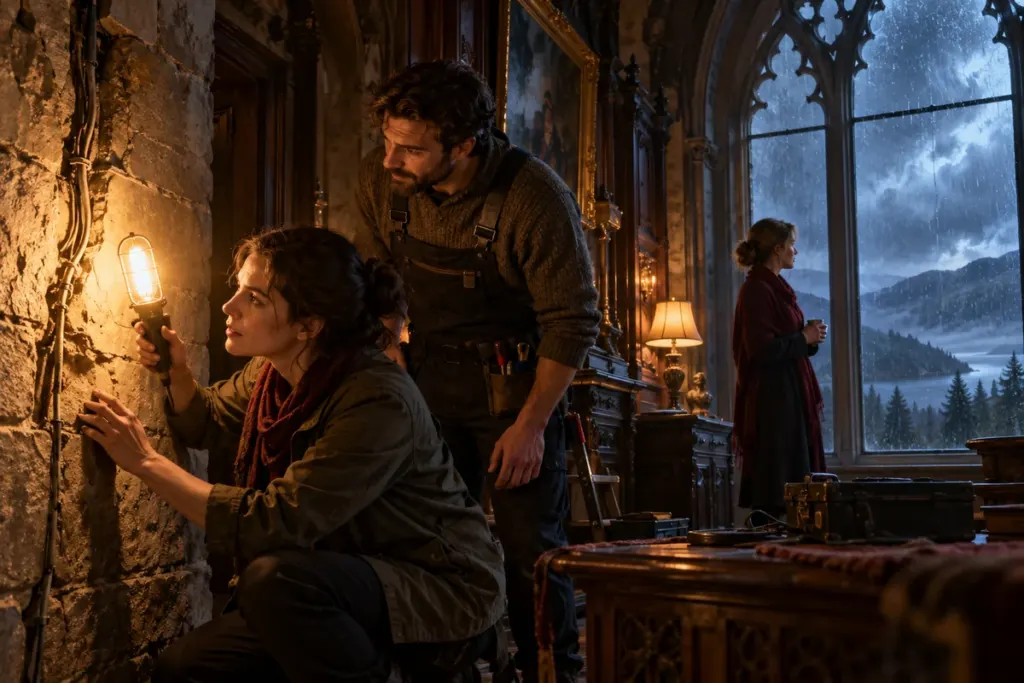
A gothic house romance with professional allies offers a particular pleasure: two adults can be unsettled by the same building while knowing enough to question the explanation they are given. Choose it when you want attraction to develop through observation, disagreement and useful cooperation. The locked door should change a decision. The professional title should affect what the character notices. Neither the ominous house nor the word gothic, by itself, promises a ghost.
In Alisson Bento’s The House Below the Signal, architectural conservator Nora Bell arrives for an assessment at a disused utility house below the remote Vale lodge. Electrician Eli Mercer has been called to the same place. They have separate tasks, a narrowing window of time and reasons to distrust easy conclusions. Their adult M/F romance grows alongside an independent suspense story. The opening gives you enough to decide whether that combination interests you without explaining the warning horn or the hidden records.
Start with what the worker expected to find
The most useful detail in an unsettling house is often a discrepancy. Nora expects a survey appointment; instead, she finds a front door nailed shut and a brass plate polished that morning. Those details point in different directions. One blocks entry. The other suggests recent care. Neither explains who benefits from the arrangement, but together they make the house feel actively managed rather than simply abandoned.
That difference matters if you enjoy a capable visitor. A character who understands nothing about a building might experience every noise as equally threatening. Nora arrives with an assignment and a way of documenting what she sees. Her baseline lets her recognize something worth asking about. The reader can share the question without needing her qualifications or a lesson in construction.
Look for a sample that establishes the expected task before multiplying anomalies. A survey, an inventory or a repair can provide a clear reason to enter and a standard against which surprises register. If every surface is described as sinister from the first sentence, the atmosphere may still be enjoyable, but you have a different reading experience: saturation in mood rather than a changing interpretation of evidence.
You can test your preference with a simple comparison. Would you rather follow an unfamiliar guest learning a household’s routines, or a professional noticing that an official description does not match the room? Neither is inherently better. The second gives competence a place inside the unease, and makes the commission itself part of the suspense.
You’re on the list. Your free stories are waiting in the Reader Vault. The House Below the Signal
Let two specialties produce two different kinds of doubt
Nora asks to see a complete report before accepting a demolition conclusion. Eli questions a supposedly dead system that still has a supply. Their observations are connected by the property, but they are not interchangeable. He cannot settle her assessment with a confident glance, and her paperwork cannot answer every question in his inspection. Each brings a limit as well as knowledge.
This is where professional allies can become more interesting than a generic protective pairing. One adult may recognize what the other needs to check, even when they cannot perform that check themselves. Respect becomes visible in the space left for another person’s work. Eli does not need to become an architectural conservator for his attention to Nora’s questions to matter.
The opening also gives them a dry conversational rhythm. Nora asks that things remain undisturbed for photographs; Eli briefly treats that instruction as including him. The exchange has a practical basis, so the humor does not suspend the scene’s purpose. For readers who like restrained attraction, these small adjustments can be more enticing than immediate declarations of fascination.
When choosing a similar story, ask whether both jobs change the plot. If one profession only supplies a flattering introduction before the other lead takes over, the romance may offer a different fantasy. Here the invitation is to enjoy people who need one another’s judgment. These are fictional observations, not instructions for inspecting a building or handling an electrical system.
Read access as part of the relationship
A door can limit a route, establish a rule or expose a contradiction. It can also show you how one character treats another. In the opening, Eli opens the side entrance and steps away from the threshold. That is a small action, but it gives Nora room to enter rather than turning his knowledge of the property into authority over her body.
It is worth separating that interaction from the house’s wider uncertainty. A person can behave considerately inside an environment whose arrangements remain troubling. The story does not need every kind action to solve every danger. Indeed, the attraction may depend on finding someone who shares your questions while neither of you controls the whole situation.
Read the opening of The House Below the Signal with that distinction in mind. Notice the front entrance, the alternative route, the requests to preserve what is there and the pressure to finish quickly. The pleasure comes from watching access and permission acquire meaning in a specific encounter, not from assuming that every closed door has the same explanation.
If you enjoy a romantic lead who might be the captor or the source of danger, ask for that directly in another recommendation. Professional allies facing a troubling property offer a different starting arrangement. The existing guide to refuge, captivity and alliance in forced proximity helps name the distinction, though its examples belong to mafia romance rather than this couple’s story.
Records can make the house more unsettling than a shadow does
Hidden records sound atmospheric, but their narrative value depends on what they could change. A document might explain a previous decision, challenge an official account or attach a name to something the character has not agreed to. You do not need to know its contents in advance to decide whether you enjoy that kind of suspense.
At Nora’s first meeting with maintenance contact Walter Cassell, a condition summary is offered where she wants a complete report. The discrepancy is concrete: the brief conclusion does not supply the material she asks to inspect. Her response is to request more information and preserve what she has actually been shown. That creates a traceable question rather than a vague conviction that someone seems unpleasant.
Readers who like documentary suspense often want uncertainty to accumulate through such limits. A paper can be authentic while incomplete. A signature can raise a question without answering how it got there. An apparently tidy explanation may cover less than its presenter implies. The attraction of this approach lies in following the difference between a record and a claim made about it.
It also changes the romance. Trust can mean taking someone’s concern seriously before they can prove an entire theory. It need not mean agreeing with every suspicion. A useful reading question is whether the lovers can share incomplete information honestly. That is more specific than asking whether the hero is protective, and leaves the eventual discoveries intact.
The storm should alter the options, not manufacture compatibility
A stormbound setting brings time and distance into the relationship. An appointment intended to last an afternoon can become an extended stay. People who expected to leave may have to reconsider privacy, resources and responsibility. In this story’s premise, the weather strands Nora with Eli and a woman trying to recover her brother’s forgotten warning. There is more than a romantic duet inside the pressure.
For a reader, that means forced proximity and chosen closeness remain separate questions. The weather can keep two people in the same place; it cannot establish that they respect one another or want the same future. Look for moments where attraction survives a boundary or a difference of judgment, rather than existing only because the characters cannot get away.
Imagine two hypothetical versions of the same commission. In one, the storm mainly creates uninterrupted conversation beside a warm stove. In another, it narrows the characters’ ability to verify information and makes a disputed warning urgent. Both can be romantic. If you want the second, choose descriptions that connect weather to the task and its consequences rather than relying only on the promise of one roof.
You can enjoy peril and still prefer an ally who does not add pressure. That combination is central to the appeal here: an unsettling environment beside the possibility of a trustworthy partnership. The suspense does not have to disappear before tenderness becomes legible, and tenderness does not make the storm merely decorative.
Choose your supernatural expectation separately
A horn that should no longer work invites several kinds of curiosity. Who believes it is disused? What has actually been checked? Why would someone want its warning forgotten? These are useful questions to carry into a suspense story. Jumping straight to a ghost would discard some of the uncertainty the premise offers.
The publisher description for House of Rayne, for example, explicitly identifies a sapphic gothic romance with supernatural suspense and dark magic. That is a clear statement about that separate book’s framework. It illustrates why an explicit description is more informative than importing supernatural rules from the gothic label. It is not a claim that the books share a relationship structure, heat level or world.
The House Below the Signal is presented as contemporary gothic romantic suspense, with an adult M/F couple, sensual tension and consensual kissing without graphic sexual detail. Those are useful expectations. A haunting visual atmosphere is not evidence of ghosts, vampires, curses or historical time periods. Keep the questions you want unanswered; verify only the categories that would change your reading choice.
The broader gothic romance guide to atmosphere and consequential houses compares different ways of entering an ominous property. This article narrows the lens to two workers assessing the same house: how their methods, limits and shared attention make the romantic alliance convincing.
Three ways to decide whether this is tonight’s kind of suspense
First, consider how you like to encounter clues. If a fresh alteration, an incomplete report and a disputed system make you want the next conversation, professional investigation may be a strong match. If your favorite pleasure is simply wandering through a beautifully described mansion, you may want a more leisurely emphasis on household life. You can enjoy both, but they satisfy different moods.
Second, decide where you want uncertainty in the relationship. An uneasy host-and-visitor arrangement can keep the romantic lead’s intentions central. An ally arrangement lets you enjoy two people beginning to rely on one another while uncertainty expands around them. Nora and Eli’s premise invites the latter reading without promising that attraction makes every disagreement vanish.
Third, separate intensity from explicitness. Threat, confinement by circumstance and charged attention can create tension without graphic sex. The stated heat here is descriptive rather than a universal numerical scale. If kissing and a slow-burn professional bond suit you, the danger can supply urgency without changing that intimacy promise.
Two neighboring reading questions may help refine the choice. The guide to hidden-vampire romance by the harbor moves toward a specifically supernatural premise. The guide to priest romance with a glassmaker heroine explores a different source of forbidden attraction. They are separate thematic comparisons, not further adventures for Nora and Eli.
When the instruments matter more than the grand staircase
Consider the scale of the building that attracts you. A utility house below a lodge offers different pleasures from an aristocratic mansion full of family portraits. Its significance can live in what it once did: carrying a warning, sheltering work or connecting people who no longer tell the same story about it. A modest room can become gothic when its ordinary function has been concealed or disputed.
Nora’s folding brass rule adds another kind of history. It belonged to her father, and she keeps it partly because he did. The object connects measurement to memory without making memory a substitute for measurement. Eli’s care in placing his screwdriver on a cloth likewise gives care a visible scale. If those details attract you, request a gothic romance where working objects and habits carry intimacy. You may be seeking less grandeur and more consequential attention: people who understand that what gets overlooked can still matter.
Begin with the question the house makes you ask
You do not need the eventual explanation of the horn, the records or the danger to choose this story. A stronger starting point is a question about the first appointment: why do two professionals meet so much pressure to accept an account neither has finished checking? That question ties atmosphere to action and gives the developing alliance something substantial to do.
The story resolves its local suspense and offers a hopeful committed romantic future. It takes place years before The Blizzard Between Us, the related paid novel, on the remote Vale lodge property. The setting connects them; different protagonists face a separate danger in the novel. Neither that relationship nor membership in Gothic Tales establishes that every title on the shelf shares continuity.
The House Below the Signal is an invitation to start with Nora’s arrival and see whether her way of reading the building draws you in. Read the opening free in your browser, then confirm your email to continue through the complete novella. For a wider choice of premises, explore the free-story hub. Take the door, the incomplete record and the careful ally as your starting pleasures, and leave the house’s answers for the story.