A damaged recording can sound convincing long before anyone has established what it means. That is a particularly intimate problem for an M/M dark academia romance: the man who can buy access may also be the man whose attention the specialist wants. Attraction arrives inside a disagreement about who gets to interpret another person’s voice. If your favorite academic tension comes from scholarship, class and compromised patronage rather than a timetable of lectures, an audio-restorer hero offers a different way into the atmosphere.
The useful question is not simply whether a collector is dangerous or a restorer is clever. It is whether their work leaves room for a truth neither can conveniently own. In The Sound We Kept, Asa Vale and Julian Voss meet around three damaged harbor recordings and a ten-day deadline. This is an adult M/M romance with charged kissing and closed-door intimacy. The archive supplies the pressure; the relationship still has to earn its own ending.
An archive changes what the darkness is about
Dark academia can invite a reader through stone corridors, expensive coats and people who know precisely which reference will embarrass someone else. Those pleasures become more substantial when knowledge has consequences. Here the important room contains objects whose public interpretation could fix a dead man’s reputation. Wealth can buy an audience for an accusation. Skilled listening may complicate the accusation without offering the same immediate spectacle.
That gives the romantic imbalance a specific shape. Asa does not merely feel out of place among richer people. He has work to perform, conditions under which he can responsibly perform it, and an invoice that matters to him. Julian has the polish and connections to make access possible. A reader can enjoy the attraction while noticing that access and independence are not interchangeable gifts. Being admitted to a room does not automatically mean being allowed to disagree there.
This is also why an archival setting can suit readers who want intellectual conflict without a student-professor relationship. The central pair are adult men meeting through preservation work and collecting. The premise does not require you to imagine a classroom hierarchy, assign either man a faculty title, or import an initiation ritual. Their friction already exists in money, reputation and competing claims to authority.
You’re on the list. Your free stories are waiting in the Reader Vault. The Sound We Kept
Nineteen seconds are enough to create a problem
The opening makes a public claim arrive before a careful investigation. Rupert Dane treats a nineteen-second digital excerpt as evidence that the dead Malcolm Reed was a murderer. Nell Price, the archivist, has custody of three wax cylinders on temporary deposit. Those details place two versions of the past beside each other: a portable excerpt that appears ready to explain everything, and fragile objects that still require patient attention.
Asa’s first important contribution is a limit. He does not promise immediate playback to satisfy the room. He wants to inspect condition first. When he hears the copied excerpt, an abrupt cut and a change in noise suggest a question about what has been presented. They do not establish fraud. The distinction is small enough to disappear in an impatient conversation and large enough to determine whether a character seems intellectually trustworthy.
For a romance reader, this is more than mystery setup. It offers a way to assess the man Julian is being asked to respect. Asa is interesting because he can tolerate an unresolved answer in front of people who would prefer certainty. If you enjoy competence attraction, watch for that willingness to be inconvenient. A handsome declaration that the restorer is brilliant would carry less weight than another powerful man allowing his inconvenient judgment to stand.
Restoration is a compelling job when it cannot grant wishes
An audio-restorer hero could easily become a convenient machine for producing the missing confession. The more engaging possibility is a specialist whose skill sharpens the uncertainty. Asa needs the recording’s surrounding material and a defensible association between a file and an object. He cannot make a copied fragment acquire a trustworthy history merely by making its words easier to hear. His usefulness includes refusing a flattering shortcut.
That refusal also gives readers a good test for the romance. Does Julian want Asa’s actual judgment, or does he want an impressive expert to endorse a preferred story? The difference can become visible in a conversation about access or scheduling before either man admits desire. A patron who likes intelligence only when it agrees with him creates a different romantic experience from one who learns to bear correction.
The opening does not ask readers to become preservation technicians. Its emotional stakes are legible without specialist knowledge: someone is being accused; the evidence is incomplete; a paid professional risks displeasing the people who can pay him. Technical vocabulary works best here as the material of a disagreement. The reader need only understand what a decision costs Asa and what accepting that decision costs Julian.
Class enters through the objects people can replace
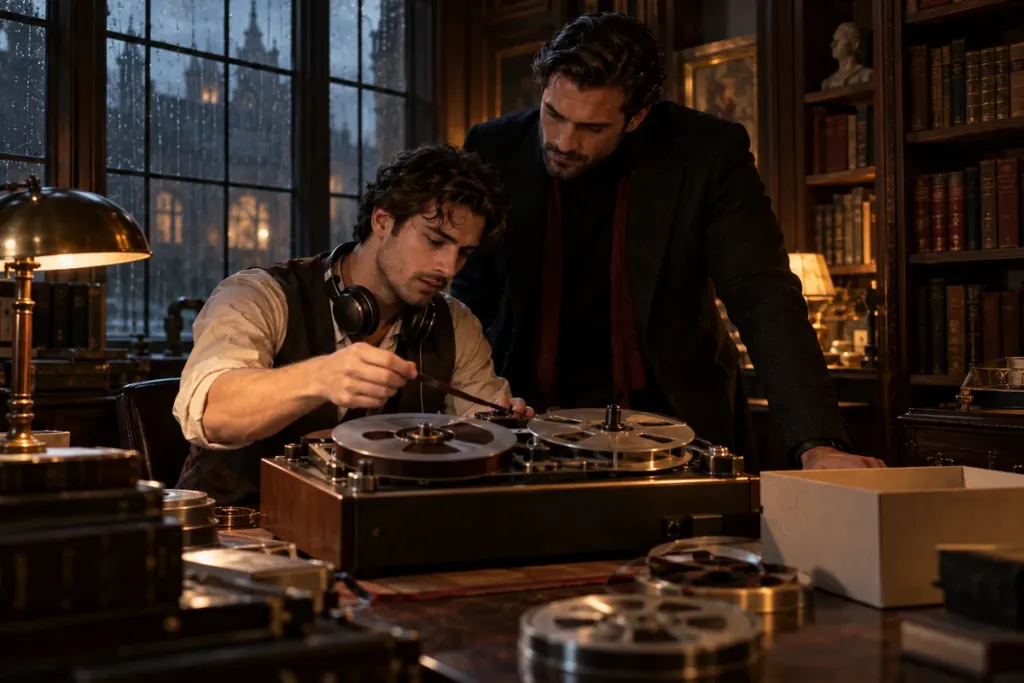
Asa’s wet shoes, repaired headphones and unpaid invoice do useful work beside Julian’s expensive coat. They make the difference between these men tangible before anyone gives a speech about class. Repaired equipment implies a relationship to cost that a polished room may prefer not to notice. An unpaid invoice gives a generous offer its edge. The attraction can be welcome while the fee remains consequential.
This kind of class tension is especially satisfying when the less wealthy partner retains a recognizable professional life. Asa has something Julian cannot simply purchase in advance: a judgment that must remain his own. That does not erase his financial vulnerability. It makes the vulnerability dramatically useful, because saying no to the wrong request has an identifiable price. A reader can feel the temptation of patronage without mistaking it for uncomplicated rescue.
Consider which version you enjoy. Some readers want a wealthy lover to remove everyday pressures quickly. Others prefer the uneasy pleasure of an offer that improves circumstances while creating fresh obligations. The Sound We Kept is pitched around dangerous patronage and reluctant alliance, so the second appetite is particularly relevant. The interesting reading question is what support permits Asa to do, and what Julian expects to receive in return.
A previous correction can hurt more than a general insult
Asa and Julian do not enter the archive as blank social equals. Their opening history includes a wrong date on a tape box. Julian corrected Asa publicly; Asa corrected the underlying mistake the next morning; other people remembered Julian as the person who had been right. The injury concerns credit as much as embarrassment. It gives Asa a concrete reason to distrust effortless authority.
That is a useful distinction for readers tired of an alliance built on a vague misunderstanding. A fact can be corrected while its social effect survives. The man with status may remain the remembered authority even after someone else does the unglamorous repair. Asa’s resistance therefore has an intelligible basis. He does not need to be irrationally hostile to keep tension alive, and Julian cannot resolve everything merely by announcing admiration.
Watch for whether a developing romance recognizes the difference between private approval and public behavior. Complimenting a specialist in an intimate moment and giving him room to speak in a consequential meeting are different actions. This opening invites that comparison without proving in advance how Julian will change. It leaves the reader something worth testing as the alliance develops: whether his attention can become a form of respect Asa can actually use.
Possessive attraction needs a precise object
A powerful collector is an unusually pointed romantic figure because collecting already involves possession. It is easy to understand why exclusivity might feel flattering to a man whose work has been overlooked. It is equally easy to see why an exclusive fee could become troubling. Does Julian want a particular period of Asa’s professional time, or a claim over the person performing it? The tension lies in that possible slippage.
Readers can enjoy the possessive charge while attending to its form. Notice whether interest makes room for Asa’s duties, whether a disagreement remains possible, and whether another person’s boundary changes what Julian actually does. These are scene questions rather than a demand that every dark romance offer the same power balance. They help you choose the kind of intensity you want: negotiated exclusivity, deliberate moral discomfort, or a stronger captivity fantasy.
The archive gives an early, concrete boundary. Nell does not allow the cylinders to leave overnight with either man. Julian accepts that refusal. This single moment is not a certificate for his entire character. It is a small, observable act in a room where his power might have been used differently. For a broader comparison of power and meaningful choices, the guide to agency beside a powerful partner offers a useful framework, though its heroine examples should not be mistaken for this M/M cast.
The archivist keeps the romance from owning the whole room
Nell’s role matters because the central couple are not the only people with legitimate authority. She distinguishes permission to make a preservation transfer from permission for public use. That difference stops a collector’s enthusiasm or a restorer’s curiosity from settling every question. The objects have a custody arrangement; attraction does not dissolve it. The relationship develops inside a world with other people’s responsibilities.
For readers, a credible supporting professional can deepen intimacy by making it less automatic. Asa and Julian cannot create a private bubble simply by taking the recordings somewhere convenient. They have to negotiate with circumstances and with a woman who has her own duty to the material. Time together becomes something arranged within limits rather than an entitlement attached to the wealthier hero.
This also enlarges the moral question. Whose voice survives is not identical to which lover wins an argument. The dead speaker, the archivist, the person making an accusation and the specialist all occupy different positions around the same objects. A romance that lets those positions remain distinct can offer public stakes without reducing everyone else to obstacles placed between two men and a kiss.
A deadline should compress work and desire differently
Ten days is a useful promise for a reluctant alliance. It is long enough to suggest repeated decisions rather than one dramatic encounter, and short enough that delays have consequences. A deadline can make every professional compromise feel more expensive. It can also give attraction a temporary shelter: a character may tell himself that wanting someone is manageable because the assignment will end.
The first chapter makes that limit concrete through the terms Asa asks to change. His report must reach Julian and the archive together; the fee must not purchase his future labor or make a finding depend on a donor’s approval. A previously arranged two-hour repair job also stays in his diary. As a scene, this is revealing because the negotiation concerns what Julian does not get. Asa can need the money without pretending he has no other commitments. Julian’s agreement is an observable response, while the attraction makes Asa wonder what exclusivity might mean beyond the written hours. If you enjoy careful bargains becoming emotionally inconvenient, those small retained obligations may be more compelling than a patron promising unrestricted generosity.
The best question for this setup is what must remain after the deadline expires. A finished task does not automatically create an equal relationship, and a kiss does not settle a dispute about evidence. Readers who like braided romantic and external arcs can look for separate progress in each. Can the men work together more honestly? Can they speak about wanting each other without disguising the request as a business term?
Asa’s earlier professional mistake adds another pressure without making him an unreliable villain by default. The opening identifies an unauthorized preservation copy from his university years, not a wholesale history of fabricated evidence. That specificity matters. A character can be vulnerable to exposure and still have a justified objection now. If you enjoy morally complicated competence, the attraction lies partly in watching present judgment stand beside an imperfect past.
Choose the heat and the emotional promise separately
This story’s adult M/M pairing and dark academic atmosphere do not imply explicit sex. Its stated heat is charged kissing and closed-door adult intimacy. Readers seeking graphic on-page scenes should use that description rather than infer a spice level from wealth, possessiveness or an expensive coat. Readers who prefer lower-detail intimacy can still expect attraction to matter; restraint can carry substantial emotional pressure.
The relationship promise is a complete happy ending for Asa and Julian. That promise is distinct from claiming the opening has already proved them compatible or from revealing how the recordings’ questions resolve. It lets you choose an emotionally reassuring destination while retaining uncertainty about the route. The combination may suit a reader who wants intellectual danger and a difficult alliance without a tragic romantic endpoint.
If institutional permission is the attraction rather than archives themselves, the companion guide to a priest romance with a glassmaker heroine offers a different comparison. That guide follows an adult M/F couple and gothic priest romance; it changes both the relationship and the source of authority. Comparing the two can clarify whether you want authority rooted in money and collecting or a separate form of forbidden attraction.
Where this listening assignment fits your next read
The Sound We Kept uses original protagonists in a story placed three years before Drafting Forever. Asa and Julian’s complete romance is its own entry point. The paid novel follows a different M/M couple in the harbor university and public-memory setting. That connection does not make every Harbor Archive title a single continuous cast, and it does not require the prequel to expose the selected novel’s secrets. Choose the source book for another reading experience rather than an assumed account of these men’s entire future.
For this particular mood, look for three pleasures together: an expert whose uncertainty is part of his competence, a patron whose attraction is tested by refusal, and evidence whose context matters more than its dramatic first impression. If that combination appeals, keep The Sound We Kept on your reading list. The free story collection provides the broader place to compare premises, pairings and heat before deciding which kind of pressure you want next.