
A monthly total leaves a scheduling question unanswered
An audiobook’s normal-speed duration can tell a listener how much content is left. A playback-speed calculation can estimate how many wall-clock listening hours that content takes. Neither quantity, on its own, locates the next renewal of an expiring allowance. A book may fit the combined hours available across two cycles and still encounter a period with no usable quota. This article isolates that scheduling issue with a transparent hypothetical model, not a test of any subscriber’s account.
The motivating policy is Spotify’s public explanation that included audiobook time is debited at normal speed and that unused included time expires each monthly cycle. The current page also says the number of included hours varies by country. We therefore do not treat fifteen hours as a universal allowance or publish a plan-price comparison. Seven, ten, fifteen and twenty hours are chosen model inputs. The cycle lengths, playback speeds and listening-time budgets are likewise selected scenarios, not measured consumer behavior.
The central starting condition is deliberately explicit: the entire chosen allowance is unused when the book begins, even if the first reset is only one day away. Listening availability is represented as a smooth daily flow rather than a real session at a specific hour. Results are elapsed modeled days within those assumptions. They do not establish a calendar finish date, say that a particular book is available on Spotify, or promise that a reader will maintain the assumed pace.
What comes from the source and what we choose
Spotify’s Audiobooks in Premium plans help page was read on 31 October 2026 using its US route. It explains that adjusting playback speed does not change the amount debited from an allocation for the same content, and that replay consumes allocation again. At the next billing period, included hours renew while unused included hours from the preceding period disappear. These factual rules motivate the model’s separate content and availability quantities. They do not supply the numerical grid or validate its simulated schedules.
The same source describes account eligibility, add-ons, separately purchased titles and top-up hours with different rules. Those are not merged into this experiment. The model has one expiring included allowance, no top-ups, no add-on, no purchased-book exception and no transfer between accounts. A user whose actual access depends on a different arrangement must not treat a scenario row as a description of that arrangement. Current account details and the provider’s terms remain necessary to establish actual eligibility and hours.
We choose three constant cycle lengths—28, 30 and 31 days—to examine sensitivity. Actual monthly billing cycles follow account calendars and need not repeat a constant length. We also choose complete book-content lengths, a fully unused initial balance and a uniform availability flow. Those assumptions make the experiment reproducible and reveal a mechanism, but they deliberately omit the irregular sessions, pauses, changing playback speeds and personal schedules that would be needed to predict a real completion date.
Keep content hours separate from time available to listen
Let L be the chosen content length in normal-speed hours. Let w be the chosen wall-clock listening hours made available per elapsed day, and v the playback-speed multiplier. Their product, w × v, is the hypothetical flow of content hours that can be consumed per day while allowance remains available. Without a quota-induced pause, the modeled elapsed duration is L divided by that product. This is an availability model; it does not measure comprehension, enjoyment or whether a speed is suitable.
The allowance H is expressed in normal-speed content hours. Listening to a twenty-hour book once therefore requires twenty content hours in this experiment at both 1× and 2× speed. At 2×, the modeled active wall-clock requirement is ten hours; it is not a ten-hour debit. That distinction follows the captured policy. In the model, changing speed can change where the allowance is exhausted relative to a reset, while leaving the content debit of the complete book unchanged.
A daily budget is not interpreted as one session that starts at midnight, noon or a commuting time. Instead it supplies a continuous average flow, so a result such as 32.5 modeled days has a precise mathematical meaning within the model but no independently verified meaning as a consumer’s deadline. Concentrating the same listening budget into discrete sessions could change boundary timing. We do not silently convert the flow results into dates or claim that the fractional day represents a real listening appointment.
How the reset model works
Each case begins with L hours of unfinished content, H hours of unused quota and d days until the first reset. During that interval, progress cannot exceed any of three quantities: unfinished content, remaining quota or the available flow multiplied by the interval length. If the book finishes, the calculation stops immediately. Otherwise, any remaining part of the interval elapses, unused included quota expires, a new full allowance becomes available and the next interval has the chosen constant cycle length C.
That sequence repeats until all content is consumed. A quota-induced wait is the time that remains after quota has been exhausted and before the next reset. Unused quota can instead disappear when the interval is too short to consume it. These are different mechanisms: a listener can enter a fresh period with unfinished content because the previous allowance ran out, or because time available before renewal was insufficient to use the balance. The download retains both wait and expired-hour outputs.
All arithmetic uses exact fractions. For every case, total elapsed modeled time equals active time, L ÷ (w × v), plus the quota-induced waiting time. No monetary rounding, subscription price or time-zone rule is involved. The input validator rejects nonpositive lengths, allowances, time budgets, speeds, cycle lengths and first-reset intervals, as well as an initial interval longer than the chosen cycle. Unsupported states are errors rather than silently replaced values.
One twenty-hour book, three starting phases
Choose a twenty-hour book, a full unused fifteen-hour allowance, one wall-clock hour per day represented as continuous flow, playback at 2× and a thirty-day repeating cycle. Active completion would take ten modeled days if quota never forced a pause. Begin seven days before the first reset: fourteen content hours fit in that initial interval, one unused included hour expires, and the remaining six content hours take three modeled days after renewal. The book completes in ten elapsed modeled days without a quota-induced wait.
Begin only one day before the reset with the same full unused initial balance. Two content hours are consumed and thirteen unused quota hours expire. In the next full cycle, fifteen more content hours use the entire new allowance in seven and a half modeled days. Three content hours remain, so the calculation waits for another reset before finishing in one and a half active days. Total elapsed time is thirty-two and a half modeled days. The extra interval is a result of the chosen initial phase and expiring balances.
Begin thirty days before the first reset instead. Fifteen content hours exhaust the initial allowance after seven and a half modeled days. The remaining twenty-two and a half days of that cycle are a quota-induced wait; five content hours are completed in two and a half modeled days after renewal. The same total of thirty-two and a half days arises through a different path. Equal totals can therefore conceal different expired balances and reset counts, which the full output keeps visible.
The full design does not select only a dramatic example
The primary grid includes seven chosen content lengths: 5, 10, 15, 20, 25, 30 and 40 hours. It combines them with allowances of 7, 10, 15 and 20 content hours; daily wall-clock availability of one quarter, one half, one or two hours; and playback speeds of 0.75×, 1×, 1.5× and 2×. Each combination is evaluated for constant cycle lengths of 28, 30 and 31 days. Every whole-day first-reset position from one day through the cycle length is retained.
There are 1,344 profiles before the starting phase is varied. Because the three cycle lengths contribute 28 + 30 + 31 = 89 initial phases, the full calculation contains 39,872 phase cases. A second file reduces each profile to the shortest and longest modeled elapsed duration across its selected phases and their difference. Keeping the primary file permits readers to inspect the paths behind that reduction rather than treating a range as a confidence interval.
In this design, 692 profiles have a positive phase spread. That is a count of chosen mathematical profiles, not the proportion of Spotify customers affected by resets. No parameter is assigned a real-world probability, no listener sample is drawn and no title catalogue is measured. A different grid would change the count. The substantive result is the conditional mechanism and its transparent boundaries, not an apparently large number of simulated cases or a claim of population prevalence.
A useful boundary: when the quota cannot bind
If H is at least w × v × C, the full allowance can cover the entire hypothetical content flow of any complete cycle. Since the first interval is no longer than C and starts with H unused, it also cannot exhaust quota before renewal. Within this model, quota-induced waiting is then zero at every tested starting phase, whatever the chosen book length. Completion follows the active-flow calculation alone. This is a sufficient condition for no quota-induced wait, not a statement about catalogue access or personal interruptions.
The grid contains 308 profiles satisfying that condition. Other profiles can also finish without waiting, particularly when the chosen book is short enough or a reset arrives at a favorable point. Failing the sufficient condition does not imply that every book must pause or that every phase produces a different completion window. The per-profile minimum and maximum outputs keep these cases distinguishable instead of treating all allowance-constrained profiles as identical.
The frontier also explains why faster playback does not always produce an equal reduction in elapsed modeled days. It increases the content flow available during active time but does not enlarge the content quota. Some of the active-time saving can be followed by a longer interval waiting for renewal. That is a mathematical consequence of holding the other assumptions fixed, not evidence that speeding up causes frustration, improves reading ability or changes the value of a particular subscription.
What a reader can take from the model
For an actual reading plan, three separate pieces of information matter: normal-speed content remaining, allowance actually remaining and the next reset. A playback-speed calculator addresses the first quantity’s wall-clock requirement, while an account counter and billing information address the other two. The model shows why replacing those inputs with an annual total or a generic monthly quota can omit the point where access pauses. It does not check those inputs on anyone’s behalf.
A reader should also distinguish included hours from top-ups, purchased titles and other access routes. The source describes exceptions and additional products that are excluded here. Adding them would require a different declared model with their own validity, deduction-order and eligibility rules. This article makes no recommendation to buy them, cancel a plan or choose one service over another. No cost, catalogue quality, library wait time or retained-access comparison is calculated.
The full-unused-balance assumption is especially important near a reset. In real life, earlier listening may have consumed some or all of that balance. A smaller starting balance can change the first interval and the number of later resets. Our fixed design does not claim that readers normally begin a long book with every included hour unused. The assumption is visible so that the mechanism can be assessed honestly, rather than hidden inside a seemingly personalized finish-date promise.
Durations are also compared from different hypothetical starting states. A shorter duration therefore does not mean an earlier absolute calendar day. Each case assumes its own fully unused starting balance afresh; the cases are not a continuous observation of one account across several possible start days. The difference between ten and 32.5 modeled days therefore implies no advice to begin a book later. Without the actual prior history and the real calendar, such a rule would not be supported by the calculation.
Reproduction and interpretation limits
The public Python recipe uses only the standard library and includes every selected input. Running it creates the complete phase CSV, the per-profile sensitivity CSV, the ninety-row worked example and a summary. Exact fractions are retained alongside display decimals. The calculations check the decomposition of elapsed time into active time and waiting, and verify zero quota-induced wait wherever the sufficient full-cycle capacity condition holds. These are implementation checks against the declared model, not a test of Spotify’s app.
The source was accessed through a public help page, not a customer login or a subscription purchase. We did not play a book, test a meter, inspect private usage or validate an actual billing calendar. Source pages remain third-party material and are not bundled in the public recipe. The download contains selected paraphrased policy facts, original code, chosen scenarios and derived results. Their availability establishes no rights in an audiobook or permission to access a subscriber catalogue.
The contribution is a bounded reset-phase sensitivity analysis. It extends the familiar distinction between content time and listening time by making an expiring balance’s calendar position explicit. It does not claim that the distinction itself is new, that no other planning tools exist, or that the illustrated waits occur for a given proportion of readers. A useful completion plan needs actual balances, eligibility and a real schedule; this model explains which missing inputs a monthly-hours total cannot supply.
The reset phase changes where a quota-induced wait appears
The complete thirty-phase worked example for a chosen twenty-content-hour book, fully unused fifteen-hour initial allowance, thirty-day cycles, continuous one-wall-clock-hour-per-day availability and three chosen speeds. At 2×, seven days to reset gives 10 elapsed modeled days; one or thirty days gives 32.5. No actual completion date is predicted.
Full chart and source

Scroll horizontally to inspect the chart. ↔
Chart and values
Scroll horizontally to see all columns.
| Days until first reset | 1×: modeled elapsed days | 1.5×: modeled elapsed days | 2×: modeled elapsed days |
|---|---|---|---|
| 1 | 35 | 33.333 | 32.5 |
| 2 | 35 | 33.333 | 32.5 |
| 3 | 35 | 33.333 | 10 |
| 4 | 35 | 13.333 | 10 |
| 5 | 20 | 13.333 | 10 |
| 6 | 20 | 13.333 | 10 |
| 7 | 20 | 13.333 | 10 |
| 8 | 20 | 13.333 | 10.5 |
| 9 | 20 | 13.333 | 11.5 |
| 10 | 20 | 13.333 | 12.5 |
| 11 | 20 | 14.333 | 13.5 |
| 12 | 20 | 15.333 | 14.5 |
| 13 | 20 | 16.333 | 15.5 |
| 14 | 20 | 17.333 | 16.5 |
| 15 | 20 | 18.333 | 17.5 |
| 16 | 21 | 19.333 | 18.5 |
| 17 | 22 | 20.333 | 19.5 |
| 18 | 23 | 21.333 | 20.5 |
| 19 | 24 | 22.333 | 21.5 |
| 20 | 25 | 23.333 | 22.5 |
| 21 | 26 | 24.333 | 23.5 |
| 22 | 27 | 25.333 | 24.5 |
| 23 | 28 | 26.333 | 25.5 |
| 24 | 29 | 27.333 | 26.5 |
| 25 | 30 | 28.333 | 27.5 |
| 26 | 31 | 29.333 | 28.5 |
| 27 | 32 | 30.333 | 29.5 |
| 28 | 33 | 31.333 | 30.5 |
| 29 | 34 | 32.333 | 31.5 |
| 30 | 35 | 33.333 | 32.5 |
Full unused fifteen-hour allowance at the start, constant thirty-day cycles and one wall-clock hour per elapsed day represented as continuous flow. No top-ups, carryover, replay or observed behavior; outputs are modeled elapsed days, not actual completion dates.

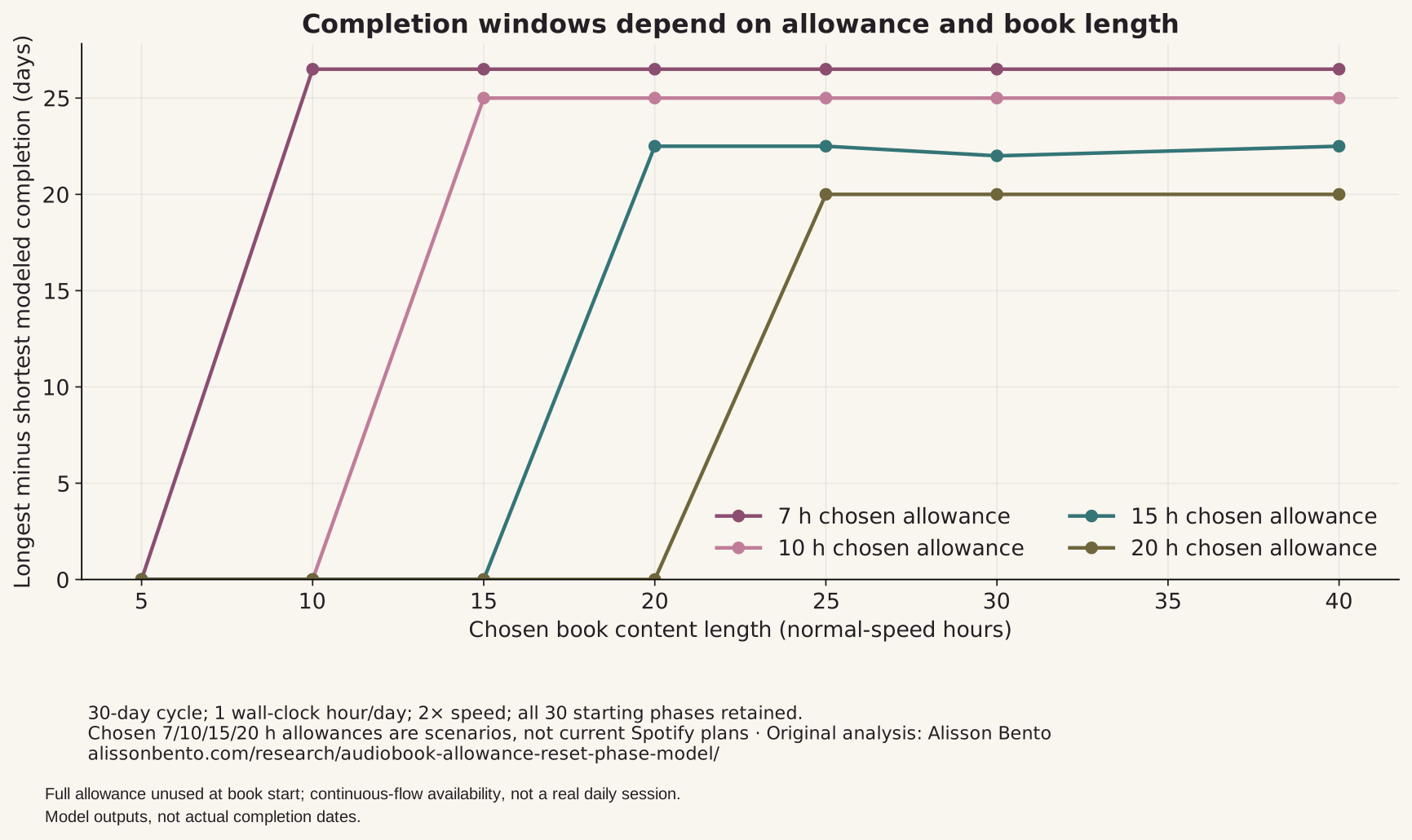
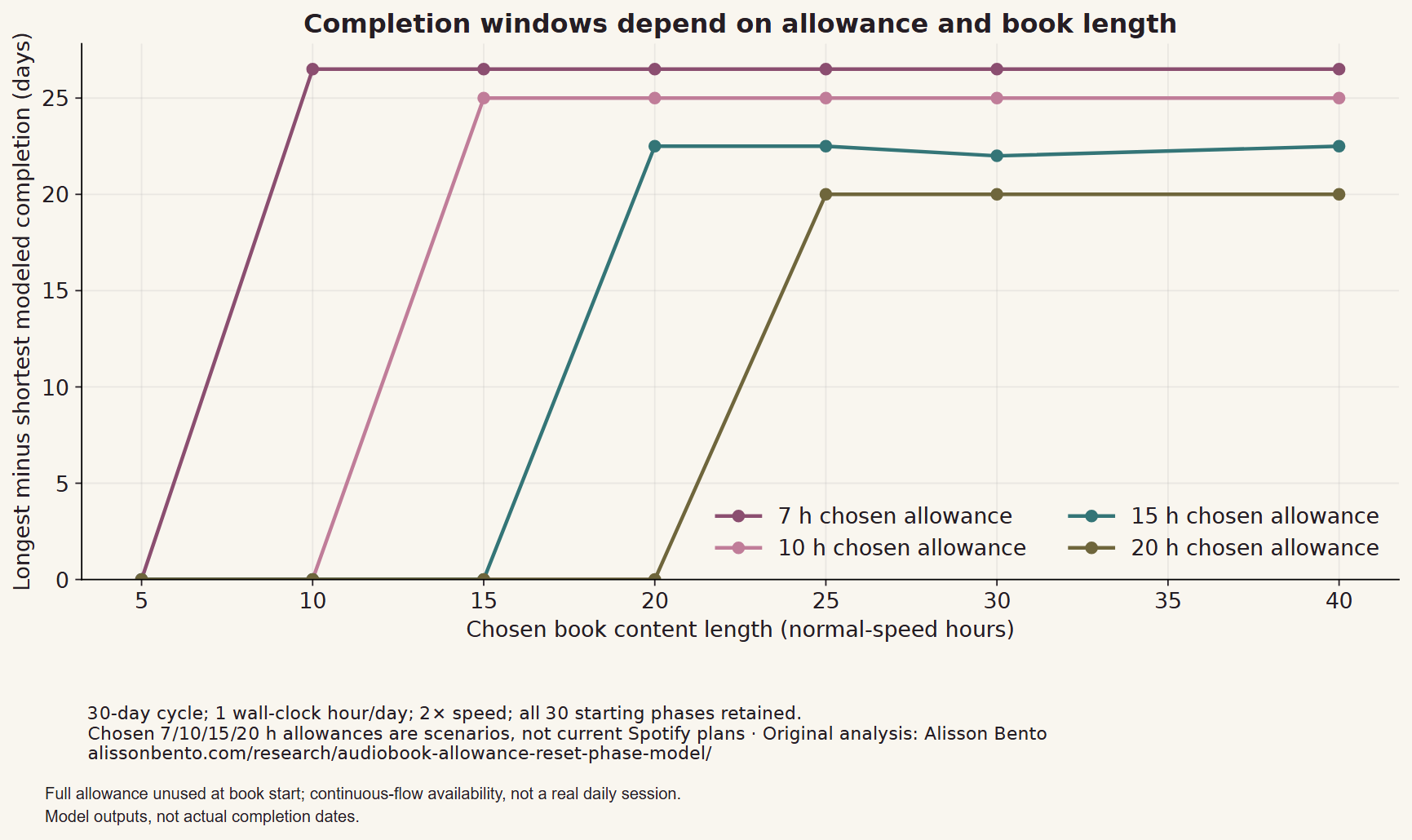
Completion windows depend on allowance and book length
Phase sensitivity for seven chosen content lengths and hypothetical 7, 10, 15 and 20-hour allowances, at two-times playback, thirty-day cycles and one continuous wall-clock hour per elapsed day. Each allowance is fully unused initially; these are not observed consumer ranges or a list of current plans.
Full chart and source
Scroll horizontally to inspect the chart. ↔
Chart and values
Scroll horizontally to see all columns.
| Content length (h) | Chosen allowance (h) | Shortest modeled days | Longest modeled days | Phase spread (days) |
|---|---|---|---|---|
| 5 | 7 | 2.5 | 2.5 | 0 |
| 5 | 10 | 2.5 | 2.5 | 0 |
| 5 | 15 | 2.5 | 2.5 | 0 |
| 5 | 20 | 2.5 | 2.5 | 0 |
| 10 | 7 | 5 | 31.5 | 26.5 |
| 10 | 10 | 5 | 5 | 0 |
| 10 | 15 | 5 | 5 | 0 |
| 10 | 20 | 5 | 5 | 0 |
| 15 | 7 | 34 | 60.5 | 26.5 |
| 15 | 10 | 7.5 | 32.5 | 25 |
| 15 | 15 | 7.5 | 7.5 | 0 |
| 15 | 20 | 7.5 | 7.5 | 0 |
| 20 | 7 | 36.5 | 63 | 26.5 |
| 20 | 10 | 10 | 35 | 25 |
| 20 | 15 | 10 | 32.5 | 22.5 |
| 20 | 20 | 10 | 10 | 0 |
| 25 | 7 | 65.5 | 92 | 26.5 |
| 25 | 10 | 37.5 | 62.5 | 25 |
| 25 | 15 | 12.5 | 35 | 22.5 |
| 25 | 20 | 12.5 | 32.5 | 20 |
| 30 | 7 | 94.5 | 121 | 26.5 |
| 30 | 10 | 40 | 65 | 25 |
| 30 | 15 | 15.5 | 37.5 | 22 |
| 30 | 20 | 15 | 35 | 20 |
| 40 | 7 | 126 | 152.5 | 26.5 |
| 40 | 10 | 70 | 95 | 25 |
| 40 | 15 | 42.5 | 65 | 22.5 |
| 40 | 20 | 20 | 40 | 20 |
One wall-clock hour/day as continuous flow, 2× playback, constant thirty-day cycles and all thirty whole-day initial phases. Every chosen allowance starts fully unused. Values do not enumerate current Spotify plans or observed listener ranges.
Data & downloads
Scroll horizontally to see all columns.
| Days until first reset | 1×: modeled elapsed days | 1.5×: modeled elapsed days | 2×: modeled elapsed days |
|---|---|---|---|
| 1 | 35 | 33.333 | 32.5 |
| 2 | 35 | 33.333 | 32.5 |
| 3 | 35 | 33.333 | 10 |
| 4 | 35 | 13.333 | 10 |
| 5 | 20 | 13.333 | 10 |
| 6 | 20 | 13.333 | 10 |
| 7 | 20 | 13.333 | 10 |
| 8 | 20 | 13.333 | 10.5 |
| 9 | 20 | 13.333 | 11.5 |
| 10 | 20 | 13.333 | 12.5 |
| 11 | 20 | 14.333 | 13.5 |
| 12 | 20 | 15.333 | 14.5 |
| 13 | 20 | 16.333 | 15.5 |
| 14 | 20 | 17.333 | 16.5 |
| 15 | 20 | 18.333 | 17.5 |
| 16 | 21 | 19.333 | 18.5 |
| 17 | 22 | 20.333 | 19.5 |
| 18 | 23 | 21.333 | 20.5 |
| 19 | 24 | 22.333 | 21.5 |
| 20 | 25 | 23.333 | 22.5 |
| 21 | 26 | 24.333 | 23.5 |
| 22 | 27 | 25.333 | 24.5 |
| 23 | 28 | 26.333 | 25.5 |
| 24 | 29 | 27.333 | 26.5 |
| 25 | 30 | 28.333 | 27.5 |
| 26 | 31 | 29.333 | 28.5 |
| 27 | 32 | 30.333 | 29.5 |
| 28 | 33 | 31.333 | 30.5 |
| 29 | 34 | 32.333 | 31.5 |
| 30 | 35 | 33.333 | 32.5 |
Full unused fifteen-hour allowance at the start, constant thirty-day cycles and one wall-clock hour per elapsed day represented as continuous flow. No top-ups, carryover, replay or observed behavior; outputs are modeled elapsed days, not actual completion dates.
Scroll horizontally to see all columns.
| Content length (h) | Chosen allowance (h) | Shortest modeled days | Longest modeled days | Phase spread (days) |
|---|---|---|---|---|
| 5 | 7 | 2.5 | 2.5 | 0 |
| 5 | 10 | 2.5 | 2.5 | 0 |
| 5 | 15 | 2.5 | 2.5 | 0 |
| 5 | 20 | 2.5 | 2.5 | 0 |
| 10 | 7 | 5 | 31.5 | 26.5 |
| 10 | 10 | 5 | 5 | 0 |
| 10 | 15 | 5 | 5 | 0 |
| 10 | 20 | 5 | 5 | 0 |
| 15 | 7 | 34 | 60.5 | 26.5 |
| 15 | 10 | 7.5 | 32.5 | 25 |
| 15 | 15 | 7.5 | 7.5 | 0 |
| 15 | 20 | 7.5 | 7.5 | 0 |
| 20 | 7 | 36.5 | 63 | 26.5 |
| 20 | 10 | 10 | 35 | 25 |
| 20 | 15 | 10 | 32.5 | 22.5 |
| 20 | 20 | 10 | 10 | 0 |
| 25 | 7 | 65.5 | 92 | 26.5 |
| 25 | 10 | 37.5 | 62.5 | 25 |
| 25 | 15 | 12.5 | 35 | 22.5 |
| 25 | 20 | 12.5 | 32.5 | 20 |
| 30 | 7 | 94.5 | 121 | 26.5 |
| 30 | 10 | 40 | 65 | 25 |
| 30 | 15 | 15.5 | 37.5 | 22 |
| 30 | 20 | 15 | 35 | 20 |
| 40 | 7 | 126 | 152.5 | 26.5 |
| 40 | 10 | 70 | 95 | 25 |
| 40 | 15 | 42.5 | 65 | 22.5 |
| 40 | 20 | 20 | 40 | 20 |
One wall-clock hour/day as continuous flow, 2× playback, constant thirty-day cycles and all thirty whole-day initial phases. Every chosen allowance starts fully unused. Values do not enumerate current Spotify plans or observed listener ranges.
Evidence & method
How we calculated it
- This is an exploratory deterministic model with explicitly chosen inputs, not a survey or observed outcome study.
- Run the included Python 3 standard-library recipe to reproduce the complete CSV and JSON outputs; exact fractions preserve the arithmetic.
- All source rules, starting conditions, unsupported inputs and exclusions are stated in the visible article and downloadable methods.
What the data cannot tell us
- The entire chosen allowance is unused at the start, even one day before reset. Smaller actual starting balances are outside this fixed design.
- Daily availability is a continuous flow, not one real discrete listening session. Fractional elapsed days are model quantities, not consumer completion dates.
- The chosen 7/10/15/20-hour allowances and constant 28/30/31-day cycles do not enumerate current Spotify plans or actual monthly billing calendars.
- No account eligibility, title availability, app-meter behavior, reader sample, comprehension, price or monetary value was tested.
- Top-ups, add-ons, separately purchased titles, replay and interruptions are excluded; source exceptions are not silently folded into the model.
- Case counts and per-profile ranges are not population prevalence or confidence intervals.
Original sources
- Spotify Audiobooks in Premium plans
No source-backed claim that every chosen 7/10/15/20 h scenario or constant 28/30/31-day cycle is an actual plan. No title availability or listener account was tested.
Accessed October 31, 2026
Cite & reuse this study
Alisson Bento. Why audiobook hours alone do not determine a completion window. Original bounded computational reference; source rules accessed 31 October 2026. https://alissonbento.com/research/audiobook-allowance-reset-phase-model/
Original article, derived calculations and charts by Alisson Bento. Third-party provider pages and trademarks remain their owners’ material; no provider endorsement or blanket rights in books, recordings or full source pages are implied.
Corrections or editorial questions