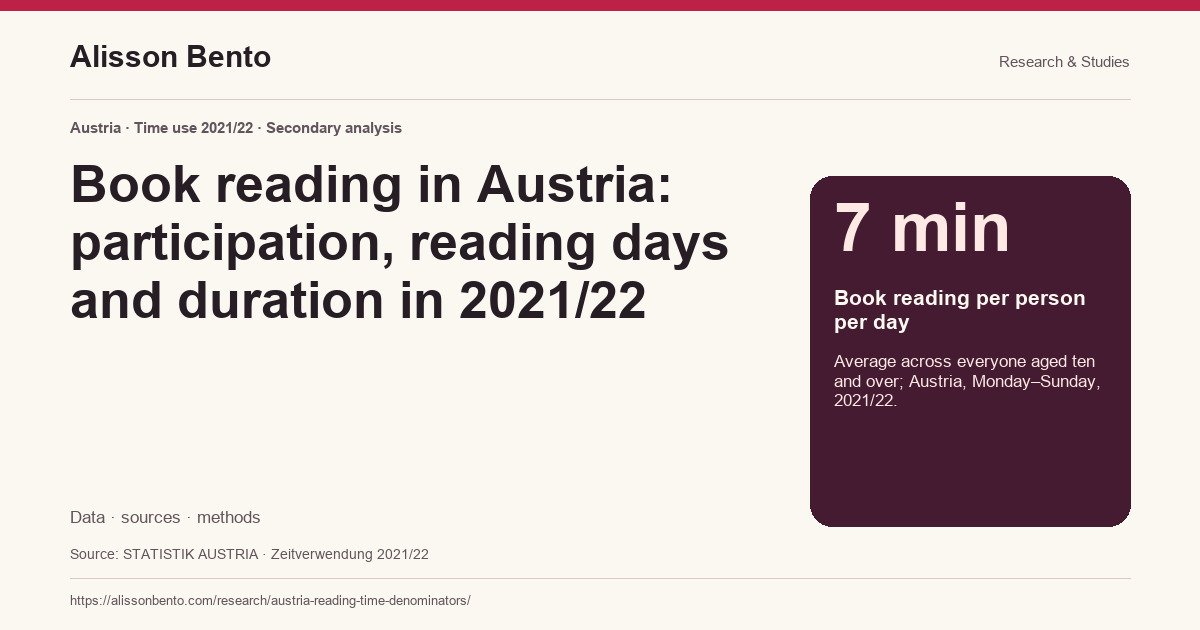
Three numbers answering three different questions
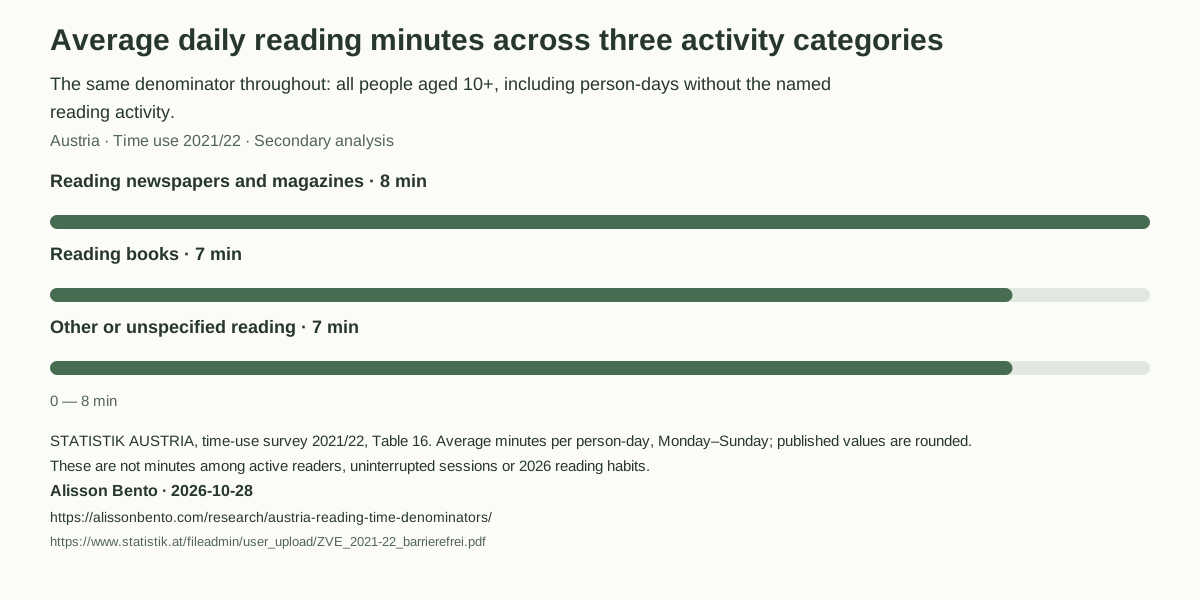
How much space does book reading occupy in everyday life? The answer depends on whether we mean everyone surveyed, days when reading actually occurred, or participation across several observation days. In Austria’s survey, the daily population average answers the first question. It includes people and days without recorded book reading, so it does not describe a typical reading session.
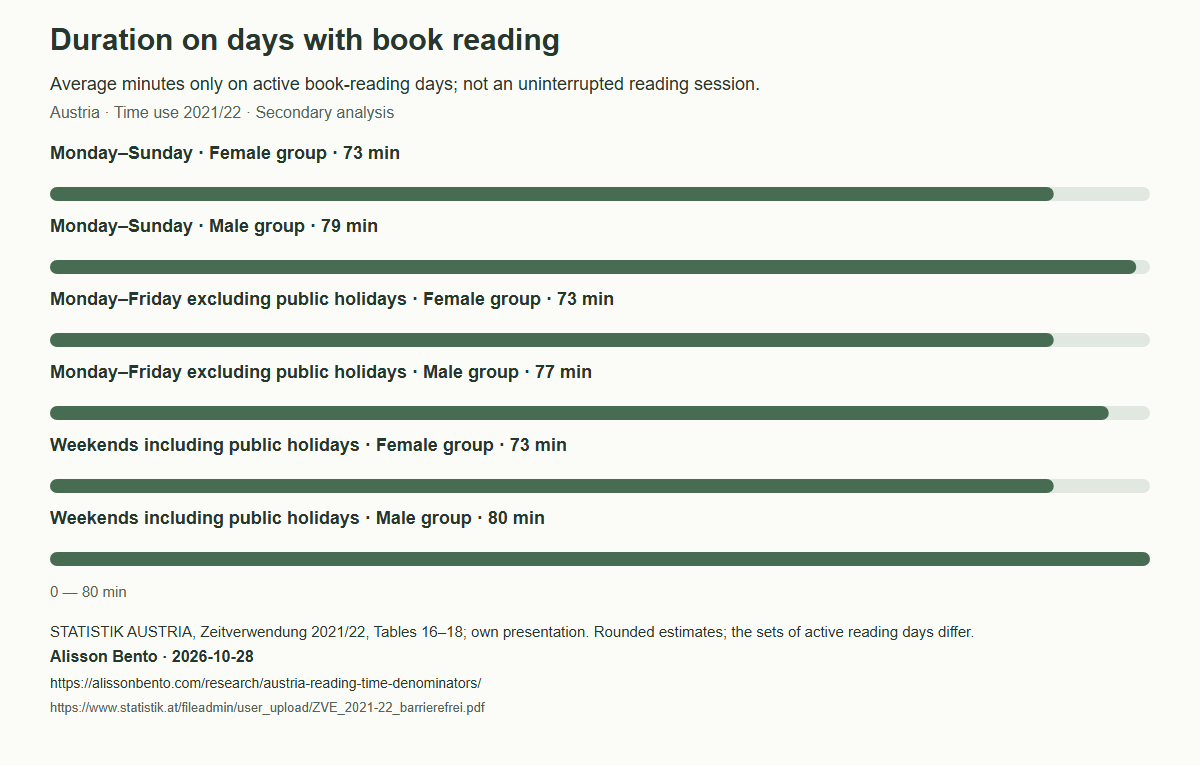
The 75 minutes refer only to active reading days. A person could have accumulated that time in several separate periods. The table does not establish uninterrupted attention, chapter or page counts. It did not measure reading speed either.
The report uses another definition for participation: a person participates if the activity appears on at least one of their two diary days. The Monday–Sunday figure of 14.4% is therefore not the probability of reading a book on a randomly chosen day. It is not an annual readership rate. This distinction is essential when reusing the data.
Participation and duration show different sex gaps
Across both diary days, published book-reading participation is 18.1% for women and girls and 10.6% for men and boys. The difference between these rounded table estimates is 7.5 percentage points. Table headings shorten the groups to women and men, although the survey population starts at age ten.
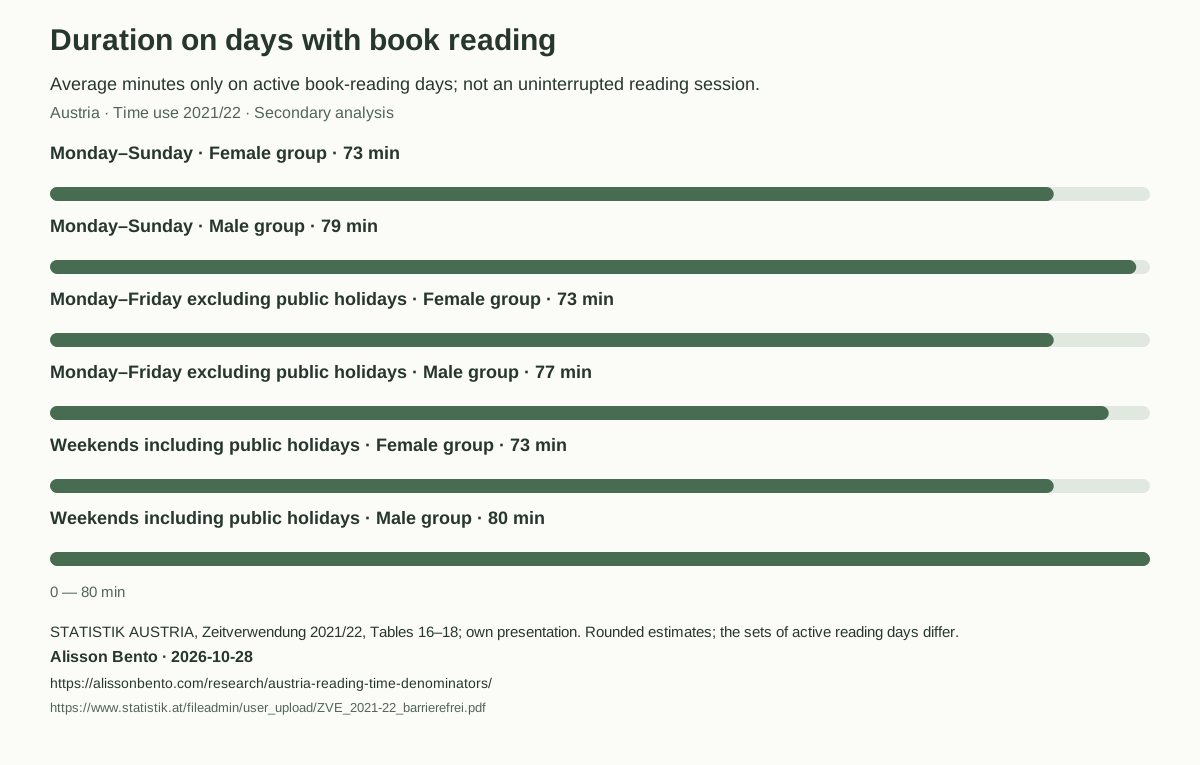
On active book-reading days, the female group averages 73 minutes and the male group 79 minutes. This descriptive difference therefore points in the opposite direction to participation. It says nothing about reading ability, interest in particular genres or the length of an uninterrupted session. People who read may also differ in age and other characteristics.
Daily averages across all people are eight and five minutes respectively, a gap of three minutes in the rounded estimates. An exact arithmetic division of that gap into a participation contribution and a duration contribution would be invalid using the published overall figures: participation counts people across two days, while duration refers to active days.
What weekdays and weekends add
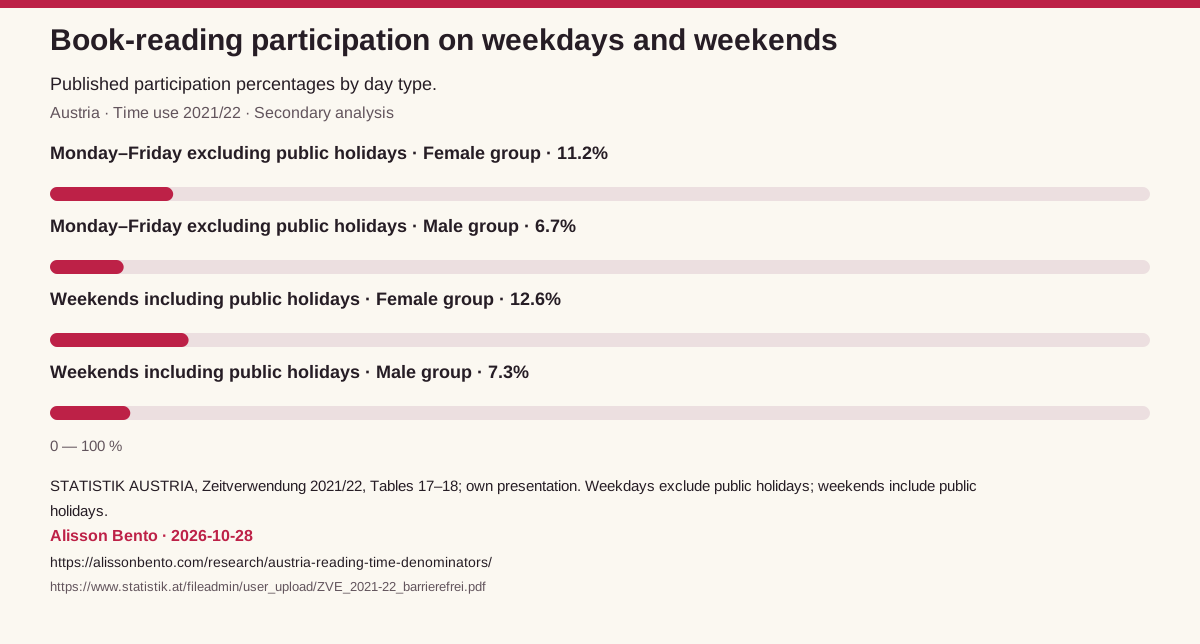
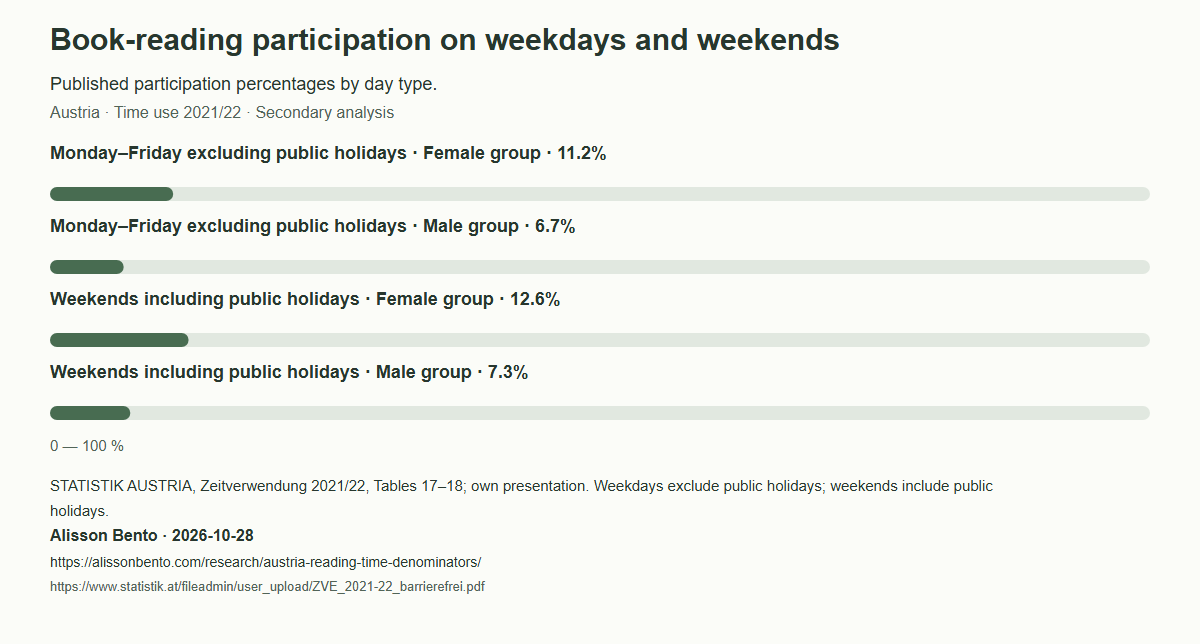
The separate day-type tables report female participation of 11.2% on weekdays excluding public holidays and 12.6% on weekends including public holidays. The corresponding male figures are 6.7% and 7.3%. The descriptive sex gaps are therefore 4.5 and 5.3 percentage points. The difference between those gaps is 0.8 percentage points; we do not present it as a statistically established effect.
Average duration on active book-reading days remains 73 minutes for the female group in both day types. The male estimate increases from 77 to 80 minutes. Averages across everyone are eight and nine minutes for the female group, and five and six minutes for the male group.
This comparison provides more detail than a single weekly estimate. It does not show that work causes the difference or that the same individuals read more at weekends. These are weighted survey estimates, not an experiment or long-term tracking of individual reading habits.
Keeping books, newspapers and other reading separate
The source distinguishes book reading, newspapers and magazines, and a residual category for other or unspecified reading. For newspapers and magazines, the overall estimates are eight minutes per person per day, 23.4% participation across both days, and 50 minutes per active day. For the residual category, they are seven minutes, 16.5% and 62 minutes.
These percentages cannot be added to obtain a share of uniquely identified readers. The same person may appear in several reading activities. Nor can conditional durations be summed as total reading time: each refers to a different set of active days. The table therefore presents the three activities alongside one another.
This page contributes a checkable comparison of denominators and the published sex and day-type differences. All underlying estimates come from STATISTIK AUSTRIA. We did not conduct our own population survey or measure the current German or Austrian romance market.
How editors and reading programmes can use these figures
For an article about the place of books within the daily timetable, the average across everyone is useful. For the time accumulated on days with book reading, use the active-day duration. Participation can describe reach during the short observation window if the two days are stated explicitly.
The data do not establish an optimal reading timetable for an individual. Someone developing a personal routine can first note the time they actually have available and choose reading times that fit their daily life. That plan is an individual choice; the survey estimates do not guarantee a change in habits.
When quoting the figures, include the country, survey years, minimum age, activity and denominator together. The shorthand “Austria reads for seven minutes” omits essential information. All 27 comparison rows and the calculations of descriptive gaps are available to download.
Book-reading participation on weekdays and weekends
Published participation percentages by day type.
Scroll horizontally to inspect the chart. ↔
Chart values as text
Duration on days with book reading
Average minutes only on active book-reading days; not an uninterrupted reading session.
Scroll horizontally to inspect the chart. ↔
Chart values as text
Average daily reading minutes across three activity categories
The same denominator throughout: all people aged 10+, including person-days without the named reading activity.
Scroll horizontally to inspect the chart. ↔
Chart values as text
Data & downloads
Scroll horizontally to see all columns.
| Day type | Group | Activity | Minutes/all person-days | Participation (%) | Minutes/active days |
|---|---|---|---|---|---|
| Monday–Sunday | All people | Reading newspapers and magazines | 8 | 23.4 | 50 |
| Monday–Sunday | Female group | Reading newspapers and magazines | 7 | 23.1 | 45 |
| Monday–Sunday | Male group | Reading newspapers and magazines | 9 | 23.8 | 54 |
| Monday–Sunday | All people | Reading books | 7 | 14.4 | 75 |
| Monday–Sunday | Female group | Reading books | 8 | 18.1 | 73 |
| Monday–Sunday | Male group | Reading books | 5 | 10.6 | 79 |
| Monday–Sunday | All people | Other or unspecified reading | 7 | 16.5 | 62 |
| Monday–Sunday | Female group | Other or unspecified reading | 8 | 20.5 | 60 |
| Monday–Sunday | Male group | Other or unspecified reading | 5 | 12.4 | 65 |
| Monday–Friday excluding public holidays | All people | Reading newspapers and magazines | 7 | 15.7 | 47 |
| Monday–Friday excluding public holidays | Female group | Reading newspapers and magazines | 7 | 15.2 | 44 |
| Monday–Friday excluding public holidays | Male group | Reading newspapers and magazines | 8 | 16.3 | 51 |
| Monday–Friday excluding public holidays | All people | Reading books | 7 | 9.0 | 74 |
| Monday–Friday excluding public holidays | Female group | Reading books | 8 | 11.2 | 73 |
| Monday–Friday excluding public holidays | Male group | Reading books | 5 | 6.7 | 77 |
| Monday–Friday excluding public holidays | All people | Other or unspecified reading | 6 | 11.0 | 55 |
| Monday–Friday excluding public holidays | Female group | Other or unspecified reading | 7 | 13.6 | 55 |
| Monday–Friday excluding public holidays | Male group | Other or unspecified reading | 4 | 8.2 | 55 |
| Weekends including public holidays | All people | Reading newspapers and magazines | 9 | 16.0 | 55 |
| Weekends including public holidays | Female group | Reading newspapers and magazines | 7 | 15.4 | 49 |
| Weekends including public holidays | Male group | Reading newspapers and magazines | 10 | 16.6 | 61 |
| Weekends including public holidays | All people | Reading books | 7 | 10.0 | 75 |
| Weekends including public holidays | Female group | Reading books | 9 | 12.6 | 73 |
| Weekends including public holidays | Male group | Reading books | 6 | 7.3 | 80 |
| Weekends including public holidays | All people | Other or unspecified reading | 8 | 10.2 | 76 |
| Weekends including public holidays | Female group | Other or unspecified reading | 9 | 12.6 | 72 |
| Weekends including public holidays | Male group | Other or unspecified reading | 6 | 7.7 | 82 |
Minutes are rounded means. Overall participation means at least one of two diary days; see the source for separate day types. Minimum age: ten.
Scroll horizontally to see all columns.
| Day type | Participation (percentage points) | Minutes/all person-days | Minutes/active days |
|---|---|---|---|
| Monday–Sunday | 7.5 | 3 | -6 |
| Monday–Friday excluding public holidays | 4.5 | 3 | -4 |
| Weekends including public holidays | 5.3 | 3 | -7 |
Female minus male group throughout; calculated from rounded estimates, without significance tests.
Evidence & method
How we calculated it
- The sole underlying source is STATISTIK AUSTRIA’s publicly available Zeitverwendung 2021/22 report (Vienna, 2023). Fieldwork ran from October 2021 to December 2022 and involved 4,342 households. People aged ten and over completed a diary on a weekday and a weekend or public-holiday day. Activities were recorded in ten-minute intervals.
- The source weights its sample using sociodemographic characteristics. This page analyses published rounded aggregate estimates and calculates no new sample weights. The groups are the sex categories published in the report.
- From Tables 16, 17 and 18, we extracted three reading activities for the total population, females and males: 3 day types × 3 reading activities × 3 groups = 27 rows. Relevant PDF pages are 158, 162 and 166 (printed pages 156, 160 and 164). Denominator definitions appear on PDF page 36 (printed page 34).
- Times were converted from hours:minutes to whole minutes. Percentage-point gaps equal female minus male participation within each day type. Time gaps use the separately published rounded estimates. A percentage-point difference is not a relative percentage change.
- The overall book-reading row was visually checked against the original. Additional automated control values check the extracted seven minutes, 14.4%, 75 minutes, 18.1% and 79 minutes. The script re-extracts all 27 rows from the same public PDF and records its SHA-256 checksum.
- The analysis was prepared on 28 October 2026. The year 2026 refers to the analysis, not the observation period. If the source file changes, the extraction must be checked again.
What the data cannot tell us
- The results describe Austria in 2021/22, including a pandemic-affected period, rather than reading behaviour in 2026 or in Germany.
- The population begins at age ten. These are not adult-only statistics or an audience analysis for adult novels.
- The recorded main activity is measured. Reading alongside another activity, very short periods and missing diary entries may be recorded differently or not appear.
- Book reading does not identify genres, sales, completed books or words read. These rows do not distinguish formats or genres.
- Percentages and times are rounded and subject to sampling uncertainty. These tables provide no standard errors for the reading cells analysed. We therefore make no claims of statistical significance.
- Participation across two days, all-person daily averages and active-day duration use different denominators. They are not multiplied into a supposedly exact decomposition.
- The same people may appear in the three reading activities. Participation percentages cannot therefore be added as counts of unique readers. No causal claims are made about sex, work, parenthood or media use.
Original sources
- STATISTIK AUSTRIA: Zeitverwendung 2021/22 – Ergebnisse der Zeitverwendungserhebung (2023)
Underlying data and methods: Tables 16–18 and Section 2.10.2. The imprint permits accurate reproduction and adaptation with source attribution and an adaptation notice.
Accessed October 28, 2026
Cite & reuse this study
Alisson Bento (2026). Book reading in Austria: participation, reading days and duration in 2021/22. Independent analysis of published STATISTIK AUSTRIA data, Zeitverwendung 2021/22 (2023), Tables 16–18. https://alissonbento.com/research/austria-reading-time-denominators/
Underlying data: STATISTIK AUSTRIA. Extracted table content has been structured and supplemented with descriptive differences. When reusing it, retain the source, adaptation notice, period and denominators; observe the original report’s rights conditions.
Corrections or editorial questions