Two tasks hidden inside one book reference
A reader following a citation often needs two different things: the exact part that supports a claim and a comfortable way to read its surrounding book. Those tasks can lead to different records. A chapter DOI can identify the cited part, while an EPUB publication belongs to the parent book. Replacing the chapter record with the book record may improve format discovery while weakening the reference. Keeping only the chapter can have the opposite effect.
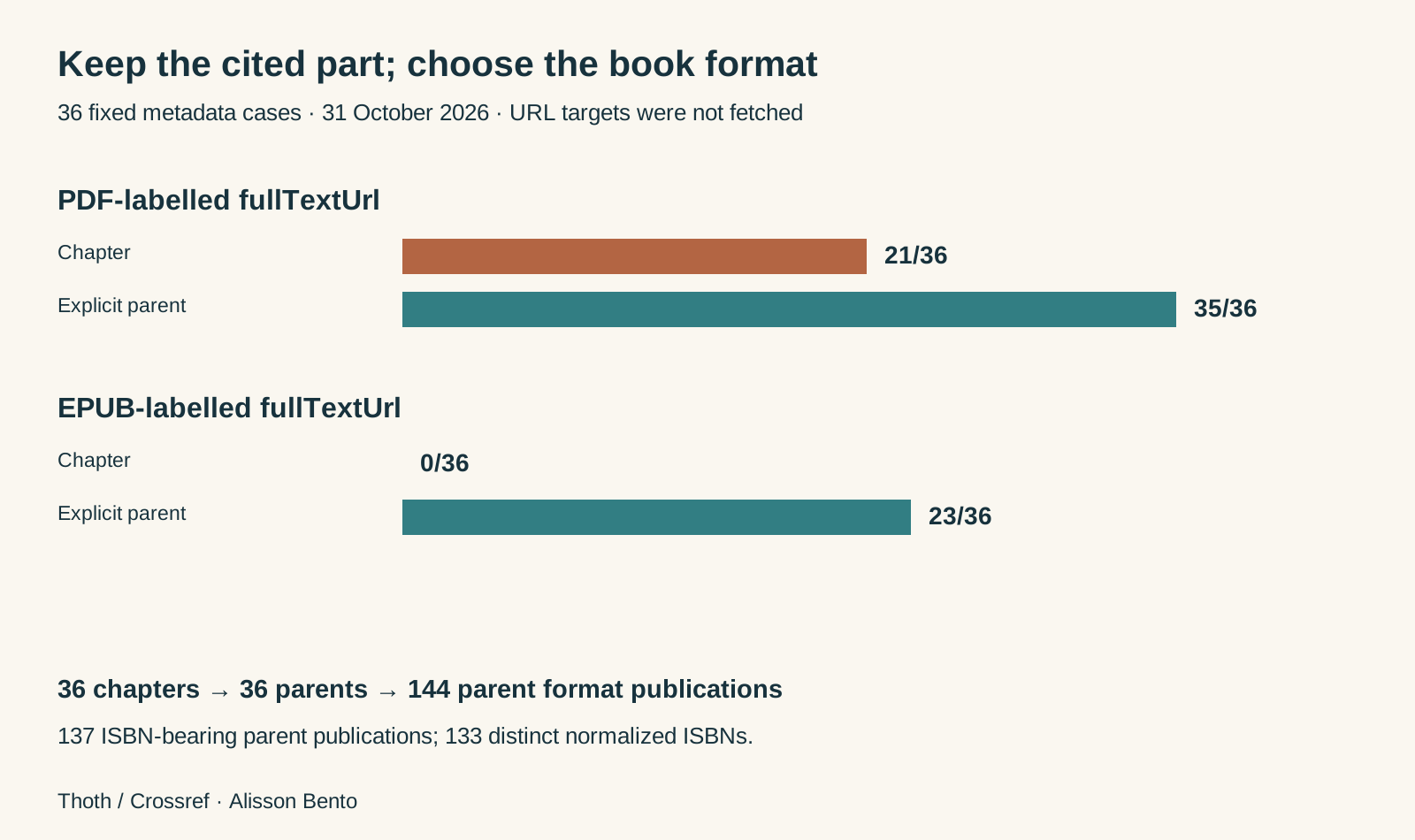
This study follows explicit relationships in a fixed frame of thirty-six chapter records from Thoth, an open metadata service for scholarly books. All thirty-six identify a distinct parent record. The graph contains 144 parent format publications, of which 137 have an ISBN. None of the thirty-one format publications attached directly to the chapter records has an ISBN. These counts describe metadata objects in this frame, not thirty-six creative works or 144 different books.
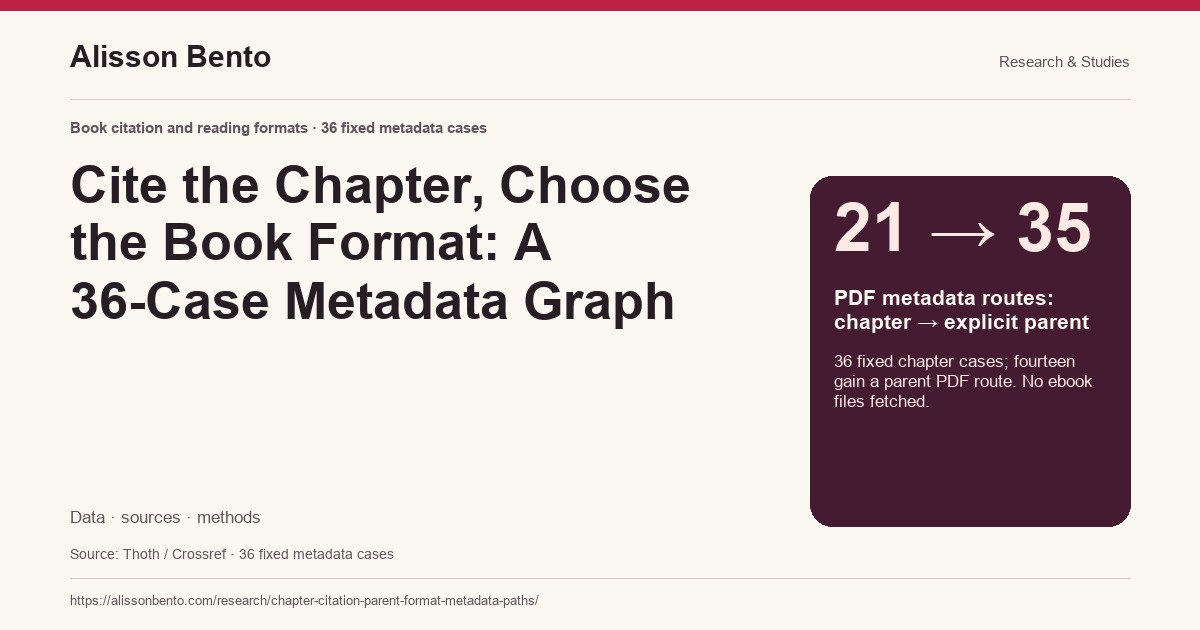
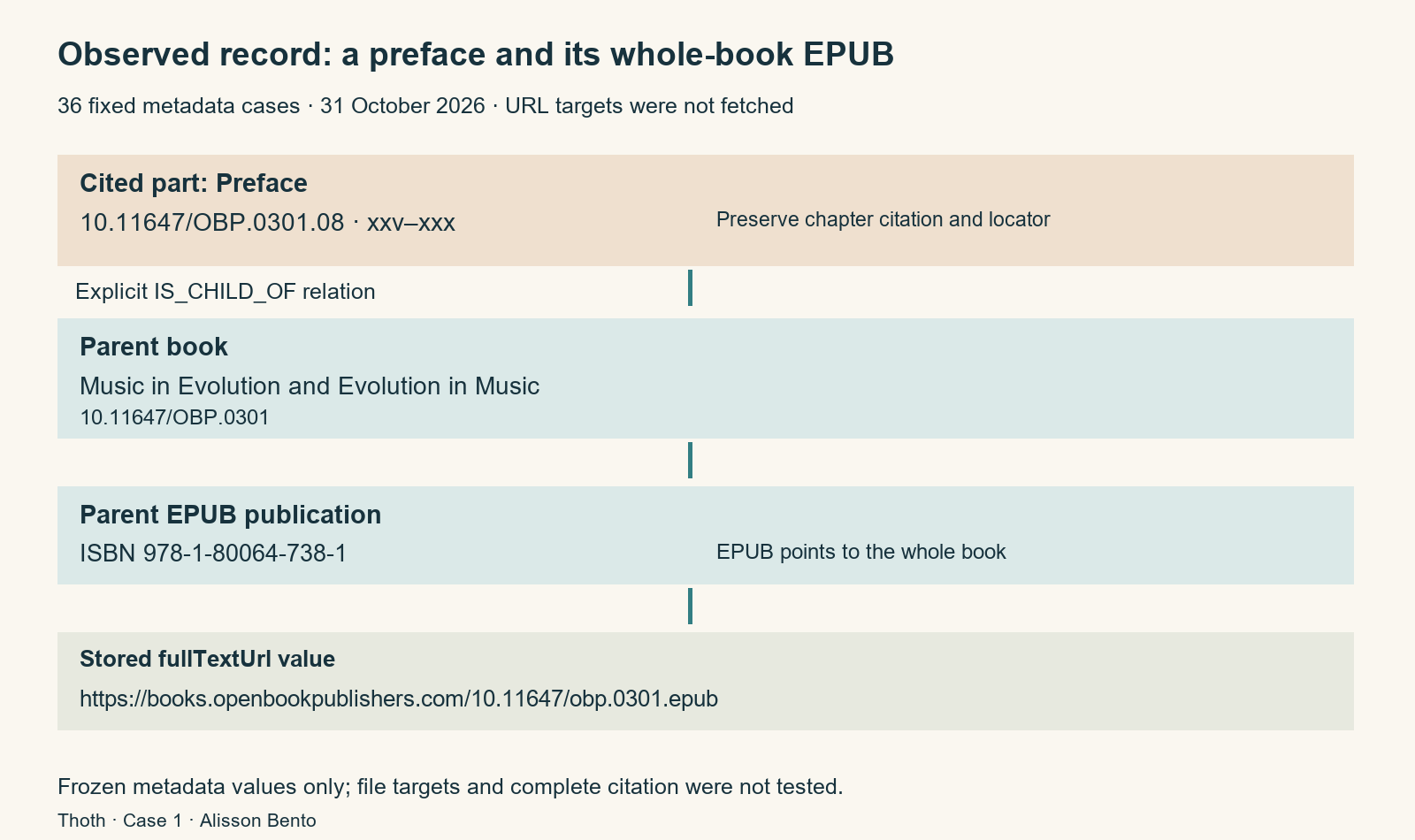
The useful result is a retrieval branch. Twenty-one chapter records supply a PDF full-text URL in a format-labelled publication; their explicit parents supply one in thirty-five cases. No chapter supplies an EPUB route, while twenty-three explicit parents do. A catalogue can keep the cited part and offer a separately labelled whole-book reading option. The extra route should not silently replace the citation.
The fixed case frame and its boundaries
The analysis plan was recorded before inspecting chapter outcomes. Selection takes the first thirty-six ACTIVE chapter records ordered by work UUID in ascending order from the public Thoth GraphQL API. All publishers are eligible. The minimum for proceeding was twenty-four retrievable chapter records and eight distinct explicit parents. No failed or inconvenient case is replaced. The API request and response are pinned with a timestamp and fingerprint.
This is a bounded case study, not a probability sample. UUID ordering is a reproducible selection rule for the frozen response, but it does not make the cases representative of open access publishing, all Thoth records, library catalogues or commercial ebooks. Sixteen parents use an Open Book Publishers DOI prefix; other prefixes also appear. That composition is a property of this frame, not an estimate of publisher market share.
The starting objects are classified as book chapters by Thoth. They include prefatory material, so the results must not be presented as thirty-six substantive argument chapters. A chapter is the source record type here. It is not a guarantee about the literary function, length, novelty or independent usefulness of the item. The case ledger retains titles and page fields to make that distinction inspectable.
What counts as a usable metadata path
For this audit, a parent path requires an explicit IS_CHILD_OF or IS_PART_OF relationship to a parent work ID. A similar title, an ISBN match or a DOI suffix is not used to invent a relationship. Every selected record has exactly one qualifying relation in the pinned response. Those relations reach thirty-six different parent IDs; there is no repeated parent within the selected chapter frame.
A format route requires a publication explicitly labelled PDF or EPUB and at least one nonempty fullTextUrl on one of that publication’s locations. A URL stored only in a landingPage field does not pass that narrower rule. Neither does an EPUB publication with no full-text URL. The distinction matters: twenty-five parents have an EPUB publication record, but only twenty-three meet the URL rule.
The audit does not fetch the ebook files. A stored URL is evidence of a metadata route, not proof that the file is currently reachable, downloadable without an account, complete, accessible, correctly formatted or legally reusable. The graph tells an interface where to offer a carefully labelled next step. It cannot certify what will happen after the user follows it.
A nonempty fullTextUrl is the provider’s field value, not necessarily a direct file address. Some PDF-labelled pointers in this frame lead to catalogue-style addresses, including AOSIS records ending in /catalog/book/566 and /catalog/book/262. They still pass the declared metadata-field rule. They must not be described as verified PDF files, and a reader-facing link should identify that it may open a catalogue page. A stricter rule requiring downloaded bytes and a validated media type would answer a different question and could produce a lower count.
The PDF and EPUB decisions differ
The chapter PDF field route is present in twenty-one of the thirty-six cases. Parent traversal yields a parent PDF route in thirty-five. Within this exact frame, fourteen cases therefore gain a PDF metadata route when the question changes from the cited part to its explicit parent. That is a gain in discoverable whole-book options, not evidence that fourteen chapter files are missing from the internet.
The EPUB difference is larger. Chapter publications supply no EPUB full-text URL, while twenty-three parents do. This pattern gives a reader a reason to traverse upward when seeking a reflowable whole-book edition. It gives no reason to claim that those EPUBs contain identical pagination, preserve every feature of a chapter PDF, or support the same page reference.
A useful interface would offer “Cited part” and “Whole book: EPUB” as separate destinations where the metadata supports both. When only the parent PDF route is available, the label should identify that scope too. The interface must preserve the selected chapter’s title, DOI and available page range while making the broader reading context visible.
ISBNs in chapter records can describe the container
Thirty selected Thoth chapter records have a DOI. Public Crossref lookups return twenty-eight records for them; two return HTTP 404, and six selected chapters have no DOI in the Thoth response. Of the twenty-eight retrieved records, twenty-seven are typed book-chapter and one is typed posted-content. The latter is retained as a cross-system type disagreement, not coerced into a chapter category.
Twenty-five of the twenty-eight retrieved chapter-side Crossref records include ISBNs. In every one of those twenty-five cases, at least one ISBN also appears on an explicitly linked parent-format publication in Thoth after removing hyphens for comparison. Eighteen records contain multiple ISBNs. Fifteen contain more than one ISBN labelled electronic in Crossref’s isbn-type field.
That result is a practical warning for imports. An ISBN encountered inside a chapter JSON record does not establish that the chapter has its own ISBN-bearing artifact. The broad electronic label also does not necessarily choose between PDF, EPUB, HTML or another electronic publication. In this frame, typed parent publication records provide the more specific format association. The ISBN overlap corroborates a container association; it does not establish creative-work identity.
The parent graph adds a second warning. Its 137 ISBN-bearing publications contain 133 distinct normalized ISBN strings. Two parent records each reuse one ISBN across paperback, PDF and HTML publications: Educational Utopias, with 9789464851359, and AI Ergo Sum, with 9789403870809. No shared ISBN crosses parent IDs in this frame. These are recorded shared values, not a judgement of compliance. Even after the parent is known, the ISBN alone cannot distinguish those three format nodes; the publication type and location remain necessary.
Why a parent-only catalogue loses the cited unit
Rolling the selected chapters up to their thirty-six explicit parents does not reduce the number of rows in this particular frame, because every selected chapter has a different parent. The study therefore makes no claim about how many sibling chapters a parent grouping would merge. A lower row count is not needed for information loss: replacing a chapter record with its parent still changes what the row identifies.
Thirty chapter DOIs and thirty-three chapter first-and-last-page pairs are present in the pinned Thoth data. A parent-only export cannot be assumed to preserve them unless it carries a separate child reference. Similarly, exporting all 137 ISBN-bearing parent format publications as if each were a separate cited book would expand one parent record into several format objects without adding evidence of additional intellectual works.
The defensible counting unit depends on the task. Count the thirty-six seed chapter records for this audit’s citation paths; count the thirty-six explicit parents for its book-context paths; count 144 parent publications for format inventory. None of those units can substitute for the others. An author portfolio, library holdings report or journalist’s citation count must declare which object it means before presenting a total.
Registry lookups preserve unknowns
The combined registry check makes sixty-six public Crossref requests: thirty chapter DOI lookups and thirty-six distinct parent DOI lookups. Sixty return HTTP 200 and six return HTTP 404. The latter are not evidence that the DOI is invalid or that the book does not exist. Crossref is one registration service, and this study does not query alternative agencies to fill those gaps.
None of the twenty-eight retained chapter-side metadata snapshots contains the explicit parent DOI as an exact identifier value. This observation is not a newly discovered defect. A Crossref staff post from March 2025 already describes the missing book DOI in chapter JSON and documents an XML retrieval route. The present audit does not test that XML route, so it cannot compare its coverage or reliability with Thoth.
A robust importer should distinguish a missing chapter DOI in the starting metadata, an unsuccessful lookup at one registry, a different registry type, and a missing typed parent identifier in a successful response. Combining all four into “bad metadata” would erase the operational distinction that determines the next useful action.
Worked example: one preface, several reading formats
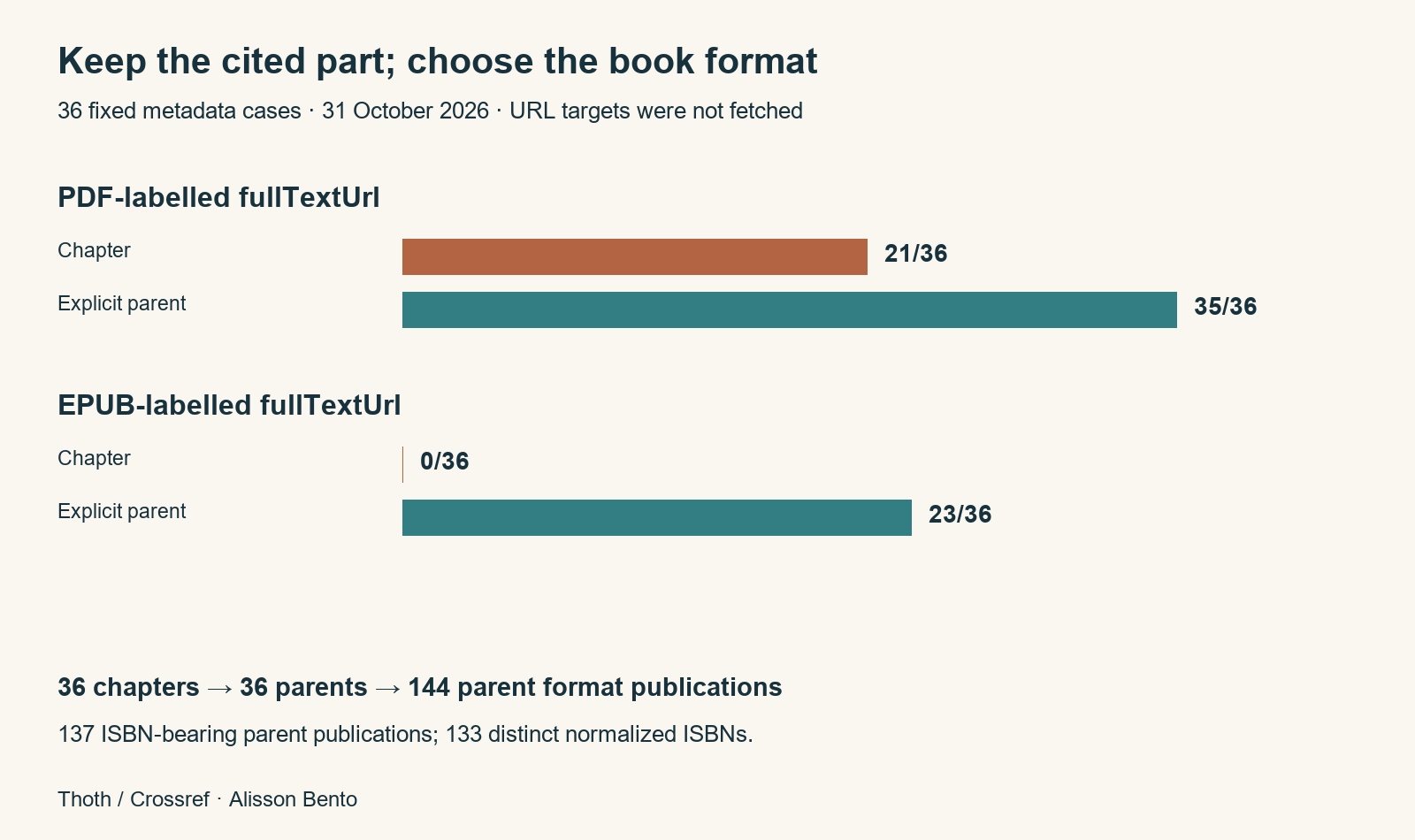
The first selected record is the preface to Music in Evolution and Evolution in Music. Its chapter DOI is 10.11647/OBP.0301.08, and its explicit parent DOI is 10.11647/OBP.0301. The parent has seven format publications in the frozen graph: paperback, hardback, PDF, HTML, XML, EPUB and AZW3. Each of those parent publications has an ISBN.
The chapter-side Crossref record includes those seven ISBNs, separating print and electronic categories. That response is useful bibliographic context, but an importer that treats every listed ISBN as a separate preface edition would attach parent format identity to a child item. The Thoth path preserves the distinction: preface record, explicit parent relation, selected parent publication, and its location.
For someone quoting the preface, the cited unit remains the preface. For someone wanting the surrounding volume on an ereader, the parent EPUB branch is useful. Those decisions can coexist in one catalogue display. The metadata graph enables that separation without claiming the files were downloaded or that one format is equivalent to another for every scholarly purpose.
What was already known, and what this adds
Crossref’s book guidance already distinguishes title and chapter citation identifiers and advises against multiplying DOIs merely because a file format changes. Its markup guide describes book containers and inherited top-level metadata. Thoth’s 2026 report reviews international book and chapter metadata requirements. Those are foundations for this analysis, not findings produced by it.
The contribution is the frozen operational comparison: the same thirty-six starting records are followed through explicit parent relations, format publications and stored locations, while their chapter-side registry responses are retained. The downloadable graph shows where the cited part stops and the whole-book reading route begins. It also exposes cases where a nominal EPUB publication lacks the URL required by the declared route test.
This is separate from studies counting DOI-bearing books, assessing research quality, measuring citations or estimating sales. It does not rank publishers or prove that a provider’s entire catalogue is incomplete. A bounded graph is useful precisely because a reader can inspect its cases and reproduce the transformation instead of treating a coverage percentage as a universal verdict.
A reusable catalogue and citation check
First identify the unit the user intends to cite. Preserve its source record ID, title, DOI when present, and available locator. Next follow a typed parent relation when the task requires book context. Select the desired reading format from that parent’s publication records, then offer the stored location with a label that identifies both scope and format.
Keep missing states visible. A chapter without a DOI can still have a title, page range and parent relation. A parent without an EPUB full-text URL should remain an unresolved EPUB route, even when an EPUB publication record exists. A registry 404 should be attached to that lookup and timestamp, not rewritten as an assertion that the referenced object is nonexistent.
Finally, keep licensing separate from relationships. Thoth’s metadata is released under CC0, and Crossref permits reuse of bibliographic facts; neither fact grants permission to reuse the books themselves. The public analysis omits full book text, abstracts and personal contact records. It offers metadata decisions for readers, journalists and catalogue maintainers, with download behavior, content equivalence and copyright assessment left untested.
Contributor names and roles were not queried in this audit. Consequently, the ledger supports preserving the citation unit and its locator; it does not validate a complete formatted citation or assign authorship. Anyone preparing a reference must still inspect the relevant contributor metadata and apply the required citation style. A title, DOI and page range alone are not a substitute for that step.
Reproduce the frozen graph before refreshing it
The downloads separate the original selection plan, the frozen metadata, the case table and the derived graph. Nodes distinguish cited parts, explicit parents, format publications and locations. Edges preserve the declared relationship or the structural attachment used in the analysis. The case table keeps the chapter-side registry status alongside the parent format indicators, so a failed lookup remains visible in the denominator.
Run the analysis against the supplied frozen snapshots to reproduce these counts. Refreshing the public APIs is a separate operation: records can be corrected, removed or added, and newly inserted UUIDs can change the live first-thirty-six frame. Original HTTP-response fingerprints and sanitized stored-snapshot fingerprints are identified separately. The public snapshots omit abstracts and references; their hashes therefore intentionally differ from the original response hashes. A refresh should retain its own retrieval time, plan, snapshots and results instead of overwriting this dated evidence.
Even a part without a DOI carries usable information
Case 2, Apresentação, belongs to Gêneros televisivos e modos de endereçamento no telejornalismo. Thoth supplies no DOI for this part, but keeps pages 7 to 15, the record itself and the explicit relation to the parent DOI 10.7476/9788523211998. A PDF route exists for both the part and the book; the parent also has an EPUB route. Requiring a DOI as a precondition for keeping the chapter would therefore remove information that the graph already separates usefully.
A bibliographic workflow must treat a missing chapter DOI as an unknown value. It must not fill the field with the book DOI and then claim that this identifies the chapter. Title and locator can be kept while contributors and citation style are checked separately. Choosing the book EPUB is a different action, supported by the registered relationship. The example distinguishes a missing persistent identifier, a missing relationship and a missing format. It also prevents counting only the 30 DOI cases and then presenting that subset as all 36 selected cases. A gap in one field need not remove the whole usable context.
Case 19, a part of Chi ha diritto a essere dimenticato? I diritti all’oblio e le sfide contemporanee, shows another concrete limit. In the frozen data the chapter DOI, the first and last page, and the PDF and EPUB routes under the stated rule are missing, including for the parent. The title and the explicit relation remain available. An import must not copy the missing details from another part or assign an unobserved locator. Here the value lies in a clearly delimited unresolved state: the system knows the stated book context but lacks the fields needed for a format path under the declared criterion. Anyone preparing a citation must check the missing information at the appropriate source. Readers can keep the book context as long as it is not presented as proof of a reachable file or of an already fully checked citation. Such a case also belongs unchanged to the starting set; replacing it would artificially raise the claimed success of the method and hide precisely the practical limit that an honest interface has to show.
An EPUB publication can remain without a resolved route
Case 20 is the Amapiano chapter from Local economic development: Innovation, new technology and green economies. It carries the DOI 10.4102/aosis.2025.BK566.06 and pages 109 to 133. The parent record contains an EPUB publication, but no fullTextUrl value for that format in the frozen response. Its PDF pointer uses a catalogue address. The mere existence of the EPUB record therefore does not make this case one of the 23 with a filled EPUB route. The two counts must stay separate in an export.
Case 24, linked to Information knowledge and technology for development in Africa, shows the same separation between EPUB publication and access field. These two cases explain the gap between 25 publications and 23 routes. An interface can name the catalogued format and offer the book page as context. It must, however, preserve the unresolved access state. No alternative file was downloaded and no unavailability is claimed. The result stays limited to what the source registered in the chosen field. An additional file test would require its own observation with its own date and evidence.
Three layers make an import checkable
An import can keep three layers instead of choosing one universal identifier. The first keeps the cited part with its source ID and locator. The second keeps the explicit relation and the book record. The third holds the publications by format with their locations. That way an EPUB address can be corrected without rewriting the cited object, and a further book format can be added without artificially creating a new chapter. The relation permits a change of usage context while the original point of reference remains recognisable.
The check must verify the scope of the labels as well as the filled links. A button for the whole book must still be recognisable as the whole book when it is shown next to a chapter. An electronic ISBN can help to recognise a publication but must not displace the format category. In the two examples with an ISBN shared across paperback, PDF and HTML, the number alone selects no target. The publication record provides the necessary operational separation. This decision can be followed using the supplied nodes, edges and format rows.
Provider status and observation date must also be kept. An HTTP 404 response may be corrected later or may concern another registration agency. A publication without an access field may receive a new link. That is no reason to rewrite the frozen results retrospectively. New information belongs in a new observation that stays comparable with the old state. In this way the method helps readers and catalogue teams without pretending to be a general quality rating of the books or a verdict on publishers. It makes concrete decisions checkable and keeps the limits of each observed item visible. For a later repetition it should also be recorded which source files changed and which stayed the same. Only this separation allows an honest comparison of the stored metadata state with a new query.
Chapter citation and parent format are different paths
A pointer means a nonempty fullTextUrl on the labelled publication. No destination fetch or direct-file validation. Same 36 starting records.
Full chart and source
Scroll horizontally to inspect the chart. ↔
Chart and values
Scroll horizontally to see all columns.
| Publication label | Chapter cases | Explicit-parent cases | Additional parent cases |
|---|---|---|---|
| 21 | 35 | 14 | |
| EPUB | 0 | 23 | 23 |
A pointer means a nonempty fullTextUrl on the labelled publication. No destination fetch or direct-file validation. Same 36 starting records.
Observed preface → parent → EPUB publication → stored pointer
Exact frozen first record; chapter DOI 10.11647/OBP.0301.08 and parent DOI 10.11647/OBP.0301. No ebook target tested.
Full chart and source

Scroll horizontally to inspect the chart. ↔
Chart and values
Scroll horizontally to see all columns.
| Graph layer | Observed value | Meaning |
|---|---|---|
| Cited part | Preface · DOI 10.11647/OBP.0301.08 · xxv–xxx | The record being cited; it has its own DOI and page range |
| Parent book | Music in Evolution and Evolution in Music · DOI 10.11647/OBP.0301 | Explicit parent work record (IS_CHILD_OF): the book, not the preface |
| Parent format | EPUB · ISBN 978-1-80064-738-1 | Format publication of the parent with its own ISBN; not an edition of the preface |
| Stored field | https://books.openbookpublishers.com/10.11647/obp.0301.epub | fullTextUrl stored in the metadata; the target was not fetched |
Exact frozen first record; chapter DOI 10.11647/OBP.0301.08 and parent DOI 10.11647/OBP.0301. No ebook target tested.
Data & downloads

Scroll horizontally to see all columns.
| Publication label | Chapter cases | Explicit-parent cases | Additional parent cases |
|---|---|---|---|
| 21 | 35 | 14 | |
| EPUB | 0 | 23 | 23 |
A pointer means a nonempty fullTextUrl on the labelled publication. No destination fetch or direct-file validation. Same 36 starting records.
Scroll horizontally to see all columns.
| Parent title | Normalized ISBN | Publication labels |
|---|---|---|
| Educational Utopias | 9789464851359 | PAPERBACK / PDF / HTML |
| AI Ergo Sum | 9789403870809 | PAPERBACK / PDF / HTML |
Recorded values only; no compliance judgement. No shared ISBN crosses parent IDs in this frame.
Scroll horizontally to see all columns.
| Graph layer | Observed value | Meaning |
|---|---|---|
| Cited part | Preface · DOI 10.11647/OBP.0301.08 · xxv–xxx | The record being cited; it has its own DOI and page range |
| Parent book | Music in Evolution and Evolution in Music · DOI 10.11647/OBP.0301 | Explicit parent work record (IS_CHILD_OF): the book, not the preface |
| Parent format | EPUB · ISBN 978-1-80064-738-1 | Format publication of the parent with its own ISBN; not an edition of the preface |
| Stored field | https://books.openbookpublishers.com/10.11647/obp.0301.epub | fullTextUrl stored in the metadata; the target was not fetched |
Exact frozen first record; chapter DOI 10.11647/OBP.0301.08 and parent DOI 10.11647/OBP.0301. No ebook target tested.
Evidence & method
How we calculated it
- First 36 ACTIVE Thoth chapter records, WORK_ID ASC; fixed before outcomes; no replacements. All explicit parent relations and format publications retained.
What the data cannot tell us
- Nonempty format-labelled fullTextUrl fields only; URL targets were not fetched. Convenience frame, including front matter; no population, compliance, creative-work identity or content-license inference. Contributor metadata and complete citation were not validated.
Original sources
- Thoth: integrations and CC0 metadata
CC0 metadata; not a license for book content.
Accessed October 31, 2026
- Thoth public API root
Actual root advertises public GraphQL endpoint and API version.
Accessed October 31, 2026
- Crossref REST API documentation
Public registered bibliographic metadata retrieval.
Accessed October 31, 2026
- Crossref metadata retrieval and licensing
Bibliographic facts reusable; abstracts omitted.
Accessed October 31, 2026
- Crossref books and chapters guidance
Existing book/chapter citation and format DOI guidance.
Accessed October 31, 2026
- Crossref books and chapters markup guide
Book container, chapter metadata and ISBN inheritance.
Accessed October 31, 2026
- Crossref: chapter licenses and parent DOI in JSON, March 2025
Known JSON parent-DOI limitation; documented XML path not tested.
Accessed October 31, 2026
- Thoth Open Metadata: International Metadata Recommendations, and Platform-Specific Requirements for Open Access Books and Chapters
Prior international book and chapter metadata review.
Accessed October 31, 2026
- Nine Million Book Items and Eleven Million Citations
Prior book-item citation study; not input to this graph.
Accessed October 31, 2026
Cite & reuse this study
Alisson Bento. Cite the Chapter, Choose the Book Format: A 36-Case Metadata Graph. Original finite metadata-path analysis of Thoth and Crossref, frozen 31 October 2026. https://alissonbento.com/research/chapter-citation-parent-format-metadata-paths/
Credit Alisson Bento and the source services. Preserve the fixed frame, field-pointer definition, missing cases and separation between cited part and whole-book format. Metadata reuse does not license the books.
Corrections or editorial questions