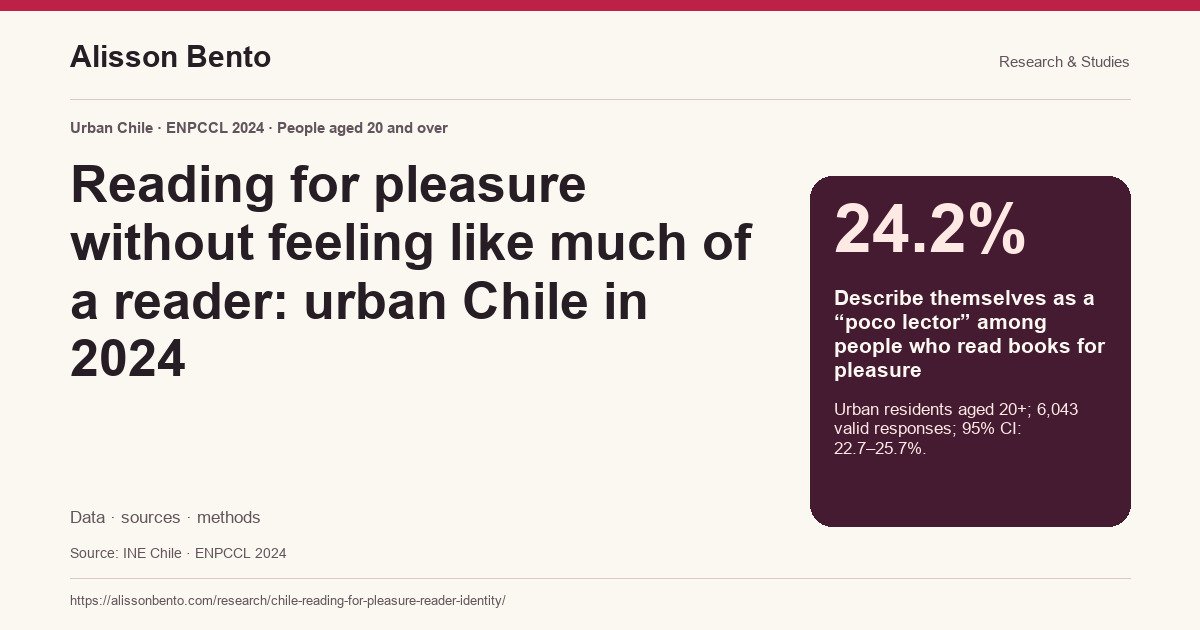
Reader identity is more than a book count
The main result compares two different answers within the same survey: reporting books read for pleasure or leisure during the previous twelve months, and the way people describe themselves as readers. About one in four people in this group chooses “poco lector”, the Spanish category meaning someone who reads little. This does not mean that they do not read, do not understand what they read, or have given up books.
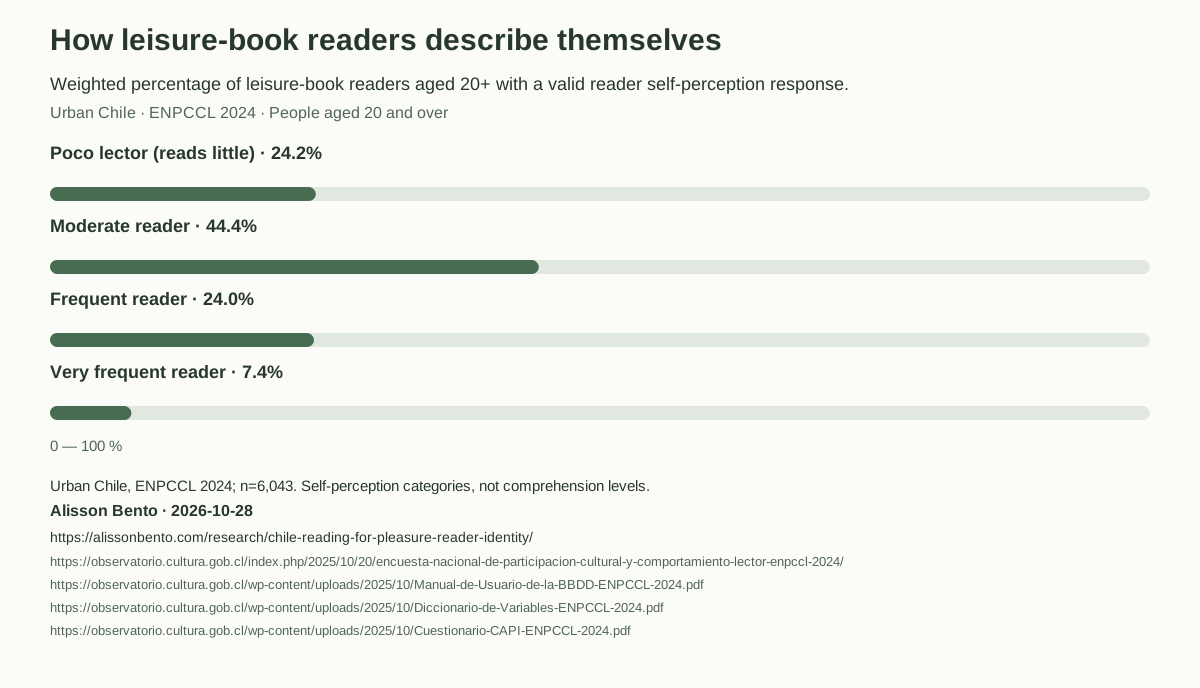
The complete distribution puts the figure in context: 44.4% describe themselves as moderate readers, 24.0% as frequent readers and 7.4% as very frequent readers. These are self-perception categories. The survey does not set a book count that requires someone to choose a particular category. The comparison shows a gap between reported behaviour and identity without attributing it to a psychological cause.
Frequency and volume tell different stories
Among people who report reading books at least once a week and meet the leisure-reading filter, 15.1% describe themselves as a poco lector. The frequency question concerns reading books for at least fifteen minutes; it does not establish that all of those weekly reading occasions are recreational. The purpose of each occasion is not observed.
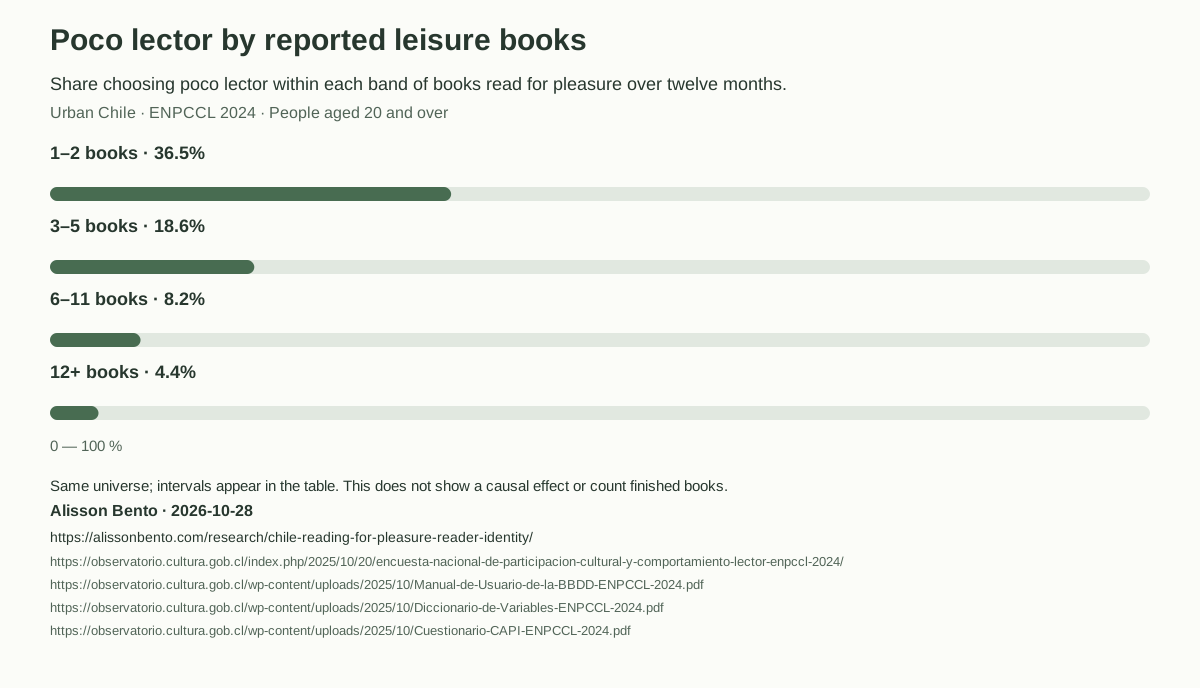
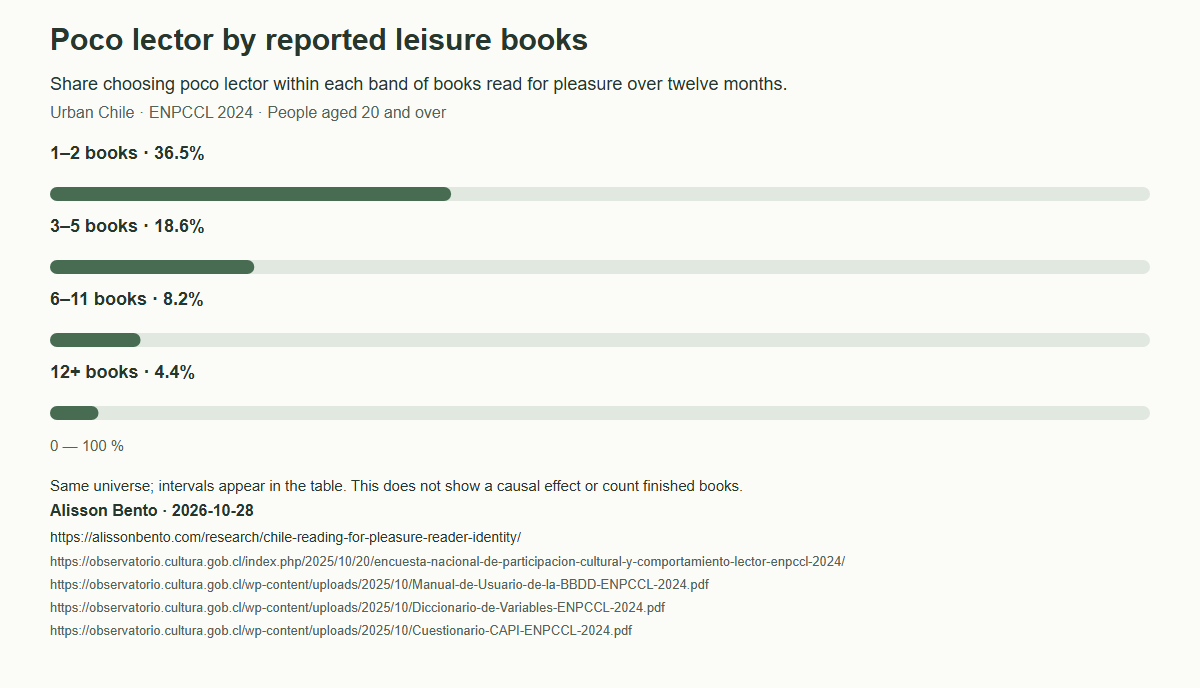
The share choosing poco lector is 36.5% among those reporting one or two leisure books in twelve months; 18.6% among those reporting three to five; 8.2% for six to eleven; and 4.4% for twelve or more. The last percentage has an interval of 2.2% to 6.6%, whose relative width calls for caution. The analysis describes associations; it does not show that increasing a book quota changes a person’s identity. The twelve-or-more-book group contains only 24 poco lector responses; relative uncertainty is high and this estimate should not be used as a headline figure.
Age and sex: describing differences without attaching labels
The estimate is 23.6% among men and 24.6% among women in the analysis group. Their intervals overlap substantially; no statistically significant difference between them is claimed here.
By age, estimates range from 21.3% among readers aged 20 to 29 to 30.9% among those aged 60 to 69. These groups were observed once, so they cannot show how an individual changes as they age. The public file groups ages 15 to 19 together, preventing separation of 18- and 19-year-olds. This study therefore uses ages 20 and over rather than presenting an unsupported analysis of all adults.
Sixteen regions, with uncertainty shown
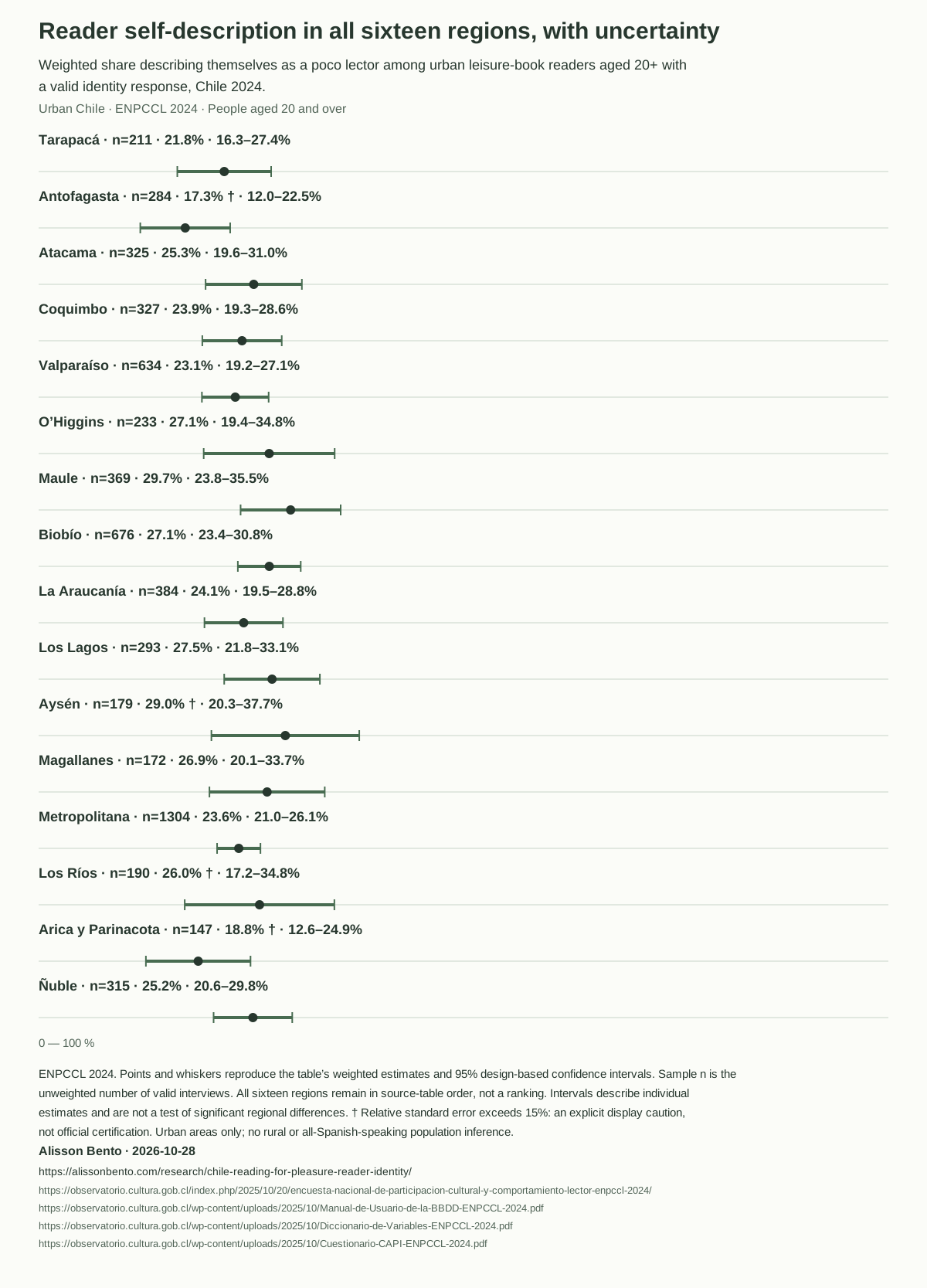
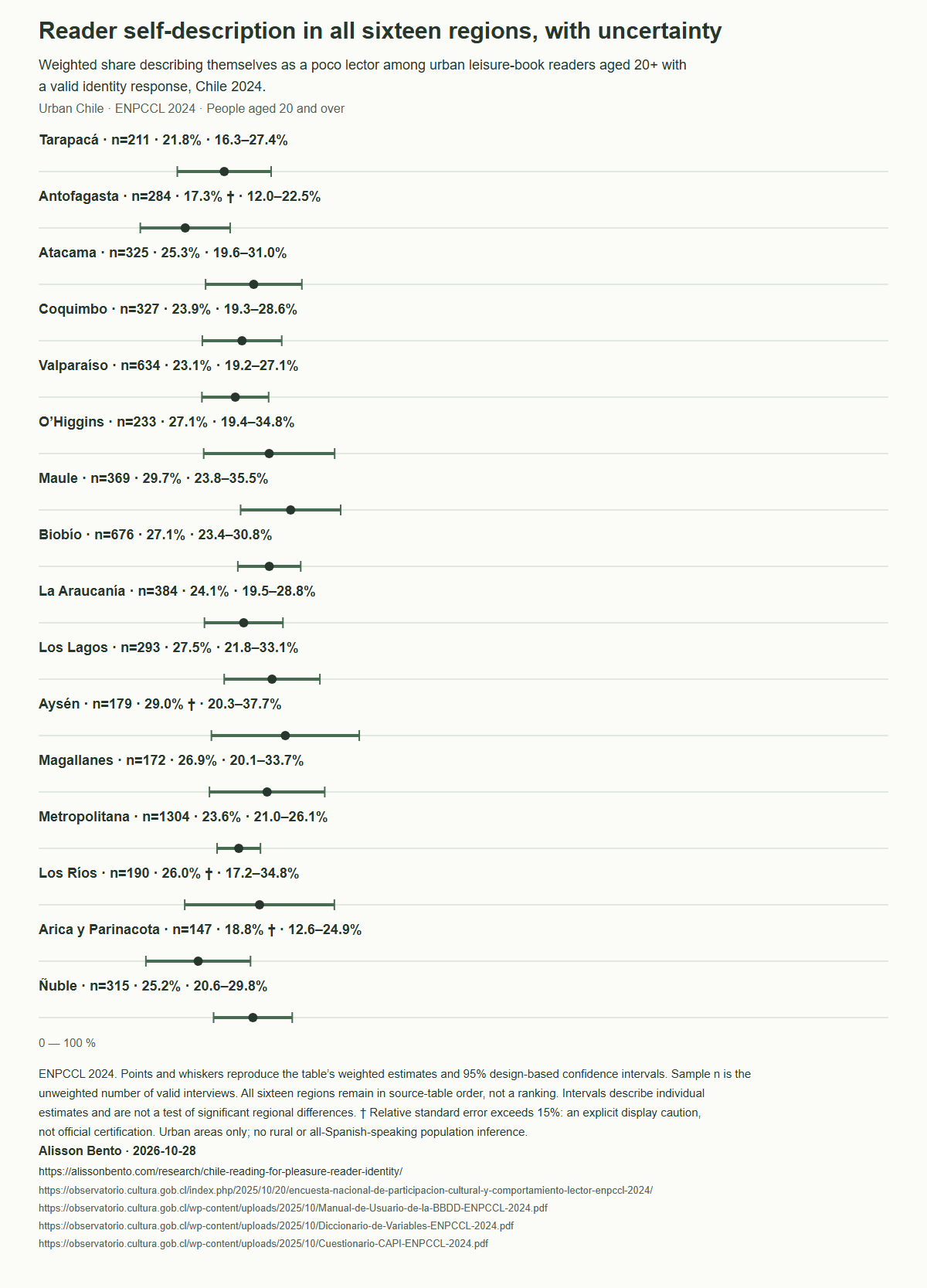
The regional table publishes the interview base, weighted estimate and interval for each of the sixteen regions. Every estimate refers exclusively to urban residents aged 20 and over who meet the leisure-book-reading filter and answer the self-perception question. No row describes the entire population of its region.
Regional sample sizes range from 147 to 1,304 interviews in this domain. Differences between point estimates do not justify ranking the “best readers”. A wide interval, for example, can be compatible with several positions in a ranking. The table supports local questions and examination of the evidence, rather than declaring winners.
How this finding can be used
For a library or book club, the finding raises a practical question: could an invitation addressed only to people who already call themselves readers miss people who do read books for pleasure? Communication built around a story, topic or conversation could be a reasonable hypothesis to test. This survey does not evaluate such invitations or establish that they will work.
For individuals, these results set no minimum book count that grants or removes reader status. Journalists can cite the figure while retaining its population, year and source: an independent analysis of official data, rather than a new survey or a measurement of behaviour in 2026. It also does not identify romance preferences, purchases or visits to this website.
How leisure-book readers describe themselves
Weighted percentage of leisure-book readers aged 20+ with a valid reader self-perception response.
Scroll horizontally to inspect the chart. ↔
Chart values as text
Poco lector by reported leisure books
Share choosing poco lector within each band of books read for pleasure over twelve months.
Scroll horizontally to inspect the chart. ↔
Chart values as text
Reader self-description in all sixteen regions, with uncertainty
Weighted share describing themselves as a poco lector among urban leisure-book readers aged 20+ with a valid identity response, Chile 2024.
Scroll horizontally to inspect the chart. ↔
Chart values as text
Data & downloads
Scroll horizontally to see all columns.
| Group | Valid interviews | Describe themselves as a poco lector | 95% CI |
|---|---|---|---|
| Total (aged 20 and over) | 6043 | 24.2% | 22.7–25.7% |
| Men | 2307 | 23.6% | 21.3–25.8% |
| Women | 3736 | 24.6% | 22.6–26.6% |
| 20–29 | 1058 | 21.3% | 17.9–24.8% |
| 30–39 | 1397 | 23.3% | 20.3–26.4% |
| 40–49 | 1055 | 22.2% | 18.7–25.7% |
| 50–59 | 903 | 25.8% | 22.1–29.5% |
| 60–69 | 830 | 30.9% | 26.5–35.4% |
| Over 70 (source label) | 800 | 25.6% | 21.3–29.8% |
Each percentage uses its own base of leisure-book readers aged 20+. The 95% CIs account for the complex survey design.
Scroll horizontally to see all columns.
| Leisure books | Valid interviews | Describe themselves as a poco lector | 95% CI |
|---|---|---|---|
| 1–2 books | 2873 | 36.5% | 34.1–38.9% |
| 3–5 books | 1846 | 18.6% | 16.1–21.1% |
| 6–11 books | 776 | 8.2% | 5.5–11.0% |
| 12+ books | 548 | 4.4% | 2.2–6.6% |
Reported books read for pleasure in the previous twelve months; not necessarily finished.
Scroll horizontally to see all columns.
| Region | Valid interviews | Describe themselves as a poco lector | 95% CI |
|---|---|---|---|
| Tarapacá | 211 | 21.8% | 16.3–27.4% |
| Antofagasta | 284 | 17.3% | 12.0–22.5% |
| Atacama | 325 | 25.3% | 19.6–31.0% |
| Coquimbo | 327 | 23.9% | 19.3–28.6% |
| Valparaíso | 634 | 23.1% | 19.2–27.1% |
| O’Higgins | 233 | 27.1% | 19.4–34.8% |
| Maule | 369 | 29.7% | 23.8–35.5% |
| Biobío | 676 | 27.1% | 23.4–30.8% |
| La Araucanía | 384 | 24.1% | 19.5–28.8% |
| Los Lagos | 293 | 27.5% | 21.8–33.1% |
| Aysén | 179 | 29.0% | 20.3–37.7% |
| Magallanes | 172 | 26.9% | 20.1–33.7% |
| Metropolitana | 1304 | 23.6% | 21.0–26.1% |
| Los Ríos | 190 | 26.0% | 17.2–34.8% |
| Arica y Parinacota | 147 | 18.8% | 12.6–24.9% |
| Ñuble | 315 | 25.2% | 20.6–29.8% |
Urban residents aged 20+ who read books for pleasure. Order follows territorial codes; this is not a ranking.
Evidence & method
How we calculated it
- Source: the public enpccl_puf.dta file from ENPCCL 2024, Chile’s Ministry of Cultures, Arts and Heritage and National Statistics Institute. Downloaded and analysed on 28 October 2026. The file contains 34,787 household roster records; 12,263 are selected respondents (kish_dummy=1). This filter is applied before constructing the survey design.
- Age: rph_edad contains anonymised bands. Codes 3 to 8 are selected, corresponding to ages 20 and over, with 11,536 interviews. edad_aux is not used to invent an 18+ distinction that the public file cannot support.
- Leisure reading: lectura_libros from 1 to 6, lectura_tipo_3=1, and libros_ocio from 1 to 500. This domain contains 6,047 interviews. Four without valid reader self-perception are excluded, leaving 6,043. Main numerator: lectura_auto=1 (1,499 interviews); denominator: lectura_auto from 1 to 4. Person weighting yields 24.1631449859%, displayed to one decimal place.
- Each estimate is a ratio of weighted sums using fexp_p. Variance is calculated by Taylor linearisation of the ratio: weighted residuals are summed by Varunit within Estrato_ENPC, applying m/(m−1) to the between-cluster variation within each stratum. The full design for selected respondents is retained, with zero contribution outside each domain: 1,429 pseudo-clusters, 48 pseudo-strata and 1,381 degrees of freedom.
- Two-sided 95% intervals use the t distribution with 1,381 degrees of freedom and are bounded at 0–100. No finite-population correction or multiple-comparison adjustment is applied. These are approximations based on the published design; they do not correct recall, response or measurement error. No significance between groups is claimed.
- The public tables contain derived aggregates only. The CSV retains unrounded figures, numerators, weighted denominators, sample bases and intervals. The downloadable program reproduces the calculation from the official file. The JSON documents variables and sources. No individual record is published.
What the data cannot tell us
- Urban coverage; results do not represent rural Chile or all Spanish speakers.
- Observations are from 2024 and recall covers the twelve months preceding the interview; this is not a 2026 measurement.
- Only people aged 20 and over are included because ages are anonymised; the entire 15–19 band is excluded.
- Self-perception, leisure books and frequency describe different concepts. Poco lector does not mean a nonreader, illiteracy or reading difficulty.
- General book-reading frequency does not identify the purpose of each reading occasion. Books reported as read were not necessarily finished.
- Intervals do not justify regional rankings or causal conclusions. This is neither a longitudinal analysis nor an experiment.
- The 12+ book proportion has greater relative uncertainty. These independently calculated indicators are not certified by INE; n>=60 is not presented as official approval.
- The analysis does not identify literary genre, purchase intent, sales, unique website readers or the effectiveness of reading-promotion programmes.
Original sources
- ENPCCL 2024 — página oficial y microdatos
Official public microdata; 2024 observations, urban population aged 15+; this independent analysis is restricted to ages 20+.
Accessed October 28, 2026
- Manual de usuario de la base de datos ENPCCL 2024
Official manual: Kish filter, person weights and survey-design variables.
Accessed October 28, 2026
- Diccionario de variables ENPCCL 2024
Official variable and category dictionary.
Accessed October 28, 2026
- Cuestionario CAPI ENPCCL 2024
Official questionnaire: self-perception and leisure-reading filters.
Accessed October 28, 2026
Cite & reuse this study
Alisson Bento. Reading for pleasure without feeling like much of a reader: urban Chile in 2024. 28 October 2026. Independent analysis of ENPCCL 2024 (Ministry of Cultures and INE, Chile). https://alissonbento.com/research/chile-reading-for-pleasure-reader-identity/
The text, charts and tables derived from this analysis may be reused with attribution to Alisson Bento and a link to the study. Original data remain subject to their respective owners’ conditions; no licence to the official microdata is granted here.
Corrections or editorial questions