
Two dimensions of a reading habit
Reading frequently and reading for a long time are different descriptions of a habit. Mexico’s MOLEC 2025 survey allows those descriptions to be examined together because the same respondents answered questions about how frequently they read books and how many minutes they accumulated on an average book-reading day. The resulting profile is more informative than treating either a frequency percentage or a duration percentage as a complete account of reading. It does not, however, turn the survey into a diary of individual reading sessions.
Among literate adults with known ages who reported reading books in the previous twelve months, 30.73% combined daily or at-least-weekly reading with at most thirty minutes on a reading day. Another 13.80% combined the monthly, quarterly or yearly frequency categories with more than thirty minutes. These are weighted shares of the same adult book-reader population. Their difference is 16.93 percentage points, but neither share tells us what proportion of all Mexican adults follows that pattern.
The comparison needs the other two cells beside it. Daily or weekly reading with more than thirty minutes accounts for 41.78%, while less-frequent reading with at most thirty minutes accounts for 13.68%. Thus, the two highlighted combinations are not opposites that exhaust the population. Frequent reading is compatible with either duration range. A reader who sees only the two diagonal cells would miss the largest cell in the four-way description: daily or weekly reading combined with more than thirty minutes.
Who counts as a book reader here?
The analysis uses the selected-person file from INEGI’s Módulo sobre Lectura, collected from June 2 to June 27, 2025. The survey’s national coverage includes urban and rural areas and usual residents aged twelve or over in occupied private dwellings. This article selects a narrower domain: literate people aged eighteen or over with known age who qualify as book readers under the instrument. It is therefore neither a profile of every adult nor a profile of everyone who reads any kind of text.
Book readership is established using both the direct question and its conditional verification question. A person who initially says no can subsequently confirm reading a book, including an unfinished book or a manual. Omitting that second route would discard eligible readers and change the population being described. Conversely, the blank verification field after a direct yes is a normal questionnaire skip, not a negative answer. Both routes are included here, rather than treating the direct question as the complete definition.
The resulting adult domain contains 2,151 respondents and represents a weighted population of 54,481,954. That second number is a survey expansion estimate, not a census enumeration. Two book readers have unknown ages and cannot be classified confidently as adults; they are excluded. The code for age ninety-seven and over is retained. Books read for necessity as well as pleasure are eligible, so the results cannot be narrowed to recreational reading, fiction, completed books, or customers looking for a particular kind of story.
What the two questions actually measure
The frequency question asks about book reading in the previous twelve months and offers five answers: daily, at least once a week, at least once a month, at least once every three months, and at least once a year. These are the instrument’s mutually exclusive coded answers. Their wording should not be converted into exact numbers of reading days. In particular, a weekly answer does not identify whether a respondent read on one, two, or several days in a typical week.
The time question asks how many minutes the person dedicated to books on an average reading day. INEGI’s results report describes this as accumulated time. Someone could accumulate that total through one continuous period or through several separate opportunities during the day; the question does not distinguish those situations. It also does not measure time spent on every calendar day. Days without book reading are not inserted as zero-minute observations in the duration answer.
These limitations matter when the two answers are placed together. A joint cell is a combination of two reported characteristics, not a measured weekly volume of reading. Multiplying a frequency code or an assumed number of days by the reported minutes would manufacture an exposure that the survey does not supply. The paired answers support the statement that a reader reported a particular frequency category and duration range. They do not support an exact number of reading minutes per week, an uninterrupted-session length, or a measure of sustained attention.
Keeping the full joint profile visible
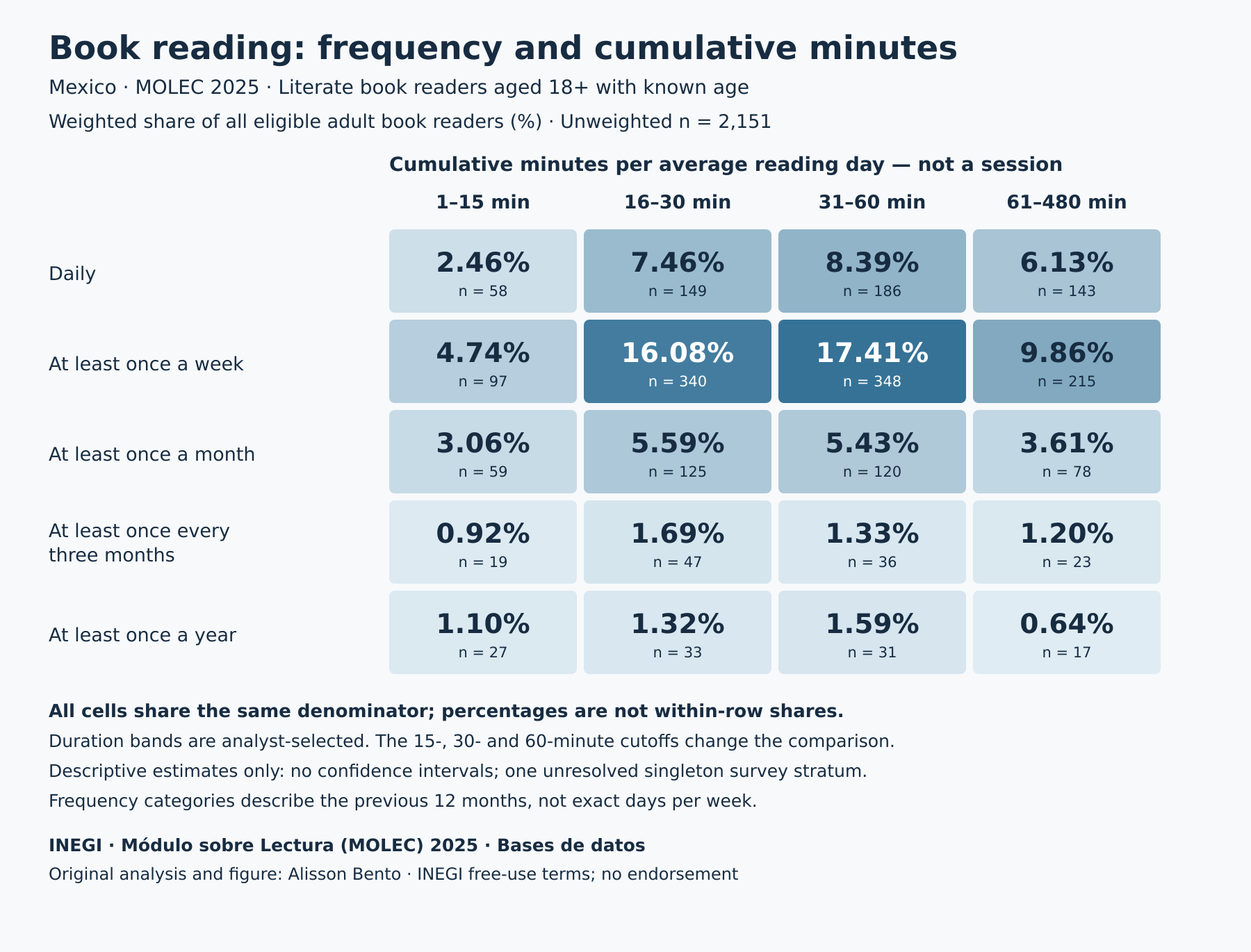
The detailed table retains all five original frequency categories and divides recorded minutes into four transparent analytical bands: one to fifteen, sixteen to thirty, thirty-one to sixty, and sixty-one to 480. Every cell uses all eligible adult book readers as its denominator. Consequently, the twenty cells together describe the entire domain, apart from ordinary rounding differences. A cell is not a percentage only of daily readers or only of people in its duration band.
This arrangement preserves information lost when the five frequency answers are collapsed into two groups. Daily and weekly answers remain separately visible, as do monthly, quarterly and yearly answers. Readers can inspect whether a broad pattern is spread across categories instead of assuming that everyone assigned to a combined group has the same habit. The accompanying aggregate file also retains the unweighted respondent count and weighted numerator for every cell, allowing the displayed shares to be checked without distributing individual records.
The table should be read descriptively rather than as a ranking of superior and inferior habits. A larger cell describes a more common reported combination in this weighted domain; it does not establish an optimal way to read. Differences can reflect occupations, schooling, health, available time, preferences, and many other circumstances not isolated by this calculation. Nor does the table identify changes within an individual. It summarizes different respondents’ retrospective answers at one survey occasion, not the development of a habit over time.
Thirty minutes is a choice, not a natural boundary
The primary contrast uses thirty minutes because it offers a clear and interpretable division of cumulative reading-day time. The numerical question itself does not ask respondents to choose a short or long category. Those labels would be analytical interpretations, not original answers. INEGI’s results report also presents duration summaries using fifteen-, thirty-, and sixty-minute boundaries, but that reporting practice does not establish a scientifically privileged cutoff for short reading or a threshold of reader satisfaction.
With the thirty-minute split, daily-or-weekly readers at or below the boundary account for 30.73% of the domain, compared with 13.80% for less-frequent readers above it. The 16.93-percentage-point difference is a subtraction between two shares with the same denominator. It is not a relative risk, a percentage change over time, or a difference in the average minutes of two groups. The cells were defined before inspecting their weighted estimates, and the full four-cell distribution accompanies the comparison.
The boundary must remain in any concise summary. Saying that frequent, short reading is simply more common would suppress the fact that “short” has been defined here rather than measured as a respondent’s judgment. It would also conceal the noncomplementary cells. A defensible description names the population, specifies the frequency grouping, states the thirty-minute boundary, and makes clear that the time is cumulative on reading days. Those details are part of the result, not optional technical qualifications.
The sensitivity check changes the headline
Two additional cutoffs, fifteen and sixty minutes, were specified before calculating the joint results. At fifteen minutes, the daily-or-weekly and lower-duration combination accounts for 7.20% of adult book readers. The monthly, quarterly or yearly and higher-duration combination accounts for 22.41%. Their difference is negative 15.21 percentage points. The direction of the thirty-minute comparison therefore reverses when the lower-duration definition is restricted to a quarter of an hour.
At sixty minutes, the frequent and lower-duration combination rises to 56.53%, while the less-frequent and higher-duration combination falls to 5.45%. Their difference is 51.07 percentage points. These are not three independent discoveries about different populations. They are three descriptions of the same people under different analytical boundaries. Raising the cutoff moves some frequent readers into the lower-duration cell and moves some less-frequent readers out of the higher-duration cell, so the comparison is inherently responsive to that choice.
The substantive lesson is to retain the profile rather than select whichever threshold produces the strongest slogan. The fifteen-minute result is not a reason to erase the thirty-minute result, and the sixty-minute result does not validate a general preference for brief reading. Together they demonstrate that the phrase “low duration” is too underspecified to carry a stable headline. The complete distribution and the sensitivity table allow readers to see exactly which definition supports each numerical statement, without pretending that one boundary resolves every practical question.
Missing answers, endpoints and source checks
The original selected-person file contains 4,240 observations. Across all ages, 2,474 respondents meet the book-reader screen and have both frequency and time answers. The populated fields match the reconstructed screening route exactly. Within that eligible group, the inspected data contain no blank duration answers, zero minutes, out-of-range durations, or separate unknown-frequency codes. Structural blanks outside the book-reading module are excluded through eligibility rather than recoded into zero reading time.
The descriptor gives a valid duration range from one to 480 minutes. Four adult-domain respondents have a value of 480. The inspected documentation does not label that value as an open-ended “480 or more” category or state that it is a censoring threshold. This analysis therefore preserves it as recorded and does not invent a topcoding rule. The highest table band ends at 480 because that is the documented range of this data field, not because longer reading is impossible in ordinary life.
As an external consistency check, the all-age weighted frequency and duration margins reproduce the official report’s published rounded percentages. This supports the reading of the routes, weights and variables, although it does not independently establish the adult joint cells. One separate discrepancy remains visible: the raw weighted mean is approximately 59.5293 minutes, whereas the report displays an integer of 59 minutes. The inspected documentation did not explain that display convention. No mean-duration claim is used in this article, and the discrepancy is disclosed rather than silently described as an exact match.
What the weighting does, and does not, solve
Each estimate uses FAC_ELE, the expansion weight for the selected person. Within the eligible adult domain, the weights for respondents in a cell are added and divided by the weights for all domain respondents. Multiplying that ratio by one hundred produces the displayed percentage. Dwelling or household weights would answer a different question and are not substituted. Counts of interviewed respondents are retained separately so that an estimated population total is never mistaken for the number of people interviewed.
MOLEC’s design is more complex than an unweighted sample of unrelated observations. The design documentation describes stratification and four sampling stages, including selection into the master sample. The public file contains ninety-nine design strata and 1,201 primary sampling units. One stratum contains only one observed primary sampling unit, with four respondents. Three of those respondents belong to this adult book-reader domain. Their presence makes this a genuine unresolved issue for variance estimation, not a stratum that can be dismissed as irrelevant to the analysis.
The inspected official documentation did not supply a justified treatment for that singleton in this calculation. Accordingly, no confidence intervals, significance tests, or inferential rankings are provided. Neither a large weighted population nor successful reproduction of point estimates resolves that uncertainty. The values remain useful weighted descriptive estimates, but small differences should not be advertised as statistically established population contrasts. A future inferential analysis would need an explicit, defensible variance treatment and independent checking rather than an undisclosed software default chosen to obtain a preferred result.
Why this is not an annual trend or a reading prescription
The national 2025 framework differs from the earlier urban adult headline series. Its geographic coverage and age scope cannot be assumed interchangeable with those earlier releases, and this article does not splice them into a trend. Restricting the new data to adults does not, by itself, restore the old sampling universe or erase questionnaire changes. The observation period is the 2025 fieldwork, with book frequency recalled over the preceding twelve months; the later date on which files were accessed does not make the results evidence about reading in 2026.
The joint profile also differs from a comparison of reasons for not reading. Here the analysis begins with people who qualify as book readers and examines two characteristics of their reported practice. It does not explain why nonreaders do not read, measure the obstacles experienced by all adults, or infer that one media activity displaces another. Keeping the domain explicit prevents the everyday word “reader” from shifting meaning between books, social media, and all textual materials.
For authors, educators and people considering their own habits, the cautious use of these results is descriptive context. Multiple frequency-duration combinations coexist, and the apparent balance between two selected combinations changes with the duration boundary. Nothing here establishes demand for shorter stories, an ideal chapter length, a reading-speed advantage, or the effect of an intervention. Those questions require measurements and designs suited to them. Respecting that boundary makes the observed profile more useful because its claims remain tied to what respondents actually answered.
A result that can be checked without exposing people
The accompanying files provide compact aggregate numerators, denominators, respondent counts and percentages, together with code that recalculates the displayed profile and threshold contrasts. An independent computation reproduced all twenty detailed cells and all twelve cells across the three threshold comparisons at the integer numerator and denominator level. This check is stronger than comparing rounded chart labels, because different underlying values can sometimes round to the same displayed number. It verifies the implemented arithmetic without claiming to eliminate survey error.
Individual records, household identifiers and design-unit records are not included in the distributed materials. Optional record-level verification requires obtaining the official source separately and respecting its conditions. Source references identify the questionnaire, descriptor, microdata, sample-design documentation and results report so that readers can distinguish measurement definitions from this article’s analytical choices. INEGI produced the survey; the combinations and explanations presented here are independent calculations, not an official endorsement or a new survey release.
The central conclusion is deliberately narrower than a slogan about short reading. Among the specified adult book readers, frequency and accumulated reading-day duration can be jointly described, and the thirty-minute contrast has a reproducible value. But the full profile matters, the compared cells are not complements, and the threshold sensitivity changes the direction of the comparison. Those features are the finding. Preserving them gives readers an account of variation in reported book-reading habits without claiming that one numerical boundary defines how people ought to read.
Complete frequency-by-duration profile
Mexico · MOLEC 2025 · Literate adult book readers 18+ with known age, n=2,151. Weighted share of all eligible readers, not within-frequency share.
Full chart and source

Scroll horizontally to inspect the chart. ↔
Chart and values
Scroll horizontally to see all columns.
| Reported frequency | 1–15 minutes (%) | 16–30 minutes (%) | 31–60 minutes (%) | 61–480 minutes (%) |
|---|---|---|---|---|
| Daily | 2.46 | 7.46 | 8.39 | 6.13 |
| At least once a week | 4.74 | 16.08 | 17.41 | 9.86 |
| At least once a month | 3.06 | 5.59 | 5.43 | 3.61 |
| At least once every three months | 0.92 | 1.69 | 1.33 | 1.20 |
| At least once a year | 1.10 | 1.32 | 1.59 | 0.64 |
Weighted percentages of all literate adult book readers aged 18+ with known age; n = 2,151. All twenty cells share one denominator. Duration is cumulative on an average reading day, not per session. Analytical bands; no confidence intervals. Respondent counts and exact weighted inputs are in the aggregate download.
Data & downloads
Scroll horizontally to see all columns.
| Reported frequency | 1–15 minutes (%) | 16–30 minutes (%) | 31–60 minutes (%) | 61–480 minutes (%) |
|---|---|---|---|---|
| Daily | 2.46 | 7.46 | 8.39 | 6.13 |
| At least once a week | 4.74 | 16.08 | 17.41 | 9.86 |
| At least once a month | 3.06 | 5.59 | 5.43 | 3.61 |
| At least once every three months | 0.92 | 1.69 | 1.33 | 1.20 |
| At least once a year | 1.10 | 1.32 | 1.59 | 0.64 |
Weighted percentages of all literate adult book readers aged 18+ with known age; n = 2,151. All twenty cells share one denominator. Duration is cumulative on an average reading day, not per session. Analytical bands; no confidence intervals. Respondent counts and exact weighted inputs are in the aggregate download.
Scroll horizontally to see all columns.
| Frequency | Duration on a reading day | Weighted share (%) | Respondents |
|---|---|---|---|
| Daily or at least weekly | At most 30 minutes | 30.73 | 644 |
| Daily or at least weekly | More than 30 minutes | 41.78 | 892 |
| Monthly, quarterly or yearly categories | At most 30 minutes | 13.68 | 310 |
| Monthly, quarterly or yearly categories | More than 30 minutes | 13.80 | 305 |
Same adult book-reader denominator for every cell. Highlighted diagonal cells are not complements; no causal or significance interpretation.
Scroll horizontally to see all columns.
| Cutoff (minutes) | A (%) | B (%) | A minus B (percentage points) |
|---|---|---|---|
| 15 | 7.20 | 22.41 | −15.21 |
| 30 | 30.73 | 13.80 | 16.93 |
| 60 | 56.53 | 5.45 | 51.07 |
A = daily/weekly and at or below cutoff; B = monthly/quarterly/yearly and above cutoff. Both use all adult book readers. Cutoffs are analyst choices, not original response categories. Differences are computed from unrounded shares, so they can differ by 0.01 from the difference of the rounded values shown.
Evidence & method
How we calculated it
- INEGI MOLEC 2025 national selected-person microdata; fieldwork June 2–27, 2025. Domain: literate adults aged 18+ with known age in occupied private dwellings who reported book reading in the previous twelve months.
- Eligibility uses F_S1_3 = 1 and either P2A = 1 or P3A = 1, including conditional confirmation of unfinished books and manuals. EDAD 18–95 or 97 is retained; code 98 unknown excluded.
- P6 retains five reported frequency categories. P7 is numeric cumulative minutes on an average book-reading day; it is not a session or a calendar-day average. All eligible P6/P7 values were present and valid.
- FAC_ELE weighted ratios use a common denominator of 54,481,954 represented adult book readers; unweighted n = 2,151. Thirty-minute primary diagonal comparison and fifteen-/sixty-minute sensitivities were specified before joint estimates.
- Independent computation reproduced all twenty detailed cells and twelve sensitivity cells at integer numerator/denominator level. All-age marginal percentages reproduce official rounded results; mean display mismatch is separately disclosed.
- Descriptive only: ninety-nine strata, 1,201 PSUs and one unresolved singleton stratum containing three domain members. No confidence intervals, significance tests or frequency-by-minutes products.
What the data cannot tell us
- Retrospective self-reports, private-dwelling coverage, literacy and adult known-age eligibility constrain generalization; two book readers have unknown ages. The domain includes necessity and pleasure reading, not recreational readers only.
- Duration bands are analytical and threshold-sensitive. Recorded range 1–480 minutes is not documented as a 480+ topcode; four eligible respondents report 480.
- The paired answers do not supply exact reading days, weekly totals, uninterrupted-session length, attention, reading speed, causal effects or demand for shorter books.
- The redesigned national 2025 survey is not spliced with earlier urban adult series. Small joint cells and unresolved singleton variance prevent inferential ranking.
- Raw weighted mean 59.5293 minutes does not conventionally round to the official displayed integer 59; the display convention is unexplained in inspected sources. No mean is used as an article finding.
Original sources
- INEGI MOLEC 2025 project
INEGI MOLEC 2025 project: Project, national redesign and distribution discovery.
Accessed October 30, 2026
- INEGI MOLEC 2025 public CSV microdata
INEGI MOLEC 2025 public CSV microdata: TMOLEC local-only analysis; selected-person observations.
Accessed October 30, 2026
- INEGI MOLEC 2025 file descriptor
INEGI MOLEC 2025 file descriptor: Codes, age 98 unknown, age 97 topcode, FAC_ELE/UPM_DIS/EST_DIS.
Accessed October 30, 2026
- INEGI MOLEC 2025 questionnaire
INEGI MOLEC 2025 questionnaire: Questionnaire printed pages 10–11: literacy filter, direct/verification book screening, P6 frequency and P7 numeric minutes per average reading day.
Accessed October 30, 2026
- INEGI MOLEC 2025 sample design
INEGI MOLEC 2025 sample design: Selected-person weighting and ultimate-cluster variance, equations 17–20. No singleton resolution identified.
Accessed October 30, 2026
- INEGI MOLEC 2025 results
INEGI MOLEC 2025 results: Report pp17–19 labels P7 cumulative daily reading time, duration margins and P6 frequency margins; all-age margins reproduced. Report integer 59 minute mean is not conventional rounding of raw weighted 59.5293; mean not a pilot estimand.
Accessed October 30, 2026
- INEGI MOLEC 2025 RNM metadata
INEGI MOLEC 2025 RNM metadata: Public-use access, attribution, design and universe.
Accessed October 30, 2026
- INEGI free-use terms
INEGI free-use terms: Own licence: attribution and nonmisleading reuse, no implied official endorsement.
Accessed October 30, 2026
Cite & reuse this study
Alisson Bento. How often and how long? Mexico’s joint profile of adult book reading. Independent analysis of INEGI, Módulo sobre Lectura (MOLEC) 2025. Sources accessed October 30, 2026. https://alissonbento.com/research/mexico-book-frequency-duration-2025/
Source: INEGI. Módulo sobre Lectura (MOLEC) 2025. Bases de datos. INEGI’s own free-use terms apply; https://www.inegi.org.mx/inegi/terminos.html. Calculations and explanation: Alisson Bento. Independent analysis, no official endorsement. Only aggregates and code are distributed.
Corrections or editorial questions