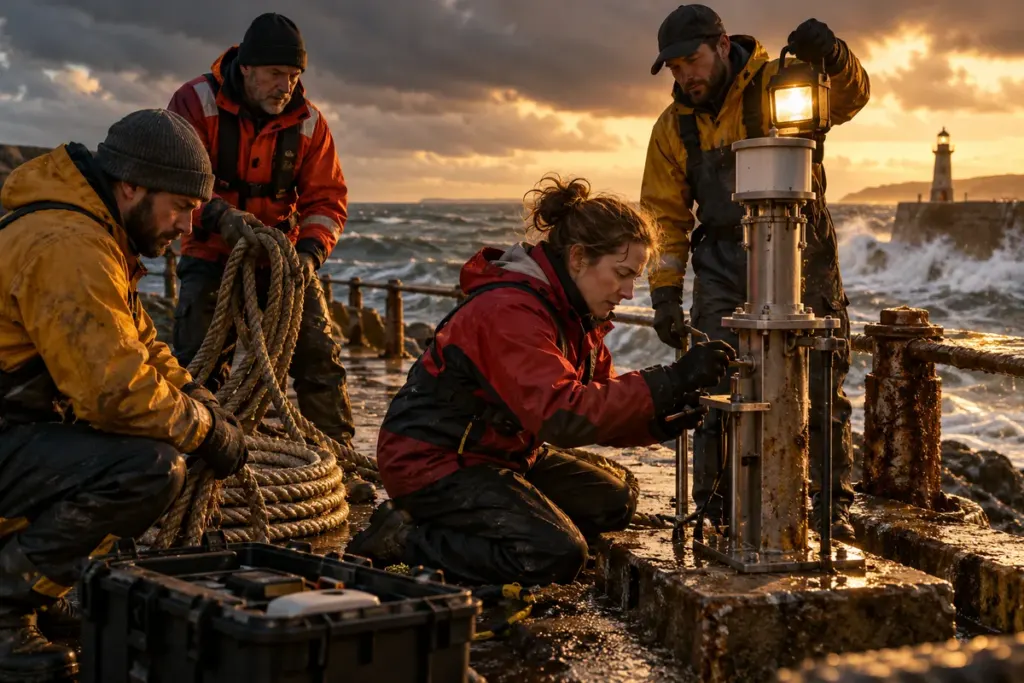
A storm-rescue romance with a capable heroine is most appealing when her knowledge changes what the group does. If you want why-choose attraction alongside that competence, look for more than three men impressed by a clever woman. Look for a problem they cannot understand in quite the same way without her, and for different emotional connections that survive their cooperation under pressure.
The Last Safe Harbor offers that combination through marine technician Mara Ives. At Gull Reach, the water is rising while a tide gauge reports that it is falling. Owen, Caleb, and Finn are part of the response around her, but Mara brings the instrument expertise. The invitation is a complete adult why-choose romance with three protective men, forced proximity, and a coastal rescue problem, rather than a contest whose eventual prize is one surviving suitor.
Begin with the contradiction, not the storm spectacle
The first sentence gives the reader two incompatible accounts of the same place: the gauge says one thing, the water does another. That is a compact opening for readers who enjoy being asked to notice. Before a dramatic evacuation or a declaration of love, the story has a discrepancy that matters to someone doing her job.
Mara watches foam climb a previously dry bolt. Her attention makes the setting legible through a character, rather than presenting a page of weather description followed by a heroine who has nothing to contribute. The attraction begins in the same scene, with Owen teasing her about her interest in the bolt. Observation and flirtation share the page.
That mixture can help you identify your reading mood. Perhaps you want a disaster backdrop large enough to force an admission. Perhaps you want an investigation into why information is wrong. Here the opening makes the reliability of an instrument part of the suspense, while the premise also mentions missing boat fuel. Those details offer specific uncertainties beyond whether the storm will look frightening.
The opening does not establish the answer to those uncertainties. You can enjoy the hook without deciding immediately who is responsible or how the rescue concludes. The question for choosing the story is whether a practical discrepancy and growing personal closeness sound more attractive than uninterrupted action.
You’re on the list. Your free stories are waiting in the Reader Vault. The Last Safe Harbor
Expertise is attractive when someone gives it time
Owen asks how long Mara needs to check the gauge. She distinguishes a useful initial check from a definitive diagnosis. His answer gives her time for both. The moment is brief, yet it identifies a particular romantic pleasure: her work is treated as worth waiting for.
A capable heroine can be praised in a blurb while being rushed, dismissed, or repeatedly overruled in scenes. Readers who have had enough of that pattern may appreciate an opening where a man’s competence includes recognizing the limits of his own knowledge. Owen does not have to become an instrument specialist to be useful beside her.
He also helps physically when asked, holding the reference staff while she checks a reading. Their knees are close, and Mara notices the smell of his rain shell. The task makes proximity meaningful without requiring her to stop understanding the problem. Attraction distracts her enough to break a pencil tip, but it does not replace the work.
This is a useful distinction if you want professional competence and romantic vulnerability together. A woman can want someone intensely while still having a relevant answer. A story can let her be funny, embarrassed, uncertain, and knowledgeable in the same scene. Competence becomes a lived part of the voice rather than a certificate the narration waves before handing the plot to the men.
Whose information changes the plan?
To judge a rescue premise, follow the movement from observation to response. Does someone recognize a discrepancy? Does anyone else listen? Does the new information change what the adults were planning to do? Those questions concern cause and effect in fiction; you do not need specialist training to see whether the story gives a character influence.
In the sample, Mara’s comparison confirms that the station display is inconsistent with what she is measuring. Owen asks whether that could affect access decisions. The next step is to tell Nessa Holt, who runs Gull Reach. Nessa asks to see the information and responds to it. Mara’s expertise moves beyond a private conversation with an attractive man.
That wider response matters. It prevents recognition from being only a romantic compliment. Other adults need the information because the place has workers, equipment, and obligations beyond the quartet’s chemistry. A reader who likes a heroine embedded in a functioning world gets more than admiration from three love interests.
There is another benefit: the scene can create trust without requiring Owen to accept everything blindly. He asks a relevant question about consequences. Mara supplies the specialized interpretation. Cooperation can be attractive because the adults bring different abilities, rather than because one must become universally right for the other to count as supportive.
A rescue story can offer reciprocal usefulness
The phrase protective heroes can make it sound as though the heroine’s only role is receiving. A team story can offer a different balance. She might understand a failing system while the men contribute other skills, local knowledge, practical help, or steadiness. The pleasure is not keeping a scoreboard of who saves whom.
Mara’s presence already alters what the group knows. Owen makes room for the work and helps with a task. Caleb arrives with supplies and notices where her notebook can remain dry. Finn is initially located through a radio check and Mara’s recollection that he makes her laugh over the radio. Each introduction directs attention toward a different interaction.
These opening details do not justify inventing a complete division of duties for the rest of the novella. They do give you a starting point for choosing the cast. If you enjoy practical collaboration, you can listen for what each person contributes before the weather becomes the only thing anyone talks about.
Reciprocity also allows limits. A heroine need not suddenly be a physician, navigator, mechanic, and crisis commander to remain essential. When competence becomes universal, the pleasures of cooperation can shrink. A more interesting arrangement lets her need other people without making her own contribution decorative.
Seven workers make the setting bigger than the romance
The premise places seven workers in need of a way home. That detail changes the emotional scale. The adults’ choices matter to people outside the developing relationship, giving the storm a social consequence rather than treating everyone else as scenery around four attractive leads.
If you enjoy chosen-family romance, notice how a story handles those surrounding people. Do they have names, requests, irritations, or responsibilities? Can the heroine care about them without having to mother every adult? Does the group make room for ordinary kindness while remaining aware of the external problem?
Nessa’s opening scene gives Gull Reach an organizer with her own questions and authority. Mara has been hired as an independent instrument verifier, and the station faces a transfer inspection. These work arrangements explain why people are together before the romance needs to keep them there. Their presence has a reason beyond a convenient storm forecast.
This may suit readers who like a place to feel active under pressure. It may be less appealing if you want nearly every page confined to the heroine and her partners. Neither mood is better; the workers and the station’s practical life signal that this premise includes a community problem alongside the romantic one.
The short deadline changes the emotional pressure
Owen initially describes a forty-eight-hour assignment, subject to the weather. A short working visit can make attraction feel inconvenient because ordinary opportunities seem limited. The adults cannot assume there will be months of casual encounters in which to work out what a look meant.
A storm adds a second kind of time pressure. Plans become vulnerable to conditions outside anyone’s preferences. For a reader, that can make small exchanges feel unusually vivid: a remembered pencil, a joke, or a brief question can become something the heroine carries into a harder scene.
Pressure alone cannot supply a convincing group relationship. You may enjoy immediate chemistry while still wanting the adults to say what they mean. Notice whether they learn particular things about each other or merely repeat that the situation is intense. An urgent setting can accelerate disclosure without making all disclosures equally revealing.
Consider whether you want attraction that predates the emergency. Mara has known the team through equipment trials on the mainland. The sample gives six weeks of familiarity with Owen and memories of Caleb and Finn. That history offers a foundation beyond strangers bonding solely because a road is threatened by water.
Humour can keep the storm from swallowing the voices
The opening’s jokes are tied to what is happening: a bolt becomes an unlikely marriage prospect, a broken pencil acquires an opinion, and the water proves difficult to interview. These exchanges let you hear Mara responding to the men as people. The weather does not force the narration into one solemn register from the first paragraph.
For readers choosing suspense, that matters as much as the danger level. You may want tension with room to breathe rather than an atmosphere in which every sentence announces doom. A dry observation can preserve personality under pressure without promising that the book will become a comedy.
Caleb’s remembered care also has a particular tone. Mara recalls that, after a minor injury during an earlier equipment trial, he listened to her explanation of the repair instead of using the moment to lecture her. The attraction comes from attention to her interest, not merely the existence of capable hands.
Try listening for the heroine’s sense of humour in a sample. Does it belong to her circumstances and her way of seeing? Do the men’s replies create distinct exchanges? If you cannot hear anyone beneath the general protective mood, the premise may be stronger than your attachment to its people.
Three romantic partners need more than shared urgency
Why choose indicates that Mara’s desired future includes all three men rather than a required final elimination. The suspense can bring them together, but readers may still want private recognition, different vulnerabilities, and space for each bond to develop. Group cooperation and group romance are related pleasures with different demands.
You can like a team immediately while remaining unsure which individual connection interests you most. That is a useful reason to continue, provided the story keeps offering particular exchanges. It need not give each partner mechanically equal page time in every scene. Equal significance is a question of emotional consequence, not counting lines.
For a separate question about endings, the guide to where a why-choose group’s arc finishes distinguishes a completed romance from a completed external task. Here the story is presented as a complete standalone prequel. You are not being asked to infer closure from the fact that a rescue plot has a destination.
The intimacy description is also specific: sensual kisses and romantic touch, without graphic sexual detail, with all romantic leads adults. A group configuration does not make the story automatically explicit. Nor does it establish male-male romantic content. Check those interests separately instead of reading every possible bond into the word group.
Keep the fictional instruments inside the fictional experience
A good sample can make an unfamiliar job understandable without turning the reader into an expert. Here, you need to grasp that the gauge’s report conflicts with Mara’s observations and that the discrepancy matters to people planning their movements. The emotional consequence is that she must be heard.
This guide is about how that device shapes suspense. It does not offer a way to assess real weather, diagnose equipment, choose evacuation timing, or conduct a rescue. The fictional scene can feel convincing because its causal relationships are clear while still remaining an invented situation with an invented response team.
That boundary also makes selecting the story simpler. You do not need to test the technical system yourself to decide whether you enjoy a heroine whose knowledge matters. Read for clarity, consistent limits, and the relationship between new information and changed decisions. If technical vocabulary repeatedly hides the emotional stakes from you, another sample may offer a better fit.
Find the kind of competence you want to follow
For an indoor refuge built around a woman’s professional record, compare three ex-military friends and a forged signature. That premise asks whose authorization counts. Gull Reach instead puts unreliable information inside a place whose access is becoming uncertain. Similar relationship architecture can support quite different reading experiences.
If a temporary professional posting interests you more than a coastal storm, the companion guide to why-choose closeness during a relief doctor’s short assignment considers another time-limited setting. These are thematic comparisons, not claims that the professionals share an employer, a crisis, or a romantic history.
The exact later companion for The Last Safe Harbor is Guarded at Sea. Fortress Six Maritime and its San Diego annex connect the stories; the casts and conflicts are distinct. A military or rescue shelf can suggest further reading, but it does not extend that continuity to every neighboring title.
Use the free-story reading hub to compare broader preferences, then return to the opening question: whose knowledge changes the situation? Explore The Last Safe Harbor if you want a woman with an essential professional contribution, three men who respond to her as an adult, and attraction developing while a coastal station’s ordinary arrangements stop feeling secure. Read the opening free in your browser, then confirm your email to continue the story.