
A catalogue match starts a decision; it does not finish it
A teacher or librarian looking for an adapted school text needs more than a reassuring title match. The right question is whether the record leads to an appropriate edition, in a useful form, through a route the reader can actually use. In a fixed examination of twelve works prescribed for the French general-track première programme for 2026–27, every work produced public PLATON catalogue matches. That positive result is worth preserving. It does not establish twelve complete, suitable or immediately obtainable reading solutions.
The limited decision ledger published with this study follows the next layers. It separates the bibliographic source edition from adaptation records attached to it, distinguishes deposited adaptations from completed declarations and pending reports, and keeps the curriculum's exact text requirements visible. Its purpose is to help a teacher, school library or authorized intermediary ask a better next question. It does not advise a pupil to replace an assigned work, certify an accessible file, or decide whether a particular person qualifies for a service.
Why these twelve works form a useful fixed frame
The Ministry's programme supplies three choices within each of four objects of study: narrative, literature of ideas, theatre and poetry. The teacher selects a work and its associated pathway within that structure. This creates a real planning problem. Before teaching begins, an available route to a particular edition can matter, but the number of catalogue results alone cannot determine the choice. The same subject heading may conceal a youth adaptation, a collection containing several plays, or an edition with different supporting material.
The frame contains all twelve general-track units, without substituting easier titles when matching becomes difficult. It retains the bilingual requirement for Le Chevalier de la charrette, the specified additions from the 1752 edition of Lettres d'une Péruvienne, and Rimbaud's defined sequence of twenty-two poems. It also keeps the general track distinct from the technological track where the prescribed scope differs. These constraints turn the catalogue exercise into an edition decision rather than a popularity list or a count of files bearing familiar names.
What the discovery result actually contains
Thirteen predefined phrase observations, including two Rimbaud aliases, yielded sixty-four distinct public bibliographic document records. All results reported for those declared searches were captured within the limits. Each record belongs to the bibliographic layer: it can carry a title, author statement, source identifier, collection and edition information. It is not a separate literary work or automatically an independent, curriculum-compliant reading option. Several records can describe editions of the same work, while one larger collection can contain the target alongside other texts.
Complete retrieval of these particular query results is also different from complete retrieval of every possible edition. The interface's option called EXACT still returned title variants. Author forms, punctuation, aliases and cataloguing choices can affect discovery. The ledger therefore says what was observed under the declared searches and gives a public record for follow-up. A missing label or an unobserved format is not converted into proof that no other adaptation exists in PLATON, another service, a library collection or the commercial market.
Read the access states before adding their numbers
Across the captured source records, the deposited route contained 169 adaptation-metadata records. Another 93 records described completed adaptations declared but not deposited. These states deserve separate treatment. A deposited record identifies material recorded in the platform's deposited layer. A non-deposited declaration describes a different route, potentially requiring a different conversation with an intermediary. Neither observation is a loan, an eligibility decision, a successful download or a promise that an organization can fulfil a request now.
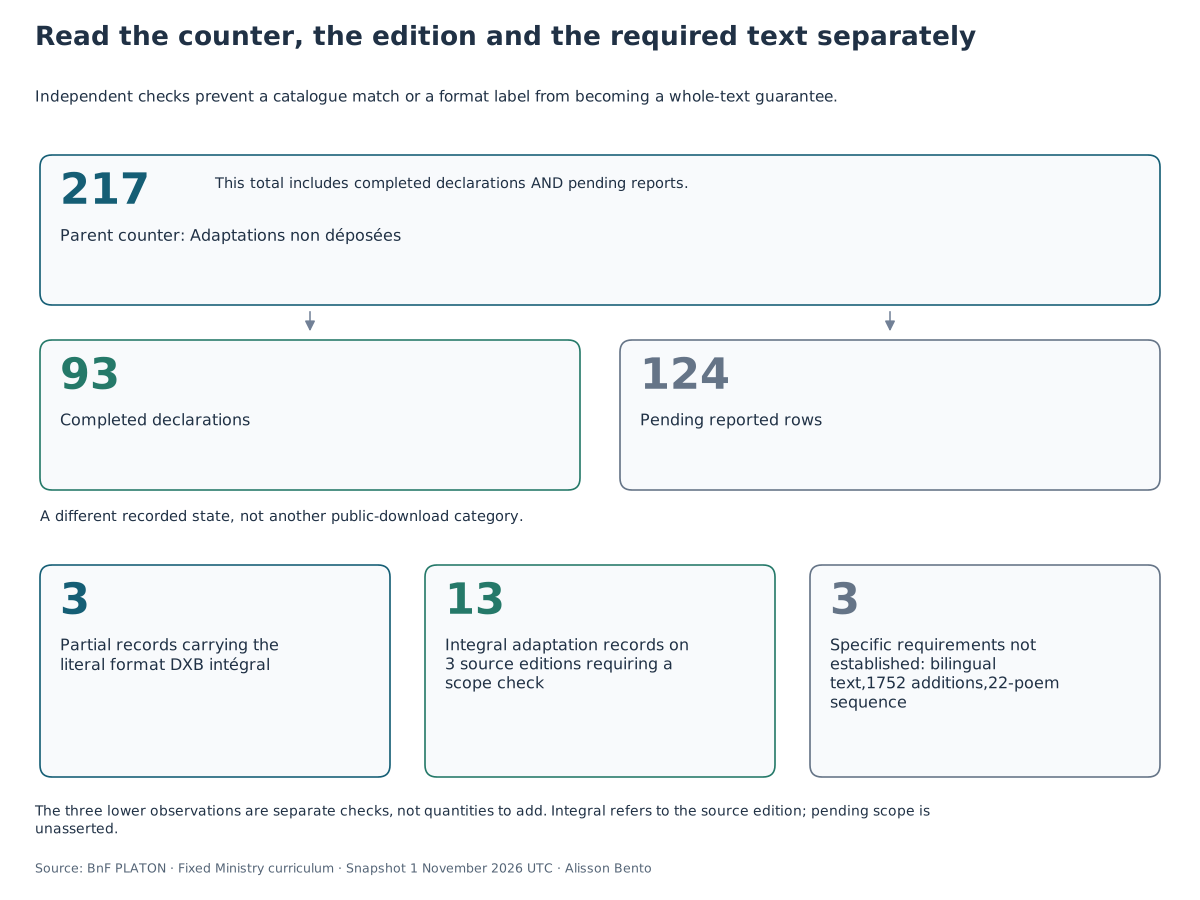
The public detail pages also have a parent counter labelled Adaptations non déposées. Its total across this fixed result was 217. The nested counters explain that number: 93 completed declarations plus 124 reports marked in progress. The relationship held on every one of the sixty-four captured pages. Reading 217 as completed declarations would include the pending reports; adding the pending counter again would count them twice. The distinction changes how a library interprets apparent supply, even though the arithmetic itself is elementary.
A pending report is neither a finished adaptation nor a unique plan
The completed rows expose source transcription identifiers, and the 262 completed records have distinct identifiers in this snapshot. The 124 pending rows do not expose an equivalent public identifier. Two pairs are indistinguishable in their returned fields. The appropriate response is to retain the provider's reported row count and state the identity uncertainty. Silently reducing it to 122 would assume duplicate plans; calling it 124 unique plans would assume distinct plans. Neither assumption is supported by what the public source exposes.
Pending objects also carry generic serialized fields that can look more informative than their public presentation. In this capture they contain a false partial-adaptation flag and a zero format identifier, while the pending table presents an organization and status date rather than an asserted format or extent. The analysis does not treat those defaults as integral adaptations. A report may also be old. Its recorded date is not a delivery deadline or evidence that active production is occurring today. Planning should keep pending status visible instead of treating it as stock.
Separate a format label from the extent of an adaptation
Among completed records only, 251 contain an explicit provider declaration that the adaptation is integral relative to its source edition; eleven are explicitly partial. These are reported metadata states, not findings from opening the books. The distinction cannot be inferred from the format name. Three actual partial-adaptation records carry the literal label DXB intégral. The word inside that format label does not override the separate extent declaration. Keeping both fields prevents a seemingly helpful shortcut from becoming a false whole-text claim.
The corresponding caution applies to abrégé in Braille labels. The Braille abbreviation system concerns coding, rather than automatically identifying an abridged literary source. The Association Valentin Haüy's reference material provides that context. A source collection explicitly called Classiques abrégés is a different bibliographic warning. The study identifies source-edition abridgment from bibliography, not by searching format labels for a word. Literal source labels remain intact in the ledger, without turning them into a quality ranking or an automatic compatibility recommendation.
A complete adaptation can still belong to a different source edition
Le Chevalier de la charrette provides a concrete example. The nine matched bibliographic records include one explicitly abbreviated source edition and two sources described as translated and adapted. Thirteen completed adaptation records attached to those three sources are marked integral. That is not a contradiction. An adaptation can cover its chosen source edition while the edition itself has a different relationship to the medieval work. Translated and adapted is a scope warning to investigate, rather than automatic proof that the text is shortened or educationally unusable.
The prescribed bilingual requirement is a further question. The captured metadata does not explicitly establish that requirement for these matches. An integral flag, a recognizable title or a long list of formats cannot supply the missing evidence. A useful enquiry to an authorized library would therefore name the exact source identifier, explain the bilingual requirement and ask what the adaptation actually contains. It would not simply ask for any complete Lancelot file. This is why the illustrative record links are starting points for investigation, not endorsed editions.
Partial does not automatically mean unsuitable
The opposite shortcut is also unsafe: a partial adaptation is not necessarily an unusable school text. A school edition can include an introduction, exercises, images and a dossier in addition to the literary text. A partial adaptation might preserve the required text while omitting some apparatus, or it might omit something essential. A page range alone cannot settle that question without understanding the edition. One captured Rimbaud description specifies poems only, but that still does not independently establish the exact prescribed sequence.
For Lettres d'une Péruvienne, the requirement includes particular additions from 1752. For Cahier de Douai, it identifies twenty-two poems with stated endpoints. The ledger leaves those requirements unestablished where public metadata cannot demonstrate them. It does not label the adaptations defective or assume the additional material is absent. The practical task is to identify the precise contents that need confirmation. That narrower question is more useful than either accepting every integral declaration as sufficient or rejecting every partial declaration without further examination.
Different formats answer different planning questions
The observed format sets differ across the fixed work searches. For Pot-Bouille, the one matched bibliographic source record supplies a human-voice MP3 label. Other works expose text-oriented, Braille or mixed labels. For a reader who needs navigable text, a generic statement that the novel has an adaptation would therefore be too coarse. The observed audio route is useful information, but it does not establish a text route, and the bounded search does not establish that text adaptations are absent elsewhere.
A separately declared paper large-print adaptation is also different from a deposited digital record. A document intended for further production is not automatically a ready-to-use reader file. The ledger preserves labels such as DOC, DOCX as one provider category rather than inventing two files. It does not infer software support, font suitability, narration quality or ease of navigation from extensions. The relevant next step is to connect the reader's stated need with an evidenced edition and route, with the authorized intermediary confirming what can actually be supplied.
A workable sequence for a teacher and library
Start with the assigned work and its required scope, not the biggest result count. Record any bilingual requirement, defined selection or added section that matters. Then use a bibliographic identifier and the edition description to keep a promising candidate distinct from a retelling, an explicitly abbreviated edition or a broader collection. The ledger can reduce the initial navigation work because it puts the fixed programme unit and the relevant source record in the same place. It does not remove the need for bibliographic judgement.
Next, distinguish a deposited adaptation, a completed non-deposited declaration and a pending report. Check the extent declaration in the correct completed route, then ask whether that extent includes the actual curricular requirement. Finally, contact or work through an appropriately authorized organization or library using its normal procedures. This study sends no enquiries and tests no eligibility. It offers a structured question: can this precise edition, in this reported format, cover this prescribed text through your service? That is a more actionable enquiry than assuming that every catalogue hit is a free file available to every pupil.
How the snapshot was assembled and checked
The twelve-unit question and frame were frozen before the first title query. A source-feasibility pilot used the first programme entry and inspected its public bibliographic and route metadata. After independent source review, a separate acquisition-only addendum declared the remaining search phrases, aliases, record limits and matching states before those eleven case outcomes. It preserved the known pilot rather than pretending the whole extraction was one unseen preregistered event. No difficult case was replaced after its result became visible.
The source was the current public catalogue's intentional read-only search, detail and metadata operations, not a guessed restricted route. A working public PLATON SRU endpoint was not established, and the general BnF catalogue SRU was not substituted. The full pass made 226 successful metadata requests, with no truncated declared query. The capture interval includes reused pilot records from 00:09 through 00:16 UTC on 1 November 2026, corresponding to 31 October locally. Independent offline checks verified response fingerprints, the fixed frame, the row counts and the counter hierarchy.
What can be reproduced publicly, and what remains private
The public input is a limited twelve-row decision ledger, accompanied by a few original aggregate observations and field definitions. The supplied code recalculates the displayed summaries and figures from those safe inputs without accessing the live platform. That is an exact, testable reproduction claim for the published analysis. It is not a promise that the full protected operational JSON is publicly frozen or that a future search will return the same records. The platform is mutable, and later observations must carry their own dates.
The extraction audit and raw metadata captures remain private. Lawfully obtained snapshots supplied for a separate audit would need their own provenance and observation interval. BnF's descriptive-metadata policy supports source-attributed reuse, while PLATON's terms also reserve database rights. This publication does not turn that general policy into an all-fields licence for an operational database replica. It publishes original limited decision facts, not raw file lists, filenames, sizes, organization histories, covers or book content. Public consultation and the restricted delivery of adapted books remain different permissions and different activities.
The contribution and the limits belong together
PLATON and its format diversity were already described by Marianne Clatin and by BnF. This study does not claim to invent catalogue analysis or discover the platform. Its contribution is a reusable, fixed curriculum reference that checks the path from a work match to an edition, an adaptation state and an access route. The parent counter, pending defaults and source-edition examples show why those distinctions change interpretation. Their value does not depend on complicated mathematics, a negative headline or a claim that the catalogue is acting improperly.
The scope remains one bounded public discovery snapshot. It measures no national accessible-book supply rate, reader population, waiting time or organizational performance. No book file, assistive technology or reading experience was tested. A provider whole-edition declaration remains a provider declaration; an unestablished curriculum requirement remains unestablished. Used within those limits, the ledger helps a teacher and library prepare a precise follow-up. The strongest conclusion is a practical one: choose and verify the edition, extent and route together before treating a familiar title as the reading solution.
Reported routes for twelve prescribed works
Three separate record states are retained for every fixed work.
Full chart and source

Scroll horizontally to inspect the chart. ↔
Chart and values
Scroll horizontally to see all columns.
| Prescribed work | Source bibliography records | Deposited records | Completed declarations, not deposited | Pending reported rows |
|---|---|---|---|---|
| Le Chevalier de la charrette | 9 | 21 | 13 | 6 |
| Pot-Bouille | 1 | 1 | 0 | 0 |
| Pluie et vent sur Télumée Miracle | 1 | 9 | 2 | 6 |
| Discours de la servitude volontaire | 12 | 25 | 7 | 23 |
| Entretiens sur la pluralité des mondes | 2 | 3 | 0 | 4 |
| Lettres d’une Péruvienne | 3 | 12 | 0 | 2 |
| Le Menteur | 6 | 8 | 2 | 7 |
| On ne badine pas avec l’amour | 11 | 29 | 16 | 23 |
| Pour un oui ou pour un non | 4 | 14 | 3 | 7 |
| Cahier de Douai | 11 | 37 | 32 | 29 |
| La rage de l’expression | 2 | 4 | 2 | 8 |
| Mes forêts | 2 | 6 | 16 | 9 |
Records under the declared searches only. Pending counts are reported rows, not unique plans. Work names remain in the source language; no row certifies suitability or current delivery.

Read the counter, source edition and required text separately
The parent counter includes both completed declarations and pending reports. Three lower checks preserve independent format, edition and curriculum uncertainties.
Full chart and source
Scroll horizontally to inspect the chart. ↔
Chart and values
Scroll horizontally to see all columns.
| Observation | Count | Interpretation |
|---|---|---|
| Non-deposited parent counter | 217 | Includes completed declarations and pending reports |
| Completed non-deposited declarations | 93 | Completed metadata state; not a present delivery promise |
| Pending reported rows | 124 | Not unique plans; extent and format are unasserted |
| Integral-of-source-edition declarations | 251 | Completed rows only; prescribed text is a separate question |
| Partial declarations | 11 | Completed rows only; omitted apparatus may differ from omitted literary text |
| Partial rows labelled DXB intégral | 3 | Literal format label does not override adaptation extent |
| Integral rows on source editions requiring a scope check | 13 | Thirteen rows on three source records; not thirteen certified unsuitable choices |
| Specific curriculum requirements not established | 3 | Bilingual text, 1752 additions and exact 22-poem sequence remain unknown |
The first three rows describe one parent/child relationship. Extent applies only to completed adaptations. The last three observations are independent checks and must not be added.

Data & downloads
Scroll horizontally to see all columns.
| Prescribed work | Source bibliography records | Deposited records | Completed declarations, not deposited | Pending reported rows |
|---|---|---|---|---|
| Le Chevalier de la charrette | 9 | 21 | 13 | 6 |
| Pot-Bouille | 1 | 1 | 0 | 0 |
| Pluie et vent sur Télumée Miracle | 1 | 9 | 2 | 6 |
| Discours de la servitude volontaire | 12 | 25 | 7 | 23 |
| Entretiens sur la pluralité des mondes | 2 | 3 | 0 | 4 |
| Lettres d’une Péruvienne | 3 | 12 | 0 | 2 |
| Le Menteur | 6 | 8 | 2 | 7 |
| On ne badine pas avec l’amour | 11 | 29 | 16 | 23 |
| Pour un oui ou pour un non | 4 | 14 | 3 | 7 |
| Cahier de Douai | 11 | 37 | 32 | 29 |
| La rage de l’expression | 2 | 4 | 2 | 8 |
| Mes forêts | 2 | 6 | 16 | 9 |
Records under the declared searches only. Pending counts are reported rows, not unique plans. Work names remain in the source language; no row certifies suitability or current delivery.
Scroll horizontally to see all columns.
| Observation | Count | Interpretation |
|---|---|---|
| Non-deposited parent counter | 217 | Includes completed declarations and pending reports |
| Completed non-deposited declarations | 93 | Completed metadata state; not a present delivery promise |
| Pending reported rows | 124 | Not unique plans; extent and format are unasserted |
| Integral-of-source-edition declarations | 251 | Completed rows only; prescribed text is a separate question |
| Partial declarations | 11 | Completed rows only; omitted apparatus may differ from omitted literary text |
| Partial rows labelled DXB intégral | 3 | Literal format label does not override adaptation extent |
| Integral rows on source editions requiring a scope check | 13 | Thirteen rows on three source records; not thirteen certified unsuitable choices |
| Specific curriculum requirements not established | 3 | Bilingual text, 1752 additions and exact 22-poem sequence remain unknown |
The first three rows describe one parent/child relationship. Extent applies only to completed adaptations. The last three observations are independent checks and must not be added.
Evidence & method
How we calculated it
- Fixed twelve general-track curriculum units from the 2026–27 Ministry programme, with four objects and three teacher choices per object; preserve every unit and its specified scope.
- Freeze the frame before the pilot. Preserve the known pilot, then freeze acquisition aliases and limits before the remaining eleven case outcomes; thirteen declared phrase observations returned 64 source bibliography records.
- Use only intentional unauthenticated public metadata operations. Preserve private source bodies, identifiers, request details and fingerprints; do not download adapted or publisher-source books.
- Separate bibliography, deposited adaptation, completed non-deposited declaration and pending report. Compare nested counters with the corresponding route, rather than treating a parent counter as one completed category.
- Require an actual boolean extent declaration in a completed route. Treat pending default fields as unasserted; preserve pending reported rows without inventing unique-plan identities.
- Publish only the original limited 12-row decision ledger, aggregate observations, definitions and own reproduction code. Public figures reproduce those safe inputs; private extraction audit is a separate evidence layer.
What the data cannot tell us
- Complete results for declared discovery queries are not complete work-global, national, commercial or all-edition coverage. A missing route is not proof of global absence.
- Metadata records are not readers, loans, currently obtainable files or certified choices. Pending rows are not unique plans, and old reports may be stale.
- Provider integral/partial declarations concern the source edition. The bilingual requirement, 1752 additions and exact 22-poem sequence remain unestablished by captured metadata.
- No content, eligibility, delivery, usability, accessibility or assistive-technology test was performed. Formats are not assumed to be interchangeable.
- The Ministry programme was read successfully before a separate direct capture returned 403; no later request or bypass was used. The original source observation and capture limitation remain explicit.
- The original source-only protocol, subsequent acquisition addendum and two corrected interpretation drafts remain auditable. Post-acquisition semantic adjudication is not represented as preregistered knowledge.
Original sources
- French Ministry of Education, general-track première programme 2026–27
The Ministry's general-track programme defines the fixed twelve units and the exact bilingual, expanded-edition and poem-selection constraints. Do not combine it with the technological-track variants.
Accessed October 31, 2026
- BnF PLATON public catalogue
The public PLATON catalogue identifies deposited adapted titles and directs beneficiaries to authorized organizations/libraries. Public discovery is not direct public book delivery.
Accessed October 31, 2026
- BnF, Actualités du catalogue 57, April 2024
BnF's April 2024 announcement corroborates intentional public consultation and format facets after the 2023 redesign. Its historical platform figures are not reused as current measurements.
Accessed October 31, 2026
- BnF descriptive-metadata reuse conditions
BnF's general descriptive-metadata reuse policy concerns descriptive metadata; it is not asserted as an all-operational-fields licence for PLATON.
Accessed October 31, 2026
- PLATON CGU
PLATON's own CGU reserves database rights. The limited original public facts do not reproduce raw protected operational payloads or adapted books.
Accessed October 31, 2026
- Marianne Clatin, Arabesques 106, 2022
Clatin's 2022 article supplies prior platform context, rather than current measurements for this study.
Accessed October 31, 2026
- BnF PLATON public document 8856
The public detail for document 8856 illustrates bibliographic identity and separate route tabs; it is not an endorsed edition, direct delivery route or content test.
Accessed October 31, 2026
- Association Valentin Haüy, Manuel d’abrégé braille français
The Association Valentin Haüy reference concerns Braille coding, separated from abridgment of a literary source; it is not a test of an adapted book.
Accessed October 31, 2026
Cite & reuse this study
Alisson Bento. 2026. An adapted title is only the first step: PLATON routes for twelve school works. Original limited derived analysis of one fixed curriculum and public catalogue snapshot. https://alissonbento.com/research/accessible-book-format-routes/
Curriculum: French Ministry of Education. Catalogue: Bibliothèque nationale de France, PLATON. Original limited derived ledger, calculations, figures and explanatory analysis: Alisson Bento. Retain source/date and stated bounds; no source endorsement or licence for raw operational payloads or adapted books is inferred.
Corrections or editorial questions