
A majority depends on what is counted
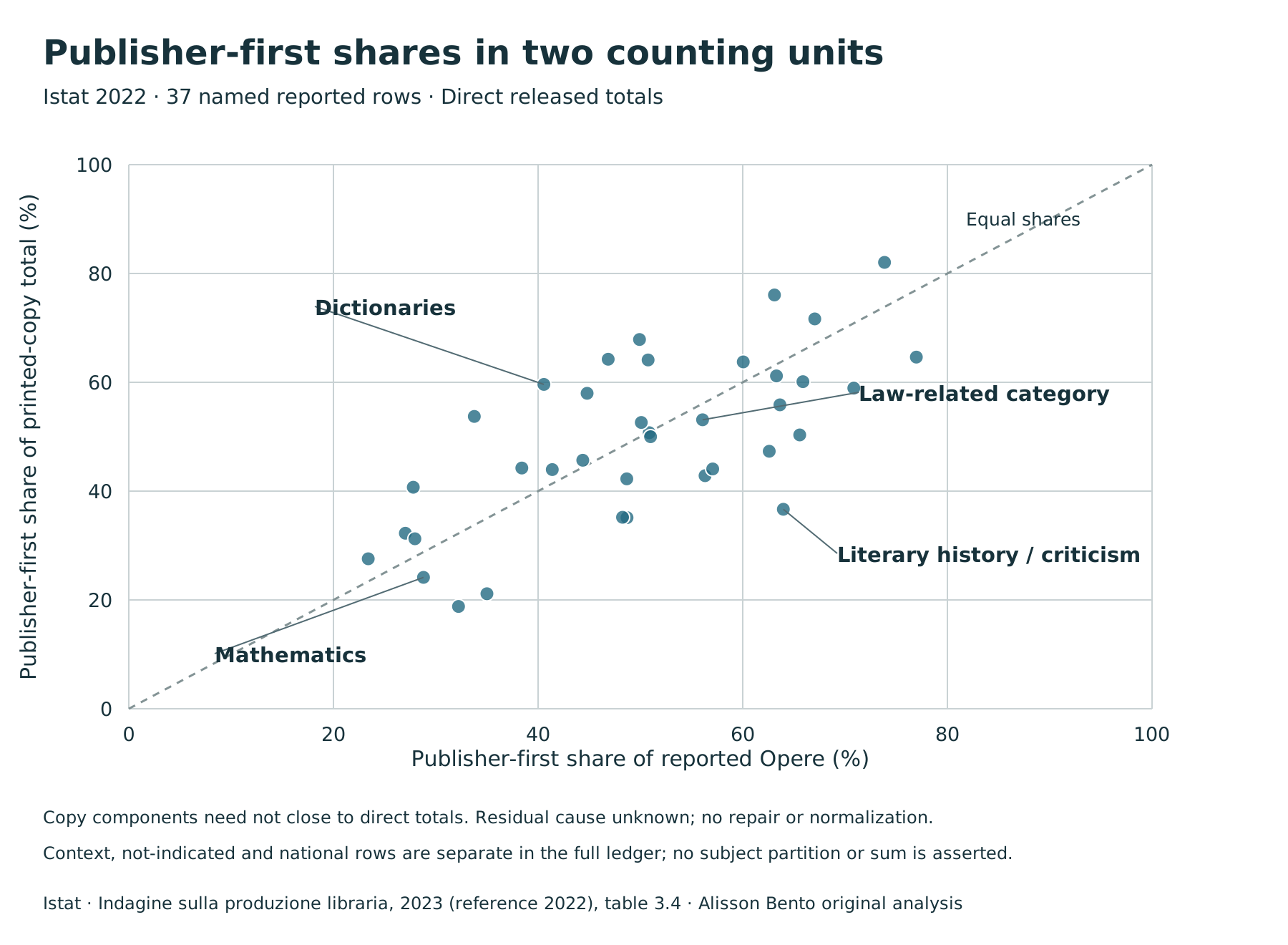
In Istat’s 2022 dictionaries row, publisher-first publications account for 40.57% of reported production units but 59.61% of printed-copy volume. Unchanged reprints show the opposite balance: 56.60% of units and 38.44% of copies. In the literary-history and criticism row, the contrast runs the other way. Publisher-first output is 63.97% of units but 36.66% of copies, while reprints account for 32.76% and 59.14%, respectively. These are two views of the same reporting year, not before-and-after changes.
The distinction matters when a publishing report describes how much material was produced. Counting each reported publication unit once describes a different aspect of production from counting its printed copies. Neither measure can substitute for readership, sales or demand. A large share of publisher-first units does not automatically mean that most reported copies belong to that class, and a reprint-heavy unit count does not guarantee an equally reprint-heavy copy profile.
This analysis follows that question through the full fixed set of 37 named, nonindented subject rows in Istat’s table 3.4. It preserves all three edition classes rather than reducing them to a binary new-versus-old split. Three indented rows, the “Not indicated” row and the published national context are retained separately. The contribution is this conditional subject-by-edition profile, not the discovery that titles and copies have different denominators.
First by a publisher is not first in the world
The source’s “Prima edizione” has a narrower meaning than a reader might expect: a publication issued for the first time by that publisher. It is not necessarily the first appearance of the underlying work anywhere, a newly written text or a new cultural creation. A publisher’s first issue of an established work can therefore belong in this class. Throughout this study, “publisher-first” is shorthand for that source definition, not an independently verified history of originality.
“Edizione successiva” is an edition distinguished from the first by changes to its text and/or typographic presentation, even when issued in the same year. It is called a modified edition here. The category does not certify a substantive revision, correction or improved text: typography alone can qualify. “Ristampa,” translated as unchanged reprint, refers to a publication without changes to the text and/or typographic presentation relative to its preceding edition, following the source’s definition.
The column labelled Opere counts source-reported production units. It should not be read as a deduplicated count of cultural works, ISBNs, authors, physical volumes or printing batches. Tiratura means printed copies, and this particular table reports it in thousands. The available documentation does not establish the detailed treatment needed to reconstruct print-on-demand batches or the first printing of each manifestation. Those unknowns remain outside the analysis rather than being silently resolved by terminology.
The finite table and its reporting frame
The data concern activity in 2022, collected in 2023 and published in the 2022 cultural-statistics release. The main physical-print frame covers Italian publishers and other public or private entities whose principal activity is book publishing. It excludes digital-only publishers, secondary or occasional publishing production, publications produced on behalf of third parties and output produced through self-publishing platforms. Platforms were investigated separately. These aggregates are not the whole book market, and their connection to Italian publishers does not establish that every copy was physically printed inside Italy.
Istat’s production definition includes printed, nonperiodical publications of at least five pages, subject to stated exclusions. It includes official publications and certain numbered fiction distributed through newsstands, while excluding specified advertising and service publications and other out-of-scope products. The questionnaire also gives a conditional inclusion rule for multivolume works. That rule is not a licence to reinterpret Opere as a physical-volume count; the analysis keeps the published production unit unchanged.
Table 3.4 contains 41 reported subject rows before its direct total. The main comparison uses 37 named, nonindented rows. Poetry and theatre, adventure and mystery books, and other novels and short stories appear as three indented contextual rows following modern literary texts. “Not indicated” is retained separately. Formatting does not prove an exhaustive, disjoint hierarchy. Accordingly, no subject rows are summed, no parent is added to its children, and no claim of complete leaf-category coverage is made.
Two direct-total-referenced shares
For each edition class within a reported row, the first quantity is its Opere count divided by that row’s directly published total Opere. The second is its Tiratura divided by that row’s directly published total Tiratura. Their difference, copy share minus Opere share, is expressed in percentage points. A positive gap means that the class has a larger share in the copy measure than in the production-unit measure. It is not an increase through time.
Both denominators stay exactly where the source puts them. The analysis does not replace a direct total with a sum of the three displayed components, and it does not force the resulting shares to close to 100%. This choice preserves a real reconciliation limitation in the released table. Displayed English percentages use two decimal places for readability; downloads retain exact fractions derived from the released numeric tokens, along with the original selected source quantities and every residual.
A second descriptive quantity is 1,000 times a class’s Tiratura divided by its Opere count. The multiplier converts the reported thousand-copy unit. The result is copies per source-reported production unit, not an observed initial print run, a publisher’s typical batch or a recommendation about how many copies to print. If a denominator is zero or unavailable, the corresponding quotient remains undefined. A missing symbol is never converted into a convenient zero.
Dictionaries and literary criticism point in opposite directions
Dictionaries provide a compact example of why the two counts cannot be interchanged. The row reports 43 publisher-first units out of 106, with 276 thousand copies out of 463 thousand. Reprints contribute 60 units and 178 thousand copies. Thus the publisher-first class is below half of the unit count but above half of the copy total, while reprints are above half of units but below half of copies. No book’s reading or sales performance is observed in this comparison.
Literary history and criticism provide an opposing profile, not a universal rule about literature. Here, 861 publisher-first units correspond to 874 thousand copies; 441 reprint units correspond to 1,410 thousand copies. The direct totals are 1,346 units and 2,384 thousand copies. Publisher-first output therefore has the larger unit share, but unchanged reprints have the larger copy share. The modified-edition class remains visible as well: 3.27% of units and 4.24% of copies, rather than disappearing into an undifferentiated “old” category.
The paired examples show why neither “reprints carry more copies” nor its opposite is an adequate summary of the table. Dictionaries have a publisher-first gap of +19.05 percentage points, whereas literary history and criticism have a gap of −27.31 points. The figures show every named primary row, not only these contrasting witnesses. The examples explain how to read the complete pattern; they do not define an outcome-selected sample or establish which field deserves publishing investment.
What the class-specific quotient explains—and does not
In dictionaries, the released quantities imply about 6,418.60 copies per publisher-first production unit, compared with 2,966.67 per reprint unit. In literary history and criticism, the corresponding ratios are about 1,015.10 and 3,197.28. Those opposite relative intensities account descriptively for the opposite unit-to-copy profiles. They are averages of released aggregates within the source categories, not a distribution of individual books’ printing quantities, nor a statement that each publication received the displayed number of copies.
The comparison deliberately stops before a causal explanation. The table does not show why a publisher assigned a particular number of copies, which titles were successful, how many copies remained unsold or how readers encountered them. It also does not link each class to its individual publishers and works in this released aggregate. A ratio across many reported units can describe the resulting production profile without identifying the business process or audience behaviour that generated it.
The same restraint applies to a large quotient. It is not evidence that a typical first edition began with a large batch, that print-on-demand was absent or that a reader was more likely to find the book. Multivolume composition, batch timing and manifestation identity are not reconstructed. The defensible reading is strictly conditional: within this source-reported row and class, the released copy volume divided by the released Opere count has the stated value.
Modified editions are a substantive third class
The law, public-administration, social-security, social-assistance and insurance row shows why the middle class matters. Modified editions account for 8.29% of Opere but 18.49% of copies, a +10.20 percentage-point gap. Publisher-first publications and reprints both have smaller copy shares than unit shares in that row. A binary comparison that merged modified editions with reprints would conceal the class to which this additional copy weight belongs, while calling it textual revision alone would overstate the source definition.
Mathematics supplies another clear middle-class profile. Modified editions make up 22.08% of production units and 31.99% of copies, a +9.91 point difference. The reported class quantities are 138 units and 1,003 thousand copies, yielding about 7,268.12 copies per reported modified-edition unit. This does not imply a first batch of that size or that mathematical content was substantively updated. It describes a class that can include textual or typographic change under Istat’s reporting rules.
These examples connect the three-class analysis to a practical reading task. When a report says that a field’s copy production is weighted toward previously issued material, a reader still needs to know whether that weight belongs to unchanged reprints or modified editions. The distinction is descriptive, not a ranking of editorial quality or freshness. The full matrix keeps all three categories for every named row, so the explanation does not depend on selecting only fields where the middle category is conspicuous.
Counterprofiles and context keep the comparison honest
Not every row changes as dramatically as dictionaries or literary criticism when the counting unit changes. In physical and natural sciences, publisher-first output accounts for 44.37% of Opere and 45.67% of copies; modified editions are 9.63% and 9.56%; reprints are 46.00% and 44.77%. The two views are comparatively close across all three classes. This counterprofile is part of the answer: a method that looked only for large gaps would give a misleading impression of universal disagreement.
Other rows have a mixture of close and less-close components. Primary-school textbooks have a reprint share of 67.88% of units and 67.59% of copies, even though their publisher-first and modified-edition shares differ more. Classical literary texts have a reprint share of 60.89% of units versus 75.93% of copies. Modern literary texts instead have a publisher-first share of 70.85% versus 58.93%. These are source subject labels, not independent evidence about the age or cultural novelty of each underlying work.
The three indented modern-literature rows are shown separately rather than added together or treated as a new exhaustive partition. Their publisher-first profiles also differ: poetry and theatre have 81.50% of units versus 63.02% of copies, while adventure and mystery books have 64.96% versus 76.77%. The “Not indicated” row is retained without allocating its production to named subjects. The direct national profile is separate context, not a replacement for the row-level comparisons or a denominator reconstructed by adding subject rows.
Fifteen copy totals do not reconcile exactly
All released Opere components reconcile with their direct row totals in this fixed extraction. Printed-copy components do not always do so. Fifteen reported rows have a three-class Tiratura sum that differs from the directly published total by +1 or −1 in the table’s thousand-copy unit. These discrepancies are disclosed in the complete residual ledger, including contextual and not-indicated rows. They are not repaired, removed, redistributed to an invented fourth class or hidden by normalizing the shares.
The largest absolute copy-share-sum discrepancy is exactly 25/79 of a percentage point, approximately 0.316456 points. This is a known reconciliation difference among released values, not a confidence interval, a bound on measurement error or proof that the underlying unrounded results would be unchanged. Its cause is unknown from the retained documentation. In particular, the analysis does not attribute it to rounding merely because the source presents copy quantities in thousands and uses an integer display format.
Direct-total-referenced shares remain interpretable under that limitation, but they must not be drawn as guaranteed 100%-closing compositions. The scatter plot compares two published-total ratios, and the matrix shows their signed differences; neither uses a 100% stack. The downloaded data preserve the exact denominators, component values and residuals. Ordinary display rounding in this article is a separate presentation choice, not an explanation of the source’s reconciliation discrepancies.
Census-derived does not mean complete or unimputed
The underlying collection has a census design, but its released results are processed aggregates with incomplete response, not a complete unedited administrative ledger. The methodology describes online checks, manual and automatic review, recontact and correction. Its reported unit-response percentages are not estimates of the proportion of all books or copies captured. No population coverage share, sampling confidence interval or significance test is manufactured from the number of reporting publishers or the 37 subject rows.
The full 2022 report explicitly documents a recovery procedure for 3.9% of responding units: CATI for other questionnaire sections and archive-based imputation of printed-book data. That figure is not 3.9% of editions, copies, all imputation or total error. Separately, missing subject and publication-language characteristics were imputed using Informazioni Editoriali data. Incomplete response and characteristic imputation are different limitations. The available aggregate table does not quantify their influence on each subject-by-edition cell, so the analysis cannot supply that missing uncertainty.
These qualifications matter especially because subject classification is central to the comparison. The results retain the source’s processed subject assignments rather than constructing an unsupported unimputed-only subset or pretending that every classification was directly reported. Household reading estimates in the same provider report come from a different survey; their uncertainty tables do not apply here. Nor are these 2022 publisher-collection profiles pooled with later ISBN-based production sources to manufacture a growth story.
How to use and reproduce the comparison
Istat’s report already describes national title and copy production, edition-class counts, publisher-size concentration, broad genres and selected subject contrasts. Those established findings deserve attribution. This analysis adds the full conditional within-row three-class profile and its complete reconciliation record, not a new mathematical identity or a first-ever method claim. Its useful conclusion is that a publishing-production description needs the counting unit, the publisher-relative edition definition and the third class together; a national headline alone cannot specify every subject profile.
The public bundle supplies only selected aggregate facts, the complete reported-row panel, definitions and reproducible calculations. Its standard-library Python command works from the declared flat files without the full source workbook or any network request. It recreates all row and class profiles, undefined states, direct national context and residuals. Exact source URLs and original-file fingerprints make optional source verification possible; the default calculation does not require downloading the complete workbook or any publisher-level microdata.
For a reader, the safest use is interpretive: ask which production unit a statement counts, what “first edition” means for its publisher, whether modified editions remain separate, and whether reported components reconcile. The table does not answer whether an author should enter a subject market, how many copies to print, which books sold, or what anyone read. Preserving those boundaries makes the contrast useful without converting a detailed production release into demand, income, cultural-value or causal advice.
Publisher-first shares in two counting units
All 37 named reported subject rows, 2022. Publisher-first shares in two source counting units; direct released totals.
Full chart and source

Scroll horizontally to inspect the chart. ↔
Chart and values
Scroll horizontally to see all columns.
| Reported subject | Publisher-first Opere (%) | Publisher-first copies (%) |
|---|---|---|
| General subjects | 65.88 | 60.12 |
| Dictionaries | 40.57 | 59.61 |
| Philosophy, metaphysics, metapsychics and astrology | 63.63 | 55.86 |
| Psychology | 27.80 | 40.71 |
| Religion and theology | 44.79 | 57.98 |
| Sociology | 46.85 | 64.24 |
| Statistics | 27.03 | 32.26 |
| Political science, political economy and public finance | 60.05 | 63.75 |
| Law, public administration, social security, social assistance and insurance | 56.07 | 53.11 |
| Military art and science | 62.59 | 47.32 |
| Pedagogy and didactics (source exclusions) | 41.39 | 43.96 |
| Primary-school textbooks | 27.96 | 31.24 |
| Trade, communications and transport: economic aspect | 23.40 | 27.56 |
| Ethnography, customs, folklore and popular traditions | 67.04 | 71.65 |
| Philology and linguistics | 32.22 | 18.80 |
| Mathematics | 28.80 | 24.15 |
| Physical and natural sciences | 44.37 | 45.67 |
| Ecology | 73.86 | 82.04 |
| Medicine, pharmacy, veterinary science, hygiene and dietetics | 50.86 | 50.74 |
| Technology, engineering, industries, arts and crafts | 38.41 | 44.24 |
| Computing | 33.77 | 53.73 |
| Agriculture, forestry, animal husbandry, hunting and fishing | 48.69 | 35.13 |
| Domestic economy, furnishing and fashion | 50.99 | 50.00 |
| Cooking and recipe books | 50.08 | 52.62 |
| Trade, communications and transport: organizational and technical aspect | 48.67 | 42.25 |
| Architecture and urban planning | 63.30 | 61.17 |
| Visual arts and photography | 76.97 | 64.63 |
| Music and performance (source inclusions) | 56.32 | 42.83 |
| Entertainment, games and sport | 57.06 | 44.07 |
| Literary history and criticism | 63.97 | 36.66 |
| Geography, travel and atlases | 48.25 | 35.19 |
| Tourist guides | 50.75 | 64.11 |
| History, biographies and heraldry | 65.57 | 50.33 |
| Political, social and economic current affairs | 49.91 | 67.86 |
| Classical literary texts | 35.00 | 21.14 |
| Modern literary texts | 70.85 | 58.93 |
| Comics | 63.10 | 76.05 |
Same 2022 row, different counting units. Opere is source-reported production units; copies are printed-copy volume. Both shares use the row’s directly published total. English labels preserve source category scope; exact Italian labels/footnotes are in the ledger. No subject sum or exhaustive partition is asserted.

Three edition classes, different unit-to-copy gaps
All 37 named rows and all three edition classes; copy-share minus Opere-share gaps in percentage points.
Full chart and source

Scroll horizontally to inspect the chart. ↔
Chart and values
Scroll horizontally to see all columns.
| Reported subject | Publisher-first gap (pp) | Modified-edition gap (pp) | Reprint gap (pp) |
|---|---|---|---|
| General subjects | −5.77 | +1.28 | +4.49 |
| Dictionaries | +19.05 | −0.89 | −18.16 |
| Philosophy, metaphysics, metapsychics and astrology | −7.78 | +0.98 | +6.80 |
| Psychology | +12.91 | +4.00 | −16.91 |
| Religion and theology | +13.19 | +2.20 | −15.40 |
| Sociology | +17.38 | +3.42 | −20.69 |
| Statistics | +5.23 | −0.83 | −4.40 |
| Political science, political economy and public finance | +3.70 | +2.25 | −6.01 |
| Law, public administration, social security, social assistance and insurance | −2.96 | +10.20 | −7.24 |
| Military art and science | −15.26 | +2.05 | +13.22 |
| Pedagogy and didactics (source exclusions) | +2.57 | +1.09 | −3.67 |
| Primary-school textbooks | +3.28 | −2.99 | −0.29 |
| Trade, communications and transport: economic aspect | +4.16 | +4.76 | −8.92 |
| Ethnography, customs, folklore and popular traditions | +4.61 | −1.09 | −3.26 |
| Philology and linguistics | −13.42 | +1.81 | +11.62 |
| Mathematics | −4.65 | +9.91 | −5.23 |
| Physical and natural sciences | +1.31 | −0.08 | −1.23 |
| Ecology | +8.18 | +1.27 | −9.45 |
| Medicine, pharmacy, veterinary science, hygiene and dietetics | −0.13 | +9.80 | −9.59 |
| Technology, engineering, industries, arts and crafts | +5.83 | −0.86 | −4.88 |
| Computing | +19.96 | +1.07 | −20.72 |
| Agriculture, forestry, animal husbandry, hunting and fishing | −13.56 | +1.23 | +12.65 |
| Domestic economy, furnishing and fashion | −0.99 | +5.65 | −4.66 |
| Cooking and recipe books | +2.53 | +3.34 | −5.94 |
| Trade, communications and transport: organizational and technical aspect | −6.41 | −3.38 | +9.79 |
| Architecture and urban planning | −2.12 | +2.63 | −0.51 |
| Visual arts and photography | −12.34 | −0.09 | +12.43 |
| Music and performance (source inclusions) | −13.48 | +5.99 | +7.49 |
| Entertainment, games and sport | −12.99 | −1.77 | +14.76 |
| Literary history and criticism | −27.31 | +0.97 | +26.38 |
| Geography, travel and atlases | −13.06 | −1.05 | +14.11 |
| Tourist guides | +13.35 | −0.93 | −12.42 |
| History, biographies and heraldry | −15.24 | −0.23 | +15.47 |
| Political, social and economic current affairs | +17.95 | +0.10 | −18.00 |
| Classical literary texts | −13.86 | −1.18 | +15.04 |
| Modern literary texts | −11.93 | +5.03 | +6.89 |
| Comics | +12.95 | −0.99 | −11.96 |
Percentage points, copy share minus Opere share; same reference 2022, not time growth. Direct released totals are retained. The three gaps need not sum to zero because copy components do not always reconcile; no closure normalization.

Data & downloads


Scroll horizontally to see all columns.
| Reported subject | Publisher-first Opere (%) | Publisher-first copies (%) |
|---|---|---|
| General subjects | 65.88 | 60.12 |
| Dictionaries | 40.57 | 59.61 |
| Philosophy, metaphysics, metapsychics and astrology | 63.63 | 55.86 |
| Psychology | 27.80 | 40.71 |
| Religion and theology | 44.79 | 57.98 |
| Sociology | 46.85 | 64.24 |
| Statistics | 27.03 | 32.26 |
| Political science, political economy and public finance | 60.05 | 63.75 |
| Law, public administration, social security, social assistance and insurance | 56.07 | 53.11 |
| Military art and science | 62.59 | 47.32 |
| Pedagogy and didactics (source exclusions) | 41.39 | 43.96 |
| Primary-school textbooks | 27.96 | 31.24 |
| Trade, communications and transport: economic aspect | 23.40 | 27.56 |
| Ethnography, customs, folklore and popular traditions | 67.04 | 71.65 |
| Philology and linguistics | 32.22 | 18.80 |
| Mathematics | 28.80 | 24.15 |
| Physical and natural sciences | 44.37 | 45.67 |
| Ecology | 73.86 | 82.04 |
| Medicine, pharmacy, veterinary science, hygiene and dietetics | 50.86 | 50.74 |
| Technology, engineering, industries, arts and crafts | 38.41 | 44.24 |
| Computing | 33.77 | 53.73 |
| Agriculture, forestry, animal husbandry, hunting and fishing | 48.69 | 35.13 |
| Domestic economy, furnishing and fashion | 50.99 | 50.00 |
| Cooking and recipe books | 50.08 | 52.62 |
| Trade, communications and transport: organizational and technical aspect | 48.67 | 42.25 |
| Architecture and urban planning | 63.30 | 61.17 |
| Visual arts and photography | 76.97 | 64.63 |
| Music and performance (source inclusions) | 56.32 | 42.83 |
| Entertainment, games and sport | 57.06 | 44.07 |
| Literary history and criticism | 63.97 | 36.66 |
| Geography, travel and atlases | 48.25 | 35.19 |
| Tourist guides | 50.75 | 64.11 |
| History, biographies and heraldry | 65.57 | 50.33 |
| Political, social and economic current affairs | 49.91 | 67.86 |
| Classical literary texts | 35.00 | 21.14 |
| Modern literary texts | 70.85 | 58.93 |
| Comics | 63.10 | 76.05 |
Same 2022 row, different counting units. Opere is source-reported production units; copies are printed-copy volume. Both shares use the row’s directly published total. English labels preserve source category scope; exact Italian labels/footnotes are in the ledger. No subject sum or exhaustive partition is asserted.
Scroll horizontally to see all columns.
| Reported subject | Publisher-first gap (pp) | Modified-edition gap (pp) | Reprint gap (pp) |
|---|---|---|---|
| General subjects | −5.77 | +1.28 | +4.49 |
| Dictionaries | +19.05 | −0.89 | −18.16 |
| Philosophy, metaphysics, metapsychics and astrology | −7.78 | +0.98 | +6.80 |
| Psychology | +12.91 | +4.00 | −16.91 |
| Religion and theology | +13.19 | +2.20 | −15.40 |
| Sociology | +17.38 | +3.42 | −20.69 |
| Statistics | +5.23 | −0.83 | −4.40 |
| Political science, political economy and public finance | +3.70 | +2.25 | −6.01 |
| Law, public administration, social security, social assistance and insurance | −2.96 | +10.20 | −7.24 |
| Military art and science | −15.26 | +2.05 | +13.22 |
| Pedagogy and didactics (source exclusions) | +2.57 | +1.09 | −3.67 |
| Primary-school textbooks | +3.28 | −2.99 | −0.29 |
| Trade, communications and transport: economic aspect | +4.16 | +4.76 | −8.92 |
| Ethnography, customs, folklore and popular traditions | +4.61 | −1.09 | −3.26 |
| Philology and linguistics | −13.42 | +1.81 | +11.62 |
| Mathematics | −4.65 | +9.91 | −5.23 |
| Physical and natural sciences | +1.31 | −0.08 | −1.23 |
| Ecology | +8.18 | +1.27 | −9.45 |
| Medicine, pharmacy, veterinary science, hygiene and dietetics | −0.13 | +9.80 | −9.59 |
| Technology, engineering, industries, arts and crafts | +5.83 | −0.86 | −4.88 |
| Computing | +19.96 | +1.07 | −20.72 |
| Agriculture, forestry, animal husbandry, hunting and fishing | −13.56 | +1.23 | +12.65 |
| Domestic economy, furnishing and fashion | −0.99 | +5.65 | −4.66 |
| Cooking and recipe books | +2.53 | +3.34 | −5.94 |
| Trade, communications and transport: organizational and technical aspect | −6.41 | −3.38 | +9.79 |
| Architecture and urban planning | −2.12 | +2.63 | −0.51 |
| Visual arts and photography | −12.34 | −0.09 | +12.43 |
| Music and performance (source inclusions) | −13.48 | +5.99 | +7.49 |
| Entertainment, games and sport | −12.99 | −1.77 | +14.76 |
| Literary history and criticism | −27.31 | +0.97 | +26.38 |
| Geography, travel and atlases | −13.06 | −1.05 | +14.11 |
| Tourist guides | +13.35 | −0.93 | −12.42 |
| History, biographies and heraldry | −15.24 | −0.23 | +15.47 |
| Political, social and economic current affairs | +17.95 | +0.10 | −18.00 |
| Classical literary texts | −13.86 | −1.18 | +15.04 |
| Modern literary texts | −11.93 | +5.03 | +6.89 |
| Comics | +12.95 | −0.99 | −11.96 |
Percentage points, copy share minus Opere share; same reference 2022, not time growth. Direct released totals are retained. The three gaps need not sum to zero because copy components do not always reconcile; no closure normalization.
Scroll horizontally to see all columns.
| Reported subject | Publisher-first copies / Opere | Modified copies / Opere | Reprint copies / Opere |
|---|---|---|---|
| Dictionaries | 6,418.60 | 3,000.00 | 2,966.67 |
| Literary history and criticism | 1,015.10 | 2,295.45 | 3,197.28 |
| Law, public administration, social security, social assistance and insurance | 685.64 | 1,614.94 | 576.87 |
| Mathematics | 4,205.56 | 7,268.12 | 4,482.08 |
| Physical and natural sciences | 2,560.42 | 2,467.74 | 2,420.61 |
| Primary-school textbooks | 17,459.46 | 4,393.94 | 15,558.44 |
Derived 1,000×reported Tiratura/Opere, with Tiratura in thousands. These are ratios of released aggregates—not an individual book’s initial print run, POD batch, typical publisher quantity or printing recommendation. The complete 126 class profiles, not only these cases, are downloadable.
Scroll horizontally to see all columns.
| Reported row / role | First: Opere (%) | First: copies (%) | Modified: Opere (%) | Modified: copies (%) | Reprint: Opere (%) | Reprint: copies (%) |
|---|---|---|---|---|---|---|
| Poetry and theatre (indented context) / indented context | 81.50 | 63.02 | 2.59 | 8.39 | 15.91 | 28.49 |
| Adventure and mystery books (indented context) / indented context | 64.96 | 76.77 | 4.35 | 3.00 | 30.70 | 20.23 |
| Other novels and short stories (indented context) / indented context | 69.77 | 56.40 | 5.81 | 11.28 | 24.42 | 32.32 |
| Not indicated / not indicated | 38.86 | 48.09 | 4.81 | 3.82 | 56.32 | 48.09 |
| Published national context / national context | 55.31 | 50.98 | 6.20 | 8.33 | 38.50 | 40.68 |
Three indented rows follow modern literary texts in the source; their completeness/disjointness is not inferred. Not indicated is not reassigned. The national row is directly published context, not a sum of displayed subjects. Percentages use each row’s own direct totals.
Scroll horizontally to see all columns.
| Reported row / role | Copy residual (thousands) | Share-sum difference (pp) |
|---|---|---|
| Religion and theology / named row | −1 | −0.015593 |
| Sociology / named row | +1 | +0.117647 |
| Political science, political economy and public finance / named row | −1 | −0.064851 |
| Ethnography, customs, folklore and popular traditions / named row | +1 | +0.257732 |
| Mathematics / named row | +1 | +0.031898 |
| Medicine, pharmacy, veterinary science, hygiene and dietetics / named row | +1 | +0.081699 |
| Technology, engineering, industries, arts and crafts / named row | +1 | +0.100100 |
| Computing / named row | +1 | +0.310559 |
| Agriculture, forestry, animal husbandry, hunting and fishing / named row | +1 | +0.316456 |
| Cooking and recipe books / named row | −1 | −0.060132 |
| Literary history and criticism / named row | +1 | +0.041946 |
| Political, social and economic current affairs / named row | +1 | +0.051335 |
| Modern literary texts / named row | −1 | −0.002082 |
| Poetry and theatre (indented context) / indented context | −1 | −0.097561 |
| Not indicated / not indicated | +1 | +0.002932 |
Three copy components minus the directly published row total, in THOUSANDS of copies. All Opere residuals are zero. Copy cause is unknown, not assigned to rounding. The largest absolute share-sum difference is 25/79 pp (about 0.316456), not a confidence interval, measurement-error bound or unrounded-robustness claim. The downloadable residual ledger also retains all zero rows.
Evidence & method
How we calculated it
- Use Istat’s 2022 table 3.4 from the actual official Editoria workbook, collected in 2023. Extract exactly 336 selected aggregate cells: 41 reported rows and a separate national context, each with three class pairs and direct totals.
- Keep 37 named nonindented rows as the primary finite comparison; preserve three indented rows and Not indicated separately. Do not infer an exhaustive disjoint subject partition, add parents to children, sum subjects or treat rows as independent survey observations.
- Apply source definitions: publisher-first is first by that publisher; modified editions may change text and/or typography; reprints are unchanged. Opere is the source-reported production unit, not a unique work, ISBN, volume or initial print batch.
- Compute each class’s Opere/direct-row-Opere and Tiratura/direct-row-Tiratura fractions. Compute copy-minus-Opere percentage-point gaps and 1,000×Tiratura/Opere only where denominators are positive. Unknown or zero denominators remain undefined.
- Preserve every released token and direct denominator. Calculate class-sum-minus-direct-total residuals without repair, closure normalization, residual allocation or cause attribution. Exact fractions are exact for released cells only; article shares use two decimal places.
- The fixed descriptive breadth rule required at least 30 of 37 named rows with complete finite fields and positive direct totals; all 37 qualify. This is an analyst breadth rule, not an Istat sampling precision standard. All row dispositions remain in the ledger.
- The reported-row frame and calculation rules were fixed before worksheet numeric values were interpreted; provider-published national and selected-subject statistics were already known. This is not described as blind preregistration.
- Attribute Istat’s established provider findings and retain census-derived response, editing and imputation limits. Reproduce numerical outputs from the supplied flat selected facts/panel using standard-library Python; no microdata, network access or artificial confidence intervals.
What the data cannot tell us
- The 2022 main-activity physical-print publishing frame is not the whole book market. It excludes digital-only publishers, secondary/occasional production, publications produced on behalf of third parties and platform self-publishing output; Italian publisher scope is not proof of printing geographically inside Italy.
- Publisher-first does not mean first-ever worldwide or new cultural content. Modified editions can reflect typography alone. No individual work’s revision history, correction or editorial quality is verified.
- Opere is not a deduplicated work, author, ISBN, physical-volume or batch count. Detailed POD/multivolume/initial-run treatment is not reconstructed; copies per reported unit is not an actual first print run or printing recommendation.
- Tiratura is reported in thousands of printed copies, not sales, distribution, shop availability, loans, readers, demand, revenue or profit.
- The published aggregates include incomplete response, editing and imputation. The 3.9% recovery figure refers to responding units, not books/copies, all imputation or an error bound; separate subject/language imputation can affect the classifications used here.
- No per-cell imputation influence, measurement-error bound or suitable sampling variance is supplied. Exact arithmetic does not establish error-free coverage or justify confidence intervals, significance tests or causal explanations.
- The displayed subject hierarchy is not proven exhaustive and disjoint. Parent/context/unknown/national rows remain separate, with no subject summation, independent-row sampling claim or reallocation of Not indicated.
- Fifteen copy-component sums differ from direct totals by ±1 thousand. Cause unknown. The maximum share-sum discrepancy 25/79 pp is a released reconciliation diagnostic, not underlying-rounding robustness or a bound on error. Shares are not normalized to 100%.
- This is one 2022 cross-section, not a trend or a matched-publisher change analysis. Later ISBN-based sources and the provider’s separate household reading survey are not pooled with it.
- The analysis is for interpreting reported production. It does not establish market opportunity, fairness, cultural value, author income, reader behaviour, publishing success or a causal effect, and offers no business or print-quantity recommendation.
Original sources
- Istat, Statistiche culturali – Anno 2022
Official 2022 cultural-statistics release, published 19 December 2023, links the aggregate workbook, methodology and glossary. Reference year and collection year are distinguished.
Accessed October 31, 2026
- Istat, Editoria 2022 workbook, table 3.4
Actual table 3.4 supplies the selected 336 numeric cells, source-reported subject rows and direct totals. Its title explicitly states Tiratura in thousands; original workbook fingerprint is provided separately.
Accessed October 31, 2026
- Istat, Statistiche culturali 2022 glossary
The glossary establishes publisher-relative first publication, modified text/typography and unchanged reprints. It does not establish unique-work, initial-batch or POD semantics.
Accessed October 31, 2026
- Istat, Statistiche culturali 2022 methodology
The methodology documents the main-activity physical-print census frame, incomplete response, checking and correction. No complete administrative-response or cell-error claim follows.
Accessed October 31, 2026
- Istat, 2022 book-production questionnaire
The 2022 questionnaire defines printed nonperiodical works of at least five pages, exclusions and conditional multivolume inclusion; no per-volume reconstruction is attempted.
Accessed October 31, 2026
- Istat, Produzione e lettura di libri in Italia – Anno 2022
The 14 December 2023 report is prior art for national, broad-genre and selected-subject results. Its production methods explicitly document unit recovery and subject/language imputation; its household-reading precision section is a different survey.
Accessed October 31, 2026
- Istat legal notice
Istat’s legal notice supplies the default CC BY 4.0 terms and attribution/adaptation duties, with exceptions and separate logo/third-party rights. No blanket article licence or endorsement is claimed.
Accessed October 31, 2026
Cite & reuse this study
Alisson Bento. 2026. First for the Publisher, Not Always Most Copies. Original analysis of Istat’s 2022 reported book-production profiles. https://alissonbento.com/research/italy-publisher-first-copy-profiles-2022/
Selected Istat aggregate facts and source taxonomy are reused with attribution under Istat’s default CC BY 4.0 notice, unless otherwise indicated. Calculations, presentation and interpretation are Alisson Bento original analysis. No licence for the entire article, agency logo, third-party work or publisher book content is inferred.
Corrections or editorial questions