
The joint diary-day result
Among U.S. adults living with household children in the 2025 American Time Use Survey, an estimated 73.4% of diary days coded for reading to or with those children contained no personal-interest-reading code. The approximate 95% sampling interval is 64.1% to 81.0%. This describes the overlap of two selected primary-activity categories on the same diary day. It does not mean that those adults are nonreaders, do not enjoy books, or sacrifice their own reading because of childcare. The estimates also retain a material 2025 shutdown limitation that the sampling intervals do not cover.
The distinction changes a common-base tally. Personal-interest reading appears on about 11.3% of diary days in the defined household-child adult group. Either that code or household-child reading appears on about 16.6%. The additional 5.3 percentage points consist of days with household-child reading but no personal-interest-reading code. The extra category is not a correction to an erroneous reading measure: it answers a broader, explicitly different question. This reference shows the complete joint distribution, its conditional bases and its sampling uncertainty so that a single reading indicator is not mistaken for all the reading-related activity an adult can report.
Two codes that describe different primary activities
The first category is ATUS code 120312, reading for personal interest. Its scope is broader than novels or printed books; material can include periodicals and other non-book reading. The second is code 030102, reading to or with household children. It belongs to the household-care activity family, not the personal-interest leisure family. The analysis does not merge code 040102 for reading with nonhousehold children into the second category. That exclusion is deliberate, and it makes the child-related indicator narrower than every kind of reading with children.
A diary can contain both selected codes at different times. Each recorded activity has a primary code, and the selected categories are distinct at that activity level. Having both somewhere within a day is therefore not evidence that the respondent performed them simultaneously. It is also not evidence of attention, the number of books, reading quality or how much a particular child understood. The present question concerns whether each code has positive summed primary-activity minutes during one diary, not the total cultural value of either activity.
The wording “personal-interest reading” also needs care. In this article it names the selected official category, not every activity that an adult might personally find interesting. A respondent may enjoy reading with a child while reporting that activity under the household-child code. Conversely, a personal-interest-reading code does not establish that a book was read for pleasure rather than another personal purpose. The two categories provide an operational comparison. They do not divide rewarding and unrewarding reading, adults who care about books and those who do not, or people who read for themselves and people who only serve others.
The adult group and the diary-day base
The primary domain contains respondents aged eighteen or older whose household includes at least one child younger than eighteen, with consistent edited household-child fields. There are 1,581 unweighted respondents in that domain, drawn from 6,146 respondents in the annual source files. Their survey weights support an average-day description of the defined adult population. They are not 1,581 families observed repeatedly, and their records do not establish parenthood. A household member can live with children without being their parent, and the analysis does not reconstruct personal relationships.
ATUS asks one respondent to describe a single day running from four in the morning to four the following morning. A day without either selected code is not a claim about the rest of that person's week. The same person could read in another way, read on a different day, or do secondary reading not represented by these primary codes. The estimates therefore concern weighted person-days. They cannot be converted into the share of parents who never read, households without books, children who receive no reading support, or adults who have permanently stopped reading.
The study also retains a secondary domain fixed before the new support counts were calculated: adults in these households whose youngest household child is aged zero to five. That domain contains 666 unweighted respondents and is nested within the primary domain. It does not identify which child participated in a reading activity. Older household children may also be present. A result for this household frame must not be renamed a rate of reading to preschoolers, a measure of bedtime stories, or an outcome specifically experienced by the youngest child.
The four diary-day states
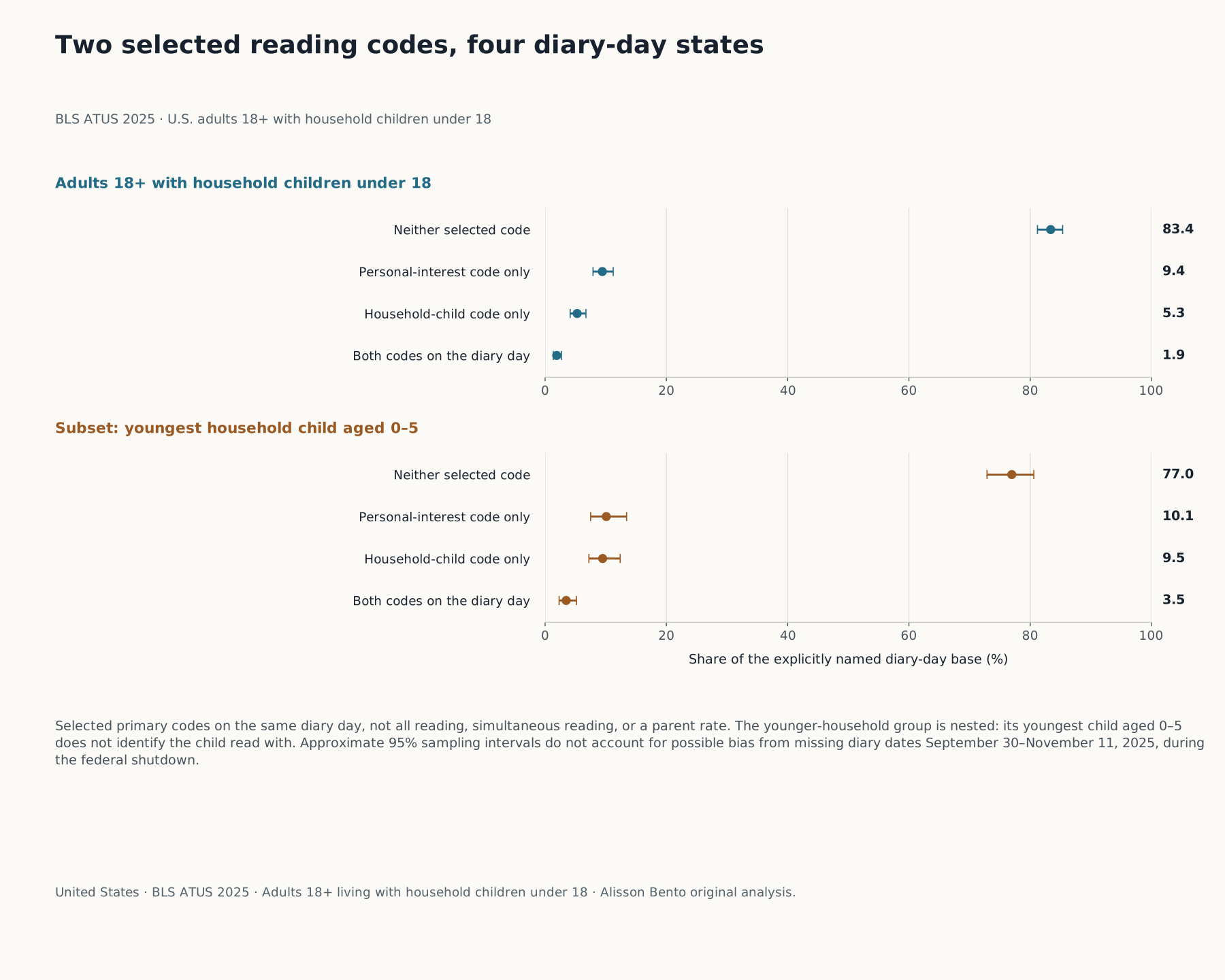
Every eligible diary belongs to one of four mutually exclusive states for the two selected codes. In the primary domain, approximately 83.4% record neither code, 9.4% record personal-interest reading only, 5.3% record household-child reading only, and 1.9% record both. “Neither” always means neither selected primary code, not no reading of any kind. The four percentages close to one hundred apart from display rounding. They supply the joint information that two separate participation percentages cannot reveal.
The marginal personal-interest-reading rate is the sum of its only-state and the both-state: approximately 11.3%. Household-child reading similarly combines its only-state and the both-state, giving approximately 7.2%. Adding those two marginal rates would double-count the days with both codes. The union instead adds the three positive joint states once, producing approximately 16.6%. This is a familiar counting identity, not a newly discovered statistical principle. The original contribution is the defined household-child domain and the verified 2025 joint estimates needed to apply it in this setting.
The sampling intervals make the smaller state visible without presenting it as exact. For the both-code state, the approximate interval runs from 1.4% to 2.7%. For household-child-only days it runs from 4.1% to 6.7% under the proportion interval method. Those are estimates for a defined population and year, not exact shares of all U.S. families. The unweighted both-code count is thirty-nine, so the overlap should not be treated as a highly precise basis for detailed demographic segmentation. No additional demographic slicing is performed.
What changes when the denominator changes
The 73.4% headline conditions on household-child-reading-coded days. Its unweighted denominator is 151 diary records, including 112 without the personal-interest code and thirty-nine with both. Weighted estimation changes the percentage from the simple raw-count fraction, and the replicate weights supply its uncertainty. The result says that most days in this particular coded group do not also carry the other selected code. It does not show that most adults who read with children lack personal reading in their lives.
Reversing the condition gives another valid but different answer. Among diary days without the personal-interest-reading code, approximately 6.0% contain the household-child-reading code, with an approximate sampling interval of 4.7% to 7.6%. The intersection is the same household-child-only state; the denominator is much larger. These two conditional percentages are not contradictory and should not be subtracted as if they were treatment effects. They are useful together because they show how the same observed overlap can occupy very different proportions of two selected bases.
On the full primary-domain base, the union-minus-personal-interest difference is about 5.3 percentage points. Its directly paired replicate estimate has an approximate interval of 4.0 to 6.6 points. The same point value also appears as the household-child-only state. The public files retain the interval method for each row: proportions use a logit transformation, while the paired percentage-point difference uses a normal interval. The slightly different displayed bounds for the identical point quantity come from these declared interval constructions, not different people or a hidden data repair.
The fixed younger-household context
In the secondary domain, approximately 77.0% of days contain neither selected code, 10.1% personal-interest reading only, 9.5% household-child reading only and 3.5% both. The personal-interest marginal is approximately 13.6%, the household-child marginal approximately 13.0%, and their union approximately 23.0%. About 73.2% of household-child-coded days lack the personal-interest code, with an approximate interval of 62.7% to 81.7%. These are a contextual profile for the fixed household frame, not a second study or a newly chosen subgroup selected for a striking result.
The two domains overlap, so their estimates are not independent samples to be combined or compared with a simple difference-of-independent-standard-errors formula. This study does not test a causal age effect or declare the secondary conditional rate equivalent to the primary one because their point values look similar. The younger-household frame also has different adult and household composition. It demonstrates that the joint-indicator question can be asked within a predeclared supported context while retaining the distinction between the youngest household child's age and the identity of the child involved in an activity.
Weights, support and source checks
Each point estimate uses the source's final ATUS weight. The calculation repeats the entire numerator-and-denominator ratio with all 160 final replicate weights, then applies the documented variance factor: four divided by 160 times the sum of squared replicate deviations from the full-weight estimate. Conditional denominators are re-estimated within each replicate rather than treated as fixed. Proportion intervals use a logit transformation and an approximate normal reference; the paired indicator difference uses its directly paired replicate quantity and a normal interval.
Before new estimates were calculated, the analysis fixed its domains, categories, quantities and support thresholds. The primary domain had to contain at least two hundred records and a final-weight Kish support measure of at least one hundred. Each joint state required at least twenty records and positive-weight Kish support of at least ten. Conditional denominators required at least sixty-two records and Kish support of at least thirty, with at least twenty numerator and complement records and positive denominators under every replicate. Both fixed domains passed. These are disclosed analyst rules, not a claim to reproduce unpublished detailed BLS publication criteria or to guarantee unbiased estimates.
Source validation also checks the unique respondent linkage, matching edited household fields and weights, complete replicate coverage, unique activity keys and nonnegative durations. Every activity diary closes to 1,440 minutes. Independently accumulated selected-code minutes match the activity-summary columns exactly. These checks help prevent a wrong code, a mismatched person or a missing weight from silently changing the population. They do not establish perfect reporting, complete classification of every reading event or absence of nonsampling error in the original survey.
The 2025 gap remains outside the intervals
The annual data contain no diaries for September 30 through November 11, 2025, during the federal government shutdown. BLS’s shutdown notice explains that the available fourth-quarter days represent the full quarter under the annual weighting and that the shutdown's effects cannot be quantified. This study does not fill in the absent diaries, move observations into those dates or claim that replicate weights remove their possible influence. Its sampling intervals do not account for shutdown-related missing-diary bias.
That limitation matters even when a numerical estimate clears a support threshold or has an interval entirely above zero. Replication measures sampling variation under the supplied design; it does not reveal unobserved behavior on the missing dates. This reference therefore avoids presenting the results as an exact annual truth or comparing them with an earlier year's estimate to announce a trend. The 2025 label remains beside every figure, and the shutdown caveat travels with the downloadable images so that it does not disappear when a chart is shared separately from the article.
What is new, and how to use it
Bone and colleagues' 2025 iScience study already examines personal reading and reading with children across 2003–2023, including the low prevalence of the latter, social context and demographic differences. This reference does not claim to discover child-related reading or update that paper's broad trend as a new insight. Its narrower contribution is a common household-child adult domain, the household-only child-reading code, the four same-day joint states and the conditional discordance with personal-interest reading. The new conditional percentage cannot be recovered from the two marginals alone.
For editors, the practical distinction is to name the indicator and its base before turning it into a reader label. For publishers or people designing shared-reading material, the data provide a reason to ask whether an audience measure includes the relevant activity. They do not predict demand, book sales, the effect of providing materials, or a benefit to a child. The downloadable tables, aggregate recipe, code and original figures let others inspect the calculation while keeping respondent records and identifiers out of the public package. BLS receives source credit; the calculations and explanation are Alisson Bento's independent work, with no government endorsement implied.
Two selected reading codes, four diary-day states
2025 adult person-days in two nested household-child domains; approximate 95% sampling intervals.
Full chart and source
Scroll horizontally to inspect the chart. ↔
Chart and values
Scroll horizontally to see all columns.
| Household domain | Selected-code quantity | Estimate (%) | Lower 95% sampling limit (%) | Upper 95% sampling limit (%) | Unweighted denominator n |
|---|---|---|---|---|---|
| Adults 18+ with household children under 18 | Neither selected code | 83.38 | 81.19 | 85.35 | 1,581 |
| Adults 18+ with household children under 18 | Personal-interest code only | 9.43 | 7.90 | 11.23 | 1,581 |
| Adults 18+ with household children under 18 | Household-child code only | 5.28 | 4.13 | 6.73 | 1,581 |
| Adults 18+ with household children under 18 | Both codes on the diary day | 1.91 | 1.35 | 2.69 | 1,581 |
| Subset: youngest household child aged 0–5 | Neither selected code | 76.96 | 72.87 | 80.59 | 666 |
| Subset: youngest household child aged 0–5 | Personal-interest code only | 10.09 | 7.51 | 13.43 | 666 |
| Subset: youngest household child aged 0–5 | Household-child code only | 9.49 | 7.22 | 12.37 | 666 |
| Subset: youngest household child aged 0–5 | Both codes on the diary day | 3.47 | 2.31 | 5.19 | 666 |
Same-day selected primary codes, not all reading or parents. Neither selected code means neither of these primary categories, not no reading of any kind. The nested youngest-child 0–5 household frame does not identify the child read with. Approximate 95% sampling intervals do not account for possible bias from missing diary dates September 30–November 11, 2025, during the federal shutdown. Selected primary codes on the same diary day, not all reading, simultaneous reading, or a parent rate. The younger-household group is nested: its youngest child aged 0–5 does not identify the child read with. Approximate 95% sampling intervals do not account for possible bias from missing diary dates September 30–November 11, 2025, during the federal shutdown.

The same intersection, two conditional bases
Two explicitly different conditional denominators for the household-child-only intersection; approximate 95% sampling intervals.
Full chart and source

Scroll horizontally to inspect the chart. ↔
Chart and values
Scroll horizontally to see all columns.
| Household domain | Selected-code quantity | Estimate (%) | Lower 95% sampling limit (%) | Upper 95% sampling limit (%) | Unweighted denominator n |
|---|---|---|---|---|---|
| Adults 18+ with household children under 18 | No personal-interest code among household-child-code days | 73.41 | 64.07 | 81.04 | 151 |
| Adults 18+ with household children under 18 | Household-child code among days without the personal-interest code | 5.96 | 4.67 | 7.57 | 1,371 |
| Subset: youngest household child aged 0–5 | No personal-interest code among household-child-code days | 73.22 | 62.69 | 81.65 | 108 |
| Subset: youngest household child aged 0–5 | Household-child code among days without the personal-interest code | 10.97 | 8.34 | 14.31 | 573 |
Same-day selected primary codes, not all reading or parents. Neither selected code means neither of these primary categories, not no reading of any kind. The nested youngest-child 0–5 household frame does not identify the child read with. Approximate 95% sampling intervals do not account for possible bias from missing diary dates September 30–November 11, 2025, during the federal shutdown. Selected primary codes on the same diary day, not all reading, simultaneous reading, or a parent rate. The younger-household group is nested: its youngest child aged 0–5 does not identify the child read with. Approximate 95% sampling intervals do not account for possible bias from missing diary dates September 30–November 11, 2025, during the federal shutdown.

Data & downloads
Scroll horizontally to see all columns.
| Household domain | Selected-code quantity | Estimate (%) | Lower 95% sampling limit (%) | Upper 95% sampling limit (%) | Unweighted denominator n |
|---|---|---|---|---|---|
| Adults 18+ with household children under 18 | Neither selected code | 83.38 | 81.19 | 85.35 | 1,581 |
| Adults 18+ with household children under 18 | Personal-interest code only | 9.43 | 7.90 | 11.23 | 1,581 |
| Adults 18+ with household children under 18 | Household-child code only | 5.28 | 4.13 | 6.73 | 1,581 |
| Adults 18+ with household children under 18 | Both codes on the diary day | 1.91 | 1.35 | 2.69 | 1,581 |
| Subset: youngest household child aged 0–5 | Neither selected code | 76.96 | 72.87 | 80.59 | 666 |
| Subset: youngest household child aged 0–5 | Personal-interest code only | 10.09 | 7.51 | 13.43 | 666 |
| Subset: youngest household child aged 0–5 | Household-child code only | 9.49 | 7.22 | 12.37 | 666 |
| Subset: youngest household child aged 0–5 | Both codes on the diary day | 3.47 | 2.31 | 5.19 | 666 |
Same-day selected primary codes, not all reading or parents. Neither selected code means neither of these primary categories, not no reading of any kind. The nested youngest-child 0–5 household frame does not identify the child read with. Approximate 95% sampling intervals do not account for possible bias from missing diary dates September 30–November 11, 2025, during the federal shutdown. Selected primary codes on the same diary day, not all reading, simultaneous reading, or a parent rate. The younger-household group is nested: its youngest child aged 0–5 does not identify the child read with. Approximate 95% sampling intervals do not account for possible bias from missing diary dates September 30–November 11, 2025, during the federal shutdown.
Scroll horizontally to see all columns.
| Household domain | Selected-code quantity | Estimate (%) | Lower 95% sampling limit (%) | Upper 95% sampling limit (%) | Unweighted denominator n |
|---|---|---|---|---|---|
| Adults 18+ with household children under 18 | Personal-interest-reading code | 11.34 | 9.62 | 13.33 | 1,581 |
| Adults 18+ with household children under 18 | Household-child-reading code | 7.19 | 5.91 | 8.72 | 1,581 |
| Adults 18+ with household children under 18 | Either selected reading code | 16.62 | 14.65 | 18.81 | 1,581 |
| Subset: youngest household child aged 0–5 | Personal-interest-reading code | 13.56 | 10.82 | 16.85 | 666 |
| Subset: youngest household child aged 0–5 | Household-child-reading code | 12.95 | 10.30 | 16.16 | 666 |
| Subset: youngest household child aged 0–5 | Either selected reading code | 23.04 | 19.41 | 27.13 | 666 |
Same-day selected primary codes, not all reading or parents. Neither selected code means neither of these primary categories, not no reading of any kind. The nested youngest-child 0–5 household frame does not identify the child read with. Approximate 95% sampling intervals do not account for possible bias from missing diary dates September 30–November 11, 2025, during the federal shutdown. Selected primary codes on the same diary day, not all reading, simultaneous reading, or a parent rate. The younger-household group is nested: its youngest child aged 0–5 does not identify the child read with. Approximate 95% sampling intervals do not account for possible bias from missing diary dates September 30–November 11, 2025, during the federal shutdown.
Scroll horizontally to see all columns.
| Household domain | Selected-code quantity | Estimate (%) | Lower 95% sampling limit (%) | Upper 95% sampling limit (%) | Unweighted denominator n |
|---|---|---|---|---|---|
| Adults 18+ with household children under 18 | No personal-interest code among household-child-code days | 73.41 | 64.07 | 81.04 | 151 |
| Adults 18+ with household children under 18 | Household-child code among days without the personal-interest code | 5.96 | 4.67 | 7.57 | 1,371 |
| Subset: youngest household child aged 0–5 | No personal-interest code among household-child-code days | 73.22 | 62.69 | 81.65 | 108 |
| Subset: youngest household child aged 0–5 | Household-child code among days without the personal-interest code | 10.97 | 8.34 | 14.31 | 573 |
Same-day selected primary codes, not all reading or parents. Neither selected code means neither of these primary categories, not no reading of any kind. The nested youngest-child 0–5 household frame does not identify the child read with. Approximate 95% sampling intervals do not account for possible bias from missing diary dates September 30–November 11, 2025, during the federal shutdown. Selected primary codes on the same diary day, not all reading, simultaneous reading, or a parent rate. The younger-household group is nested: its youngest child aged 0–5 does not identify the child read with. Approximate 95% sampling intervals do not account for possible bias from missing diary dates September 30–November 11, 2025, during the federal shutdown.
Scroll horizontally to see all columns.
| Household domain | Selected-code quantity | Estimate (pp) | Lower 95% sampling limit (pp) | Upper 95% sampling limit (pp) | Unweighted denominator n |
|---|---|---|---|---|---|
| Adults 18+ with household children under 18 | Either-code minus personal-interest-code rate, same base | 5.28 | 3.99 | 6.57 | 1,581 |
| Subset: youngest household child aged 0–5 | Either-code minus personal-interest-code rate, same base | 9.49 | 6.92 | 12.05 | 666 |
Same-day selected primary codes, not all reading or parents. Neither selected code means neither of these primary categories, not no reading of any kind. The nested youngest-child 0–5 household frame does not identify the child read with. Approximate 95% sampling intervals do not account for possible bias from missing diary dates September 30–November 11, 2025, during the federal shutdown. Paired normal percentage-point intervals, rather than logit proportion intervals. Selected primary codes on the same diary day, not all reading, simultaneous reading, or a parent rate. The younger-household group is nested: its youngest child aged 0–5 does not identify the child read with. Approximate 95% sampling intervals do not account for possible bias from missing diary dates September 30–November 11, 2025, during the federal shutdown.
Evidence & method
How we calculated it
- Use the exact frozen official 2025 ATUS Respondent, Activity, Activity Summary and replicate-weight archives, original lexicon, dictionary and September 2026 User’s Guide. Preserve source fingerprints and distinguish acquisition from later local validation.
- Fix adults aged 18+ with household children younger than 18 as the primary domain; require consistent TRHHCHILD, TRCHILDNUM and TRYHHCHILD. The nested secondary frame fixes youngest child at 0–5 and does not identify the child in an activity.
- Define positive summed primary minutes in 120312 as personal-interest code presence and 030102 as household-child-reading code presence. Exclude 040102 and do not relabel missing selected codes as no reading.
- Freeze four joint states, three marginals, two conditional directions and the same-base union-minus-personal-interest difference before new support counts. Do not rescue unsupported cells by changing ages, years or outcomes.
- Apply declared analyst support rules: domain n ≥ 200 and Kish ≥ 100; each joint cell n ≥ 20 and positive-weight Kish ≥ 10; conditional denominator n ≥ 62 and Kish ≥ 30, with numerator and complement n ≥ 20, and positive denominators for all 161 weights. These are not claimed official BLS publication criteria.
- Calculate every ratio using TUFINLWGT and all 160 final replicate weights, including variable conditional denominators. Variance is 4/160 times the sum of squared replicate deviations. Use approximate normal/logit intervals for proportions and a directly paired normal interval for the percentage-point contrast.
- Validate all unique IDs and activity keys, matching full weights/diary days/edited household fields, valid ages, complete nonnegative replicate weights, 1,440-minute diary closure and selected-code equality between activity and summary files.
- Reproduce all 20 aggregate rows from supplied full/replicate sufficient totals using standard-library Python. Optional raw extraction independently rebuilds those totals from exact original permitted archives without redistributing respondent data.
What the data cannot tell us
- The unit is a weighted adult diary day in the defined household-child domain, not a parent, family frequency, individual weekly habit, unique reader or child outcome.
- The youngest-child 0–5 domain is nested within the primary domain, not independent and not evidence that reading involved that youngest child.
- The two selected primary codes do not measure all reading, simultaneous reading, attention, comprehension, book formats, books finished, demand or sales. Personal-interest reading includes non-book material; nonhousehold-child reading is excluded.
- A day without either selected code is not a nonreader. Household-child-only days do not establish that care displaces personal reading or that adults lack interest in reading.
- The 2025 shutdown removed September 30–November 11 diaries. The possible missing-diary bias is outside the approximate sampling intervals; this analysis does not impute absent dates or quantify the bias.
- Point estimates and replicate sampling intervals do not eliminate nonsampling error, recall/classification limits or uncertainty from absent dates. Analyst support thresholds do not guarantee accuracy or represent unpublished official BLS reliability rules.
- The two interval constructions can produce slightly different bounds for the algebraically identical household-child-only state and same-base difference. The method for each row is retained openly.
- This is one 2025 cross-section. No earlier-year trend, causal effect, equivalence test, parenthood classification, child-development benefit or intervention result is claimed.
- Bone et al. (2025) already studied personal reading and reading with children. The limited new contribution is common-domain joint-code and conditional coverage, not discovery of shared reading.
Original sources
- BLS: American Time Use Survey 2025 data files
The official 2025 data release supplies the four public-use files. Exact originally acquired archive versions are locally revalidated; no fresh remote availability claim or redistribution of microdata.
Accessed October 28, 2026
- BLS: 2025 ATUS Interview Data Dictionary
The 2025 interview dictionary defines household-child presence/count and youngest-child age. These edited household fields do not establish parenthood or the age of a child in a particular reading activity.
Accessed October 28, 2026
- BLS: 2025 ATUS Activity Coding Lexicon
The 2025 lexicon identifies 120312 personal-interest reading, 030102 household-child reading and the deliberately excluded 040102 nonhousehold-child category.
Accessed October 28, 2026
- BLS: ATUS User’s Guide, September 2026
The September 2026 User’s Guide defines the diary universe, primary-activity limitations, linking, final/replicate weights and 4/160 variance formula. Appendix N does not disclose detailed numeric reliability thresholds.
Accessed October 28, 2026
- BLS: effects of the October 2025 federal shutdown on ATUS
The official shutdown notice was verified in the original source review. Missing 2025 diary dates and unquantifiable shutdown effects remain a limitation outside these sampling intervals.
Accessed October 28, 2026
- Bone et al. (2025), iScience: The decline in reading for pleasure over 20 years of the American Time Use Survey
Bone and colleagues already describe both reading families and 2003–2023 marginal trends. This analysis narrows its contribution to the 2025 common-domain joint and conditional quantities.
Accessed October 28, 2026
- BLS: linking and copyright information
BLS source attribution and reuse information are kept separate from first-party analysis, agency marks and third-party rights; no endorsement is inferred.
Accessed October 28, 2026
Cite & reuse this study
Alisson Bento. Reading with household children has a different diary-day footprint. 2026. Independent analysis of BLS ATUS 2025 public-use data. https://alissonbento.com/research/us-household-child-reading-day-overlap-2025/
BLS is credited for the official public-use source data and documentation; prior research is credited separately. Original calculations, code, charts and explanation are by Alisson Bento. The original figures and calculations may be reused with attribution and a link, retaining their scope and shutdown limitation. No government endorsement, agency-logo licence or licence to third-party material is implied.
Corrections or editorial questions