Sarah Adams’s Just for the Camera arrived November 10 as part of All I Want for Christmas, a five-story collection of holiday romances from Amazon Original Stories. In Adams’s entry, ER nurse Felicity “Fizzy” Callahan is asked to play the bride opposite pop star Silas Ford in a holiday music video. He gets a powder-blue tuxedo. She gets the difficult assignment of looking as though she is falling in love in a room full of people paid to watch.
The U.S. release is a short story, and Brilliance Publishing lists Amy Melissa Bentley as the narrator of the individual audio edition. The musical setup gives the story a fast, visually clear beginning, while the holiday collection gives it a place among several distinct ways to write a winter wedding. Adams’s contribution stands out for a delightfully specific reason. A wedding is being made for the camera, and the performance may give the person who feels least comfortable on the set a chance to learn something real.
Fizzy has a good reason to feel out of her element
Felicity works in an emergency room, a setting with its own kind of urgency and a clear reason for her to be present. A music-video set asks for a different set of instincts. There are marks to hit, moods to communicate, and other people whose work depends on getting a usable performance. Fizzy is accustomed to practical forms of attention. The new job of the moment asks her to be watched while she attempts something she has little reason to expect she will do well.
That is a fun way to introduce a cautious heroine because it gives her caution a use. In the environment where she spends her working life, attending to what might go wrong can be a strength. The same habit can make it harder to respond spontaneously when a director asks for convincing romance. Adams can find humor in the change of situation while keeping the reader’s affection for the person doing her best to navigate it.
Her nickname helps, too. “Fizzy” suggests energy and movement, while the description gives her a more reserved temperament. The two details make room for a reader to imagine someone who may be livelier in the right company than an early impression would suggest. Putting her next to a performer in a highly visible situation is an efficient way to find out what she does when she has less control over the image she presents.
From Alisson Bento’s books
Vampire
A vampire romance about a captive bargain that turns into the only place she wants to be.
Kindle edition · Check Kindle Unlimited availability on Amazon.
Silas has a role to play and a person to meet
The published description introduces Silas Ford as a tattooed pop star. A wedding scene gives him a character to embody, a costume, and an expected chemistry with the person playing the bride. He arrives with a professional relationship to performance. Fizzy arrives with a different understanding of what makes a moment feel sincere. That gives the pair something to discover about each other even before either person can know whether the feelings prompted by the scene will survive outside it.
The pop-star role also changes the direction of a classic fake-relationship setup. An audience expects to see a believable couple, and everyone working on the production has a legitimate reason to want the two leads to look happy together. Fizzy can lean into that expectation while still treating it as a task with a clear end. Silas has the same professional reason to keep the scene going. The premise gives them a socially acceptable excuse to take one another’s hands before either needs to explain why the moment matters.
A music video also allows for repetition without requiring a long fictional timeline. The same look or gesture can be attempted more than once, and the story can attach a fresh emotional meaning to each attempt. A small improvement in how a character responds may be visible to the other lead before it is visible to the people watching the performance. Adams’s setup makes that sort of change particularly easy to picture.
A pretend wedding is a smart way to start a short romance
Short romantic fiction benefits from an opening situation that comes with established expectations. A wedding offers clothing, staging, and a public declaration that readers can recognize immediately. A fake wedding borrows those details and gives the leads a different relationship to them. They have to act as though they know what the gestures mean together even when they are still learning each other’s habits.
The holiday music-video setup adds another degree of compression. A finished video is designed to make a collection of small images feel like a complete story. A short romance has a related problem. It needs enough space for a turn in the relationship, and each scene can earn its place by changing how someone understands what just happened. Adams has found a premise where a glance, a costume choice, or a change in the quality of a smile can belong to the work on the set and to the development of the romance.
There is a useful difference between the couple’s apparent objective and the reader’s curiosity. The production wants a scene that looks right. Readers are likely to want to see the moment when the scene feels different to the people performing it. In a longer book that discovery might unfold through a chain of meetings. Here, the form gives a single occasion enough pressure to do substantial emotional work.
The powder-blue tuxedo tells you something about the tone
The jacket color is a small detail in the publisher’s copy, and it does a surprising amount of work. A conventional black tuxedo might disappear into the general idea of a wedding. Powder blue makes the outfit feel like a deliberate production choice, which helps the reader imagine why Fizzy might have a difficult time taking the situation entirely seriously. It also suits a story that makes room for sincerity inside something plainly staged.
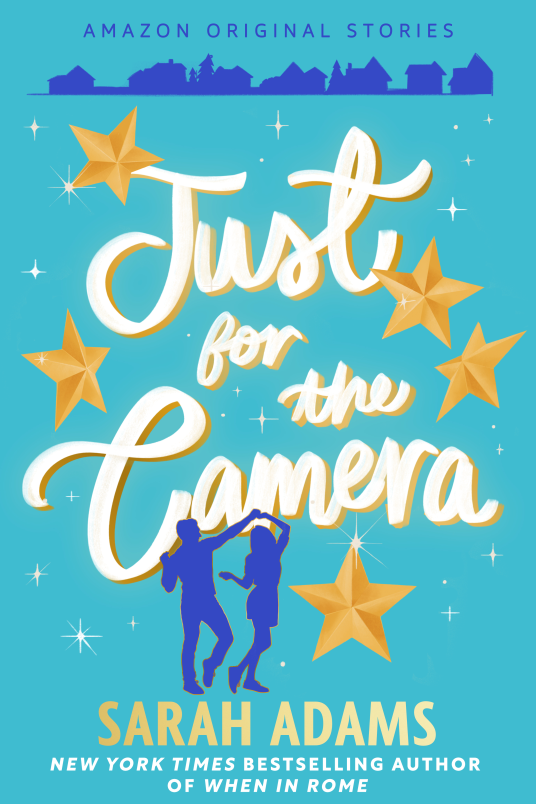
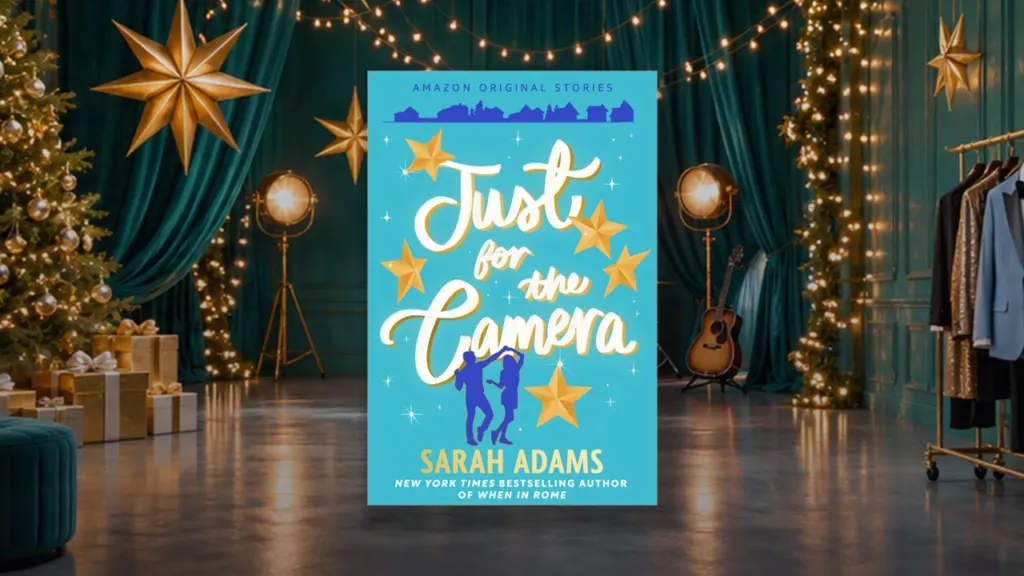
The individual cover carries the same spirit. A turquoise field, gold stars, and dancing silhouettes set a festive mood before a reader opens the story. The design is closer to the visual language of a holiday performance than to a formal wedding portrait. It is a good match for a story in which the expected images of a wedding are being assembled by people who also have a job to finish.
Readers who know Adams from When in Rome can recognize the author’s pleasure in a specific comic situation without needing any continuity from that novel. Fizzy and Silas belong to their own story. The opening calls for a slightly flustered lead, a confident performer, and a very visible opportunity for an unexpected change in mood. The particularity of those details is what makes the premise memorable in a November calendar full of winter releases.
How Adams’s story fits the five-story collection
The collection All I Want for Christmas is built around winter weddings and brings together Catherine Walsh, Sarah Adams, Elizabeth Stephens, Lorraine Brown, and Lana Ferguson. The contributors use different kinds of complications. Walsh’s Just Say I Do puts an imminent wedding in doubt when a Christmas Eve journey goes awry. Stephens’s White Water Wedding brings a wedding planner and a football star into the same celebration. Brown’s entry turns to mistaken identity at a Scottish Highlands wedding, and Ferguson’s The Plus-One Pact gives a ski-resort wedding a pretend-couple problem.
Adams’s story uses a wedding as a piece of work for a production crew. That gives the collection a welcome variation on why a couple might find themselves dressed for the occasion. Fizzy and Silas can participate in a set of familiar romantic rituals while the larger gathering has a professional goal. The real connection can therefore develop within sight of several people who are occupied with getting the shot.
There are several enjoyable ways to read the collection. Someone interested in a celebrity romance can choose Adams first. Someone who wants to compare two kinds of acting like a couple can pair Adams and Ferguson. Readers who like settings to help determine the romantic mood can try one story set on a production and another where winter weather changes the available choices. The common occasion makes the differences between the contributors easier to notice.
From Alisson Bento’s books
Vampire
A vampire romance about a hero who claims her and never lets anyone forget it.
Kindle edition · Check Kindle Unlimited availability on Amazon.
Reading or listening in one sitting
The individual release and the collected edition answer different needs. Brilliance’s page credits Amy Melissa Bentley for the audio of Just for the Camera, while the collection’s audio listing names several narrators. The individual title is useful if you want a single short read or listen. The collection is a convenient choice if the wedding theme appeals across several different authors. Both listings give November 10, 2026, as the publication date.
The format lends itself to a reading group that has limited time. Everyone can begin with the same story and compare what caught their attention before trying another wedding setup. It can also work for a reader who wants to see how Adams handles a romance with fewer scenes than a full-length novel. The fun of this particular premise lies in looking for the precise moment a performance starts to carry information neither lead expected.
If you listen, a useful detail to notice is how a line addressed to the other character can also be part of the job of making the video. A speaker might have a good reason to make a sentence sound convincing for the production and still be surprised by how it feels to say it. A narrator can convey that double purpose with pacing, emphasis, or a pause. The script-within-the-story gives the audio edition a potentially enjoyable layer of performance.
Why a holiday release can work before December
Publishing on November 10 gives the collection a useful place on the calendar. Some readers want to choose their holiday books early and would like to know how much time a title asks of them. A short story is easy to fit between longer reads, and a collection allows those sessions to remain separate. Someone who wants a single romance can pick the setup that appeals. Someone who likes to revisit a collection through a busy season can return to the common wedding theme without needing to remember an extended plot from the previous sitting.
Adams’s setting makes her story particularly suitable for an early start. It is a holiday production, which means the characters are doing some of the work that helps a season look festive before an audience sees the finished scene. The decorations and wedding clothes belong to a planned image. Fizzy’s interest in Silas, if it takes her by surprise, belongs to the person still figuring out what she feels inside that image. The difference gives the holiday detail a function beyond atmosphere.
For a reading group, the production also supplies a question that can be answered without discussing a later revelation. Which detail first makes you believe the two leads are seeing each other clearly? It could be a moment of humor, a choice about how much to say, or a gesture that has meaning after a take is over. The invitation is to give that short change the same attention you would give a turn that takes several chapters in a novel.
Why the release is a good early holiday pick
The story makes a persuasive case for beginning the season with one sharply drawn encounter. It offers a place and an assignment a reader can understand quickly, along with two people whose experiences of that assignment are different enough to matter. Fizzy’s discomfort gives the reader something to root for beyond the success of the music video. Silas’s ease with the situation gives him room to notice how she feels about the work they are doing together.
For a short discussion, ask what makes a rehearsed gesture feel personal. Then consider which person is taking a bigger risk when the answer becomes clear. A performer may know how to make affection look easy, and the person outside that profession may be particularly good at recognizing when the explanation has changed. Adams’s premise gives those possibilities a festive frame and keeps the underlying question small enough to explore in a single sitting.
Just for the Camera is available now as a November 10 release. Its appeal is easy to describe to someone looking for their first holiday romance of the season. A nurse has to pretend she is a bride, a pop star has a part to play, and the production may be the one place where both of them get a chance to be more candid than they intended. Adams makes that discovery sound like a lovely reason to stay until the end of the shoot.
Sources
- Brilliance Publishing’s publication and narration listing
- Amazon Original Stories’ individual title listing on NetGalley
- Amazon Original Stories’ collection listing on NetGalley
Cover art source: Amazon Original Stories ebook cover, via NetGalley. Background is an editorial illustration.