
A different reporting rule identifies additional days, not a truer reader count
In Canada’s 2022 Time Use Survey public-use file, 14.4% of diary days record the detailed primary activity classified as reading. When an explicitly reported simultaneous-reading activity also qualifies, the observed share becomes 21.6%. The addition is 7.2 percentage points, with an approximate design-based 95% interval of 6.4 to 8.0 points. That is a meaningful difference between two operational rules applied to the same diaries. It is not evidence that the first rule misses that many true book readers, or that the second estimates a more accurate population prevalence.
The distinction matters for two reasons. First, the primary reading category explicitly mentions online or paper books, periodicals and newspapers, whereas the simultaneous category is simply reading. The two prompts do not establish identical purposes or material coverage. Second, 31.7% of diary days contain at least one eligible episode without a stated simultaneous-activity response. A missing response is not proof that no reading occurred. Both the scope of the categories and the hierarchy used to record concurrent activity shape the comparison.
This study asks what changes when reading is retained through both available reporting channels, how those channels overlap on the same day, and which main-activity contexts appear among days added by the broader rule. Its contribution is a joint account of ascertainment, reporting completeness and context. It does not estimate additional reading minutes, identify books or genres, evaluate attention, or explain why people read. Treating the results as a reporting comparison preserves their usefulness without turning administrative categories into claims about an unobserved true reading population.
The reference period is a day, and the collection period crosses two years
The source is Statistics Canada’s corrected public-use microdata file for the 2022 Time Use Survey. Collection occurred from July 2022 to July 2023. The target population comprises people aged fifteen and over in the ten provinces, excluding institutional residents and residents of reserves. The estimates therefore do not describe every Canadian resident, children below fifteen, or a calendar-year total for 2022. The survey’s year label and its actual collection period are both retained rather than treated as interchangeable dates.
Each respondent describes one designated twenty-four-hour diary day, beginning at four in the morning and ending at four the next morning. The public file contains 12,336 person records and 168,078 episode records. These are not 168,078 independent respondents. Multiple episodes describe the same person’s day and must be combined before calculating whether that day contains a reading report. A person can contribute several episodes but only one observation to the principal person-day proportions.
The one-day reference also limits the meaning of a negative classification. Someone whose diary contains no positive reading code might read on other days, read for a purpose classified elsewhere, fail to state an activity, or undertake reading not retained by the available prompts. This is not an annual survey of whether someone ever reads books. Nor does a positive day establish a regular habit, preferred format, educational achievement or literary identity. The analysis deliberately avoids comparisons with reading percentages from other national instruments whose questions and reference periods differ.
The two codes do not define an identical kind of reading
The detailed primary activity code used here is TUI_01=1201. Its questionnaire description covers reading books, periodicals and newspapers online or on paper. It is distinct from listening to music, radio or podcasts, and from the broader mass-media group that also includes television and technology use. The simultaneous activity code is TUI_03=4109, labelled reading. Neither code is restricted to fiction or romance, and the simultaneous label does not specify the same examples or purposes as the primary category.
This difference is consequential rather than cosmetic. A person might describe paid work as the main activity and reading as something done simultaneously. That report does not establish leisure reading during work; the reading could be part of the work itself. Similarly, the absence of a primary reading code does not exclude reading embedded in studying, caring for children or other purpose-based activities. Adding all those categories would answer another question, so they are not silently relabelled as reading in this analysis.
The comparison therefore combines recording hierarchy with potentially different category scope. It cannot isolate a pure effect of asking a secondary question, because the two channels are not equivalent measurement instruments. Statistics Canada also explains that processing can use information about simultaneous activities to complete missing primary information. The released channels are thus not independent validation tests. The defensible language is additional observed days under a two-channel rule, not recovered hidden readers, corrected book-reading prevalence or a measure of reading that official statistics overlooked.
What simultaneous means in this diary
The questionnaire defines a simultaneous activity as something done alongside the main activity without interrupting it. Official guidance tells respondents to record a separate activity if an interruption lasts more than five minutes or the location changes. When more than one secondary activity occurs, respondents are instructed to choose the more important one. The 2022 user guide confirms that only one simultaneous activity can be selected per episode. This design can leave additional concurrent activities outside the retained record.
An inconsistency in the documentation deserves explicit treatment. The episode codebook includes a select-all instruction for the simultaneous question, whereas the current guide and respondent guidance describe a single selection. The actual questionnaire does not repeat that select-all wording, and the public episode file contains one simultaneous-activity field. The analysis follows the documented one-field structure while reporting the wording discrepancy. It does not infer multiple retained secondary responses from an inconsistent line of explanatory text.
Essential sleep is outside the simultaneous-activity prompt and receives a structural skip. That is different from explicitly reporting no other activity, and different again from an unstated response. The file also records approximate secondary-duration categories, such as about half the main activity’s time. Those categories are not exact minutes. Multiplying every secondary report by the main episode’s duration, or assigning a precise half-duration, would create time measurements the survey does not supply. This study consequently analyzes occurrence and context, not simultaneous reading time.
The overlap separates additional days from additional episodes
Four mutually exclusive observed-report states clarify the comparison. Primary reading is recorded without simultaneous reading on 11.1% of diary days. Simultaneous reading is recorded without a primary reading code on 7.2%. Both channels record reading somewhere during the day on 3.3%, and neither channel records reading on 78.4%. The labels refer to positive codes in the released diary, not to confirmed absence of reading. In particular, the last group is not a population of established nonreaders.
The primary total combines the primary-only and both-channel groups, producing 14.4%. The simultaneous total combines the simultaneous-only and both-channel groups, producing 10.5%. The union includes all three positive-report groups and reaches 21.6%. Adding the two channel totals directly would double-count the days in their overlap. The relevant increase from the primary-only rule to the two-channel rule is therefore the simultaneous-only group, not every day containing a simultaneous-reading report and not the number of such episodes.
The overlap is at the person-day level. A day classified in both channels might contain primary reading in the morning and simultaneous reading in the evening; the classification does not require both codes to occur in the same episode. Conversely, several simultaneous-reading episodes on a day without primary reading still add only one day to the union. This distinction prevents the episode-rich diaries from carrying disproportionate influence and keeps the reported percentage-point addition aligned with the question being asked.
Unstated responses remain visible
At least one eligible simultaneous-activity response is unstated on 31.7% of weighted diary days, with an approximate 95% interval of 30.4% to 33.0%. This person-day measure is not the percentage of all episodes with missing responses: a person with one unstated episode and a person with several both qualify. Structural sleep skips are excluded. The measure describes a reporting-completeness limitation within the diary, not the prevalence of unobserved simultaneous reading.
Missing responses occur across all four observed-report states. The joint share with an unstated eligible response and no reading recorded in either channel is 25.3% of all diary days. The corresponding joint shares are 3.5% for primary-only reports, 1.9% for simultaneous-only reports and 1.0% for both-channel reports. These figures retain the full denominator. They do not assign reading to any missing episode or presume that a positive report elsewhere makes the rest of the diary complete.
A prespecified sensitivity calculation restricts the denominator to respondents without an unstated eligible simultaneous response. Within that selected subset, primary reading appears on 14.5% of days, either-channel reading on 22.2%, and the additional observed share is 7.7 percentage points, with an interval of 6.7 to 8.8 points. This is not a corrected national estimate. The subset can differ systematically from other respondents. Its value is to show what the same classification produces under a different reporting-completeness condition, without concealing the selection involved.
Main-activity contexts on the additional observed days
Among days with simultaneous reading but no recorded primary reading, 35.1% include at least one simultaneous-reading episode during a main activity classified as eating or drinking. The corresponding proportions are 7.6% for travel, 3.2% for paid work and 14.3% for the mass-media activity group. Another 51.7% include a simultaneous-reading episode in other valid main-activity groups. These are proportions of the additional observed days, not percentages of all diary days or of total reading time.
The context groups can overlap. Someone may report reading while eating and reading during travel on the same day, so the percentages are not components that should sum to one hundred. Each context is recorded at most once per person-day for this calculation, however many qualifying episodes occurred. The broad other-valid group remains broad; it is not interpreted as a specific leisure practice. The missing-primary-context estimate is suppressed under the release rules rather than displayed as an observed zero.
These contexts help explain what the additional reporting channel contains without attributing motives or effects. A travel classification does not identify a safe or unsafe reading situation, and the analysis makes no recommendation to read while driving. A paid-work context does not establish distraction, lost productivity or leisure. A mass-media context does not measure comprehension or divided attention. The data identify combinations of reported activities under the instrument’s categories; they do not assess how well a person performed either activity.
Weighting, uncertainty and disclosure
All episodes are collapsed to person-day indicators before estimation. The person weight is applied once to each diary, and all five hundred supplied person-level bootstrap weights are used to recompute the proportions. For conditional contexts and the complete-reporting subset, both numerator and denominator are recomputed in every replicate. The estimate of variability is based on deviations of replicate proportions from the full-weight proportion. Repeating a person’s weight across episodes without this aggregation would answer a different question and understate the dependence within diaries.
The reported approximate 95% intervals use a delta-method logit transformation with the replicate variance. They represent sampling uncertainty under the supplied weighting scheme, not uncertainty about every unstated response, classification choice, reporting error or omitted concurrent activity. They are not exact probability statements about a fixed population value. The positive addition has its own interval calculated directly from the simultaneous-only indicator; it is not obtained by subtracting the endpoints of two independently treated intervals.
The source’s release guidance also governs publication. National proportion denominators below the specified thresholds receive a caution flag or suppression, and very small numerators require confidentiality protection. Complementary cells must not reveal a suppressed value through subtraction. Degenerate or invalid intervals are not presented as precise certainty. Estimates and interval endpoints are rounded after calculation, using a common precision justified by their interval widths. Downloads follow the same rules: no respondent records, raw weights or unrounded study estimates are redistributed.
Why the actual file layout had to be checked
The downloadable episode documentation does not provide a single consistent field order. The PDF dictionary and SPSS input specification place several variables at positions different from those in the actual text file. The SAS and Stata specifications agree with each other and with the observed 5,071-character episode record. For example, the actual detailed primary code occupies columns 52–55 and the simultaneous code columns 56–59. Using the conflicting positions could produce plausible-looking but incorrect classifications, rather than an obvious failure to open the file.
The selected layout was tested against several independent structural properties. Person identifiers linked completely; episode keys were unique and sequential; duplicated episode-number fields agreed; every person’s episode durations summed to 1,440 minutes; and every episode’s full weight and five hundred replicate weights matched the associated person record. Published codebook marginal frequencies for the relevant reading and missing-response codes also reproduced. Checksums and decompression checks preserve the identity of the original source entries. These checks support the parser without changing or repairing any official source values.
The archive includes correction notices, including a change to SPSS ordering and later changes to derived duration variables. The analysis documents what was actually found in the downloaded version rather than assuming that a correction notice guarantees agreement among every accompanying file. Its primary estimates use the verified detailed activity codes, not the affected derived work or other-duration totals. The supplied schema mapping makes the discrepancy inspectable, so reproduction depends on explicit byte positions and verified source fingerprints rather than undocumented software defaults.
Existing research and the narrower contribution here
Concurrent reading is not a new discovery. Southerton and Whillans’s 2024 study of UK time-use diaries already defines reading through main or other activities, reports participation and studies synchronization and activity connections. Its finding that 51% of reading time was synchronized with another activity is important prior work, not a directly comparable Canadian benchmark. A share of reading time involving another activity differs from the share of person-days added when the reporting rule changes; a synchronized-reading day may already contain a separate primary-reading episode.
Statistics Canada has also analyzed simultaneous activities in its study of telework using the 2022 survey. That work groups reading with other leisure activities and examines their occurrence during paid work. The present study does not repeat its telework comparison or claim a novel method for recognizing concurrency. Its narrower contribution combines a channel-decomposed person-day addition, explicit reporting completeness and the main-activity contexts specifically associated with the added days. The potentially different scope of the two reading labels is part of that result, not an inconvenience removed from interpretation.
The public reproduction program requires the original permitted source archive and produces only rounded, disclosure-screened aggregates. Source links, entry fingerprints, methods and the validated schema accompany it. The conclusion remains a comparison of reporting rules: retaining the simultaneous channel identifies additional observed days, but does not reveal a truer book-reader population. Reading statistics become more useful when their categories, reference periods, missing responses and observation units remain visible alongside the headline percentage.
Two channels, four observed reporting states
Canada · 2022 Time Use Survey · Collection July 2022–July 2023
Full chart and source
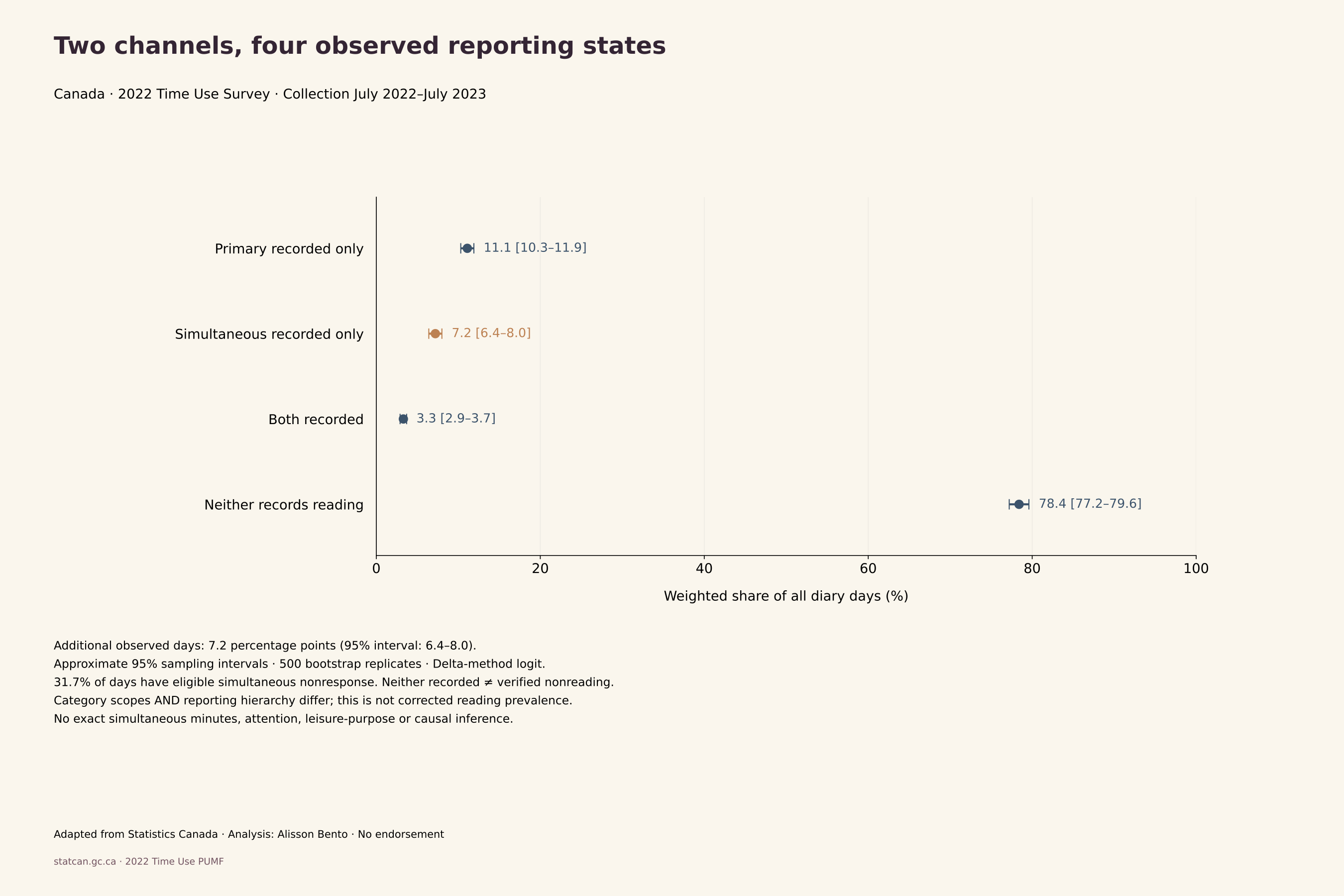
Scroll horizontally to inspect the chart. ↔
Chart and values
Scroll horizontally to see all columns.
| Observed state or rule | Estimate (%) | Lower 95% (%) | Upper 95% (%) |
|---|---|---|---|
| Primary recorded only | 11.1 | 10.3 | 11.9 |
| Simultaneous recorded only | 7.2 | 6.4 | 8.0 |
| Both channels recorded | 3.3 | 2.9 | 3.7 |
| Neither channel records reading | 78.4 | 77.2 | 79.6 |
| Any primary reading code | 14.4 | 13.5 | 15.3 |
| Any simultaneous reading code | 10.5 | 9.6 | 11.4 |
| Either channel | 21.6 | 20.4 | 22.8 |
| Additional observed days (percentage-point addition) | 7.2 | 6.4 | 8.0 |
Weighted percentages of all diary days. Approximate 95% sampling intervals. Neither positive code does not mean verified nonreading. Category scopes and hierarchy jointly differ.

Main-activity contexts on additional observed days
Canada · 2022 Time Use Survey · Collection July 2022–July 2023
Full chart and source

Scroll horizontally to inspect the chart. ↔
Chart and values
Scroll horizontally to see all columns.
| Main-activity context | Estimate (%) | Lower 95% (%) | Upper 95% (%) |
|---|---|---|---|
| Eating or drinking | 35.1 | 30.2 | 40.4 |
| Travel | 7.6 | 5.4 | 10.5 |
| Paid work | 3.2 | 2.0 | 5.1 |
| Mass media | 14.3 | 9.4 | 21.1 |
| Other valid main groups | 51.7 | 46.3 | 57.1 |
| Missing main group | Suppressed | Suppressed | Suppressed |
Denominator: days with simultaneous reading but no recorded primary reading. Each day can have multiple contexts; shares need not sum 100. Suppressed is not zero. No exact secondary minutes or attention inference.

Data & downloads
Scroll horizontally to see all columns.
| Observed state or rule | Estimate (%) | Lower 95% (%) | Upper 95% (%) |
|---|---|---|---|
| Primary recorded only | 11.1 | 10.3 | 11.9 |
| Simultaneous recorded only | 7.2 | 6.4 | 8.0 |
| Both channels recorded | 3.3 | 2.9 | 3.7 |
| Neither channel records reading | 78.4 | 77.2 | 79.6 |
| Any primary reading code | 14.4 | 13.5 | 15.3 |
| Any simultaneous reading code | 10.5 | 9.6 | 11.4 |
| Either channel | 21.6 | 20.4 | 22.8 |
| Additional observed days (percentage-point addition) | 7.2 | 6.4 | 8.0 |
Weighted percentages of all diary days. Approximate 95% sampling intervals. Neither positive code does not mean verified nonreading. Category scopes and hierarchy jointly differ.
Scroll horizontally to see all columns.
| Measure and denominator | Estimate (%) | Lower 95% (%) | Upper 95% (%) |
|---|---|---|---|
| Any eligible simultaneous nonresponse; all days | 31.7 | 30.4 | 33.0 |
| Nonresponse and primary-only; all days | 3.5 | 3.1 | 4.0 |
| Nonresponse and simultaneous-only; all days | 1.9 | 1.6 | 2.3 |
| Nonresponse and both; all days | 1.0 | 0.8 | 1.2 |
| Nonresponse and neither recorded; all days | 25.3 | 24.0 | 26.6 |
| Any primary code; complete-reporting subset | 14.5 | 13.4 | 15.7 |
| Either channel; complete-reporting subset | 22.2 | 20.7 | 23.7 |
| Additional observed days; complete-reporting subset | 7.7 | 6.7 | 8.8 |
First five rows: percentages of all diary days. Last three: only days without eligible simultaneous nonresponse; a selected subset, not corrected national estimates.
Scroll horizontally to see all columns.
| Main-activity context | Estimate (%) | Lower 95% (%) | Upper 95% (%) |
|---|---|---|---|
| Eating or drinking | 35.1 | 30.2 | 40.4 |
| Travel | 7.6 | 5.4 | 10.5 |
| Paid work | 3.2 | 2.0 | 5.1 |
| Mass media | 14.3 | 9.4 | 21.1 |
| Other valid main groups | 51.7 | 46.3 | 57.1 |
| Missing main group | Suppressed | Suppressed | Suppressed |
Denominator: days with simultaneous reading but no recorded primary reading. Each day can have multiple contexts; shares need not sum 100. Suppressed is not zero. No exact secondary minutes or attention inference.
Evidence & method
How we calculated it
- Secondary analysis of corrected 2022 Statistics Canada Time Use public-use files; collection July 2022–July 2023.
- All 12,336 person-days, age 15+, ten provinces, outside institutions and reserves; 168,078 episodes collapsed by PUMFID.
- Primary TUI_01=1201; simultaneous TUI_03=4109. Different scopes and hierarchy jointly define observed addition.
- WGHT_PER once per person; 500 WTBS bootstrap replicates, ratio recomputed in each domain; approximate delta-logit 95% intervals.
- Source quality thresholds, small-cell/complementary protection and source-guided rounding applied to every public result.
- Actual TXT schema independently matches SAS/Stata; PDF/SPSS episode positions conflict. Source files not altered.
What the data cannot tell us
- No true-reader correction, all-reading, book-only, leisure-only, attention, comprehension or causal claim.
- One diary day is not annual reader status; only one simultaneous activity is retained; source editing can use secondary reports in primary imputation.
- Primary and simultaneous labels do not establish identical materials or purposes. Concurrent paid-work reading need not be leisure.
- Eligible simultaneous nonresponse affects 31.7% of days. Complete-reporting subset is selected, not a corrected national population.
- Approximate sampling intervals do not bound nonresponse, recall or classification error. No exact secondary minutes inferred.
- Context flags overlap; missing-primary context suppressed, not zero. No respondent-level data redistributed.
Original sources
- Statistics Canada: 2022 Time Use Survey public-use archive
Corrected source includes person and episode TXT, SAS/Stata/SPSS layouts, codebooks, user guide and correction notices. Actual episode TXT fits SAS/Stata, not conflicting PDF/SPSS positions. No microdata redistributed.
Accessed October 30, 2026
- Statistics Canada: 2022 Time Use PUMF release and corrections
Released March 12, 2025; correction July 4, 2025. Survey label 2022 does not replace July 2022–July 2023 collection period.
Accessed October 30, 2026
- Statistics Canada: General Social Survey public-use files
Official public download and explicit applicability of Statistics Canada Open Licence to public-use microdata.
Accessed October 30, 2026
- Statistics Canada Open Licence
Permits original and value-added reuse with attribution, accurate representation and no endorsement or reidentification. No agency insignia used.
Accessed October 30, 2026
- Statistics Canada: reporting simultaneous activities
Official 2022 respondent guidance: select the more important secondary activity if several occur; interruptions longer than five minutes should be reported separately.
Accessed October 30, 2026
- Statistics Canada: Telework, time use, and well-being
Prior 2022-survey research analyzes simultaneous leisure during paid work and explains categorical secondary duration. Not a direct comparison of our channel-specific person-day estimands.
Accessed October 30, 2026
- Southerton and Whillans: Time use surveys, social practice theory, and activity connections
British Journal of Sociology 75(2), 168–186, 2024. Primary prior work already combines main/other reading and studies synchronized time; not a directly comparable national benchmark.
Accessed October 30, 2026
Cite & reuse this study
Alisson Bento. Reading in two diary channels: what changes when simultaneous reports count. Secondary analysis of Statistics Canada 2022 Time Use Survey public-use microdata. Sources accessed October 30, 2026. https://alissonbento.com/research/canada-reading-primary-and-simultaneous-channels-2022/
Adapted from Statistics Canada, 2022 Time Use Survey public-use microdata. This does not constitute an endorsement by Statistics Canada of this product. Statistics Canada Open Licence applies to source information. Original selection, calculations and explanation: Alisson Bento. No agency insignia, confidential records or third-party article figures reproduced.
Corrections or editorial questions