
A real choice, with a deliberately narrow answer
The PNLD 2022 early-childhood literary programme offers a useful distinction between receiving a quantity of collections and choosing how many different listed items those collections contain. Its official registration manual illustrates a school selecting two different collections from a menu of twenty-three. That example supplies the decision studied here. It does not establish that every school has the same allowance, that every combination is pedagogically appropriate, or that the selected collections were subsequently delivered. The analysis stays with the documented menu and the information available when comparing two distinct choices.
Across all 253 unordered pairs in the retrieved guide, combined breadth ranges from 95 to 110 different programme codes, with a median of 100. These are not counts of canonical literary works, children reached or books read. Nor is the entire fifteen-code range a consequence of duplication: the individual collections themselves contain different numbers of listed items. Keeping collection size and repeated membership separate is therefore essential. A comparison that describes every difference as unnecessary repetition would misrepresent both the arithmetic and the educational purpose of having multiple copies.
The practical question is correspondingly modest. After choosing a first collection for educational reasons, how much can the additional code breadth vary among the other twenty-two collections? Answering this question provides one piece of decision information without substituting arithmetic for professional judgement. A smaller numerical increment may still accompany the more suitable stories, language, illustrations or classroom opportunities. The tables report every first-collection comparison, rather than selecting a few combinations that look especially impressive. Nothing here recommends maximizing the count at the expense of an educationally coherent selection.
What the source identifies, and what it does not
The source is the complete official PNLD 2022 Educação Infantil literary guide retrieved from UFAL's publication storage. Its collection tables identify a publisher, an item title with a programme code, and a genre code. The twenty-three menus are labelled mixed, nursery or preschool. This study preserves each printed programme code as an exact string, including leading zeros and the complete suffix. It does not decode the code structure or collapse differently coded entries because their titles resemble one another. The operational unit is a programme-listed bibliographic item, not an independently established intellectual work.
That distinction matters in both directions. Different codes might represent different editions, formats or programme distinctions associated with a related work. Conversely, identical titles can belong to different works. This audit does not resolve either possibility by guessing from wording. For occurrences of the same exact code, the printed title, publisher and genre were checked for consistency; no conflicts were found in the extracted tables. That check supports joining the same listed identifier across collections. It does not elevate the identifier into a universal definition of literary identity beyond this source.
The retrieved tables contain collections of 49 to 55 coded entries. The official manual also states that range, while the preserved FNDE choice notice describes 53 to 55 works. Both statements are retained rather than silently harmonized. The guide file carries a July 2025 generation timestamp, but that is not evidence of an official catalogue revision: an October 2023-created manual already gives the wider range. The results identify the exact retrieved guide snapshot and its fingerprint. They should not be described as a verified reconstruction of every detail displayed at the original choice date.
Separate nominal entries, distinct codes and repeated membership
For two collections, let A be their total number of listed entries, obtained by adding their individual sizes. Let B be the number of different programme codes in their union. The difference D = A − B is the number of entries repeated across the pair. Because each collection contains no repeated code internally, D also equals the size of the intersection between the two code sets. This is straightforward set accounting, but it prevents a common interpretive shortcut: two collections are neither two individual books nor necessarily the sum of their distinct listed identifiers.
The duplicate-entry share uses A as its denominator. If a code occurs once in each selected collection, that contributes two entries to A, one code to B and one repeated entry to D. The share therefore measures how much the nominal combined entry count exceeds distinct-code breadth. It does not mean that the repeated physical copy has no use. Copies can support simultaneous reading, separate spaces, repeated encounters or replacement needs, none of which the menu records measure. Calling D waste, loss of learning or deprivation would attach an unsupported value judgement to an accounting quantity.
In the complete pair universe, the duplicate-entry share ranges from zero to one thirteenth, approximately 7.7%, with a median of one thirty-fifth, approximately 2.9%. Duplication on this definition is modest, not evidence that the programme mainly repeats the same material. The joint-breadth range must also be read alongside the 49–55 variation in starting collection sizes. More nominal entries can raise breadth, while shared codes reduce the increment relative to that nominal total. The accompanying relationship between A, B and D is more informative than presenting the maximum and minimum breadth as a pure duplication effect.
Enumerating the whole two-collection menu
There are twenty-three choices for one collection and twenty-two different remaining choices for the other. Dividing their product by two gives 253 unordered pairs, because selecting collection A with B produces the same combined code set as selecting B with A. Every pair is included once in the pair table, including ties in the resulting counts. This finite enumeration is not a sample of school decisions. It does not require a confidence interval for sampling error, and its median is not an estimate of what the typical school selected or received.
The median of 100 distinct codes gives the middle pair outcome when all 253 values are sorted. The minimum of 95 and maximum of 110 bound the documented mathematical comparison, not a guarantee about every school's admissible or desirable choices. The manual's two-selection example provides the practical case, while the collection labels remain important context. Nothing in this analysis establishes that every combination would suit every age group or educational plan. The common menu supports an information comparison; it is not a replacement for the programme's instructions or a recommendation that educators ignore pedagogical suitability.
Equal descriptive treatment of pairs is useful because it avoids selecting combinations after seeing their results. It must not be mistaken for a behavioural model in which schools choose uniformly at random. Some combinations could be much more attractive or appropriate than others, but the source provides no observed preference weights. There is also no time trend: all pair results come from one retrieved menu. The complete pair download makes the accounting inspectable without pretending that these alternatives are independent observations of real-world adoption, delivery or reading activity.
Why the direction of the second choice matters
The same unordered pair has two possible starting points. If one collection has already been selected, the added breadth of the other is the number of its codes absent from the first. This gain equals the candidate second collection's size minus its shared codes with the chosen collection. Reversing the starting point can change the gain even though the combined breadth is unchanged. Retaining both directions produces 506 oriented comparisons. They are linked views of the same 253 pairs, not an additional dataset or independent confirmation of the findings.
Across all 506 directions, second-choice gains range from 42 to 55 programme codes, with a median of 50. The full integer frequency distribution is reported without smoothing or outcome-selected bins. For each possible first collection, the conditional table also retains all twenty-two remaining alternatives through their exact frequency counts and minimum, median and maximum. These conditional distributions are particularly useful when the first choice is already justified educationally. They show the available code-breadth variation without requiring that first decision to be replaced by whichever collection happens to produce the largest numerical total.
The conditional ranges are not all alike. For example, collection 05 has 50 starting codes and its alternatives add 48–51, with a median of 50; collection 15 has 54 starting codes and its alternatives add 42–55, with a median of 47. Both examples sit within the complete twenty-three-row table and are not rankings of quality. Even with a fixed first collection, the candidates differ in their own sizes as well as in their shared membership. Consequently, a wider gain range cannot be attributed exclusively to overlap, and a smaller gain does not establish that an alternative is inferior.
Keep pedagogical suitability ahead of the count
The source labels collections as mixed, nursery or preschool. These labels describe intended educational contexts, not values that this study converts into scores. The analysis does not rank a mixed collection against a preschool collection or infer that the categories are interchangeable for every school. The primary comparison uses the documented two-distinct-collection menu case; larger allowances mentioned elsewhere in the guide are not analysed. Extending the calculation to three, six or twelve collections would require a separately justified decision model, rather than an assumption that one interface example establishes every possible allocation rule.
A sensible use of the conditional table starts with the educationally suitable alternatives, not with the maximum in its final column. The code counts can then explain how those alternatives differ on one narrow dimension: the number of additional listed identifiers. Suitability could depend on the particular children, planned activities, accessibility needs, language, material design or existing holdings. None of those factors is measured here. The analysis therefore supplies information alongside professional judgement; it does not claim that an exact code count captures the benefits of a collection or the full variety of reading experiences it can support.
Existing holdings provide another important boundary. A second programme collection can add codes relative to the first selected collection while adding fewer new items to a school's whole library. The reverse question—how many codes a school does not already own—requires a verified inventory and compatible identifiers. No such inventory is joined to these tables. Likewise, access to a shared library or books acquired outside the programme could change a child's opportunities without changing any result in this audit. Programme-menu breadth is a specific object of measurement, not a comprehensive account of access to literature.
How this differs from thematic coverage research
Research has already examined representation and coverage within these collections. Mirian Daniela Faustino Faria's work addresses indigenous themes and their presence across collections. Official indexed material identifies a collection crosswalk for eight works; the complete thesis was not available for inspection here, so no claim is made that every analysis it contains has been ruled out as prior art. Its central concern is nevertheless important: the composition of an offered collection can matter beyond the headline quantity of books. This article does not claim to discover that issue for the first time.
Manfré and Rozzi's 2026 study examines selected narrative works from the preschool collections in relation to children's human and cultural formation. Such qualitative investigation asks questions that exact-code counting cannot answer. A bibliography with more identifiers is not necessarily richer in a particular cultural perspective, more appropriate for a group, or stronger as literature. Substituting another theme into an existing coverage analysis would also be a different undertaking from the calculation presented here. The present contribution is the complete-menu pair accounting and conditional second-choice information, not a new assessment of thematic or literary merit.
The two approaches can complement one another without being interchangeable. A thematic study may identify works of particular educational importance; the present table can describe how the surrounding listed-code membership changes when two collections are combined. It does not assign thematic meaning to the other codes or infer coverage from publishers and title words. Maintaining this separation makes the result useful while avoiding an exaggerated novelty claim.
A source audit that can be checked
The collection table section spans PDF pages 59–120. All twenty-three headings and every continuation page were inspected, and two independent extraction methods reconciled the full set of 1,192 listed occurrences. The comparison included collection, category, programme code, title, publisher, genre and source page. Each code remained a string throughout processing. Within-collection duplicates and disagreements in the descriptive fields attached to repeated codes were explicitly checked, rather than resolved by discarding rows or merging similar titles. No such conflicts remained in the audited extraction used for the calculations.
The public membership file deliberately contains only collection number, programme code and source page. Publisher cells in the guide can include identifiers unnecessary for reproducing this question, while the guide also contains protected reviews and artwork that are not needed in the calculation. Those materials are not redistributed here. A source manifest identifies the actual guide and manual files by URL, byte count and fingerprint, allowing a reader to check the source independently. The reduced membership file is sufficient to reproduce the set unions and differences without reproducing the guide's expressive content.
The calculation code enumerates the fixed pairs and directions, preserves every tied outcome and reports the complete conditional frequency tables. Ratios and medians are computed with exact rational arithmetic before any display rounding. An independent implementation, starting from a separate extraction rather than importing the calculation functions, reproduced all reported numerical values. This protects against transcription and implementation errors; it does not eliminate limitations in the source's own definitions or historical coverage. The downloadable files make those distinctions visible instead of treating reproducibility as a claim that the menu measures everything a reader might want to know.
Why these are not delivery or pupil statistics
A programme label and a selection menu are not shipment records. This study does not connect school identifiers, delivery dates, quantities received or enrolment records to the guide. It therefore cannot show which schools obtained a collection, whether shipments were complete, how repeated deliveries were recorded, or how many copies were available per child. An absent shipment record would not by itself prove zero access, and a programme title in a logistics table would not necessarily identify an individual book. Those questions require different source definitions and separate joins that are not performed here.
The distinction also prevents a misleading interpretation of the year in the title. PNLD 2022 identifies the programme represented by the guide and manual, not a verified calendar-year census of deliveries or reading. The source snapshot was retrieved in October 2026. Its file-generation timestamp, the manual's creation information and the choice notice's dates are provenance details, not interchangeable observation periods. Without a documented historical version chain, differences between published range statements should remain discrepancies. They should not be turned into an invented account of removals, additions or changes in what schools actually received.
There is no statistical uncertainty interval around the arithmetic of this fully enumerated snapshot, but there is substantial uncertainty about questions outside it. Exact code identity, historical catalogue stability, age-specific suitability, existing school holdings and actual use each impose a different boundary. A confidence interval would not resolve these definitional issues. The appropriate response is to state the measured object precisely and leave unmeasured outcomes unclaimed. That is why the results concern a documented choice menu, not equality of educational opportunity, programme effectiveness or changes in children's reading.
Use the accounting as one layer of decision information
For a reader comparing two suitable collections, the sequence is simple: identify the starting collection, consider the relevant remaining alternatives, and distinguish nominal added entries from codes already represented. The conditional table provides the range and exact frequencies across the twenty-two alternatives in the published menu. The pair download provides the corresponding combined count and repeated-entry share. These files support inspection of the arithmetic, not an automated selection rule. Educational reasons for choosing a particular item remain outside the calculation and should not be overwritten by a numerical maximum.
The central result is therefore balanced. Choosing two different collections can produce different exact-code breadth, and the incremental count depends on the starting collection and the candidate's own size and overlap. At the same time, the measured duplication is modest and may serve legitimate purposes that the menu cannot evaluate. Reporting both points avoids turning a small accounting difference into a claim of waste, while also avoiding the opposite assumption that every pair necessarily offers the same list of items. Quantity and code breadth answer related but distinct questions.
The complete enumeration makes those differences inspectable for one documented decision in one retrieved programme guide. It does not prescribe the best literature, establish school-level outcomes or settle the broader question of who has access to books. Its value lies in making a limited comparison accurate: collection counts, entry counts, distinct codes and added codes are kept separate, and the source's uncertainties stay visible. Used alongside the guide's educational descriptions and the actual needs of a school, that distinction can improve how the available information is understood without pretending to replace the rest of the decision.
Second-collection gains, keeping the first choice
PNLD 2022 · Retrieved guide snapshot · Two different collections from 23
Full chart and source
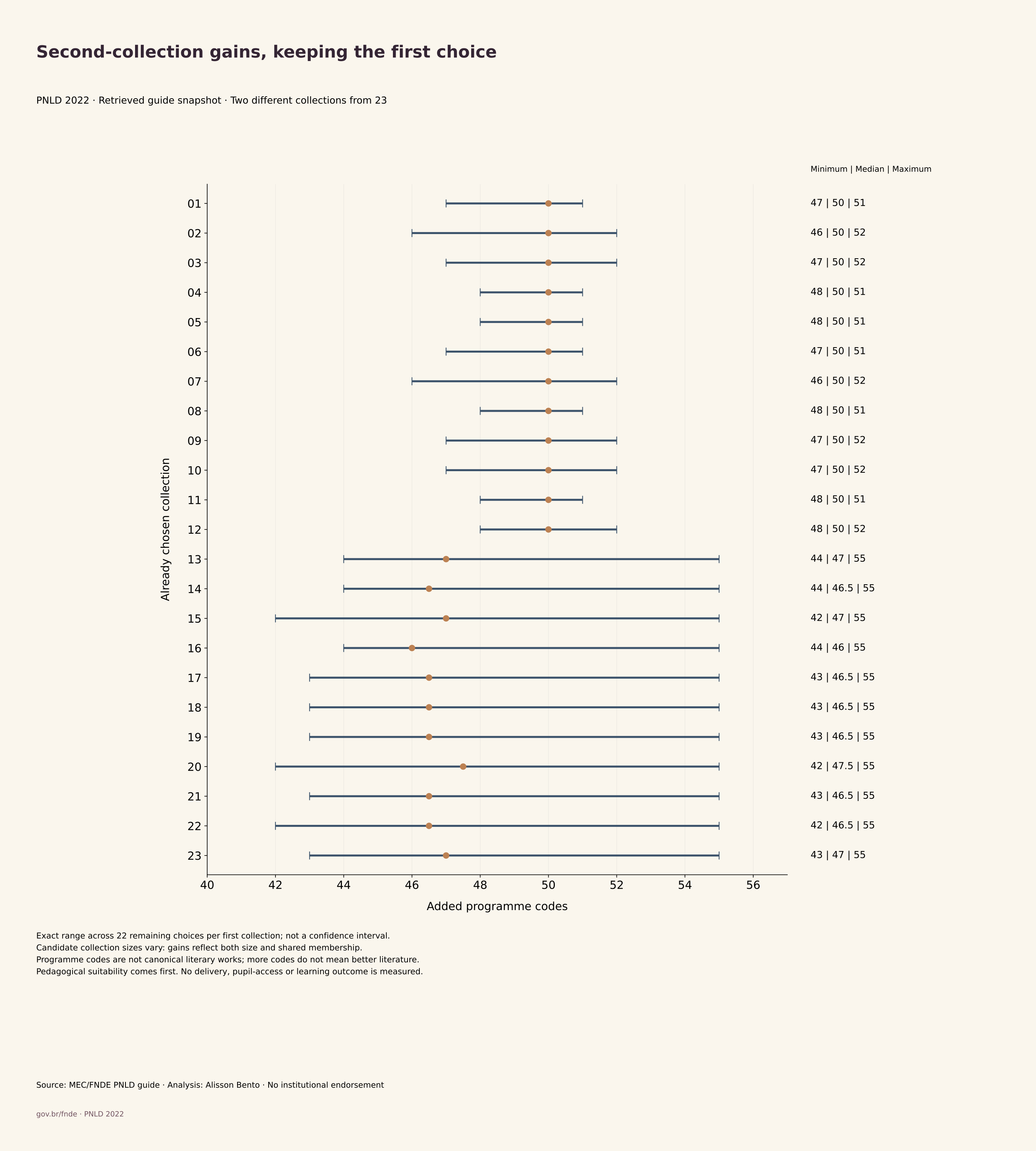
Scroll horizontally to inspect the chart. ↔
Chart and values
Scroll horizontally to see all columns.
| First collection | Category | Starting codes | Alternatives | Minimum added | Median added | Maximum added | Added codes: choices |
|---|---|---|---|---|---|---|---|
| 01 | Mixed | 50 | 22 | 47 | 50.0 | 51 | 47: 2; 49: 7; 50: 8; 51: 5 |
| 02 | Mixed | 49 | 22 | 46 | 50.0 | 52 | 46: 1; 48: 1; 49: 5; 50: 11; 51: 3; 52: 1 |
| 03 | Mixed | 50 | 22 | 47 | 50.0 | 52 | 47: 1; 48: 1; 49: 7; 50: 10; 51: 2; 52: 1 |
| 04 | Mixed | 49 | 22 | 48 | 50.0 | 51 | 48: 1; 49: 6; 50: 13; 51: 2 |
| 05 | Mixed | 50 | 22 | 48 | 50.0 | 51 | 48: 1; 49: 8; 50: 11; 51: 2 |
| 06 | Mixed | 50 | 22 | 47 | 50.0 | 51 | 47: 1; 48: 1; 49: 5; 50: 13; 51: 2 |
| 07 | Mixed | 50 | 22 | 46 | 50.0 | 52 | 46: 1; 47: 1; 48: 1; 49: 6; 50: 7; 51: 5; 52: 1 |
| 08 | Mixed | 50 | 22 | 48 | 50.0 | 51 | 48: 1; 49: 8; 50: 11; 51: 2 |
| 09 | Mixed | 50 | 22 | 47 | 50.0 | 52 | 47: 1; 48: 2; 49: 4; 50: 13; 51: 1; 52: 1 |
| 10 | Mixed | 49 | 22 | 47 | 50.0 | 52 | 47: 1; 48: 2; 49: 4; 50: 11; 51: 3; 52: 1 |
| 11 | Mixed | 50 | 22 | 48 | 50.0 | 51 | 48: 2; 49: 7; 50: 10; 51: 3 |
| 12 | Mixed | 49 | 22 | 48 | 50.0 | 52 | 48: 3; 49: 5; 50: 10; 51: 3; 52: 1 |
| 13 | Nursery | 53 | 22 | 44 | 47.0 | 55 | 44: 5; 45: 2; 46: 2; 47: 3; 53: 1; 54: 5; 55: 4 |
| 14 | Nursery | 55 | 22 | 44 | 46.5 | 55 | 44: 4; 45: 4; 46: 3; 47: 1; 53: 2; 54: 5; 55: 3 |
| 15 | Nursery | 54 | 22 | 42 | 47.0 | 55 | 42: 1; 44: 4; 45: 2; 46: 1; 47: 4; 53: 2; 54: 4; 55: 4 |
| 16 | Nursery | 55 | 22 | 44 | 46.0 | 55 | 44: 4; 45: 3; 46: 5; 53: 2; 54: 5; 55: 3 |
| 17 | Nursery | 54 | 22 | 43 | 46.5 | 55 | 43: 1; 44: 2; 45: 4; 46: 4; 47: 1; 53: 2; 54: 4; 55: 4 |
| 18 | Nursery | 55 | 22 | 43 | 46.5 | 55 | 43: 1; 44: 2; 45: 5; 46: 3; 47: 1; 53: 2; 54: 5; 55: 3 |
| 19 | Preschool | 54 | 22 | 43 | 46.5 | 55 | 43: 1; 44: 3; 45: 2; 46: 5; 47: 1; 53: 2; 54: 4; 55: 4 |
| 20 | Preschool | 53 | 22 | 42 | 47.5 | 55 | 42: 1; 44: 3; 45: 2; 46: 4; 47: 1; 48: 1; 53: 1; 54: 5; 55: 4 |
| 21 | Preschool | 55 | 22 | 43 | 46.5 | 55 | 43: 2; 44: 1; 45: 4; 46: 4; 47: 1; 53: 2; 54: 5; 55: 3 |
| 22 | Preschool | 54 | 22 | 42 | 46.5 | 55 | 42: 1; 43: 1; 45: 4; 46: 5; 47: 1; 53: 2; 54: 4; 55: 4 |
| 23 | Preschool | 54 | 22 | 43 | 47.0 | 55 | 43: 2; 44: 1; 45: 4; 46: 3; 47: 2; 53: 2; 54: 4; 55: 4 |
Each row fixes the first collection; all 22 different remaining choices are retained. Frequency notation is added codes: number of candidate choices. Category is source context, not a ranking or universal suitability rule. Candidate sizes vary as well as overlap.

All second-choice gains in the fixed menu
PNLD 2022 · Retrieved guide snapshot · Two different collections from 23
Full chart and source
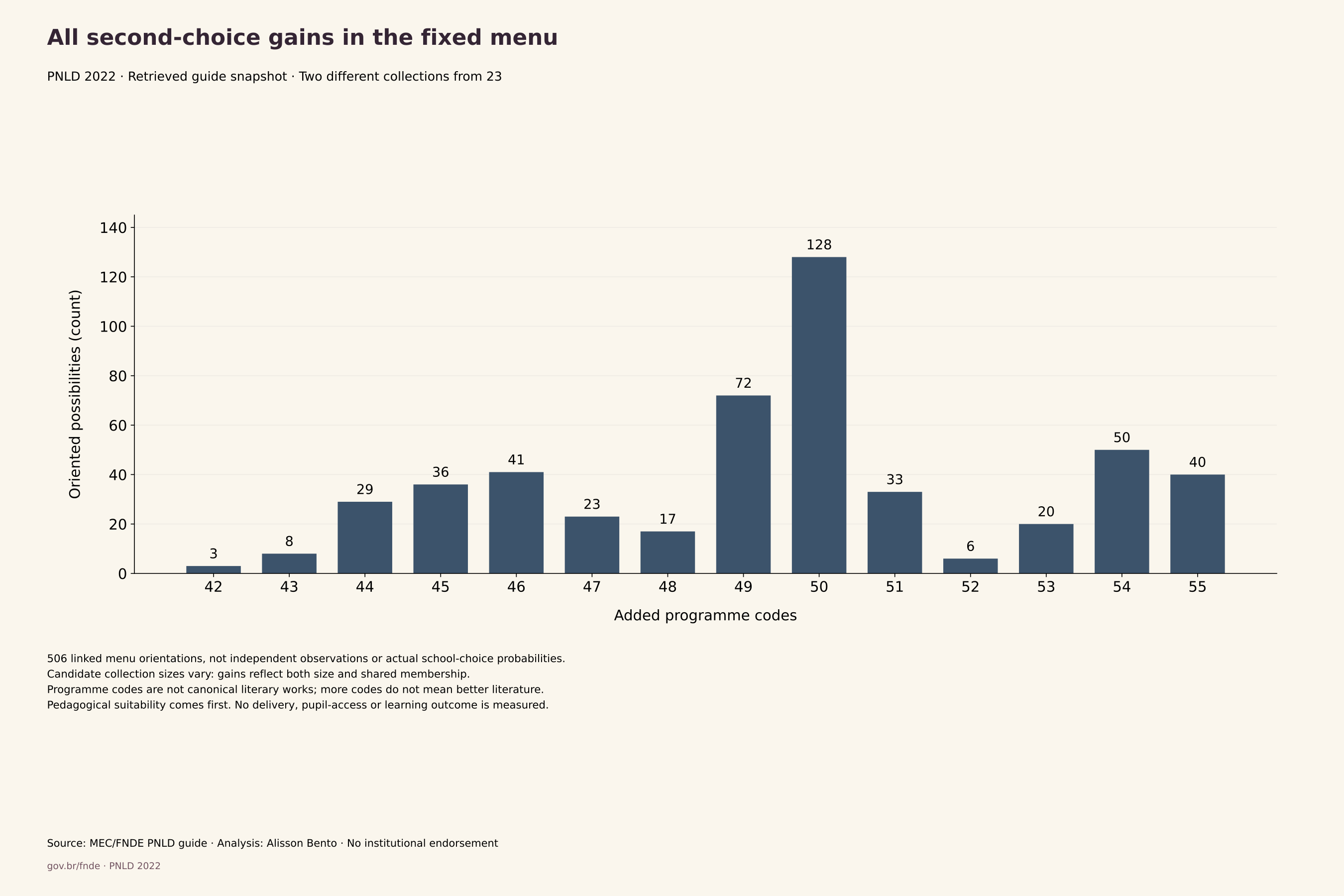
Scroll horizontally to inspect the chart. ↔
Chart and values
Scroll horizontally to see all columns.
| Added programme codes | Oriented possibilities |
|---|---|
| 42 | 3 |
| 43 | 8 |
| 44 | 29 |
| 45 | 36 |
| 46 | 41 |
| 47 | 23 |
| 48 | 17 |
| 49 | 72 |
| 50 | 128 |
| 51 | 33 |
| 52 | 6 |
| 53 | 20 |
| 54 | 50 |
| 55 | 40 |
All 506 oriented first-to-second choices, one record per orientation, no smoothing or bins. These are menu frequencies, not probabilities of actual school choices.
Data & downloads
Scroll horizontally to see all columns.
| Measure | Possibilities | Minimum | Median | Maximum |
|---|---|---|---|---|
| Distinct programme codes in a pair | 253 | 95 | 100 | 110 |
| Duplicate entries as share of A (%) | 253 | 0.0 | 2.9 | 7.7 |
| Codes added by a second collection | 506 | 42 | 50 | 55 |
Exact finite menu, not school-choice probabilities. Shares use nominal pair entries A; displayed percentages rounded to one decimal. The breadth range combines varying collection sizes and duplicate membership.
Scroll horizontally to see all columns.
| First collection | Category | Starting codes | Alternatives | Minimum added | Median added | Maximum added | Added codes: choices |
|---|---|---|---|---|---|---|---|
| 01 | Mixed | 50 | 22 | 47 | 50.0 | 51 | 47: 2; 49: 7; 50: 8; 51: 5 |
| 02 | Mixed | 49 | 22 | 46 | 50.0 | 52 | 46: 1; 48: 1; 49: 5; 50: 11; 51: 3; 52: 1 |
| 03 | Mixed | 50 | 22 | 47 | 50.0 | 52 | 47: 1; 48: 1; 49: 7; 50: 10; 51: 2; 52: 1 |
| 04 | Mixed | 49 | 22 | 48 | 50.0 | 51 | 48: 1; 49: 6; 50: 13; 51: 2 |
| 05 | Mixed | 50 | 22 | 48 | 50.0 | 51 | 48: 1; 49: 8; 50: 11; 51: 2 |
| 06 | Mixed | 50 | 22 | 47 | 50.0 | 51 | 47: 1; 48: 1; 49: 5; 50: 13; 51: 2 |
| 07 | Mixed | 50 | 22 | 46 | 50.0 | 52 | 46: 1; 47: 1; 48: 1; 49: 6; 50: 7; 51: 5; 52: 1 |
| 08 | Mixed | 50 | 22 | 48 | 50.0 | 51 | 48: 1; 49: 8; 50: 11; 51: 2 |
| 09 | Mixed | 50 | 22 | 47 | 50.0 | 52 | 47: 1; 48: 2; 49: 4; 50: 13; 51: 1; 52: 1 |
| 10 | Mixed | 49 | 22 | 47 | 50.0 | 52 | 47: 1; 48: 2; 49: 4; 50: 11; 51: 3; 52: 1 |
| 11 | Mixed | 50 | 22 | 48 | 50.0 | 51 | 48: 2; 49: 7; 50: 10; 51: 3 |
| 12 | Mixed | 49 | 22 | 48 | 50.0 | 52 | 48: 3; 49: 5; 50: 10; 51: 3; 52: 1 |
| 13 | Nursery | 53 | 22 | 44 | 47.0 | 55 | 44: 5; 45: 2; 46: 2; 47: 3; 53: 1; 54: 5; 55: 4 |
| 14 | Nursery | 55 | 22 | 44 | 46.5 | 55 | 44: 4; 45: 4; 46: 3; 47: 1; 53: 2; 54: 5; 55: 3 |
| 15 | Nursery | 54 | 22 | 42 | 47.0 | 55 | 42: 1; 44: 4; 45: 2; 46: 1; 47: 4; 53: 2; 54: 4; 55: 4 |
| 16 | Nursery | 55 | 22 | 44 | 46.0 | 55 | 44: 4; 45: 3; 46: 5; 53: 2; 54: 5; 55: 3 |
| 17 | Nursery | 54 | 22 | 43 | 46.5 | 55 | 43: 1; 44: 2; 45: 4; 46: 4; 47: 1; 53: 2; 54: 4; 55: 4 |
| 18 | Nursery | 55 | 22 | 43 | 46.5 | 55 | 43: 1; 44: 2; 45: 5; 46: 3; 47: 1; 53: 2; 54: 5; 55: 3 |
| 19 | Preschool | 54 | 22 | 43 | 46.5 | 55 | 43: 1; 44: 3; 45: 2; 46: 5; 47: 1; 53: 2; 54: 4; 55: 4 |
| 20 | Preschool | 53 | 22 | 42 | 47.5 | 55 | 42: 1; 44: 3; 45: 2; 46: 4; 47: 1; 48: 1; 53: 1; 54: 5; 55: 4 |
| 21 | Preschool | 55 | 22 | 43 | 46.5 | 55 | 43: 2; 44: 1; 45: 4; 46: 4; 47: 1; 53: 2; 54: 5; 55: 3 |
| 22 | Preschool | 54 | 22 | 42 | 46.5 | 55 | 42: 1; 43: 1; 45: 4; 46: 5; 47: 1; 53: 2; 54: 4; 55: 4 |
| 23 | Preschool | 54 | 22 | 43 | 47.0 | 55 | 43: 2; 44: 1; 45: 4; 46: 3; 47: 2; 53: 2; 54: 4; 55: 4 |
Each row fixes the first collection; all 22 different remaining choices are retained. Frequency notation is added codes: number of candidate choices. Category is source context, not a ranking or universal suitability rule. Candidate sizes vary as well as overlap.
Scroll horizontally to see all columns.
| Added programme codes | Oriented possibilities |
|---|---|
| 42 | 3 |
| 43 | 8 |
| 44 | 29 |
| 45 | 36 |
| 46 | 41 |
| 47 | 23 |
| 48 | 17 |
| 49 | 72 |
| 50 | 128 |
| 51 | 33 |
| 52 | 6 |
| 53 | 20 |
| 54 | 50 |
| 55 | 40 |
All 506 oriented first-to-second choices, one record per orientation, no smoothing or bins. These are menu frequencies, not probabilities of actual school choices.
Scroll horizontally to see all columns.
| Item | Audited scope |
|---|---|
| Collections | 23 |
| Source table pages | 62 (PDF 59–120) |
| Listed code occurrences | 1,192 |
| Source fields reconciled per occurrence | 7 |
| Unordered distinct-collection pairs | 253 |
| Directional second choices | 506 |
| Alternatives conditional on each first collection | 22 |
| Within-collection duplicate codes | 0 |
| Repeated-code descriptive-field conflicts | 0 |
The guide snapshot, not delivered books or enrolments, is the measured object. Source page counts and occurrence counts describe extraction coverage, not learning or access.
Evidence & method
How we calculated it
- Fixed the documented manual example of choosing two different collections from the 23-menu; no larger-k outcomes.
- Preserved full programme-code strings; no title merging, suffix decoding or canonical literary-work inference.
- Audited every collection table page; two independent extraction methods reconciled 1,192 occurrences across seven fields.
- Enumerated all 253 unordered pairs and 506 directions; duplicate share D/A and exact fractional medians retain ties.
- Published all 23 conditional distributions and minimal collection/code/page reproduction inputs, with independent numerical replication.
What the data cannot tell us
- This retrieved guide snapshot is not a verified historical reconstruction of the original choice-time catalogue.
- Source codes identify programme-listed bibliographic items, not necessarily different canonical intellectual works.
- The source’s two-choice example is not proof of universal school allowances or pedagogical suitability for every pair.
- Collection sizes vary 49–55; neither the joint range nor conditional gain variation is exclusively an overlap effect.
- No observed selections, shipments, received copies, school inventories, enrolment joins, access or learning outcomes.
- Guide and 2023 manual 49–55 versus notice 53–55 remains a discrepancy; PDF generation time is not an established revision date.
- Prior thematic studies are acknowledged; Faria’s full thesis was unavailable, so no exhaustive novelty claim is made.
Original sources
- MEC/FNDE: complete PNLD 2022 Educação Infantil literary guide
Retrieved complete guide; collection tables PDF pp. 59–120. File generation July 2025 is not a verified revision date. Exact programme codes, not canonical literary-work identities.
Accessed October 30, 2026
- FNDE: manual for registering PNLD 2022 early-childhood literary choices
Actual PDF pp. 12, 17–18 identifies code fields, 49–55 range and illustrative two-distinct-collection checkbox selection from 23. Not proof of universal two-collection allowances or suitability.
Accessed October 30, 2026
- FNDE: PNLD 2022 literary choice notice
Notice published September 8, 2023 and modified November 7, 2023 describes 53–55 works, unlike 49–55 in the guide and 2023 manual. Preserved as a source discrepancy, not a proven temporal revision.
Accessed October 30, 2026
- CEFET-MG: Faria dissertation defence abstract on indigenous representation in PNLD 2022
Official indexed abstract and thesis excerpts establish close prior thematic-coverage research. Full thesis was unavailable for inspection; no claim to have excluded every analysis it contains.
Accessed October 30, 2026
- Manfré and Rozzi 2026: PNLD 2022 literary collections and young children’s formation
Qualitative study of selected narrative works from preschool collections 19–23; relevant prior research, not a complete-menu exact-code pair analysis.
Accessed October 30, 2026
Cite & reuse this study
Alisson Bento. “Two PNLD collections: how much programme-code breadth changes.” Original research, 2026. Retrieved official PNLD 2022 Educação Infantil guide snapshot; accessed October 30, 2026. https://alissonbento.com/research/brazil-pnld-two-collection-code-breadth-2022/
Source information: MEC/FNDE official PNLD 2022 guide and choice manual, with source links and file fingerprints. Original code-membership extraction, calculations and explanation: Alisson Bento. No institutional endorsement is implied. Guide reviews, artwork, literary text, personal publisher identifiers, school records and child records are not redistributed.
Corrections or editorial questions