
How much can a reader line tell you?
A reader choosing a free recording may first see one name or the collective label “LibriVox Volunteers.” That distinction helps identify a catalogue credit arrangement. It leaves another practical question unanswered: where do the credited identifiers change as the files proceed? A collective project can retain one credited identifier over several consecutive files, return to an earlier identifier later, or change at every boundary. Those arrangements produce different metadata sequences even before anyone listens.
We examined ten purposefully selected English catalogue projects covering five novels. Each novel contributes two projects with the same documented source-eBook identifier. The analysis follows official section-level reader IDs in their numerical file order. It measures the sequence of credits rather than acoustic voices, acting, recording quality or listening experience. Every selected section was checked against both the official API and its public catalogue table.
The useful result is an ordering reversal. The selected Alice project has fewer distinct credited IDs than the selected Jane Eyre project, yet its credited ID changes at a larger proportion of adjacent file boundaries. A list of contributors cannot supply that proportion. The downloadable sequence tables show exactly which boundaries and repeated stretches produce it, while keeping the seven selected single-ID projects visible.
A fixed choice of novels and an unreplaced unmatched work
Before retrieving section-credit outcomes, we fixed six original-English novels: Jane Eyre, Frankenstein, Moby Dick, Alice’s Adventures in Wonderland, Great Expectations and The Secret Garden. For each, we fixed one Gutenberg source-eBook identifier. We selected the two smallest numeric LibriVox project IDs among matching English catalogue projects, excluding explicitly abridged, dramatic-reading, selection and anthology projects. Numeric ID order is a selection rule; it does not establish recording chronology or preference.
The Moby Dick discovery results did not supply a pair for its fixed eBook identifier 2701. The later catalogue project linked a different eBook identifier. We retained that failed match in the selection ledger and did not substitute another source identifier, another novel or a later preferred recording. The resulting main sample contains ten projects across five paired works. This is a transparent historical catalogue selection, with no claim to represent all novels or LibriVox releases.
Our minimum source requirement was fixed before looking up outcomes: eight projects with fully resolved section credits across at least three works. All ten selected projects passed the structural requirement. They provide 321 listed files, each with an unambiguous numeric section order and a positive official reader ID. The raw API arrays and independently captured catalogue tables agreed on all 321 section numbers and credited-ID sets. A catalogue date and complete listed-file table establish the documented release frame; they do not verify the spoken recording.
Four units that belong in separate columns
A work is the novel named by the author and title. A project is one LibriVox catalogue release. A section is one listed file, sometimes labelled as a chapter, introductory item or grouped passage. A reader ID is an exact catalogue identifier attached to that section. The number of sections differs within some source-matched pairs: the two selected Jane Eyre projects list 39 and 38 files, while the Frankenstein pair lists 22 and 25. We therefore compare each project’s own sequence without forcing files into matched chapter pairs.
The source link has a similarly limited role. Two pages pointing to the same Gutenberg eBook identifier document the same linked source identity. They do not certify identical historical text bytes, the same edition at the time of recording, identical words spoken or independently produced audio. No novel text was downloaded for this study. Titles and catalogue version labels are retained as displayed, even when a release’s URL contains a different version-like string.
Finally, the “Read by” header is distinct from the section roster. Three selected pages display the collective text “LibriVox Volunteers” without an individual reader-ID link in that header. We preserve a collective-label flag and leave its individual-header-ID count unknown. Treating the phrase as one person would be a coding error. Book coordinators, meta-coordinators and proof listeners are separate roles; their names do not become reader credits unless they also appear in the section table.
Counting a change requires a boundary and a denominator
For a project with N ordered files, there are N minus one adjacent boundaries. At each boundary we compare the exact credited-ID sets on its two sides. A boundary is eligible when both sets are known. It contains a credited-ID handoff when those sets differ. The handoff proportion is the number of changed eligible boundaries divided by the number of eligible boundaries. File zero, where present, remains in the sequence as an ordinary listed file rather than being silently removed.
All 321 selected files have exactly one credited ID, so the set-based comparison and the stricter singleton-ID comparison coincide here. The recipe nevertheless keeps both denominators explicit. A future multi-ID section would be a credited set, and a change in that set would not establish an audible handoff. A missing credit would make its adjoining comparisons unresolved. Neither case should be silently converted into another named individual or an assumed unchanged voice.
We also record runs: consecutive files carrying the same singleton ID. Each run retains its starting and ending ordinal positions, the original section numbers and its length in files. These are unweighted file counts. Five short files could occupy less time than one long file, and we did not calculate a duration-weighted substitute. The measure answers how credits are arranged across listed boundaries; it cannot supply uninterrupted minutes of listening.
Three collective labels, three different sequences
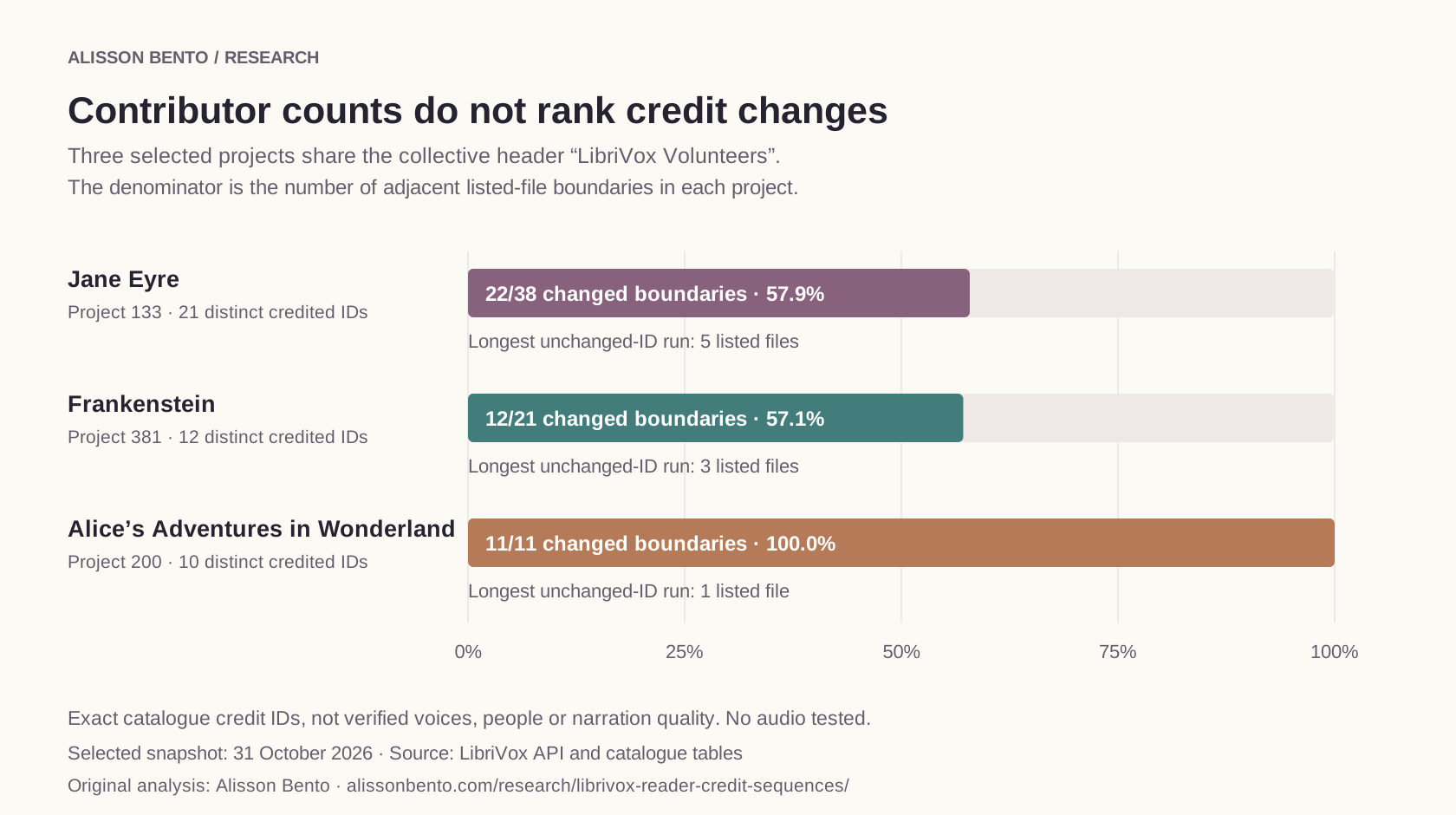
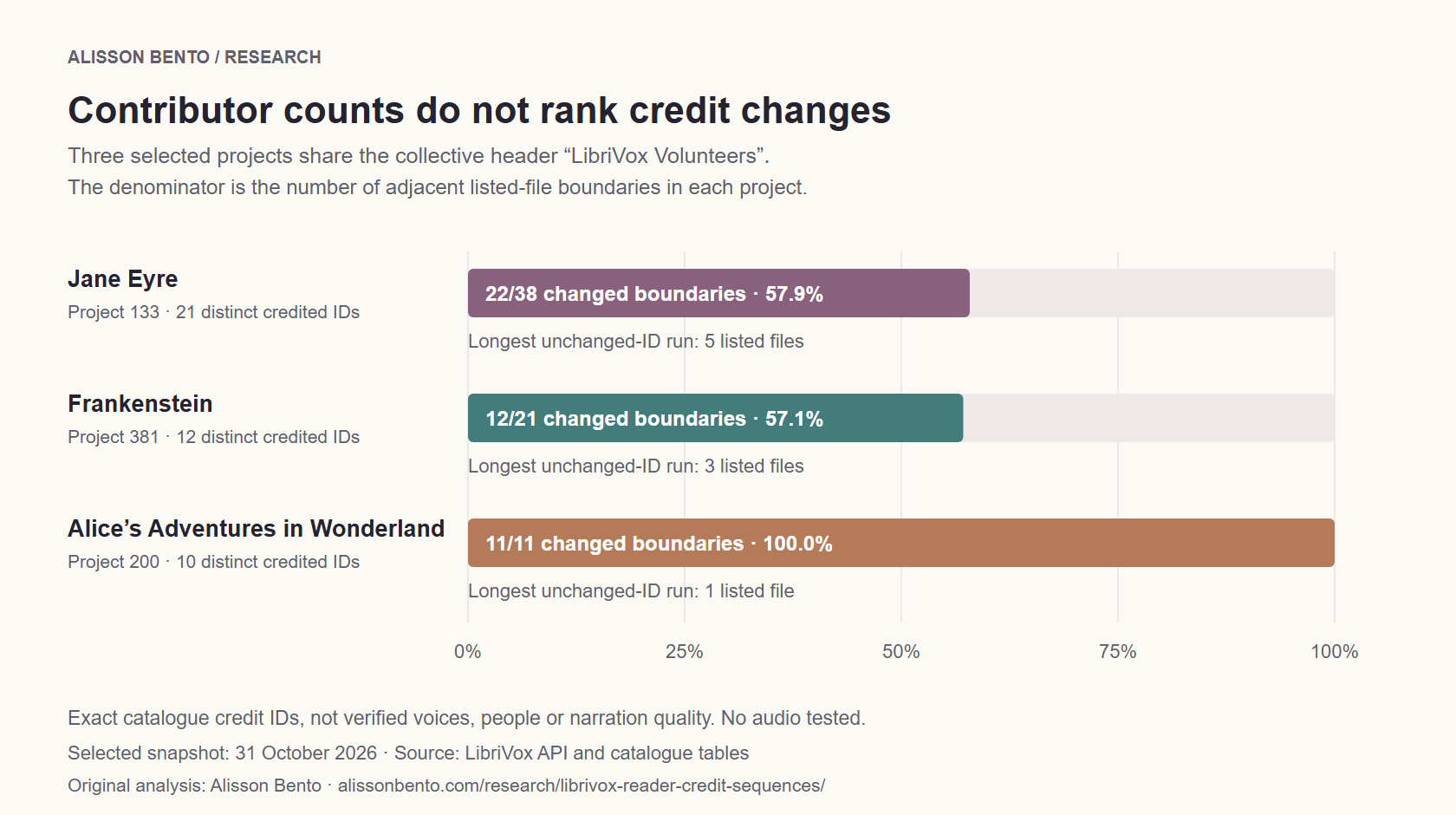
Jane Eyre project 133 lists 39 files carrying 21 distinct reader IDs. Its credited ID changes at 22 of 38 adjacent boundaries, or 57.9%. Sixteen boundaries retain the same ID, and the longest unchanged-ID run spans five files. This is direct evidence that this collective catalogue project does not change its credited identifier at every listed file boundary. Its longest run occurs at the end, across section numbers 34 through 38.
Frankenstein project 381 lists 22 files carrying 12 distinct reader IDs. It has 12 changed boundaries out of 21, or 57.1%, with nine unchanged boundaries and a longest run of three files. The introductory letters appear as section zero and remain included. The selected paired project, 5668, has 25 files and one credited ID throughout; it is a separate packaging sequence, not a file-by-file experimental control for the earlier project.
Alice project 200 lists 12 files and ten distinct credited IDs. Its ID changes at all 11 adjacent boundaries: 100%. Every unchanged-ID run therefore contains one file. Yet two identifiers return at nonadjacent positions. An ID can occur more than once without occupying consecutive files, which is why dividing the section count by the number of IDs does not give the length of a real run. The paired Alice project 900 retains one ID across its 12 listed files.
Fewer credited identifiers can accompany more frequent changes
The three collective-header projects expose the limitation of sorting by contributor count. Jane Eyre has the largest distinct-ID count, 21, but a changed-boundary proportion of 57.9%. Alice has the smallest count, ten, but a proportion of 100%. Frankenstein lies between them on distinct-ID count and slightly below Jane Eyre on changed-boundary proportion. Contributor count and adjacent-change proportion describe different features of a sequence.
Absolute handoff counts answer a third question. Jane Eyre has 22 changed boundaries while Alice has 11, partly because Jane Eyre has many more listed boundaries available. Reporting only the percentage would hide the event count; reporting only the event count would hide the different opportunities for a change. Our table therefore prints the numerator, denominator, percentage, distinct-ID count and longest run together. None of these columns receives a quality score or a preferred-recording badge.
The seven single-ID projects are retained in the full table. Each has zero changed credited-ID boundaries in its own resolved sequence. Great Expectations and The Secret Garden each contribute two such projects under the fixed selection rule. These cases prevent the illustration from becoming a collection chosen only for conspicuous changes. The observed number of collective projects is a property of this selected sample, not an estimate of how common collaborative recording is.
Keeping the same contributor counts while changing only order
A deliberately hypothetical comparison shows what the counts omit. Take a fully resolved singleton-ID sequence and group all files with each ID into one contiguous block. This preserves the number of files and every ID’s occurrence count. With K distinct IDs, those K blocks have K minus one changes between them. At least K minus one changes are necessary to encounter K identifiers in a single sequence, so this construction gives the minimum possible handoff count for that fixed multiset.
For Jane Eyre, that hypothetical minimum is 20 changes, compared with the observed 22. For Frankenstein it is 11 rather than 12; for Alice it is nine rather than 11. These arithmetic contrasts isolate information lost when a sequence is reduced to its contributor counts. The observed catalogue order is retained in every primary result. The grouped alternative is a mathematical comparison, not another observed release, a suggested edit or an arrangement that preserves the novel’s narrative order.
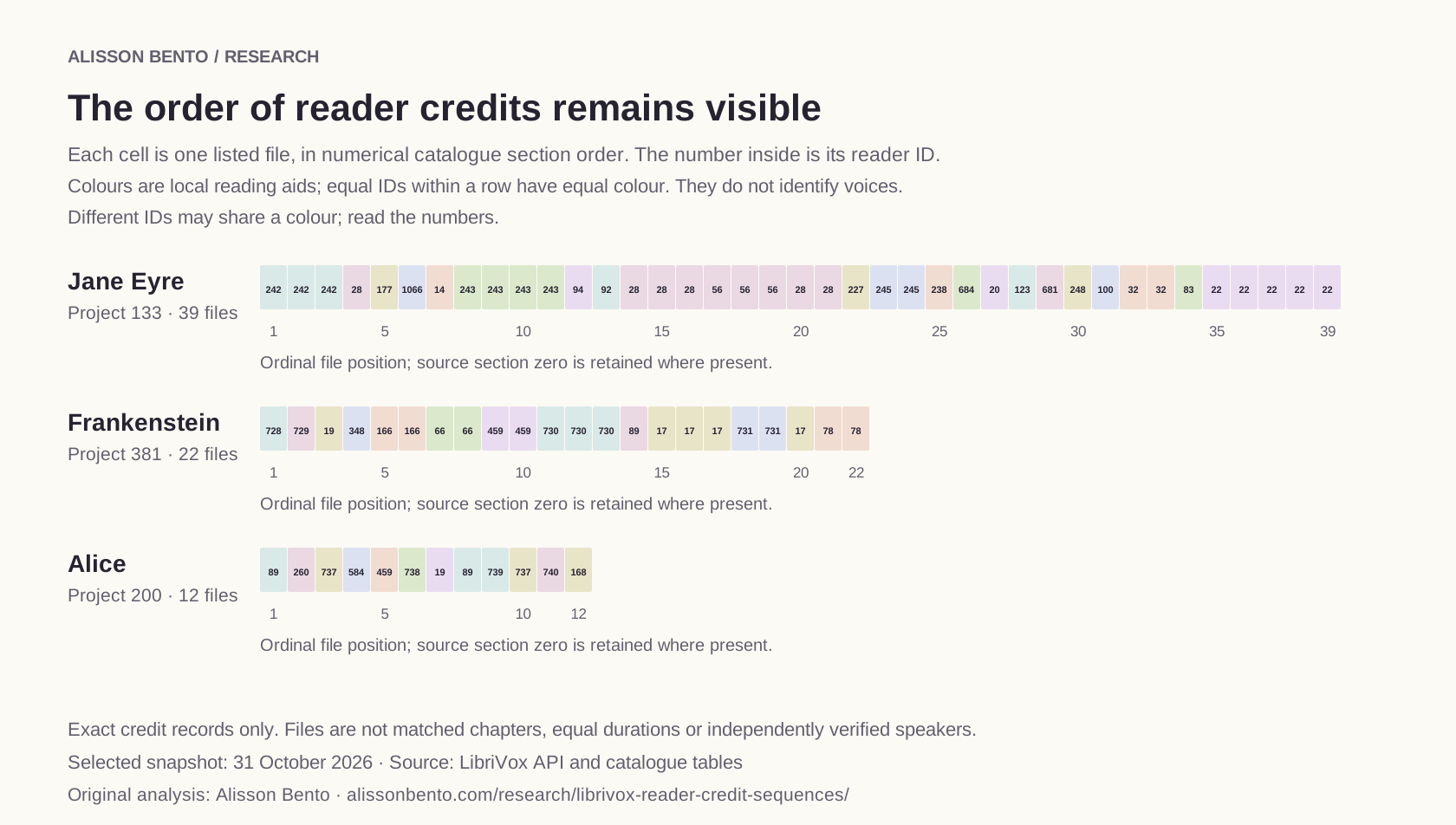
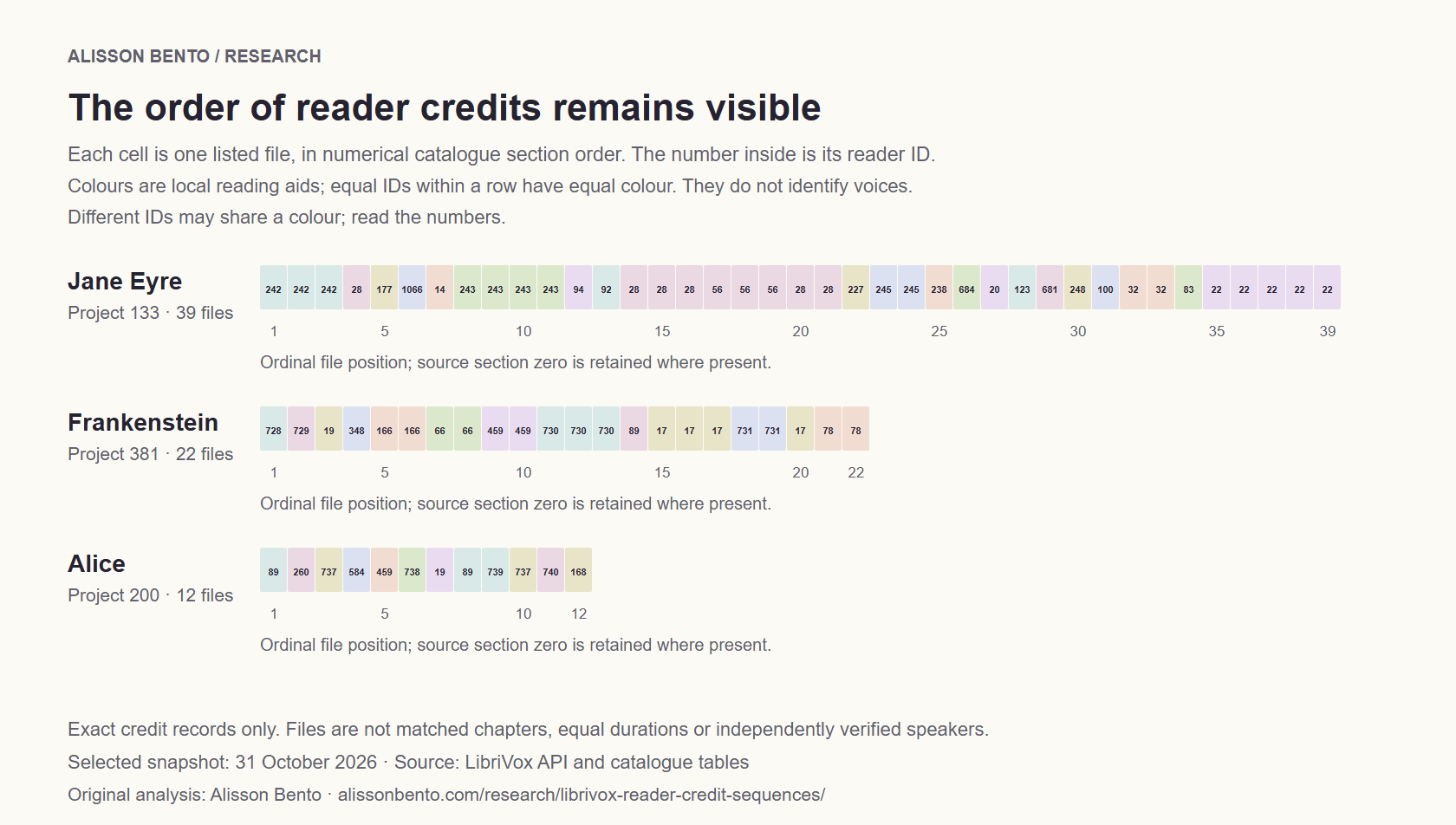
The difference also connects to nonadjacent returns. In Jane Eyre, reader ID 28 occupies three separated runs. In Frankenstein, ID 17 appears in two. Alice has two identifiers with separated appearances. A fresh run can therefore repeat an already encountered ID instead of introducing a new one. Counting unique IDs misses this distinction, while a transition table and run table preserve it. The files supply the evidence without any need to infer the identity or characteristics of an acoustic speaker.
A useful preview begins with the actual file sequence
A catalogue editor can expose the number of distinct reader IDs in the section credits alongside a simple sequence preview and a clearly labelled count of changed file boundaries. A reader who wants to inspect credit continuity could then see whether changes cluster early, recur throughout, or are absent in the listed metadata. The original catalogue already supplies per-section credits, so the contribution here is their reproducible ordered summary and the explanation of which comparisons those summaries support.
Existing LibriVox search documentation offers solo and group filters. Consumer narrator guides also discuss single-reader and collaborative recordings. One guide inspected for this study states that group recordings change reader every chapter. Our evidence concerns the narrower, verifiable catalogue-credit statement: some selected collective projects retain the same credited ID across adjacent listed files, while another changes at every boundary. This does not evaluate the guide’s subjective judgments or establish what any listener actually hears.
Primary narration research already groups LibriVox projects by common source-text links and investigates acoustic features and audience proxies. We do not claim source-link grouping as a new method. The present contribution is a bounded credit-sequence audit with exact boundaries, transparent selection and an order-preserving factual dataset. It complements a solo/group label; it does not validate a narrator recommendation, certify a cast or predict whether someone will enjoy a recording.
An identifier is evidence about a credit record
Catalogue IDs allow exact reproducible comparisons that display names alone may not support. A volunteer’s display name may change, include an alias or contain memorial information. Different IDs could refer to the same person, and an account or collective label could represent more than one person. We make no person-level deduplication. The downloaded factual rows retain the original ID separately from the displayed name so another analyst can inspect that distinction.
Conversely, an unchanged ID does not certify an unchanged sound. A person can portray different characters, change delivery or record under different conditions; a file can include material not expressed in its credit line. A changed ID does not establish a change in perceived voice either. Those questions require audio inspection and suitable methods. This study downloaded neither audio files nor cover art and did not conduct listening tests, quality scoring or attention measurement.
Projects can also share credited IDs with other projects, and catalogue releases may reuse material. The ten projects are therefore not certified independent performances. Selection of familiar novels and early numeric IDs further limits generalisation. These restrictions leave the central observation intact: within the captured metadata, contributor counts and ordered boundary changes contain different information. They prevent that observation from turning into unsupported claims about volunteers, listeners or audiobook markets.
Inspect the rows, then reproduce the summaries
The factual inputs contain one project record for each selected release and one section-credit row for each of the 321 files. Project records retain the source link, catalogue URL, catalogue date and header-credit interpretation. Section rows retain the catalogue section number, the section ID, the exact reader-ID set and displayed names. Ordinal position is an analysis convenience that follows numerical section order; it does not relabel an introductory file as the novel’s first chapter.
The portable Python recipe requires only the standard library and has no network calls, accounts or private workspace dependencies. It validates the source-resolution threshold, section counts and unique numerical order before generating project metrics, all 311 adjacent boundaries, singleton runs, per-ID occurrence counts and sequence-chart points. The source records distinguish raw response hashes from selected public factual inputs. Reproducing these tables verifies arithmetic for the frozen snapshot rather than promising the live catalogue will never change.
Charts and accessible tables use the same selected IDs and boundary counts as the downloads. The sequence figure shows ordinal file positions and literal catalogue IDs, with colour used only as a local reading aid. It does not align novels by time or equate positions between editions. Source attribution accompanies the reusable figures. Anyone quoting a result should retain the project ID and denominator, because dropping either can turn a precise sequence observation into a misleading general statement.
Contributor counts do not rank credit changes
Jane Eyre project 133: 21 credited IDs and 22 of 38 changed boundaries; Frankenstein project 381: 12 IDs and 12 of 21; Alice project 200: 10 IDs and 11 of 11. Selected catalogue metadata only; no voice, person or quality measurement.
Full chart and source
Scroll horizontally to inspect the chart. ↔
Chart and values
Scroll horizontally to see all columns.
| Work / project ID | Files | Distinct reader IDs in sections | Changed boundaries | Eligible boundaries | Changed (%) | Longest same-ID run (files) | Header credit type |
|---|---|---|---|---|---|---|---|
| Jane Eyre / 133 | 39 | 21 | 22 | 38 | 57.9 | 5 | Collective label |
| Jane Eyre / 2192 | 38 | 1 | 0 | 37 | 0.0 | 38 | Individual ID link |
| Frankenstein / 381 | 22 | 12 | 12 | 21 | 57.1 | 3 | Collective label |
| Frankenstein / 5668 | 25 | 1 | 0 | 24 | 0.0 | 25 | Individual ID link |
| Alice’s Adventures in Wonderland / 200 | 12 | 10 | 11 | 11 | 100.0 | 1 | Collective label |
| Alice’s Adventures in Wonderland / 900 | 12 | 1 | 0 | 11 | 0.0 | 12 | Individual ID link |
| Great Expectations / 2591 | 59 | 1 | 0 | 58 | 0.0 | 59 | Individual ID link |
| Great Expectations / 6729 | 59 | 1 | 0 | 58 | 0.0 | 59 | Individual ID link |
| The Secret Garden / 56 | 27 | 1 | 0 | 26 | 0.0 | 27 | Individual ID link |
| The Secret Garden / 2694 | 28 | 1 | 0 | 27 | 0.0 | 28 | Individual ID link |
A collective header has no individual-header count. Exact reader IDs are credit records, not verified unique people or voices. Handoff percentages use each project’s own listed-file boundaries.
The order of reader credits remains visible
Three literal reader-ID sequences, one cell per catalogue file. Jane Eyre project 133 has 39 files and longest singleton-ID run 5; Frankenstein project 381 has 22 files and longest run 3; Alice project 200 has 12 files and changes at every boundary. Different IDs may share a colour; read the numbers. Ordinal positions do not align text or time between projects.
Full chart and source
Scroll horizontally to inspect the chart. ↔
Chart and values
Scroll horizontally to see all columns.
| Project ID | Ordinal file position | Original section number | Exact credited reader ID |
|---|---|---|---|
| 133 | 1 | 0 | 242 |
| 133 | 2 | 1 | 242 |
| 133 | 3 | 2 | 242 |
| 133 | 4 | 3 | 28 |
| 133 | 5 | 4 | 177 |
| 133 | 6 | 5 | 1066 |
| 133 | 7 | 6 | 14 |
| 133 | 8 | 7 | 243 |
| 133 | 9 | 8 | 243 |
| 133 | 10 | 9 | 243 |
| 133 | 11 | 10 | 243 |
| 133 | 12 | 11 | 94 |
| 133 | 13 | 12 | 92 |
| 133 | 14 | 13 | 28 |
| 133 | 15 | 14 | 28 |
| 133 | 16 | 15 | 28 |
| 133 | 17 | 16 | 56 |
| 133 | 18 | 17 | 56 |
| 133 | 19 | 18 | 56 |
| 133 | 20 | 19 | 28 |
| 133 | 21 | 20 | 28 |
| 133 | 22 | 21 | 227 |
| 133 | 23 | 22 | 245 |
| 133 | 24 | 23 | 245 |
| 133 | 25 | 24 | 238 |
| 133 | 26 | 25 | 684 |
| 133 | 27 | 26 | 20 |
| 133 | 28 | 27 | 123 |
| 133 | 29 | 28 | 681 |
| 133 | 30 | 29 | 248 |
| 133 | 31 | 30 | 100 |
| 133 | 32 | 31 | 32 |
| 133 | 33 | 32 | 32 |
| 133 | 34 | 33 | 83 |
| 133 | 35 | 34 | 22 |
| 133 | 36 | 35 | 22 |
| 133 | 37 | 36 | 22 |
| 133 | 38 | 37 | 22 |
| 133 | 39 | 38 | 22 |
| 381 | 1 | 0 | 728 |
| 381 | 2 | 1 | 729 |
| 381 | 3 | 2 | 19 |
| 381 | 4 | 3 | 348 |
| 381 | 5 | 4 | 166 |
| 381 | 6 | 5 | 166 |
| 381 | 7 | 6 | 66 |
| 381 | 8 | 7 | 66 |
| 381 | 9 | 8 | 459 |
| 381 | 10 | 9 | 459 |
| 381 | 11 | 10 | 730 |
| 381 | 12 | 11 | 730 |
| 381 | 13 | 12 | 730 |
| 381 | 14 | 13 | 89 |
| 381 | 15 | 14 | 17 |
| 381 | 16 | 15 | 17 |
| 381 | 17 | 16 | 17 |
| 381 | 18 | 17 | 731 |
| 381 | 19 | 18 | 731 |
| 381 | 20 | 19 | 17 |
| 381 | 21 | 20 | 78 |
| 381 | 22 | 21 | 78 |
| 200 | 1 | 1 | 89 |
| 200 | 2 | 2 | 260 |
| 200 | 3 | 3 | 737 |
| 200 | 4 | 4 | 584 |
| 200 | 5 | 5 | 459 |
| 200 | 6 | 6 | 738 |
| 200 | 7 | 7 | 19 |
| 200 | 8 | 8 | 89 |
| 200 | 9 | 9 | 739 |
| 200 | 10 | 10 | 737 |
| 200 | 11 | 11 | 740 |
| 200 | 12 | 12 | 168 |
These 73 factual values reproduce every cell in the sequence figure. Ordinal positions are separate from original section numbers. The full 321-row source is downloadable; no audio inspected.
Data & downloads
Scroll horizontally to see all columns.
| Work / project ID | Files | Distinct reader IDs in sections | Changed boundaries | Eligible boundaries | Changed (%) | Longest same-ID run (files) | Header credit type |
|---|---|---|---|---|---|---|---|
| Jane Eyre / 133 | 39 | 21 | 22 | 38 | 57.9 | 5 | Collective label |
| Jane Eyre / 2192 | 38 | 1 | 0 | 37 | 0.0 | 38 | Individual ID link |
| Frankenstein / 381 | 22 | 12 | 12 | 21 | 57.1 | 3 | Collective label |
| Frankenstein / 5668 | 25 | 1 | 0 | 24 | 0.0 | 25 | Individual ID link |
| Alice’s Adventures in Wonderland / 200 | 12 | 10 | 11 | 11 | 100.0 | 1 | Collective label |
| Alice’s Adventures in Wonderland / 900 | 12 | 1 | 0 | 11 | 0.0 | 12 | Individual ID link |
| Great Expectations / 2591 | 59 | 1 | 0 | 58 | 0.0 | 59 | Individual ID link |
| Great Expectations / 6729 | 59 | 1 | 0 | 58 | 0.0 | 59 | Individual ID link |
| The Secret Garden / 56 | 27 | 1 | 0 | 26 | 0.0 | 27 | Individual ID link |
| The Secret Garden / 2694 | 28 | 1 | 0 | 27 | 0.0 | 28 | Individual ID link |
A collective header has no individual-header count. Exact reader IDs are credit records, not verified unique people or voices. Handoff percentages use each project’s own listed-file boundaries.
Scroll horizontally to see all columns.
| Project ID | Ordinal file position | Original section number | Exact credited reader ID |
|---|---|---|---|
| 133 | 1 | 0 | 242 |
| 133 | 2 | 1 | 242 |
| 133 | 3 | 2 | 242 |
| 133 | 4 | 3 | 28 |
| 133 | 5 | 4 | 177 |
| 133 | 6 | 5 | 1066 |
| 133 | 7 | 6 | 14 |
| 133 | 8 | 7 | 243 |
| 133 | 9 | 8 | 243 |
| 133 | 10 | 9 | 243 |
| 133 | 11 | 10 | 243 |
| 133 | 12 | 11 | 94 |
| 133 | 13 | 12 | 92 |
| 133 | 14 | 13 | 28 |
| 133 | 15 | 14 | 28 |
| 133 | 16 | 15 | 28 |
| 133 | 17 | 16 | 56 |
| 133 | 18 | 17 | 56 |
| 133 | 19 | 18 | 56 |
| 133 | 20 | 19 | 28 |
| 133 | 21 | 20 | 28 |
| 133 | 22 | 21 | 227 |
| 133 | 23 | 22 | 245 |
| 133 | 24 | 23 | 245 |
| 133 | 25 | 24 | 238 |
| 133 | 26 | 25 | 684 |
| 133 | 27 | 26 | 20 |
| 133 | 28 | 27 | 123 |
| 133 | 29 | 28 | 681 |
| 133 | 30 | 29 | 248 |
| 133 | 31 | 30 | 100 |
| 133 | 32 | 31 | 32 |
| 133 | 33 | 32 | 32 |
| 133 | 34 | 33 | 83 |
| 133 | 35 | 34 | 22 |
| 133 | 36 | 35 | 22 |
| 133 | 37 | 36 | 22 |
| 133 | 38 | 37 | 22 |
| 133 | 39 | 38 | 22 |
| 381 | 1 | 0 | 728 |
| 381 | 2 | 1 | 729 |
| 381 | 3 | 2 | 19 |
| 381 | 4 | 3 | 348 |
| 381 | 5 | 4 | 166 |
| 381 | 6 | 5 | 166 |
| 381 | 7 | 6 | 66 |
| 381 | 8 | 7 | 66 |
| 381 | 9 | 8 | 459 |
| 381 | 10 | 9 | 459 |
| 381 | 11 | 10 | 730 |
| 381 | 12 | 11 | 730 |
| 381 | 13 | 12 | 730 |
| 381 | 14 | 13 | 89 |
| 381 | 15 | 14 | 17 |
| 381 | 16 | 15 | 17 |
| 381 | 17 | 16 | 17 |
| 381 | 18 | 17 | 731 |
| 381 | 19 | 18 | 731 |
| 381 | 20 | 19 | 17 |
| 381 | 21 | 20 | 78 |
| 381 | 22 | 21 | 78 |
| 200 | 1 | 1 | 89 |
| 200 | 2 | 2 | 260 |
| 200 | 3 | 3 | 737 |
| 200 | 4 | 4 | 584 |
| 200 | 5 | 5 | 459 |
| 200 | 6 | 6 | 738 |
| 200 | 7 | 7 | 19 |
| 200 | 8 | 8 | 89 |
| 200 | 9 | 9 | 739 |
| 200 | 10 | 10 | 737 |
| 200 | 11 | 11 | 740 |
| 200 | 12 | 12 | 168 |
These 73 factual values reproduce every cell in the sequence figure. Ordinal positions are separate from original section numbers. The full 321-row source is downloadable; no audio inspected.
Scroll horizontally to see all columns.
| Project ID | Distinct IDs K | Observed handoffs | Hypothetical grouped minimum K−1 | Observed minus minimum |
|---|---|---|---|---|
| 133 | 21 | 22 | 20 | 2 |
| 381 | 12 | 12 | 11 | 1 |
| 200 | 10 | 11 | 9 | 2 |
The grouped alternative has one contiguous block per distinct ID, giving K−1 handoffs. It is not a recording, an actual edit or a narrative-order recommendation.
Evidence & method
How we calculated it
- Six novels and fixed source-eBook IDs were declared before section-credit outcomes. Two lowest eligible numeric project IDs were selected for each source-matched novel, with no replacement after the Moby Dick mismatch. The ten selected projects across five works exceeded the predeclared minimum of eight fully resolved projects across three works.
- Sort each project by its unique integer section_number, retaining section zero. Compare exact credited reader-ID sets across consecutive listed files. Divide changed known-set boundaries by eligible known-set boundaries; keep unresolved and multi-ID cases explicit. All captured sections are resolved singletons, so the set and singleton denominators coincide.
- Consecutive equal singleton IDs form a run. Report occurrence counts, runs, first/last credits and nonadjacent returns separately. For fully singleton-resolved sequences, grouping each ID into a hypothetical contiguous block preserves the multiset and attains the minimum K−1 handoffs. No actual release is reordered.
- Every selected API section-number/reader-ID set was compared with the independently captured original catalogue HTML table. These are two representations from the same provider, not independent recordings. Private raw responses are retained; public downloads contain selected factual metadata and original calculations. The isolated standard-library recipe generates UTF-8/LF CSV/JSON without network access.
What the data cannot tell us
- Purposeful early-ID selection, five paired novels and ten catalogue projects cannot estimate catalogue-wide prevalence or establish independent performances. Source-link identity does not verify identical historical editions, text bytes or speech.
- Exact reader IDs are catalogue credit identifiers. They are not verified unique people, acoustic voices or cast identities. Collective header labels and role credits are not counted as individual section readers.
- A file is not necessarily one chapter or one comparable time interval. Introductory sections remain included, runs are measured in files, and no cross-edition chapter alignment or duration weighting is claimed.
- No audio was downloaded or auditioned. No quality, comprehension, fatigue, attention, reader preference, engagement or commercial outcome was observed. A hypothetical grouping comparison is arithmetic, not an observed performance or editing recommendation.
- The snapshot was captured 31 October 2026 UTC. Display names, credits, source links and section metadata can change. The provider’s US public-domain statement is not worldwide rights advice or an invented licence for this entire article.
Original sources
- LibriVox official API documentation
Official documentation describes project and section records, the 500-record limit and considerate request pacing; reader IDs were read from the actual API section records. These are metadata records, not verified voices or listening outcomes.
Accessed October 31, 2026
- LibriVox public-domain policy
The provider includes accompanying catalogue material in its US public-domain policy. Its obsolete pre-1923 explanation is not adopted as current law or worldwide clearance; no audio, novels or covers are redistributed.
Accessed October 31, 2026
- LibriVox robots and reference-use signals
The general access and reference-use signal and use restrictions were reviewed. This study uses compact factual reference metadata, with no prohibited routes and no audio collection.
Accessed October 31, 2026
- LibriVox wiki: catalogue search and solo/group filters
Provider documentation already explains completed catalogue projects, section credits and solo/group filters. These existing features are prior art rather than discoveries of this study.
Accessed October 31, 2026
- FabaShelf: LibriVox narrator guide
The consumer guide was captured on 31 October 2026 and supplies the statement about groups changing reader each chapter. Its subjective quality judgments are not adopted; the comparison here concerns exact catalogue credit IDs at file boundaries.
Accessed October 31, 2026
- Elisha, Beguerisse-Díaz and Benetos: Audio-Based Understanding of Audiobook Narration Appeal
This 2026 primary study already groups projects by common text-source links and analyses acoustic features and audience proxies, focusing on single-narrator recordings. This credit-sequence audit makes no audio or appeal claim and does not claim source-link grouping as new.
Accessed October 31, 2026
- Amelia Chesley: The In/Visible, In/Audible Labor of Digitizing the Public Domain
Chesley’s 2019 qualitative study, page 6, discusses a reader who seems to have used a printed copy despite catalogue text links. This is her observation/inference, not a historical text mismatch independently verified here.
Accessed October 31, 2026
- LibriVox catalogue project 133: Jane Eyre
Project 133: the complete listed-file table and catalogue date were captured; section numbers and exact reader-ID sets matched the API. The source link documents linked-eBook identity, not verified speech or unique people.
Accessed October 31, 2026
- LibriVox catalogue project 2192: Jane Eyre (version 2)
Project 2192: the complete listed-file table and catalogue date were captured; section numbers and exact reader-ID sets matched the API. The source link documents linked-eBook identity, not verified speech or unique people.
Accessed October 31, 2026
- LibriVox catalogue project 381: Frankenstein, or The Modern Prometheus
Project 381: the complete listed-file table and catalogue date were captured; section numbers and exact reader-ID sets matched the API. The source link documents linked-eBook identity, not verified speech or unique people.
Accessed October 31, 2026
- LibriVox catalogue project 5668: Frankenstein, or the Modern Prometheus (version 3)
Project 5668: the complete listed-file table and catalogue date were captured; section numbers and exact reader-ID sets matched the API. The source link documents linked-eBook identity, not verified speech or unique people.
Accessed October 31, 2026
- LibriVox catalogue project 200: Alice's Adventures in Wonderland
Project 200: the complete listed-file table and catalogue date were captured; section numbers and exact reader-ID sets matched the API. The source link documents linked-eBook identity, not verified speech or unique people.
Accessed October 31, 2026
- LibriVox catalogue project 900: Alice's Adventures in Wonderland (version 3)
Project 900: the complete listed-file table and catalogue date were captured; section numbers and exact reader-ID sets matched the API. The source link documents linked-eBook identity, not verified speech or unique people.
Accessed October 31, 2026
- LibriVox catalogue project 2591: Great Expectations
Project 2591: the complete listed-file table and catalogue date were captured; section numbers and exact reader-ID sets matched the API. The source link documents linked-eBook identity, not verified speech or unique people.
Accessed October 31, 2026
- LibriVox catalogue project 6729: Great Expectations (version 2)
Project 6729: the complete listed-file table and catalogue date were captured; section numbers and exact reader-ID sets matched the API. The source link documents linked-eBook identity, not verified speech or unique people.
Accessed October 31, 2026
- LibriVox catalogue project 56: Secret Garden
Project 56: the complete listed-file table and catalogue date were captured; section numbers and exact reader-ID sets matched the API. The source link documents linked-eBook identity, not verified speech or unique people.
Accessed October 31, 2026
- LibriVox catalogue project 2694: Secret Garden (version 2)
Project 2694: the complete listed-file table and catalogue date were captured; section numbers and exact reader-ID sets matched the API. The source link documents linked-eBook identity, not verified speech or unique people.
Accessed October 31, 2026
Cite & reuse this study
Alisson Bento. When reader credits change: ten LibriVox catalogue sequences. Catalogue metadata captured 31 October 2026 UTC; original credit-sequence calculations. Cite the exact project ID and boundary denominator with any numerical result. https://alissonbento.com/research/librivox-reader-credit-sequences/
Original analysis and figures: Alisson Bento. Reuse factual results with project IDs, denominators and source links intact. Compact catalogue metadata is attributed to LibriVox; no audio, novel text, cover art or narration-quality judgement is redistributed.
Corrections or editorial questions