
The discrepancy comes before the comparison
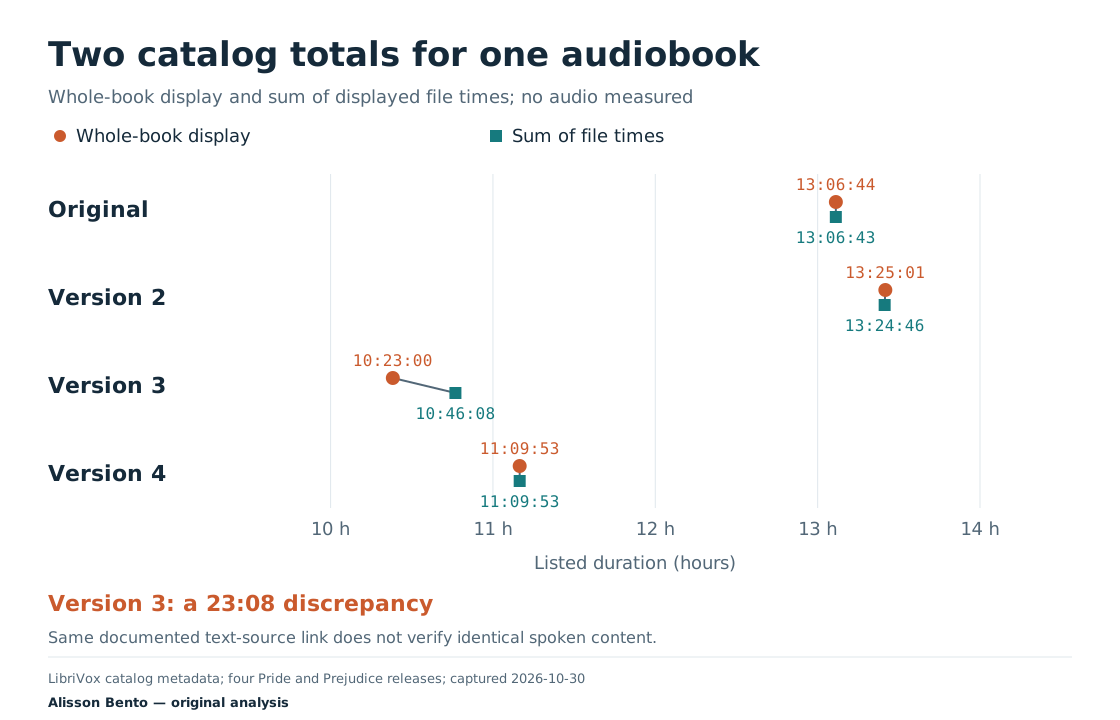
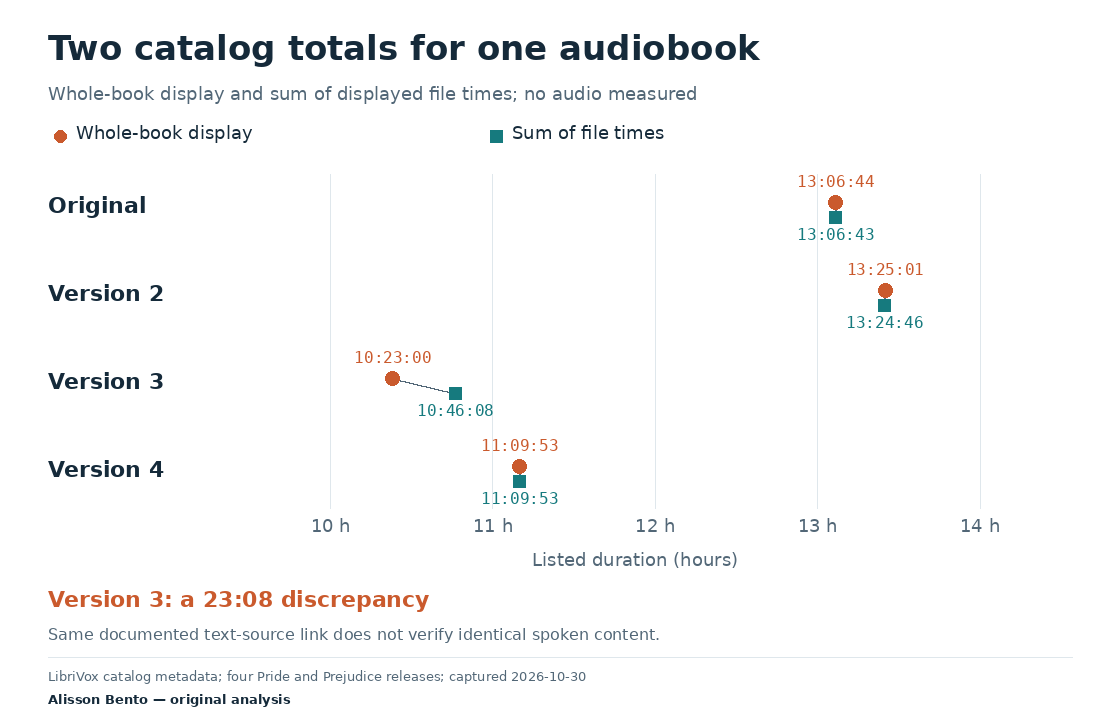
For a reader deciding whether an audiobook fits a week of listening, a running time appears to be a straightforward quantity. On the LibriVox catalog page for Pride and Prejudice, version 3, however, two representations disagree. The whole-book field displays 10 hours 23 minutes. Adding the page’s 61 displayed file durations produces 10 hours 46 minutes 8 seconds. The difference is 23 minutes 8 seconds. This is not a comparison between narrators or editions: it is an inconsistency within the metadata for one identified release.
Neither number can be promoted to the recording’s true duration from these observations alone. The study did not time downloaded audio, inspect its contents, or determine why the fields differ. Summing the files establishes what the listed components total, not whether those components describe the audio accurately. The useful result is therefore narrower and more defensible than a correction: a reader encounters two incompatible duration representations, and an analysis must keep them separate rather than silently choosing whichever supports a simpler story.
The other releases provide perspective without explaining the discrepancy. For the original, unnumbered release, the whole-book display exceeds the listed-file sum by one second. For version 2, it exceeds the sum by 15 seconds. For version 4, the two agree exactly. Version 3’s gap is consequently conspicuous within this four-release comparison. Agreement elsewhere does not validate those recordings’ actual durations, just as disagreement here does not establish missing material. The first practical distinction is between a catalog’s whole-book claim, the arithmetic of its track list, and the audio itself.
Four named releases, not a chronology or a representative sample
The comparison covers the original unnumbered English LibriVox release and the releases officially labeled versions 2, 3 and 4. Those labels identify the cases; they do not put them in publication order. Version 2 carries a catalog date of January 25, 2006, before the unnumbered release’s March 14, 2006 date. Version 3 is dated November 26, 2007, and version 4 May 5, 2010. Readers searching for a particular recording should therefore retain the official label and the catalog link rather than reconstruct an apparent sequence from the numbers.
URL wording is also an unreliable substitute for the displayed release label. Version 2’s address contains “solo-project,” while version 4’s contains “solo-version-3.” The article follows the official catalog labels throughout. This matters when a library note, reading-group message or personal listening plan needs to identify one recording unambiguously. A title and author alone identify the literary work, but they do not identify which set of files or which reported duration a reader will encounter. The links in the source notes supply that missing specificity.
The metadata observations were retrieved on October 30, 2026, as extracted catalog text. The retrieval system reported crawl ages of approximately one to three days, so this is not a claim about a synchronized live database state at one exact instant. The historical catalog dates are different kinds of dates altogether. These four releases form a bounded, purposive case study, not a representative sample of LibriVox, Jane Austen recordings or commercial audiobooks. Their value lies in the closely inspectable comparison, not in estimating how often catalog discrepancies occur elsewhere.
A shared eBook link is an identity clue, not a content guarantee
All four catalog pages document the same Online text destination. Their links use Project Gutenberg’s older address for eBook 1342 and resolve to its current eBook page for Jane Austen’s Pride and Prejudice. That common destination provides a useful basis for selecting related recordings: each release explicitly points readers toward the same documented eBook identity. It is stronger evidence of a shared source reference than matching the novel’s title alone. It does not, however, establish that the narrators worked from identical historical files or spoke identical content.
The distinction has a concrete chronological basis. The Gutenberg metadata reports an eBook release date of June 1, 1998, and a last update of September 29, 2026. That update is later than all four recording catalog dates. No historical text snapshot was acquired for this study. The currently resolving link therefore cannot certify the exact text available when any recording was made. Nor can chapter labels settle the matter: every release’s labels cover chapters 1–61 continuously, but complete labeling is not a direct examination of everything spoken within those chapters.
Grouping LibriVox recordings by shared original-text links is established prior art, not a new matching method introduced here. Section 3.1 of Elisha, Beguerisse-Díaz and Benetos’s Audio-Based Understanding of Audiobook Narration Appeal uses that approach before studying narration features and appeal. The present contribution is different: it uses an explicitly bounded group to audit catalog consistency and file boundaries. For readers, that boundary matters because a source-link match supports comparison of related releases without authorizing claims about abridgment, exact textual equivalence, narration quality or words spoken per minute.
A file is not necessarily a chapter
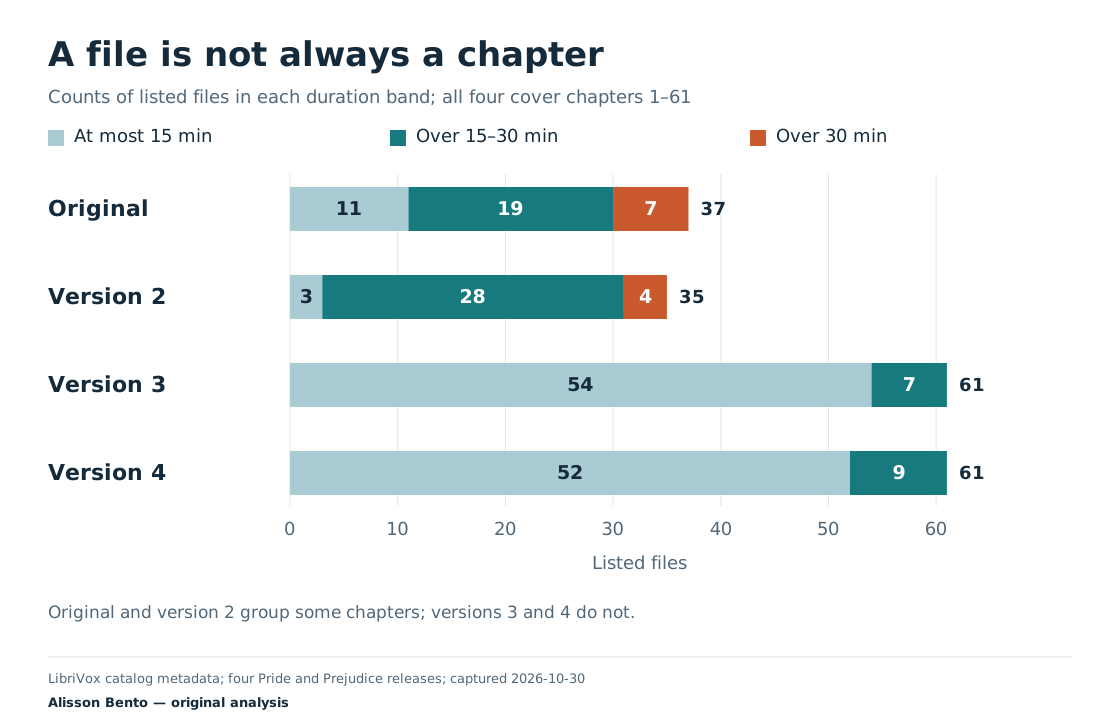
Across the four releases, the catalog lists 194 files. Their distribution is uneven: 37 in the original release, 35 in version 2, and 61 each in versions 3 and 4. All four sets of chapter labels cover the same numbered span, but the first two releases package some chapters together. Each has 22 multi-chapter files. Versions 3 and 4 instead provide one listed file per labeled chapter. A statement about track length therefore describes a different unit from a statement about chapter length unless that correspondence has first been checked.
The file-duration categories make this difference visible. The original release has 11 files at most 15 minutes long, 19 longer than 15 but no longer than 30 minutes, and seven longer than 30 minutes. Version 2 has three, 28 and four respectively. Version 3 has 54 files at most 15 minutes and seven above that threshold; version 4 has 52 and nine. Neither of the latter two has a listed file exceeding 30 minutes. The thresholds are strict: exactly 15 minutes does not count as exceeding 15.
These are complete descriptive counts for the selected track lists, not estimates requiring uncertainty intervals. They answer a practical packaging question: how many listed files cross a chosen duration boundary? They do not answer how many chapters take that long across every release. In particular, the original release’s seven files above 30 minutes, compared with version 2’s four, cannot be interpreted as evidence that collaborative narration is slower. Both the chapter grouping and the listed time differ. A reader choosing convenient file-sized sessions needs the packaging result without the unsupported performance explanation.
Planning a session means choosing the relevant unit
A 30-minute listening window can mean several things. Someone may want to finish a downloaded file, reach a chapter boundary, or stop wherever the session ends. The catalog measurements address the first of these directly, and the second only where chapter and file boundaries coincide. They do not measure whether a listener can comfortably pause midway through a scene, remember the stopping point or finish within a personal routine. Keeping those questions separate lets the same table serve different readers without pretending to predict their listening behavior.
The median and maximum file durations add useful detail beyond the counts. In release order, the medians are 17:14, 24:41, 9:31 and 9:47. The maxima are 47:33, 38:40, 27:15 and 28:02. Version 2 thus has a longer median file than the original release but a shorter longest file and fewer files above 30 minutes. Those facts are compatible because a median describes the middle of the file list, while a maximum and a threshold count describe different features of its distribution. No single statistic captures every scheduling concern.
For a reading group, an assignment expressed as chapter numbers remains distinct from an assignment expressed as track numbers. A member using a multi-chapter file may have to stop inside that file to reach the agreed chapter endpoint, whereas another member’s file may end there. The study does not locate internal chapter timestamps within grouped files, so it cannot supply those stopping times. What it can do is identify the mismatch in units before a plan is made. A file-based timetable should name the exact release; a chapter-based timetable should not assume that every download boundary matches its assignment.
Comparing sections without inventing chapter timings
To compare portions of the novel across all four releases, the analysis needs boundaries that every file arrangement can support. Dividing a multi-chapter file into chapter durations would require information the catalog does not provide. Allocating time equally between its chapters, or distributing it according to assumed text length, would manufacture measurements. Instead, the analysis finds chapter endings that are also file endings in all four releases. Consecutive shared endings define comparison blocks whose durations can be obtained entirely by adding whole listed files.
This produces 24 aligned blocks, ending at chapters 6, 8, 13, 15, 17, 20, 22, 26, 30, 35, 37, 41, 43, 45, 46, 48, 49, 51, 54, 55, 57, 58, 59 and 61. The first block therefore covers chapters 1–6, the next chapters 7–8, and so on through the end of the labeled novel. Some blocks contain several chapters and others only one. That unevenness is deliberate: the available file boundaries, rather than an invented uniform segmentation, determine the comparison units.
All 194 files are retained, and each release’s complete listed-duration sum is conserved. Nothing is discarded to make a tidier comparison, and no file is split. These blocks nevertheless remain metadata-aligned units, not verified passages of identical spoken text. They are also not a map of every available stopping point: a particular release may offer additional file or chapter boundaries within a common block. For a reader comparing assignment-sized stretches, the method’s advantage is modest but important. It obtains durations for mutually supported chapter ranges without claiming timing precision that the sources cannot supply.
How far a whole-book multiplier takes you
A natural shortcut is to use the whole-book duration ratio when translating a schedule from one recording to another. The study tests that shortcut descriptively using listed-file sums, not the conflicting headline fields. Version 3 supplies the base block durations. For each other release, its complete listed-file total is divided by version 3’s total; each version-3 block is then multiplied by that ratio. The resulting block estimate is compared with the other release’s actual listed sum for the same chapter block.
The ratios are approximately 1.2176 for the original release, 1.2455 for version 2 and 1.0368 for version 4. These are ratios of reported durations, not narrator-speed coefficients. Across the 24 blocks, median absolute percentage errors are 2.91%, 2.69% and 2.11%, respectively, at the table’s displayed precision. Each error percentage uses the compared block’s listed duration as its denominator. The median result supports a restrained conclusion: in these selected releases, a whole-book multiplier approximates the matched blocks reasonably closely in relative terms for the middle of the error distribution.
The calculation is in-sample. It uses the complete duration total of the same release whose blocks are being described, so it is not a forecast of an unseen recording or a validation of a general prediction system. Signed errors necessarily sum to zero because the multiplier makes the predicted blocks add to the compared release’s complete total. That balance is an arithmetic property, not independent evidence of accuracy. Absolute errors reveal how much local disagreement remains after the whole-book totals have been made to match, which is the relevant question when translating a particular chapter-range timetable.
Local differences still matter near a time limit
The largest absolute block errors are 244.37 seconds for the original release, 253.62 seconds for version 2 and 154.88 seconds for version 4, rounded to two decimal places. In ordinary scheduling terms, the largest deviations span roughly 2.6 to 4.2 minutes. These maxima do not negate the relatively small median percentage errors, but they answer a different question. Someone with a firm endpoint needs to know that a generally close proportional fit can still miss an individual block by several minutes.
Summing the absolute block errors gives another view of the same descriptive exercise. Relative to each compared release’s full listed total, those sums are 4.45% for the original, 3.46% for version 2 and 2.57% for version 4 at displayed precision. These percentages are not average chapter errors and should not be read as additional listening time. Positive and negative discrepancies have both been converted to magnitudes before addition. The measure summarizes the total amount of block-level mismatch that the whole-book multiplier leaves behind, with each release’s own total providing the denominator.
Only one of the 24 aligned blocks straddles a 30-minute threshold across the releases. For chapters 16–17, both the original release and version 2 list 30:30, while version 3 lists 24:55 and version 4 lists 26:20. A session planned to finish that chapter range within half an hour therefore encounters a different metadata answer depending on the release. This is a comparison of one aligned block, not an independently timed comparison of two individual chapters. It demonstrates why an overall duration ratio can be informative without replacing inspection of the relevant local track list.
The two chapter-by-chapter releases offer a finer comparison
Versions 3 and 4 permit a second analysis because each lists exactly one file for each of the 61 labeled chapters. Their chapter labels can therefore be paired directly without splitting grouped files or combining chapters into the 24 common blocks. This finer resolution is specific to these two releases. It does not justify retrospectively treating the other releases’ grouped files as measured chapter durations. Nor does direct label alignment establish that every paired file contains exactly the same spoken material.
Version 4 has a longer listed duration in 48 chapter pairs, a shorter duration in 12 and one tie. The median signed difference, calculated as version 4 minus version 3, is positive 24 seconds. Individual differences range from negative 37 seconds to positive 109 seconds. The predominantly positive differences are consistent with version 4’s longer total listed duration, but the 12 negative pairs show that the relationship is not a uniform addition to every chapter. A reader translating a chapter assignment should not distribute the overall difference evenly across all 61 chapters.
Two chapters cross the 15-minute threshold in this pairing: chapters 53 and 56 are at most 15 minutes in version 3 and strictly longer than 15 minutes in version 4. None crosses in the opposite direction. At the whole-book level, the same pair also illustrates the central measurement problem. Version 4 exceeds version 3 by 46:53 using their advertised whole-book fields, but by 23:45 using their listed-file sums. The difference between those comparisons is exactly version 3’s 23:08 discrepancy. Mixing the bases would turn one unresolved metadata inconsistency into a misleading statement about the recordings.
Reader credits do not establish independent performances
The original release is a collaborative section reading with 13 distinct displayed reader-credit strings. Versions 2, 3 and 4 each have one displayed section-reader credit: Annie Coleman Rothenberg, Karen Savage and Elizabeth Klett, respectively. These are catalog credits, not independently verified identity records. No selected release is labeled a dramatic reading in the inspected material, and the analysis does not use character-role assignments. The relevant distinction is how the catalog attributes sections, not an inferred classification of acting style or production technique.
One credit complicates any attempt to treat the four releases as independent performances. Annie Coleman Rothenberg appears in both the collaborative release and version 2, creating the possibility of historical performance reuse. The study does not determine whether reuse occurred, but it cannot assume recording independence. Consequently, a comparison labeled simply “collaborative versus solo” would overstate what the evidence supports. There is one collaborative release in this bounded set, three solo-credit releases, different file packaging, and unresolved relationships among performances. Those conditions do not isolate the effect of collaboration on duration.
For similar reasons, none of the duration results ranks narrator quality, appeal, accuracy or expressive success. A shorter listed time could not by itself establish a faster reading of identical words, because content identity and actual audio timing were not verified. Continuous chapter labels cannot establish an unabridged recording, and a longer total cannot establish greater completeness. The article’s original analysis concerns how metadata representations and packaging affect time comparisons. Keeping that contribution separate from performance evaluation makes the results more useful: readers can use the timing distinctions without mistaking them for judgments about the narrators or Austen’s text.
A more precise way to describe an audiobook choice
For a library description or reading-group plan, the first useful step is to identify the exact catalog release and link. The next is to state which duration representation is being used. Where a whole-book display and file sum disagree, both should remain visible rather than being merged into an apparently authoritative single number. A statement that version 3 “lists 10:23:00 overall, while its displayed files total 10:46:08” preserves the evidence and tells the reader why another timetable may report a different figure.
The third step is to connect the assignment to the right boundary. A plan based on whole files should consult that release’s file durations and grouping. A plan based on chapters should check whether its endpoint falls inside a multi-chapter file. For comparisons across these four releases, the 24 common blocks provide supported chapter ranges without invented internal timings; between versions 3 and 4, the 61 chapter labels provide finer alignment. Neither arrangement is a personal listening-time guarantee. They are ways of organizing the available metadata around a reader’s stated task.
The result is not a claim that catalog totals are generally unreliable or that proportional scheduling is useless. Three selected releases show small or zero internal differences, and whole-book rescaling gives modest median errors across the matched blocks. The distinctive finding is that one material inconsistency changes the apparent gap between releases, while file boundaries answer scheduling questions that a total cannot. Public source links make those claims inspectable. The unresolved audio duration, content equivalence and discrepancy cause remain outside the evidence. Readers gain a clearer description of the available choices, not a purported correction of the recordings or their catalog.
Two catalog totals for one audiobook
Whole-book display and sum of displayed file times; no audio measured
Full chart and source
Scroll horizontally to inspect the chart. ↔
Chart and values
Scroll horizontally to see all columns.
| Catalog release | Whole-book display (h:mm:ss) | Listed-file sum (h:mm:ss) | Display minus sum (seconds) |
|---|---|---|---|
| Pride and Prejudice | 13:06:44 | 13:06:43 | +1 |
| Pride and Prejudice (version 2) | 13:25:01 | 13:24:46 | +15 |
| Pride and Prejudice (version 3) | 10:23:00 | 10:46:08 | −1388 |
| Pride and Prejudice (version 4) | 11:09:53 | 11:09:53 | 0 |
Official whole-book display compared with the sum of displayed file durations. Difference is display minus sum, in seconds. Neither is verified against audio; negative does not prove missing content. Release labels follow the catalog, not chronology.
A file is not always a chapter
Counts of listed files in each duration band; all four cover chapters 1–61
Full chart and source
Scroll horizontally to inspect the chart. ↔
Chart and values
Scroll horizontally to see all columns.
| Catalog release | Files <=15 min | Files >15–30 min | Files >30 min | All listed files |
|---|---|---|---|---|
| Pride and Prejudice | 11 | 19 | 7 | 37 |
| Pride and Prejudice (version 2) | 3 | 28 | 4 | 35 |
| Pride and Prejudice (version 3) | 54 | 7 | 0 | 61 |
| Pride and Prejudice (version 4) | 52 | 9 | 0 | 61 |
Counts of listed files. <=15 minutes means at most 900 seconds; >15–30 means more than 900 and at most 1,800 seconds; >30 means more than 1,800 seconds. The first two releases group some chapters in one file; versions 3 and 4 have one file per chapter.

Data & downloads
Scroll horizontally to see all columns.
| Catalog release | Whole-book display (h:mm:ss) | Listed-file sum (h:mm:ss) | Display minus sum (seconds) |
|---|---|---|---|
| Pride and Prejudice | 13:06:44 | 13:06:43 | +1 |
| Pride and Prejudice (version 2) | 13:25:01 | 13:24:46 | +15 |
| Pride and Prejudice (version 3) | 10:23:00 | 10:46:08 | −1388 |
| Pride and Prejudice (version 4) | 11:09:53 | 11:09:53 | 0 |
Official whole-book display compared with the sum of displayed file durations. Difference is display minus sum, in seconds. Neither is verified against audio; negative does not prove missing content. Release labels follow the catalog, not chronology.
Scroll horizontally to see all columns.
| Catalog release | Files <=15 min | Files >15–30 min | Files >30 min | All listed files |
|---|---|---|---|---|
| Pride and Prejudice | 11 | 19 | 7 | 37 |
| Pride and Prejudice (version 2) | 3 | 28 | 4 | 35 |
| Pride and Prejudice (version 3) | 54 | 7 | 0 | 61 |
| Pride and Prejudice (version 4) | 52 | 9 | 0 | 61 |
Counts of listed files. <=15 minutes means at most 900 seconds; >15–30 means more than 900 and at most 1,800 seconds; >30 means more than 1,800 seconds. The first two releases group some chapters in one file; versions 3 and 4 have one file per chapter.
Scroll horizontally to see all columns.
| Compared release | Listed-sum ratio to version 3 | Median absolute block error (%) | Maximum absolute block error (seconds) | Sum absolute error / compared total (%) |
|---|---|---|---|---|
| Pride and Prejudice | 1.2176 | 2.91 | 244.37 | 4.45 |
| Pride and Prejudice (version 2) | 1.2455 | 2.69 | 253.62 | 3.46 |
| Pride and Prejudice (version 4) | 1.0368 | 2.11 | 154.88 | 2.57 |
Prediction equals each version-3 block duration times the compared release’s whole-book listed-sum ratio. No file is split. Percentage-error denominator is the compared block’s duration. In-sample descriptive calculation, not a prediction test or narrator-speed measure.
Evidence & method
How we calculated it
- The bounded frame comprises the original unnumbered English LibriVox release of Jane Austen’s Pride and Prejudice and official catalog versions 2, 3 and 4, selected by label rather than observed duration. All document Gutenberg eBook 1342 as their Online text destination.
- A prospective calculation protocol specified total-versus-file-sum differences, counts strictly above 900 and 1,800 seconds, and block-level proportional-rescaling errors. Pilot discovery had already exposed whole-book and some file durations before the protocol was persisted; this was not outcome-blind preregistration.
- Inputs are 194 displayed file rows and release metadata retrieved on October 30, 2026, from extracted public catalog text. Reported crawl ages were approximately one to three days. Historical catalog dates describe releases, not repeated observations of the catalog.
- Displayed durations were converted to seconds and summed by release. Differences equal whole-book display minus listed-file sum. File categories are at most 900 seconds, above 900 through 1,800 seconds, and strictly above 1,800 seconds.
- The intersection of all four releases’ end-chapter file boundaries defines 24 common blocks. Whole files were summed within blocks, conserving all files and complete listed totals without interpolation. Versions 3 and 4 were also paired directly across their 61 one-file-per-chapter labels.
- For each compared release, predicted block duration equals its listed-total ratio to version 3 multiplied by the version-3 block duration. Absolute percentage error uses the compared block duration; summed absolute error is divided by the compared release’s listed total. These are complete in-sample descriptive calculations, not significance tests or forecasts.
What the data cannot tell us
- Four purposively selected releases of one novel do not estimate the prevalence of discrepancies across LibriVox or other audiobook catalogs.
- All durations are displayed metadata, not measurements of downloaded audio. Neither version-3 representation is established as correct, and the 23:08 discrepancy’s cause remains untested.
- Shared eBook links establish documented source identity only. No historical text snapshot, identical text bytes, identical spoken content or chapter-word alignment was verified.
- Continuous labels for chapters 1–61 do not establish unabridged status or full spoken completeness. Playback speed and narrator reading speed were not verified.
- Multi-chapter files prevent direct chapter-level timing across all four releases. The 24 common blocks are metadata-aligned comparison units, not independently verified same-content passages or an exhaustive set of stopping points.
- Displayed reader-credit strings are not verified unique-person identities. A credit shared by the collaborative release and version 2 permits possible historical performance reuse; independence of performances is not established.
- Proportional rescaling uses the compared release’s own complete listed total, making the results in-sample. Signed errors cancel by construction; the analysis does not predict unseen recordings or evaluate narration quality.
- The October 30, 2026 retrieval preserved extracted catalog text with reported crawl ages, not original HTML bytes or a verified simultaneous live database state. No listening behavior or individual session completion was measured.
Original sources
- LibriVox — Pride and Prejudice, original unnumbered release
Official English catalog release dated 2006-03-14: whole-book display 13:06:44, 37 listed files, derived file sum 13:06:43 and section-level reader credits. Documents Gutenberg eBook 1342; retrieved as extracted text, not verified audio.
Accessed October 30, 2026
- LibriVox — Pride and Prejudice (version 2)
Official English release credited to Annie Coleman Rothenberg, dated 2006-01-25: display 13:25:01, 35 files and derived sum 13:24:46. Documents Gutenberg eBook 1342; version labels are not chronological.
Accessed October 30, 2026
- LibriVox — Pride and Prejudice (version 3)
Official English release credited to Karen Savage, dated 2007-11-26: display 10:23:00; 61 file times sum to 10:46:08. Both representations are retained; actual audio duration and discrepancy cause are unverified.
Accessed October 30, 2026
- LibriVox — Pride and Prejudice (version 4)
Official version-4 label despite the URL wording. English release credited to Elizabeth Klett, dated 2010-05-05: whole-book display and 61-file sum both 11:09:53. Documents Gutenberg eBook 1342.
Accessed October 30, 2026
- Project Gutenberg — Pride and Prejudice, eBook 1342 metadata
Destination of all four catalogs’ https://www.gutenberg.org/etext/1342 links. Reports release 1998-06-01 and update 2026-09-29; establishes shared documented eBook identity, not historical text or spoken-content equivalence. No novel text or word count reused.
Accessed October 30, 2026
- LibriVox — Public Domain policy
Provider states catalog-accompanying material is public domain in its US policy context. This is not an article license or worldwide rights determination; no audio, book text or cover art is redistributed, and dated pre-1923 prose is not current legal advice.
Accessed October 30, 2026
- Elisha, Beguerisse-Díaz and Benetos — Audio-Based Understanding of Audiobook Narration Appeal
Submitted 2026-07-02; accepted Interspeech 2026; DOI https://doi.org/10.48550/arXiv.2607.02473. Section 3.1 already groups LibriVox recordings by shared original-text links. This study instead audits catalog consistency and file boundaries; no paper tables or extended text reused.
Accessed October 30, 2026
Cite & reuse this study
Alisson Bento. 2026. “One Novel, Two Running Times: Reading the Metadata of Four Pride and Prejudice Audiobooks.” Original research. https://alissonbento.com/research/librivox-runtime-metadata-stopping-boundaries/
The article’s prose and original calculations are by Alisson Bento; Jane Austen remains the author of Pride and Prejudice, and third-party recordings and research retain their credited authorship. LibriVox states that material accompanying its catalog recordings is public domain within its US copyright-policy context. This study uses compact factual catalog metadata and original aggregates, not redistributed audio, novel text, cover art, or extended passages and tables from the cited research paper. The provider’s statement is not a Creative Commons license for this article, a grant of book rights from metadata rights, or worldwide copyright clearance. No blanket article license is assigned here, and the policy’s dated pre-1923 explanation is not offered as current legal advice.
Corrections or editorial questions