
A chapter count is also a boundary decision
A novel can have a stable total length and still produce different chapter-length distributions. The difference need not come from changing the words. It can come from deciding whether an outer narrative frame belongs to the final numbered chapter, whether opening letters count as chapters, and whether a measurement covers every retained section. This study examines those decisions in two fixed Project Gutenberg transcriptions: Pride and Prejudice, item 1342, and the 1831 version of Frankenstein, item 42324. The objective is not to rank the authors or characterize their genres. It is to show exactly how a declared structural convention changes a descriptive result.
The central example is the closing Walton continuation in the Frankenstein transcription. When that section is separate, the 24 named chapters have a population coefficient of variation of 0.20839. Attaching the same section to chapter XXIV raises the coefficient to 0.43033. The median remains 2,651 tokens, but the maximum rises from 3,746 to 8,269. An unchanged median therefore does not imply an unchanged distribution. Coverage also changes because these chapter sets include different portions of the retained text. The opening four letters remain outside both chapter-only definitions.
These are deterministic calculations for two specified files, not estimates from a representative sample of fiction. The same source bytes previously supported a different question about quotation containment. Here the objects of measurement are named structural units, their relative sizes, and their coverage of a complete retained-text denominator. Neither the quotation percentages nor the total token counts alone reveal the frame-dependent distribution reported here. The contribution is an auditable case calculation, not a claim that the general problem of text segmentation is newly discovered.
Two transcriptions, not two universal versions
The corpus was fixed before calculating chapter lengths. It contains exactly the two previously frozen files, without substitutions selected after seeing the results. Austen's transcription identifies an 1894 George Allen source, with a preface by George Saintsbury and illustrations by Hugh Thomson. Those added materials are excluded from the measured body. Shelley's file identifies the 1831 H. Colburn and R. Bentley version through an unspecified photo-reprint. The reprint's exact bibliographic identity is not established. Calling this the 1831 source version is therefore more precise than claiming access to a particular original physical copy.
Edition identity matters because chapter presentation, editorial matter, typography and transcription practice can affect computational boundaries. Project Gutenberg itself cautions that its transcriptions need not reproduce a particular print edition identically. The results here describe these transcriptions, not all editions, manuscripts, translations or adaptations of either work. No original-volume structure is reconstructed where the analyzed files do not supply one within the measured body. The source credits identify the historical contributors without transferring their authorship to the analyst.
The files were retrieved on October 30, 2026. That date identifies acquisition, not the composition or original publication of either novel. The Austen catalogue currently gives a September 29, 2026 update, while the frozen file header gives September 1. Rather than treating these dates as interchangeable, the analysis identifies the input by its exact byte length and SHA256 hash. Shelley's catalogue and header both give October 23, 2026. A subsequent replacement file, even with the same Gutenberg number, is not silently accepted as the frozen input.
What the tokenizer measures
Every reported length is a count of tokens produced by the fixed expression [A-Za-z]+(?:['’][A-Za-z]+)*. It recognizes sequences of basic Latin letters with optional internal straight or curly apostrophes. Hyphenated expressions split into separate tokens, and digits do not count as words. Accented letters and ligatures are not covered as complete alphabetic words by this expression. Keeping the rule fixed makes the calculations reproducible, but it does not make the output a universal linguistic definition of a word. The terms retained-text tokens and section tokens are consequently more accurate than pure narrative words.
Before tokenization, the raw bytes remain unchanged and are checked against their frozen hashes. A working copy is decoded and its line endings normalized. Balanced illustration blocks are replaced by whitespace, preserving normalized character positions even when a caption contains nested brackets. This removes 154 in-body illustration blocks in Austen and two in Shelley. Three numbered Shelley footnote blocks are also excluded. Their tokenizer count, including the Footnote labels, is 11. The numeric callout markers that remain contribute no alphabetical tokens. Frontmatter, introductions, prefaces, backmatter and the Gutenberg licence are outside the chosen boundaries.
Dates, salutations, signatures, verse and embedded correspondence remain inside their containing sections. Shelley's first letter starts at its heading, so its opening addressee and date contribute eight tokens that would be omitted by a first-narrative-sentence anchor. These choices define section text rather than an idealized prose-only body. Removing all letter apparatus or all formatting blocks would answer a different question and could discard meaningful correspondence. The analysis therefore reports the included material explicitly instead of assuming that everything between the first and last sentence is linguistically homogeneous.
Establishing all ninety structural units
The primary Austen partition contains 61 chapters. Its first chapter requires special handling because the Chapter I label is embedded in an illustration preceding the opening narrative sentence. The first unit begins at that verified sentence; the remaining headings run from II through LXI. Chapters XIII and XIV lack terminal punctuation, and XLVI uses mixed case. A parser that requires one exact uppercase, punctuated pattern would miss genuine boundaries. Conversely, searching anywhere for the word chapter would collect illustration references and other nonboundary material. Neither shortcut is used as sufficient evidence.
The Shelley partition contains four opening letters, 24 named chapters, and one closing Walton continuation: 29 units altogether. The letters have explicit headings and transitions involving signatures, addressees and dates. The closing continuation has its own heading after the preceding narrative break and returns to dated outer narration. Embedded correspondence and the creature's nested narrative remain inside the named chapters where they occur. Dates within the closing continuation do not create new chapter units. This preserves the distinction between an editorially named section, an embedded story and a paragraph-level change of speaker or occasion.
Every candidate boundary was checked against adjacent retained context and recorded in a separate per-boundary observation file. Complete numbering sequences, the opening anchors and final narrative endpoints were also checked. The diagnostics contain source positions and hashes rather than unnecessary passages. These are documented text-context and computational checks, not a claim of human annotation, inter-annotator agreement or a semantic gold standard. The exhaustive partitions contain no overlapping sections, and the sum of their token counts equals direct tokenization of the retained body after heading exclusion. That identity tests coverage arithmetic, while the recorded observations address why the boundaries are meaningful.
Complete partitions and chapter-only coverage
The Austen partition contains 122,174 primary tokens across its 61 chapters. Within this declared retained-text body, the chapter partition is exhaustive: its coverage is 100 percent. The Shelley exhaustive partition contains 75,228 tokens across 29 units. Its 24 chapters, with the Walton continuation separate, contain 64,397 tokens. That is 85.6024 percent of the complete retained-text denominator. The missing portion is not lost data or an extraction failure. It is the explicitly excluded set of four opening letters and the closing frame, together containing 10,831 tokens.
The opening letters contribute 5,563 tokens, while the closing continuation contributes 5,268. Attaching the latter to chapter XXIV increases the chapter-set total to 69,665 and coverage to 92.6051 percent. The four opening letters are still omitted. It would therefore be incorrect to label this attached-frame chapter set the entire novel, or to divide its chapter lengths by a denominator that pretended the letters did not exist. The complete 29-unit partition supplies the common denominator against which either chapter convention can be evaluated.
Coverage and distribution answer different questions. Coverage asks how much of the retained text belongs to the selected unit set. A median asks what lies in the middle of the ordered unit lengths, giving each selected unit equal weight. Neither quantity can substitute for the other. A distribution can look regular while omitting substantial framing material, and adding a long section to an existing unit can change the upper tail without changing the middle. Reporting both measures prevents a convenient chapter summary from becoming an unacknowledged description of only part of the text.
The distributions beyond their totals
For Austen's 61 primary chapters, the median is 1,835 tokens. The first and third quartiles are 1,563 and 2,335, while the shortest and longest units contain 676 and 5,188 tokens. The population coefficient of variation is 0.42458. These summaries distinguish the center, the middle half and the outer limits of the observed lengths. The endpoints are actual minimum and maximum counts, not confidence bounds. The longest chapter contributes 4.2464 percent of the retained chapter total, a different denominator-based description of how concentrated the text is in its largest unit.
For Shelley's 29-unit exhaustive partition, the median is 2,616 tokens, the quartiles are 2,074 and 3,015, and the range is 299 to 5,268. Its population coefficient of variation is 0.34840. This set includes letters and the closing frame, so its distribution must not be labeled a distribution of 29 chapters. For the 24 chapters alone, with the frame separate, the median is 2,651, the quartiles are 2,223 and 3,038, and the minimum and maximum are 1,784 and 3,746. These are different unit populations drawn from the same frozen transcription.
Austen's larger total coexists with a smaller median chapter length in these two cases. That observation illustrates why total length does not uniquely determine chapter size, but two purposively chosen transcriptions cannot establish a general relationship between novel length and chapter length. No regression, population correlation, author effect or genre comparison is estimated. The complete unit-count table allows readers to inspect the underlying distribution rather than relying only on compressed statistics, while the fixed corpus prevents a favorable example from being substituted after calculation.
A final frame changes the upper tail
The frame-attachment sensitivity changes one existing Shelley chapter unit rather than adding a twenty-fifth chapter. The 5,268-token continuation joins the final named chapter, yielding an 8,269-token combined unit. The number of chapter units remains 24, and the opening letters remain outside the set. The maximum consequently rises from 3,746 to 8,269, while the third quartile rises from 3,038 to 3,133.5. The median stays at 2,651 because the altered unit is not one of the two central observations used to calculate the median for this even-sized set.
The coefficient of variation rises from 0.20839 to 0.43033. It uses the population standard deviation divided by the mean, with all 24 chapter units equally weighted. Adding a large amount to one already existing unit raises the mean, but also creates a much longer upper tail. The relative dispersion rises rather than being neutralized by the larger mean. This is why reporting only the average or median would conceal an important consequence of the boundary convention. The change is deterministic under the specified reassignment, not a sampling fluctuation or an estimated causal effect.
Austen's primary coefficient, 0.42458, falls between the two Shelley chapter conventions. Thus the apparent ordering of their chapter dispersion reverses when the Walton continuation is attached. This near-crossing is a warning against treating an unlabeled summary as an authorial characteristic. It is not evidence that either writer is more variable in some general sense. The structural decision is visible in the transcription and both conventions can be reported transparently. Neither is allowed to masquerade as a uniquely natural answer without explaining what happens to the frame and to the opening letters.
Retained formatting and a narrowly defined sensitivity
A separate inspection identified six retained Austen formatting-label tokens: three NIND labels and three RIGHT labels. Two occur in chapter VII; one each occurs in XIII, XLVII, XLIX and LII. Their presence means the frozen primary total of 122,174 cannot be described as a perfectly cleaned count of narrative words. The labels occur inside formatting blocks that also contain salutations or dates. Removing each entire block would discard legitimate section text and would not be a proportionate correction to the identified issue.
The declared sensitivity therefore removes only the six label tokens at their recorded normalized character locations. It does not replace the frozen primary extraction, change the tokenizer or rewrite the original protocol after seeing results. Under this limited change, the Austen total becomes 122,168 and its coefficient of variation becomes 0.4245761045 rather than 0.4245847284. The median, quartiles, minimum and maximum are unchanged. The convention-dependent dispersion ordering described above also persists. The primary and sensitivity results are both retained so that the small numerical effect is visible rather than silently erased.
This check should not be mistaken for proof that every possible transcription artifact has been eliminated. It addresses a specific observed set of labels, not an unrestricted search for a preferred count. A more ambitious linguistic cleanup would require its own rules and validation, especially for abbreviations, hyphenation, accented characters and letter apparatus. The present conclusion is narrower: the identified six-label issue does not explain the frame-attachment result. Maintaining that distinction separates a measured robustness check from a claim of comprehensive textual perfection.
Chapter boundaries and rules for text within quotation marks are separate measurement choices; their effects do not establish pacing, dialogue prevalence or literary quality. How quotation rules change the measurement in two novel transcriptions
Reproducing the calculations without redistributing novels
The compact reproduction route starts from the supplied unit-level counts. It recalculates the exhaustive and chapter-only summaries, the attached-frame sensitivity, coverage, inclusive quartiles and population coefficients of variation. This route needs no novel download and produces derived data only. It makes the arithmetic accessible while keeping the copyrighted-status and jurisdiction questions surrounding source-text redistribution separate from the numerical task. A second, optional route verifies the exact raw files against their recorded hashes before repeating extraction with explicit input and output directories.
The extraction checks use two implementations with different structural approaches. One preserves positions by masking excluded blocks and identifies named headings; another removes nested bracket blocks iteratively and groups lines into sections. Their per-unit counts agree for all 90 units. That second implementation directly checks the exhaustive partitions. A separate summary recomputation checks the chapter-only and attached-frame statistics as well. Agreement supports the implementation for these inputs, but does not create an independent semantic annotation standard. The observation records and declared frame convention remain necessary evidence alongside the matching arithmetic.
Quartiles use inclusive linear interpolation, and the coefficient of variation uses population rather than sample standard deviation. No uncertainty interval is invented around exact frozen-file counts. The relevant uncertainties concern editions, token definition, retained formatting and structural interpretation, not sampling error from these complete unit sets. Reproduction documentation states what is hashed and how normalized positions are defined. A body hash after whitespace masking is not mislabeled as a raw substring hash. Changed source bytes fail verification rather than producing an apparently comparable result under an unchanged filename.
Scope, rights and the conclusion that survives
Both current Gutenberg item records mark their works public domain in the United States. The received headers warn users outside the United States to check applicable law. This analysis does not turn those statements into worldwide legal clearance, a trademark licence or permission to publish any source material anywhere. The public-facing materials contain compact derived counts, calculations, boundary diagnostics and references, not full novels, illustrations or prefaces. Attribution distinguishes the original authors and source contributors from Alisson Bento's original calculations and explanation.
Several questions remain outside the evidence. The sample does not represent authors, genres, national literatures or contemporary publishing. Token lengths do not measure reading time, perceived pacing, engagement, literary quality, reader taste or difficulty. The unspecified identity of Shelley's photo-reprint limits bibliographic precision, and the source files are transcriptions rather than guaranteed facsimiles. The figures compare declared measurements, not competing literary achievements. These limitations are part of the interpretation, not reasons to suppress an otherwise reproducible structural result.
The supported conclusion is that a chapter-length distribution requires an explicit account of what counts as a chapter and what remains outside it. In the Shelley transcription, separating or attaching the closing frame substantially changes the upper tail and relative dispersion while leaving the median unchanged. The exhaustive partition and coverage figures reveal the opening letters that both chapter conventions omit. Austen supplies a contrasting complete chapter partition and a transparent small formatting sensitivity, not a representative control group. Taken together, the cases demonstrate why distributions, coverage, source identity and boundary conventions belong in the same measurement report.
Chapter dispersion depends on frame convention
All five declared unit sets; population coefficient of variation and complete retained-text coverage.
Full chart and source
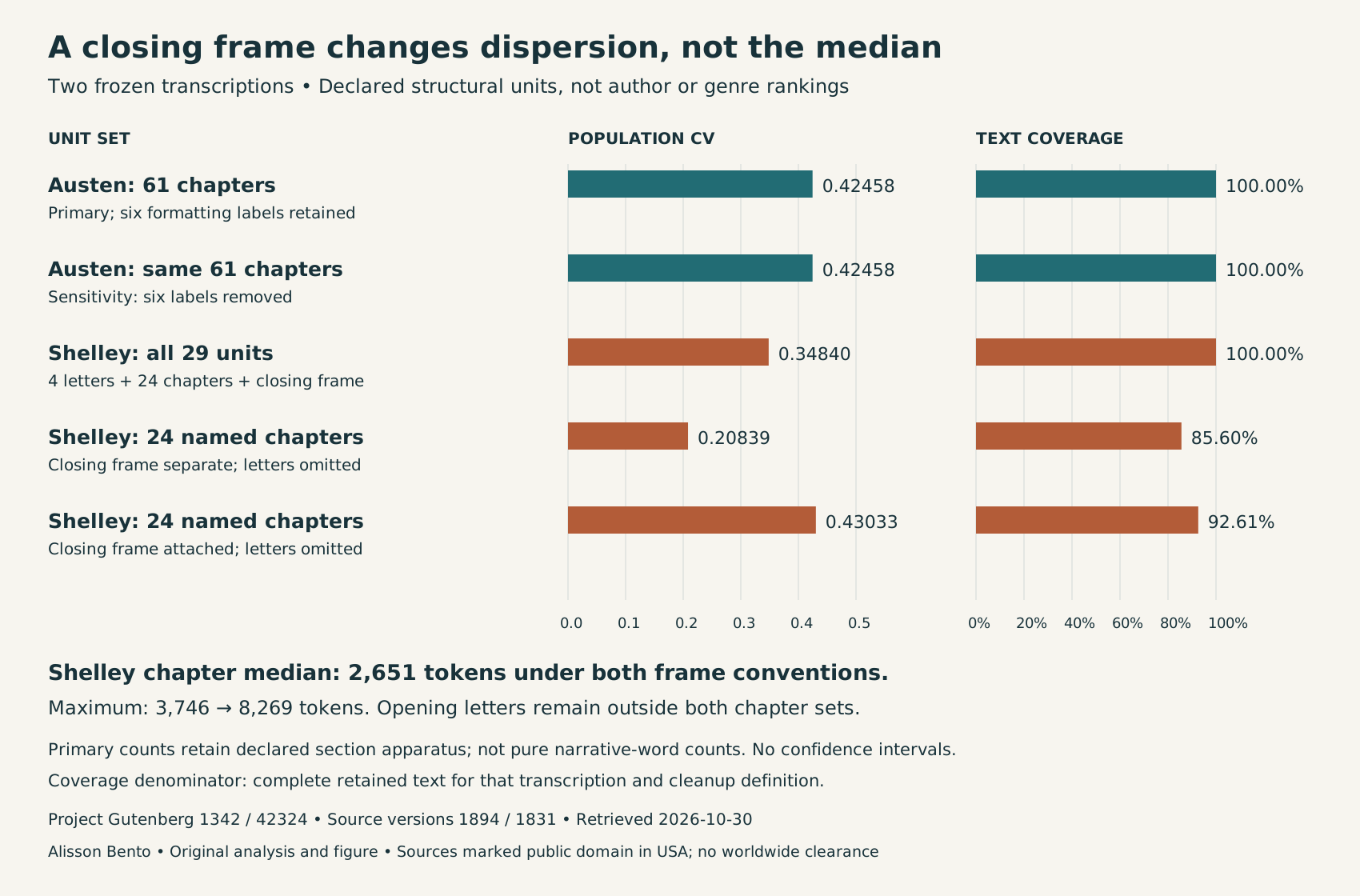
Scroll horizontally to inspect the chart. ↔
Chart and values
Scroll horizontally to see all columns.
| Unit set | Units | Tokens | Minimum | Q1 | Median | Q3 | Maximum | Population CV | Coverage (%) |
|---|---|---|---|---|---|---|---|---|---|
| Austen: 61 chapters (primary) | 61 | 122,174 | 676 | 1,563.0 | 1,835.0 | 2,335.0 | 5,188 | 0.42458 | 100.0000 |
| Austen: six labels removed | 61 | 122,168 | 676 | 1,563.0 | 1,835.0 | 2,335.0 | 5,188 | 0.42458 | 100.0000 |
| Shelley: all 29 structural units | 29 | 75,228 | 299 | 2,074.0 | 2,616.0 | 3,015.0 | 5,268 | 0.34840 | 100.0000 |
| Shelley: 24 chapters; frame separate | 24 | 64,397 | 1,784 | 2,223.0 | 2,651.0 | 3,038.0 | 3,746 | 0.20839 | 85.6024 |
| Shelley: 24 chapters; frame attached | 24 | 69,665 | 1,784 | 2,223.0 | 2,651.0 | 3,133.5 | 8,269 | 0.43033 | 92.6051 |
Tokens from fixed basic-Latin tokenizer, not pure narrative words. CV uses population SD. Coverage denominator is complete retained text for the same cleanup definition; no sampling intervals. Austen six-label row is a separate sensitivity, not replacement. Both Shelley chapter-only rows omit four opening letters.
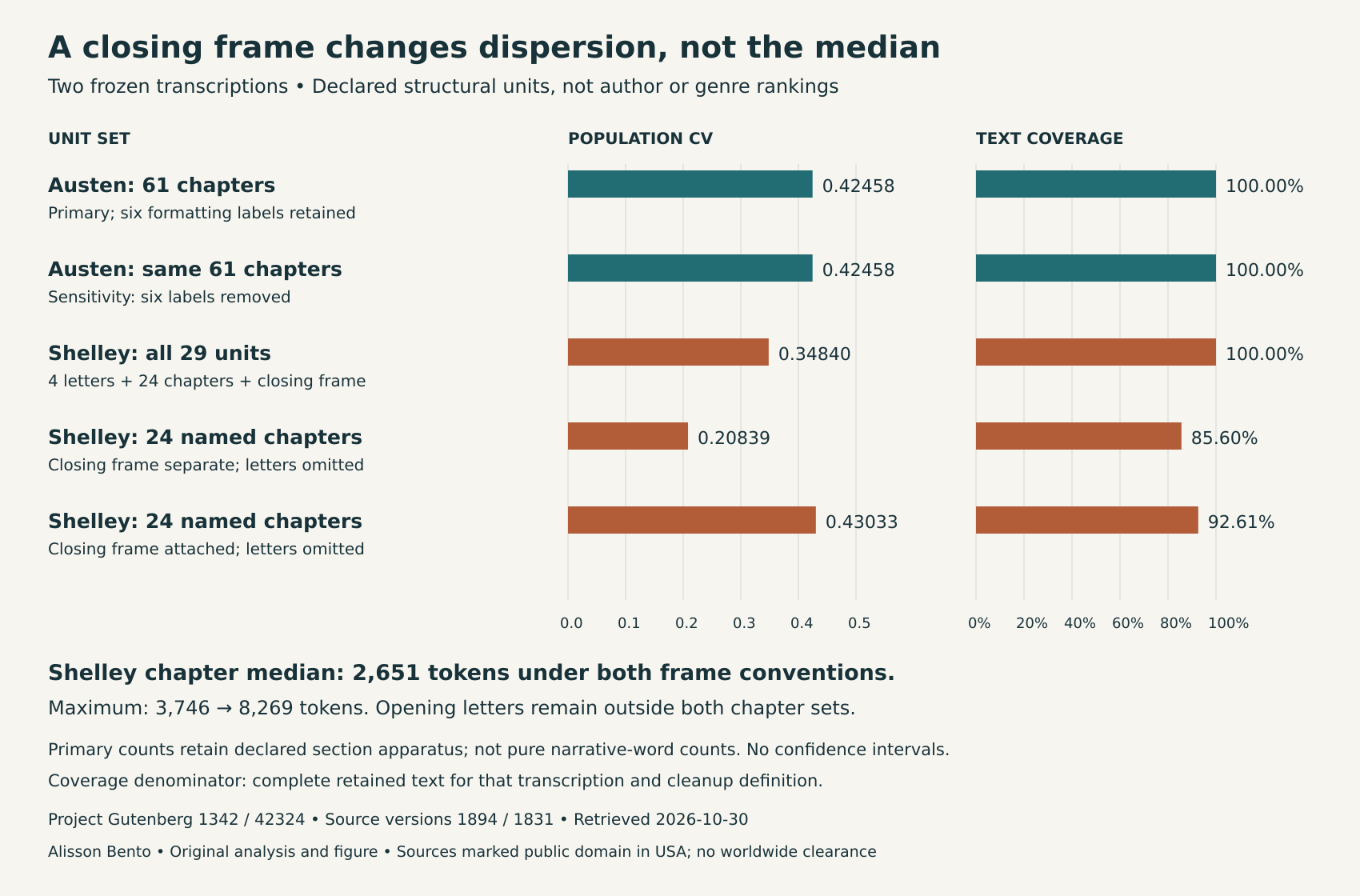
Data & downloads
Scroll horizontally to see all columns.
| Unit set | Units | Tokens | Minimum | Q1 | Median | Q3 | Maximum | Population CV | Coverage (%) |
|---|---|---|---|---|---|---|---|---|---|
| Austen: 61 chapters (primary) | 61 | 122,174 | 676 | 1,563.0 | 1,835.0 | 2,335.0 | 5,188 | 0.42458 | 100.0000 |
| Austen: six labels removed | 61 | 122,168 | 676 | 1,563.0 | 1,835.0 | 2,335.0 | 5,188 | 0.42458 | 100.0000 |
| Shelley: all 29 structural units | 29 | 75,228 | 299 | 2,074.0 | 2,616.0 | 3,015.0 | 5,268 | 0.34840 | 100.0000 |
| Shelley: 24 chapters; frame separate | 24 | 64,397 | 1,784 | 2,223.0 | 2,651.0 | 3,038.0 | 3,746 | 0.20839 | 85.6024 |
| Shelley: 24 chapters; frame attached | 24 | 69,665 | 1,784 | 2,223.0 | 2,651.0 | 3,133.5 | 8,269 | 0.43033 | 92.6051 |
Tokens from fixed basic-Latin tokenizer, not pure narrative words. CV uses population SD. Coverage denominator is complete retained text for the same cleanup definition; no sampling intervals. Austen six-label row is a separate sensitivity, not replacement. Both Shelley chapter-only rows omit four opening letters.
Scroll horizontally to see all columns.
| Component or set | Units | Tokens |
|---|---|---|
| Opening letters | 4 | 5,563 |
| Named chapters, frame separate | 24 | 64,397 |
| Closing Walton continuation | 1 | 5,268 |
| Complete partition | 29 | 75,228 |
| Named chapters, frame attached | 24 | 69,665 |
Closing frame is an explicit primary unit, not silently a chapter. Attached-frame chapter set still excludes opening letters.
Evidence & method
How we calculated it
- Fixed exact-hash corpus PG1342 and PG42324; section boundaries and tokenizer frozen before length calculations.
- 90 per-unit boundary observations, complete numbering checks, explicit opening/end anchors; no human-annotation gold-standard claim.
- Balanced illustration masking, numbered footnote exclusion, section apparatus retained; primary Austen includes six documented formatting labels.
- Inclusive interpolated quartiles and population CV; exhaustive, named-chapter and attached-frame sets use explicit coverage denominators.
- Aggregate-only default reproduction; optional raw exact-hash extraction; distinct implementation agrees on 90 per-unit counts and separate arithmetic checks cover all summary sets.
What the data cannot tell us
- Two purposive transcriptions cannot represent authors, genres, periods or populations; no population length relationship inferred.
- Token counts do not measure literary quality, taste, perceived pacing, engagement or reading time.
- Basic-Latin tokenizer and retained section apparatus prevent a pure narrative-word interpretation; six-label sensitivity is narrow, not complete cleanup.
- PG transcriptions are not guaranteed print facsimiles; Shelley photo-reprint identity unspecified.
- USA public-domain statements do not establish non-US rights, worldwide licence or source-text redistribution permission everywhere.
Original sources
- Project Gutenberg 1342: Pride and Prejudice
Project Gutenberg 1342: Pride and Prejudice: Frozen transcription title matter identifies George Allen 1894, Saintsbury preface and Thomson illustrations; added materials excluded. Official record marks public domain in USA. Raw header update September 1 differs from catalogue September 29, 2026; exact byte hash identifies input.
Accessed October 30, 2026
- Project Gutenberg 42324: Frankenstein
Project Gutenberg 42324: Frankenstein: 1831 H. Colburn/R. Bentley version via unspecified photo-reprint, not the 1818 version. Introduction excluded; reprint identity remains unspecified. Official record marks public domain in USA; header/catalogue update October 23, 2026.
Accessed October 30, 2026
- Project Gutenberg Permission How-to
Project Gutenberg Permission How-to: Explains non-US jurisdiction limits and warns transcriptions need not match a particular print edition. No universal rights clearance or endorsement inferred.
Accessed October 30, 2026
Cite & reuse this study
Alisson Bento. When a closing frame changes the chapter-length distribution. Structural measurement of Project Gutenberg transcriptions 1342 and 42324, retrieved October 30, 2026; source versions 1894 and 1831. https://alissonbento.com/research/chapter-frame-length-two-transcriptions/
Original analysis, calculations and explanation: Alisson Bento. Original novels: Jane Austen and Mary Wollstonecraft Shelley. Saintsbury preface and Thomson illustrations in Austen source excluded; Shelley source is 1831 via unspecified photo-reprint. Gutenberg items marked public domain in USA; no universal legal clearance or endorsement claimed. Compact derived data/code only, no full novels.
Corrections or editorial questions