
Before interpreting a new score, ask what changed
An editor can receive two readability reports for the same book and face an apparently simple decision: which number should guide the next revision? The useful first question is what each report actually counted. A passage sample, a complete transcription and a differently segmented set of sentences can produce different inputs to the same equation. A numerical difference therefore needs an explanation before it becomes a claim that writing improved, became more demanding or reached a different audience.
This study makes that reporting problem visible using six fixed English transcriptions of Austen’s novels. It connects reference annotation, automation of exactly the selected reference spans and automation of the full prepared text. The contribution is a reproducible comparison of formula outputs across those administrations. It neither evaluates commercial software nor tests people reading Austen. No participants, comprehension exercises or reader-age outcomes are part of the analysis.
The central finding is useful precisely because the novels were not revised between administrations. Every full-text Flesch envelope lies below its corresponding reference envelope, and every full-text SMOG envelope does too. A downward Flesch change conventionally points toward greater difficulty; a downward SMOG change conventionally points toward less difficulty. Those opposed conventions cannot turn these computations into evidence of either real outcome for readers.
Three administrations keep implementation and scope visible
N denotes the frozen source/reference annotations on preselected passages. The inherited scientific material records two separately completed annotation datasets, subsequently reconciled against their sources before the formula and whole-text results were calculated. The present execution verifies the supplied export bytes and their mathematical correspondence. That does not turn the annotation into a gold standard or a newly witnessed account of the earlier preparation process.
M applies the accepted automated counter to exactly N’s spans. It does not restart at those locations and select a fresh hundred machine-counted words. F uses the same automated counter over each complete prepared transcription. N→M consequently compares counting implementations with passage boundaries held fixed. M→F compares retained text scope under a fixed automated operator. N→F combines those differences. This arrangement supports descriptive accounting, rather than a causal estimate of a universal sampling effect.
Keeping the three labels separate also prevents a misleading shortcut. An automated result that resembles its reference counterpart on a few passages is not automatically portable to a whole book. Conversely, a whole-text result need not represent a corrected or superior version of a sample result. The administrations answer related computational questions with different inputs and, in some places, different operational sentence conventions.
The unit of evidence is an exact transcription, not a timeless novel
The six cases are Sense and Sensibility, Pride and Prejudice, Mansfield Park, Emma, Northanger Abbey and Persuasion, corresponding to Project Gutenberg items 161, 1342, 141, 158, 121 and 105. Original downloaded byte lengths and cryptographic fingerprints were checked before decoding. The specified preparation then produced matching retained-text fingerprints. This makes the application repeatable on the same files instead of relying on a title to identify interchangeable inputs.
The texts are not a controlled collection of Austen’s original printed typography. Physical edition bases differ or are incompletely identified. The acquired Pride and Prejudice names a George Allen 1894 basis; its preface and illustration material are excluded. The Northanger Abbey transcription reports substantial modernization of spelling and punctuation and names an incompletely identified Signet base. Those facts matter when an operator uses punctuation to identify sentences.
Preparation removes the declared front matter, named illustration or footnote blocks, standalone chapter or volume markers and specified formatting wrappers, while retaining their narrative contents where required. It does not silently repair spelling or replace an edition after seeing results. The findings therefore belong to these six prepared English transcriptions. They are not measurements of translated editions, all Austen editions or historical authorial style.
Flesch has two passage pools that must not be confused
The calculation uses the original Flesch Formula A: 206.835 minus 1.015 times words per sentence, minus 84.6 times syllables per word. For each reference transcription, twenty-five numerically selected paragraph starts anchor passages. The paragraph indices follow floor(k × (number of paragraphs − 1) / 25), for k from zero through twenty-four. This fixes a systematic scheme rather than asking someone to choose representative-looking prose.
Each first-hundred-reference-word passage contributes to the syllable pool, giving 2,500 weighted word occurrences per novel. Sentence length uses a separate span ending at the contextual thought-unit ending nearest the hundredth-word boundary, with an earlier-ending tie rule. Those spans can contain fewer or more than one hundred words. A sentence denominator taken from one pool and a word count taken from the other would create an unintended calculation.
Reference thought units may sometimes end at a colon or semicolon; conjunctions are not automatically treated as instructions to split. The automated counter instead uses its declared punctuation and protection rules. Overlapping selected spans retain their repeated weighting. The scheme is not a random sample and supplies no sampling confidence interval. Its value here is that the starts, endings, counts and repeated weighting remain explicit and reproducible.
Whole-text SMOG is an adaptation with a visible denominator
SMOG uses McLaughlin’s original expanded equation (d), 3.1291 + 1.0430 × square root of p. In the reference administration, p counts occurrences of words with at least three syllables across thirty selected complete printed sentences. Proper names and repeated words count as occurrences. The fixed design takes ten sentences near the beginning, ten beginning at the first eligible sentence start at or after the code-point midpoint, and the final ten sentences.
The automated counter processes those three exact blocks separately. It never invents a sentence by joining text across an omitted gap. Its punctuation proxies can nevertheless yield a different denominator from reference annotation. Pride and Prejudice and Emma each have thirty-one automated proxy sentences in the matched blocks, compared with thirty reference sentences. That is a real implementation difference, not permission to discard a sentence until the counts agree.
Automated administrations use the explicitly adapted substitution p* = 30P/S, where P is the polysyllabic occurrence count and S the proxy-sentence count. Full-text SMOG is always this density-normalized adaptation. It is not the original thirty-sentence administration or a new validation of the historical formula. The expanded equation is also kept distinct from the rounded-square-root shortcut; interchangeable names do not make those arithmetic operations identical.
Pronunciation alternatives are retained instead of quietly selected
A written word does not always have one dictionary syllable count. The exact CMU pronunciation resource used here contains alternative pronunciations, all of whose positive vowel-nucleus counts are retained. A fully resolved unlisted hyphen compound can use the sums of its listed components. Where pronunciation is absent or unresolved, automation uses the fixed transparent orthographic surrogate. That last rule is a computational fallback, not a verified pronunciation.
These alternatives generate conditional marginal envelopes. Flesch’s lower endpoint uses the highest retained syllable total because syllables enter with a negative coefficient. SMOG’s lower endpoint counts tokens whose every retained alternative has at least three syllables; its upper endpoint counts tokens with any such alternative. The range consequently preserves a particular source of ambiguity instead of concealing it behind one arbitrarily chosen dictionary entry.
An envelope is not a confidence interval, an accent distribution or an overall error bound. It does not cover unknown mistakes in the orthographic fallback, edition differences or all possible sentence interpretations. Nor does it assert that alternative pronunciations can be chosen independently with known probabilities. The CMU resource describes modern US pronunciation. It cannot certify how Austen, her contemporaries or a particular present-day reader would pronounce the text.
The outputs move even before a total order is considered
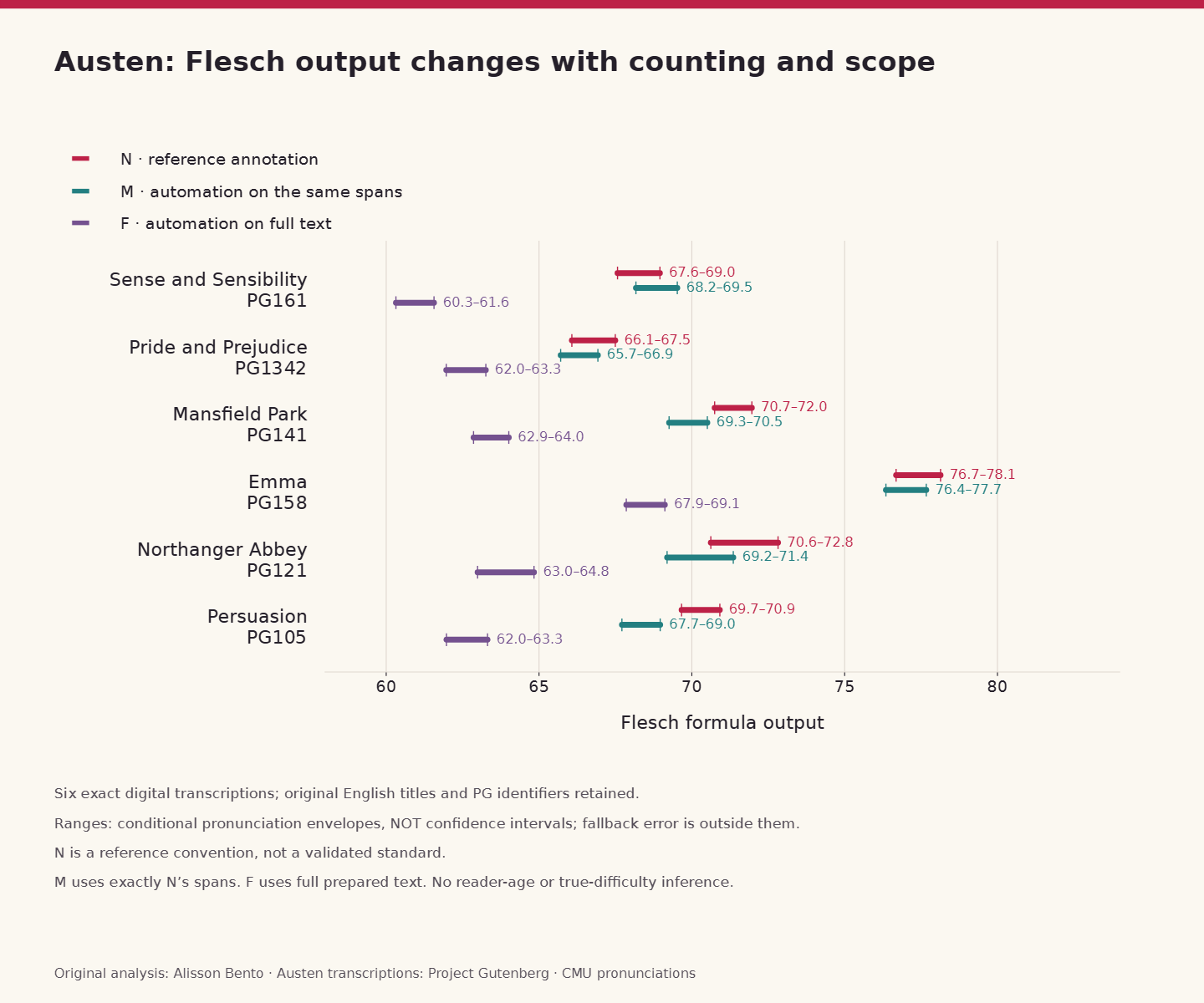
For Sense and Sensibility, the reference Flesch envelope is 67.57–68.96, matched automation gives 68.17–69.52, and full-text automation gives 60.32–61.56. For Pride and Prejudice, the corresponding ranges are 66.07–67.50, 65.71–66.93 and 61.96–63.26. These rounded displays are useful for inspection; the comparisons themselves use exact rational values, so a rounding coincidence cannot create a tie or erase a strict separation.
The remaining novels also show a lower full-text Flesch range: Mansfield Park 62.86–64.01, Emma 67.86–69.12, Northanger Abbey 62.99–64.84 and Persuasion 61.97–63.32. These are outputs of this specified formula and operator. A label about a child’s age, a class level or the suitability of a particular reader would add an outcome this application never measured.
SMOG also decreases between reference and full-text administrations in every case. Northanger Abbey changes from 15.11–15.90 to 11.11–11.68; Persuasion changes from 15.51–15.82 to 11.55–11.84. The two formulas have different units and conventional orientations. Their numbers must be inspected separately rather than subtracted from each other, averaged into a combined score or presented as votes about a reader’s actual comprehension.
A pair comparison can reverse while the books remain untouched
Six cases provide fifteen unordered pairs within one formula and administration. Across two formulas and three administrations, the complete comparison set contains ninety cells. This is a finite set of related file comparisons, not ninety independent experiments with people. A strict order is recorded only when one complete envelope lies beyond the other. That rule avoids choosing a convenient midpoint and treating its rank as certain.
Sense and Sensibility and Pride and Prejudice provide a concrete Flesch example. Under reference counting, the former’s 67.57–68.96 envelope lies above the latter’s 66.07–67.50 envelope. Under full-text counting, Sense and Sensibility’s 60.32–61.56 lies below Pride and Prejudice’s 61.96–63.26. The strict order reverses within the Flesch output scale. Neither an editorial revision nor a measured change in reader performance occurred.
There are no strict reversals from N to M for either formula, but that does not establish equivalent scores or invariant comparisons: relations can move between strict and unresolved. From M to F, there is one strict Flesch reversal and two SMOG reversals. From N to F, there is one Flesch reversal and three SMOG reversals. The latter involve Sense and Sensibility paired with Pride and Prejudice, Northanger Abbey and Persuasion.
Unresolved is a result, rather than an invitation to force a ranking
In full-text administration, six of the fifteen pair relations remain unresolved within each formula. Their conditional envelopes overlap or touch without collapsing to the same exact single value. Calling these pairs tied would claim equality that has not been established. Giving them different ranks because their displayed central values differ would remove the uncertainty convention that the analysis deliberately retained.
The distinction is practical for anyone preparing a comparison table. A partial ordering can identify some separated outputs while leaving other comparisons open. It can also show when a conclusion depends on the counting administration. A total list from first to sixth is visually simple, but its simplicity would come from an extra ranking rule rather than from complete separation of the evidence.
There are no actual exact ties in this calculation. That does not mean every pair is distinguishable. Exact ties, strict orders and unresolved relations are different categories, each with a declared arithmetic definition. Reporting their counts makes the result assessable without suggesting that the formulas have ranked the novels’ literary quality, emotional complexity, educational usefulness or commercial potential.
Feature accounting explains a score change without inventing a cause
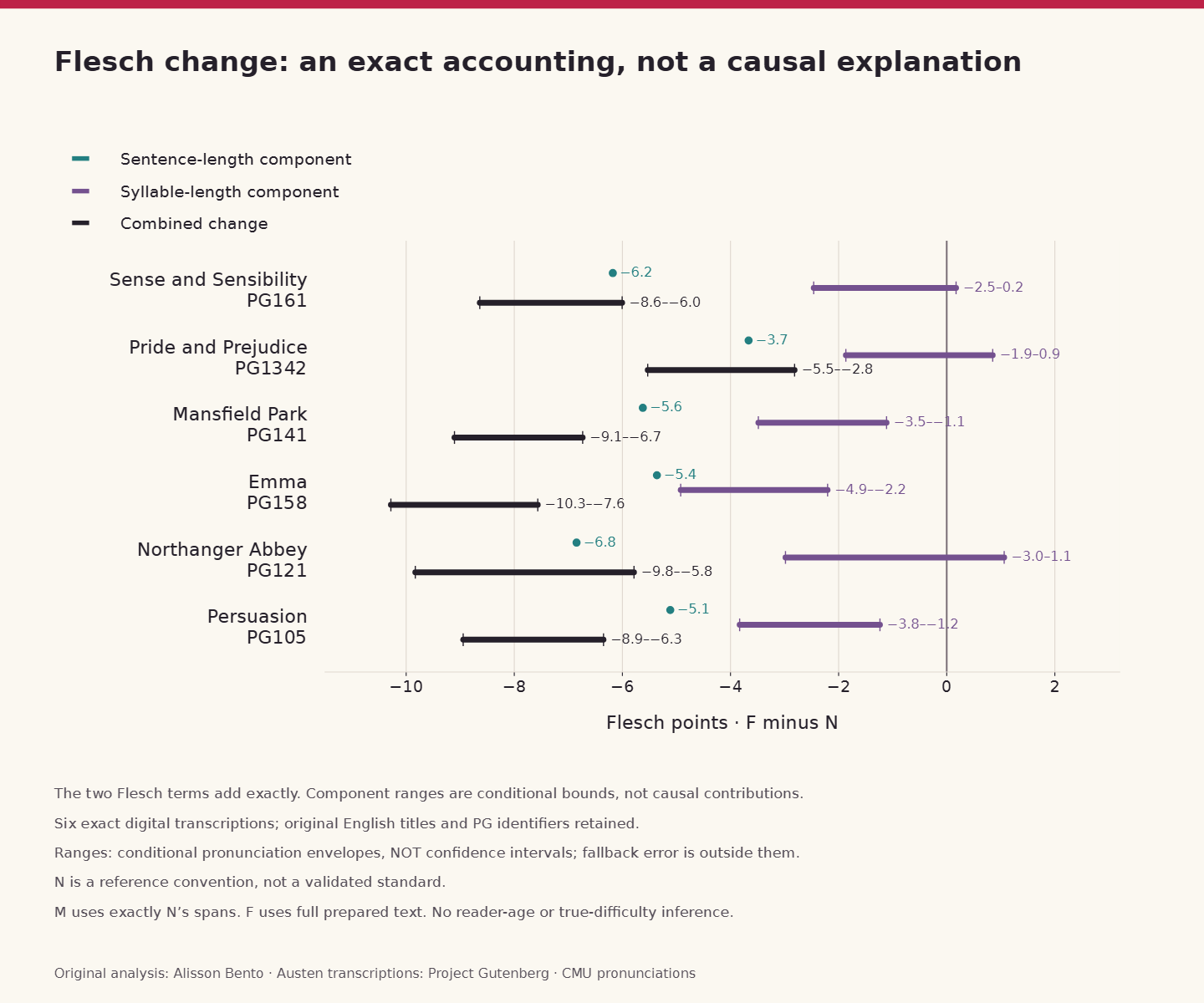
Flesch offers a transparent accounting identity: its change can be separated into the words-per-sentence contribution and the syllables-per-word contribution. The downloadable calculation preserves those exact terms and their pronunciation envelopes. This explains which numerical inputs contribute to a reported movement. It is not a causal claim about how readers respond to long sentences, nor a discovery that the formula is linear in its two inputs.
For Sense and Sensibility, the reference thought-unit average is about 16.92 words, compared with approximately 23.00 words per automated proxy sentence over the full prepared text. Emma changes from about 13.24 to 18.52 under the respective administrations. These averages use different retained scopes and operational sentence units. It would be misleading to describe them as a measured change in Austen’s prose, which was not rewritten between calculations.
The full graphic-word counts range from 77,259 in Northanger Abbey to 160,300 in Emma. Those larger retained pools are not automatically more accurate measurements of readability. They are more extensive counts under the declared machine convention. Separating the accounting terms and exposing the denominators gives editors a better diagnostic than an unexplained final score, while keeping the interpretation inside what the computation establishes.
Small fallback shares still belong in the report
Full-text automation records 1,335 fallback occurrences for Sense and Sensibility, 1,535 for Pride and Prejudice, 1,747 for Mansfield Park, 2,249 for Emma, 833 for Northanger Abbey and 1,015 for Persuasion. Relative to the corresponding graphic-word denominators, these are approximately 1.08%–1.40%. They are occurrence counts, not counts of distinct unfamiliar vocabulary, and repetition can contribute repeatedly.
A small percentage does not demonstrate negligible score error. The fallback’s unknown mistakes are outside the displayed pronunciation envelopes, and no accuracy audit against human pronunciation is supplied. The observed complete texts have no zero-nucleus or unterminated-tail flags under the specified checks. Those successful checks establish properties of these runs, not a guarantee that the operator accepts every novel, symbol or number correctly.
The operator has explicit handling for accepted numerals, abbreviations and a narrow visible-year elision convention. Unsupported shapes stop rather than silently disappearing from counts. An omitted year prefix is not reconstructed as a historical date or treated as known speech. Such details are rarely visible in a headline score, yet they determine what the numerator and denominator mean when someone attempts to reproduce it.
A reporting worksheet for editors, authors and libraries
Before comparing reports, record the exact transcription or edition and the retained text boundaries. Note whether front matter, correspondence, verse, footnotes and chapter markers are included. Then identify the formula variant, word definition, sentence convention, pronunciation resource and treatment of missing entries. A title and the phrase readability score are not enough to establish comparable inputs.
Next record the sampling or scope design. If the calculation uses selected passages, preserve their coordinates, selection rule and any overlapping weighting. If it uses complete text, say so. Identify whether the score is an adapted density-normalized use of a sampled formula. Keep separate denominators separate, and explain any uncertainty range in ordinary language. A confidence interval, a retained pronunciation envelope and an unknown fallback error are different things.
Finally, state the decision that the report can support. Here it supports checking whether a numerical comparison survives a declared change in implementation or scope. It supplies no tested recommendation to shorten sentences, choose a reading age, rewrite a novel for a market or predict KDP conversion. Readability metrics can be documented and compared carefully while the much broader questions of reader experience, narrative craft and comprehension remain open.
Austen: Flesch output changes with counting and scope
Flesch formula output
Full chart and source

Scroll horizontally to inspect the chart. ↔
Chart and values
Scroll horizontally to see all columns.
| English source title | PG ID | Administration | Lower formula output (6 decimals) | Upper formula output (6 decimals) | Exact lower Flesch fraction | Exact upper Flesch fraction | Words per sentence (6 decimals) | Lower syllables per word (6 decimals) | Upper syllables per word (6 decimals) | Words in syllable pool | Words in sentence pool | Sentence/thought-unit count |
|---|---|---|---|---|---|---|---|---|---|---|---|---|
| Sense and Sensibility | 161 | N | 67.568705 | 68.956145 | 61656443/912500 | 31461241/456250 | 16.917808 | 1.426800 | 1.443200 | 2500 | 2470 | 146 |
| Sense and Sensibility | 161 | M | 68.171140 | 69.524740 | 257346053/3775000 | 262455893/3775000 | 16.357616 | 1.426800 | 1.442800 | 2500 | 2470 | 151 |
| Sense and Sensibility | 161 | F | 60.318130 | 61.564320 | 14259994359/236413072 | 14554609911/236413072 | 23.003658 | 1.441158 | 1.455888 | 119481 | 119481 | 5194 |
| Pride and Prejudice | 1342 | N | 66.074520 | 67.495800 | 1651863/25000 | 337479/5000 | 17.089655 | 1.442000 | 1.458800 | 2500 | 2478 | 145 |
| Pride and Prejudice | 1342 | M | 65.708055 | 66.926295 | 58315899/887500 | 59397087/887500 | 17.450704 | 1.444400 | 1.458800 | 2500 | 2478 | 142 |
| Pride and Prejudice | 1342 | F | 61.964318 | 63.259938 | 222195921277/3585868920 | 45368369405/717173784 | 20.700646 | 1.448746 | 1.464061 | 121844 | 121844 | 5886 |
| Mansfield Park | 141 | N | 70.746224 | 71.964464 | 245843127/3475000 | 250076511/3475000 | 17.654676 | 1.382400 | 1.396800 | 2500 | 2454 | 139 |
| Mansfield Park | 141 | M | 69.255595 | 70.507675 | 14889953/215000 | 75795751/1075000 | 19.023256 | 1.383200 | 1.398000 | 2500 | 2454 | 129 |
| Mansfield Park | 141 | F | 62.857988 | 64.011420 | 2771574980327/44092645200 | 2822432845607/44092645200 | 23.193357 | 1.409957 | 1.423590 | 159895 | 159895 | 6894 |
| Emma | 158 | N | 76.683123 | 78.138243 | 88185591/1150000 | 89858979/1150000 | 13.239130 | 1.362400 | 1.379600 | 2500 | 2436 | 184 |
| Emma | 158 | M | 76.350667 | 77.670427 | 57263/750 | 2912641/37500 | 13.533333 | 1.364400 | 1.380000 | 2500 | 2436 | 180 |
| Emma | 158 | F | 67.855544 | 69.117947 | 188285087587/2774793000 | 191787994579/2774793000 | 18.521086 | 1.405652 | 1.420574 | 160300 | 160300 | 8655 |
| Northanger Abbey | 121 | N | 70.621219 | 72.820819 | 144773499/2050000 | 149282679/2050000 | 14.743902 | 1.407200 | 1.433200 | 2500 | 2418 | 164 |
| Northanger Abbey | 121 | M | 69.190640 | 71.356400 | 864883/12500 | 178391/2500 | 16.120000 | 1.408000 | 1.433600 | 2500 | 2418 | 150 |
| Northanger Abbey | 121 | F | 62.989861 | 64.836061 | 291586475991/4629101750 | 300132725691/4629101750 | 21.490682 | 1.420637 | 1.442460 | 77259 | 77259 | 3595 |
| Persuasion | 105 | N | 69.664436 | 70.916516 | 249050359/3575000 | 50705309/715000 | 17.720280 | 1.394000 | 1.408800 | 2500 | 2534 | 143 |
| Persuasion | 105 | M | 67.712458 | 68.964538 | 218372677/3225000 | 44482127/645000 | 19.643411 | 1.394000 | 1.408800 | 2500 | 2534 | 129 |
| Persuasion | 105 | F | 61.971489 | 63.315185 | 3778612650313/60973404000 | 3860542335913/60973404000 | 22.758743 | 1.423401 | 1.439284 | 83297 | 83297 | 3660 |
Six exact English transcriptions; N = reference conventions, M = automated counting of the exact same spans, F = automated full transcription. Conditional pronunciation envelopes are not confidence intervals or accuracy bounds; surrogate errors and edition differences are outside them. Decimal displays use six places; exact rational endpoints or densities and full-precision downloads remain available. No reader ages, comprehension or validated difficulty are inferred.
Austen: SMOG output changes with counting and scope
SMOG expanded (d) output · adapted for M/F
Full chart and source

Scroll horizontally to inspect the chart. ↔
Chart and values
Scroll horizontally to see all columns.
| English source title | PG ID | Administration | Lower expanded(d) output (6 decimals) | Upper expanded(d) output (6 decimals) | Exact lower 30P/S | Exact upper 30P/S | Lower occurrences with at least 3 syllables | Upper occurrences with at least 3 syllables | Printed/proxy sentences |
|---|---|---|---|---|---|---|---|---|---|
| Sense and Sensibility | 161 | N | 13.187428 | 13.765655 | 93/1 | 104/1 | 93 | 104 | 30 |
| Sense and Sensibility | 161 | M | 13.241360 | 13.816670 | 94/1 | 105/1 | 94 | 105 | 30 |
| Sense and Sensibility | 161 | F | 11.933836 | 12.247594 | 185070/2597 | 198495/2597 | 12338 | 13233 | 5194 |
| Pride and Prejudice | 1342 | N | 13.867442 | 14.068176 | 106/1 | 110/1 | 106 | 110 | 30 |
| Pride and Prejudice | 1342 | M | 13.742535 | 13.890293 | 3210/31 | 3300/31 | 107 | 110 | 31 |
| Pride and Prejudice | 1342 | F | 11.453541 | 11.729060 | 20830/327 | 66695/981 | 12498 | 13339 | 5886 |
| Mansfield Park | 141 | N | 13.241360 | 13.867442 | 94/1 | 106/1 | 94 | 106 | 30 |
| Mansfield Park | 141 | M | 13.187428 | 13.765655 | 93/1 | 104/1 | 93 | 104 | 30 |
| Mansfield Park | 141 | F | 11.295852 | 11.563891 | 70445/1149 | 75145/1149 | 14089 | 15029 | 6894 |
| Emma | 158 | N | 12.801484 | 12.913307 | 86/1 | 88/1 | 86 | 88 | 30 |
| Emma | 158 | M | 12.644199 | 12.754204 | 2580/31 | 2640/31 | 86 | 88 | 31 |
| Emma | 158 | F | 10.201471 | 10.484001 | 26530/577 | 28692/577 | 13265 | 14346 | 8655 |
| Northanger Abbey | 121 | N | 15.112258 | 15.903189 | 132/1 | 150/1 | 132 | 150 | 30 |
| Northanger Abbey | 121 | M | 15.202698 | 15.988068 | 134/1 | 152/1 | 134 | 152 | 30 |
| Northanger Abbey | 121 | F | 11.113767 | 11.680324 | 42138/719 | 48330/719 | 7023 | 8055 | 3595 |
| Persuasion | 105 | N | 15.514039 | 15.817743 | 141/1 | 148/1 | 141 | 148 | 30 |
| Persuasion | 105 | M | 15.425889 | 15.731717 | 139/1 | 146/1 | 139 | 146 | 30 |
| Persuasion | 105 | F | 11.553926 | 11.835004 | 3980/61 | 4250/61 | 7960 | 8500 | 3660 |
Six exact English transcriptions; N = reference conventions, M = automated counting of the exact same spans, F = automated full transcription. Conditional pronunciation envelopes are not confidence intervals or accuracy bounds; surrogate errors and edition differences are outside them. Decimal displays use six places; exact rational endpoints or densities and full-precision downloads remain available. No reader ages, comprehension or validated difficulty are inferred.

Some pairwise orders change; others become unresolved
Pairs of the six fixed transcriptions (15 per row)
Full chart and source

Scroll horizontally to inspect the chart. ↔
Chart and values
Scroll horizontally to see all columns.
| Formula | Transition | Same strict order | Strict reversal | Strict to unresolved | Unresolved to strict | Unresolved in both | Total unordered pairs |
|---|---|---|---|---|---|---|---|
| Flesch | N->M | 9 | 0 | 3 | 2 | 1 | 15 |
| Flesch | M->F | 5 | 1 | 5 | 3 | 1 | 15 |
| Flesch | N->F | 8 | 1 | 3 | 0 | 3 | 15 |
| SMOG | N->M | 11 | 0 | 1 | 0 | 3 | 15 |
| SMOG | M->F | 5 | 2 | 4 | 2 | 2 | 15 |
| SMOG | N->F | 5 | 3 | 4 | 1 | 2 | 15 |
Six exact English transcriptions; N = reference conventions, M = automated counting of the exact same spans, F = automated full transcription. Conditional pronunciation envelopes are not confidence intervals or accuracy bounds; surrogate errors and edition differences are outside them. Decimal displays use six places; exact rational endpoints or densities and full-precision downloads remain available. No reader ages, comprehension or validated difficulty are inferred.

Flesch change: an exact accounting, not a causal explanation
Flesch points · F minus N
Full chart and source

Scroll horizontally to inspect the chart. ↔
Chart and values
Scroll horizontally to see all columns.
| English source title | PG ID | Sentence component | Lower syllable component | Upper syllable component | Lower total change | Upper total change |
|---|---|---|---|---|---|---|
| Sense and Sensibility | 161 | −6.177138 | −2.460877 | 0.172752 | −8.638015 | −6.004385 |
| Pride and Prejudice | 1342 | −3.665155 | −1.866327 | 0.850574 | −5.531482 | −2.814582 |
| Mansfield Park | 141 | −5.621760 | −3.484715 | −1.113043 | −9.106475 | −6.734803 |
| Emma | 158 | −5.361185 | −4.921514 | −2.203991 | −10.282699 | −7.565176 |
| Northanger Abbey | 121 | −6.847981 | −2.982977 | 1.062823 | −9.830958 | −5.785158 |
| Persuasion | 105 | −5.114040 | −3.830986 | −1.235211 | −8.945027 | −6.349251 |
Six exact English transcriptions; N = reference conventions, M = automated counting of the exact same spans, F = automated full transcription. Conditional pronunciation envelopes are not confidence intervals or accuracy bounds; surrogate errors and edition differences are outside them. Decimal displays use six places; exact rational endpoints or densities and full-precision downloads remain available. No reader ages, comprehension or validated difficulty are inferred.
Data & downloads
Scroll horizontally to see all columns.
| English source title | PG ID | Administration | Lower formula output (6 decimals) | Upper formula output (6 decimals) | Exact lower Flesch fraction | Exact upper Flesch fraction | Words per sentence (6 decimals) | Lower syllables per word (6 decimals) | Upper syllables per word (6 decimals) | Words in syllable pool | Words in sentence pool | Sentence/thought-unit count |
|---|---|---|---|---|---|---|---|---|---|---|---|---|
| Sense and Sensibility | 161 | N | 67.568705 | 68.956145 | 61656443/912500 | 31461241/456250 | 16.917808 | 1.426800 | 1.443200 | 2500 | 2470 | 146 |
| Sense and Sensibility | 161 | M | 68.171140 | 69.524740 | 257346053/3775000 | 262455893/3775000 | 16.357616 | 1.426800 | 1.442800 | 2500 | 2470 | 151 |
| Sense and Sensibility | 161 | F | 60.318130 | 61.564320 | 14259994359/236413072 | 14554609911/236413072 | 23.003658 | 1.441158 | 1.455888 | 119481 | 119481 | 5194 |
| Pride and Prejudice | 1342 | N | 66.074520 | 67.495800 | 1651863/25000 | 337479/5000 | 17.089655 | 1.442000 | 1.458800 | 2500 | 2478 | 145 |
| Pride and Prejudice | 1342 | M | 65.708055 | 66.926295 | 58315899/887500 | 59397087/887500 | 17.450704 | 1.444400 | 1.458800 | 2500 | 2478 | 142 |
| Pride and Prejudice | 1342 | F | 61.964318 | 63.259938 | 222195921277/3585868920 | 45368369405/717173784 | 20.700646 | 1.448746 | 1.464061 | 121844 | 121844 | 5886 |
| Mansfield Park | 141 | N | 70.746224 | 71.964464 | 245843127/3475000 | 250076511/3475000 | 17.654676 | 1.382400 | 1.396800 | 2500 | 2454 | 139 |
| Mansfield Park | 141 | M | 69.255595 | 70.507675 | 14889953/215000 | 75795751/1075000 | 19.023256 | 1.383200 | 1.398000 | 2500 | 2454 | 129 |
| Mansfield Park | 141 | F | 62.857988 | 64.011420 | 2771574980327/44092645200 | 2822432845607/44092645200 | 23.193357 | 1.409957 | 1.423590 | 159895 | 159895 | 6894 |
| Emma | 158 | N | 76.683123 | 78.138243 | 88185591/1150000 | 89858979/1150000 | 13.239130 | 1.362400 | 1.379600 | 2500 | 2436 | 184 |
| Emma | 158 | M | 76.350667 | 77.670427 | 57263/750 | 2912641/37500 | 13.533333 | 1.364400 | 1.380000 | 2500 | 2436 | 180 |
| Emma | 158 | F | 67.855544 | 69.117947 | 188285087587/2774793000 | 191787994579/2774793000 | 18.521086 | 1.405652 | 1.420574 | 160300 | 160300 | 8655 |
| Northanger Abbey | 121 | N | 70.621219 | 72.820819 | 144773499/2050000 | 149282679/2050000 | 14.743902 | 1.407200 | 1.433200 | 2500 | 2418 | 164 |
| Northanger Abbey | 121 | M | 69.190640 | 71.356400 | 864883/12500 | 178391/2500 | 16.120000 | 1.408000 | 1.433600 | 2500 | 2418 | 150 |
| Northanger Abbey | 121 | F | 62.989861 | 64.836061 | 291586475991/4629101750 | 300132725691/4629101750 | 21.490682 | 1.420637 | 1.442460 | 77259 | 77259 | 3595 |
| Persuasion | 105 | N | 69.664436 | 70.916516 | 249050359/3575000 | 50705309/715000 | 17.720280 | 1.394000 | 1.408800 | 2500 | 2534 | 143 |
| Persuasion | 105 | M | 67.712458 | 68.964538 | 218372677/3225000 | 44482127/645000 | 19.643411 | 1.394000 | 1.408800 | 2500 | 2534 | 129 |
| Persuasion | 105 | F | 61.971489 | 63.315185 | 3778612650313/60973404000 | 3860542335913/60973404000 | 22.758743 | 1.423401 | 1.439284 | 83297 | 83297 | 3660 |
Six exact English transcriptions; N = reference conventions, M = automated counting of the exact same spans, F = automated full transcription. Conditional pronunciation envelopes are not confidence intervals or accuracy bounds; surrogate errors and edition differences are outside them. Decimal displays use six places; exact rational endpoints or densities and full-precision downloads remain available. No reader ages, comprehension or validated difficulty are inferred.
Scroll horizontally to see all columns.
| English source title | PG ID | Administration | Lower expanded(d) output (6 decimals) | Upper expanded(d) output (6 decimals) | Exact lower 30P/S | Exact upper 30P/S | Lower occurrences with at least 3 syllables | Upper occurrences with at least 3 syllables | Printed/proxy sentences |
|---|---|---|---|---|---|---|---|---|---|
| Sense and Sensibility | 161 | N | 13.187428 | 13.765655 | 93/1 | 104/1 | 93 | 104 | 30 |
| Sense and Sensibility | 161 | M | 13.241360 | 13.816670 | 94/1 | 105/1 | 94 | 105 | 30 |
| Sense and Sensibility | 161 | F | 11.933836 | 12.247594 | 185070/2597 | 198495/2597 | 12338 | 13233 | 5194 |
| Pride and Prejudice | 1342 | N | 13.867442 | 14.068176 | 106/1 | 110/1 | 106 | 110 | 30 |
| Pride and Prejudice | 1342 | M | 13.742535 | 13.890293 | 3210/31 | 3300/31 | 107 | 110 | 31 |
| Pride and Prejudice | 1342 | F | 11.453541 | 11.729060 | 20830/327 | 66695/981 | 12498 | 13339 | 5886 |
| Mansfield Park | 141 | N | 13.241360 | 13.867442 | 94/1 | 106/1 | 94 | 106 | 30 |
| Mansfield Park | 141 | M | 13.187428 | 13.765655 | 93/1 | 104/1 | 93 | 104 | 30 |
| Mansfield Park | 141 | F | 11.295852 | 11.563891 | 70445/1149 | 75145/1149 | 14089 | 15029 | 6894 |
| Emma | 158 | N | 12.801484 | 12.913307 | 86/1 | 88/1 | 86 | 88 | 30 |
| Emma | 158 | M | 12.644199 | 12.754204 | 2580/31 | 2640/31 | 86 | 88 | 31 |
| Emma | 158 | F | 10.201471 | 10.484001 | 26530/577 | 28692/577 | 13265 | 14346 | 8655 |
| Northanger Abbey | 121 | N | 15.112258 | 15.903189 | 132/1 | 150/1 | 132 | 150 | 30 |
| Northanger Abbey | 121 | M | 15.202698 | 15.988068 | 134/1 | 152/1 | 134 | 152 | 30 |
| Northanger Abbey | 121 | F | 11.113767 | 11.680324 | 42138/719 | 48330/719 | 7023 | 8055 | 3595 |
| Persuasion | 105 | N | 15.514039 | 15.817743 | 141/1 | 148/1 | 141 | 148 | 30 |
| Persuasion | 105 | M | 15.425889 | 15.731717 | 139/1 | 146/1 | 139 | 146 | 30 |
| Persuasion | 105 | F | 11.553926 | 11.835004 | 3980/61 | 4250/61 | 7960 | 8500 | 3660 |
Six exact English transcriptions; N = reference conventions, M = automated counting of the exact same spans, F = automated full transcription. Conditional pronunciation envelopes are not confidence intervals or accuracy bounds; surrogate errors and edition differences are outside them. Decimal displays use six places; exact rational endpoints or densities and full-precision downloads remain available. No reader ages, comprehension or validated difficulty are inferred.
Scroll horizontally to see all columns.
| Formula | Transition | Same strict order | Strict reversal | Strict to unresolved | Unresolved to strict | Unresolved in both | Total unordered pairs |
|---|---|---|---|---|---|---|---|
| Flesch | N->M | 9 | 0 | 3 | 2 | 1 | 15 |
| Flesch | M->F | 5 | 1 | 5 | 3 | 1 | 15 |
| Flesch | N->F | 8 | 1 | 3 | 0 | 3 | 15 |
| SMOG | N->M | 11 | 0 | 1 | 0 | 3 | 15 |
| SMOG | M->F | 5 | 2 | 4 | 2 | 2 | 15 |
| SMOG | N->F | 5 | 3 | 4 | 1 | 2 | 15 |
Six exact English transcriptions; N = reference conventions, M = automated counting of the exact same spans, F = automated full transcription. Conditional pronunciation envelopes are not confidence intervals or accuracy bounds; surrogate errors and edition differences are outside them. Decimal displays use six places; exact rational endpoints or densities and full-precision downloads remain available. No reader ages, comprehension or validated difficulty are inferred.
Scroll horizontally to see all columns.
| English source title | PG ID | Sentence component | Lower syllable component | Upper syllable component | Lower total change | Upper total change |
|---|---|---|---|---|---|---|
| Sense and Sensibility | 161 | −6.177138 | −2.460877 | 0.172752 | −8.638015 | −6.004385 |
| Pride and Prejudice | 1342 | −3.665155 | −1.866327 | 0.850574 | −5.531482 | −2.814582 |
| Mansfield Park | 141 | −5.621760 | −3.484715 | −1.113043 | −9.106475 | −6.734803 |
| Emma | 158 | −5.361185 | −4.921514 | −2.203991 | −10.282699 | −7.565176 |
| Northanger Abbey | 121 | −6.847981 | −2.982977 | 1.062823 | −9.830958 | −5.785158 |
| Persuasion | 105 | −5.114040 | −3.830986 | −1.235211 | −8.945027 | −6.349251 |
Six exact English transcriptions; N = reference conventions, M = automated counting of the exact same spans, F = automated full transcription. Conditional pronunciation envelopes are not confidence intervals or accuracy bounds; surrogate errors and edition differences are outside them. Decimal displays use six places; exact rational endpoints or densities and full-precision downloads remain available. No reader ages, comprehension or validated difficulty are inferred.
Scroll horizontally to see all columns.
| English source title | PG ID | Graphic words | Proxy sentences | Fallback occurrences | Fallback percent of graphic words | Zero-nucleus occurrences | Unterminated tails |
|---|---|---|---|---|---|---|---|
| Sense and Sensibility | 161 | 119481 | 5194 | 1335 | 1.117332 | 0 | 0 |
| Pride and Prejudice | 1342 | 121844 | 5886 | 1535 | 1.259808 | 0 | 0 |
| Mansfield Park | 141 | 159895 | 6894 | 1747 | 1.092592 | 0 | 0 |
| Emma | 158 | 160300 | 8655 | 2249 | 1.402994 | 0 | 0 |
| Northanger Abbey | 121 | 77259 | 3595 | 833 | 1.078192 | 0 | 0 |
| Persuasion | 105 | 83297 | 3660 | 1015 | 1.218531 | 0 | 0 |
Six exact English transcriptions; N = reference conventions, M = automated counting of the exact same spans, F = automated full transcription. Conditional pronunciation envelopes are not confidence intervals or accuracy bounds; surrogate errors and edition differences are outside them. Decimal displays use six places; exact rational endpoints or densities and full-precision downloads remain available. No reader ages, comprehension or validated difficulty are inferred.
Scroll horizontally to see all columns.
| Left English source title | Right English source title | Formula | Administration | Raw formula-output relation | Relation with conventional orientation |
|---|---|---|---|---|---|
| Sense and Sensibility | Pride and Prejudice | Flesch | N | Above | Below |
| Sense and Sensibility | Pride and Prejudice | Flesch | M | Above | Below |
| Sense and Sensibility | Pride and Prejudice | Flesch | F | Below | Above |
| Sense and Sensibility | Pride and Prejudice | SMOG | N | Below | Below |
| Sense and Sensibility | Pride and Prejudice | SMOG | M | Unresolved | Unresolved |
| Sense and Sensibility | Pride and Prejudice | SMOG | F | Above | Above |
| Sense and Sensibility | Mansfield Park | Flesch | N | Below | Above |
| Sense and Sensibility | Mansfield Park | Flesch | M | Unresolved | Unresolved |
| Sense and Sensibility | Mansfield Park | Flesch | F | Below | Above |
| Sense and Sensibility | Mansfield Park | SMOG | N | Unresolved | Unresolved |
| Sense and Sensibility | Mansfield Park | SMOG | M | Unresolved | Unresolved |
| Sense and Sensibility | Mansfield Park | SMOG | F | Above | Above |
| Sense and Sensibility | Emma | Flesch | N | Below | Above |
| Sense and Sensibility | Emma | Flesch | M | Below | Above |
| Sense and Sensibility | Emma | Flesch | F | Below | Above |
| Sense and Sensibility | Emma | SMOG | N | Above | Above |
| Sense and Sensibility | Emma | SMOG | M | Above | Above |
| Sense and Sensibility | Emma | SMOG | F | Above | Above |
| Sense and Sensibility | Northanger Abbey | Flesch | N | Below | Above |
| Sense and Sensibility | Northanger Abbey | Flesch | M | Unresolved | Unresolved |
| Sense and Sensibility | Northanger Abbey | Flesch | F | Below | Above |
| Sense and Sensibility | Northanger Abbey | SMOG | N | Below | Below |
| Sense and Sensibility | Northanger Abbey | SMOG | M | Below | Below |
| Sense and Sensibility | Northanger Abbey | SMOG | F | Above | Above |
| Sense and Sensibility | Persuasion | Flesch | N | Below | Above |
| Sense and Sensibility | Persuasion | Flesch | M | Unresolved | Unresolved |
| Sense and Sensibility | Persuasion | Flesch | F | Below | Above |
| Sense and Sensibility | Persuasion | SMOG | N | Below | Below |
| Sense and Sensibility | Persuasion | SMOG | M | Below | Below |
| Sense and Sensibility | Persuasion | SMOG | F | Above | Above |
| Pride and Prejudice | Mansfield Park | Flesch | N | Below | Above |
| Pride and Prejudice | Mansfield Park | Flesch | M | Below | Above |
| Pride and Prejudice | Mansfield Park | Flesch | F | Unresolved | Unresolved |
| Pride and Prejudice | Mansfield Park | SMOG | N | Unresolved | Unresolved |
| Pride and Prejudice | Mansfield Park | SMOG | M | Unresolved | Unresolved |
| Pride and Prejudice | Mansfield Park | SMOG | F | Unresolved | Unresolved |
| Pride and Prejudice | Emma | Flesch | N | Below | Above |
| Pride and Prejudice | Emma | Flesch | M | Below | Above |
| Pride and Prejudice | Emma | Flesch | F | Below | Above |
| Pride and Prejudice | Emma | SMOG | N | Above | Above |
| Pride and Prejudice | Emma | SMOG | M | Above | Above |
| Pride and Prejudice | Emma | SMOG | F | Above | Above |
| Pride and Prejudice | Northanger Abbey | Flesch | N | Below | Above |
| Pride and Prejudice | Northanger Abbey | Flesch | M | Below | Above |
| Pride and Prejudice | Northanger Abbey | Flesch | F | Unresolved | Unresolved |
| Pride and Prejudice | Northanger Abbey | SMOG | N | Below | Below |
| Pride and Prejudice | Northanger Abbey | SMOG | M | Below | Below |
| Pride and Prejudice | Northanger Abbey | SMOG | F | Unresolved | Unresolved |
| Pride and Prejudice | Persuasion | Flesch | N | Below | Above |
| Pride and Prejudice | Persuasion | Flesch | M | Below | Above |
| Pride and Prejudice | Persuasion | Flesch | F | Unresolved | Unresolved |
| Pride and Prejudice | Persuasion | SMOG | N | Below | Below |
| Pride and Prejudice | Persuasion | SMOG | M | Below | Below |
| Pride and Prejudice | Persuasion | SMOG | F | Unresolved | Unresolved |
| Mansfield Park | Emma | Flesch | N | Below | Above |
| Mansfield Park | Emma | Flesch | M | Below | Above |
| Mansfield Park | Emma | Flesch | F | Below | Above |
| Mansfield Park | Emma | SMOG | N | Above | Above |
| Mansfield Park | Emma | SMOG | M | Above | Above |
| Mansfield Park | Emma | SMOG | F | Above | Above |
| Mansfield Park | Northanger Abbey | Flesch | N | Unresolved | Unresolved |
| Mansfield Park | Northanger Abbey | Flesch | M | Unresolved | Unresolved |
| Mansfield Park | Northanger Abbey | Flesch | F | Unresolved | Unresolved |
| Mansfield Park | Northanger Abbey | SMOG | N | Below | Below |
| Mansfield Park | Northanger Abbey | SMOG | M | Below | Below |
| Mansfield Park | Northanger Abbey | SMOG | F | Unresolved | Unresolved |
| Mansfield Park | Persuasion | Flesch | N | Unresolved | Unresolved |
| Mansfield Park | Persuasion | Flesch | M | Above | Below |
| Mansfield Park | Persuasion | Flesch | F | Unresolved | Unresolved |
| Mansfield Park | Persuasion | SMOG | N | Below | Below |
| Mansfield Park | Persuasion | SMOG | M | Below | Below |
| Mansfield Park | Persuasion | SMOG | F | Unresolved | Unresolved |
| Emma | Northanger Abbey | Flesch | N | Above | Below |
| Emma | Northanger Abbey | Flesch | M | Above | Below |
| Emma | Northanger Abbey | Flesch | F | Above | Below |
| Emma | Northanger Abbey | SMOG | N | Below | Below |
| Emma | Northanger Abbey | SMOG | M | Below | Below |
| Emma | Northanger Abbey | SMOG | F | Below | Below |
| Emma | Persuasion | Flesch | N | Above | Below |
| Emma | Persuasion | Flesch | M | Above | Below |
| Emma | Persuasion | Flesch | F | Above | Below |
| Emma | Persuasion | SMOG | N | Below | Below |
| Emma | Persuasion | SMOG | M | Below | Below |
| Emma | Persuasion | SMOG | F | Below | Below |
| Northanger Abbey | Persuasion | Flesch | N | Unresolved | Unresolved |
| Northanger Abbey | Persuasion | Flesch | M | Above | Below |
| Northanger Abbey | Persuasion | Flesch | F | Unresolved | Unresolved |
| Northanger Abbey | Persuasion | SMOG | N | Unresolved | Unresolved |
| Northanger Abbey | Persuasion | SMOG | M | Unresolved | Unresolved |
| Northanger Abbey | Persuasion | SMOG | F | Unresolved | Unresolved |
Six exact English transcriptions; N = reference conventions, M = automated counting of the exact same spans, F = automated full transcription. Conditional pronunciation envelopes are not confidence intervals or accuracy bounds; surrogate errors and edition differences are outside them. Decimal displays use six places; exact rational endpoints or densities and full-precision downloads remain available. No reader ages, comprehension or validated difficulty are inferred.
Evidence & method
How we calculated it
- Use the six fixed Project Gutenberg source files and exact CMU dictionary members bound by their recorded byte lengths and SHA-256 fingerprints. Normalize UTF-8-sig decoding, line endings and Unicode NFC before applying frozen code-point endpoints. Apply only declared exclusions and formatting preparation, then require the expected prepared-body hashes.
- Retain the supplied reconciled reference annotations. Their earlier independence and pre-score freeze are declarations in the inherited scientific export; the present run verifies exported identities and correspondence. Validate every selected source spelling, coordinate, occurrence reference, syllable alternative, passage anchor and source binding. N is not a validated comprehension standard.
- For Flesch N, use twenty-five fixed first-hundred-word syllable spans and separate nearest-thought-ending sentence spans. For SMOG N, use three fixed disjoint ten-sentence blocks. Apply the automated operator to exactly those spans for M and to the complete prepared body for F. Retain every positive listed pronunciation alternative and report fallback/source-form diagnostics.
- Calculate Flesch with exact rational arithmetic. Display SMOG expanded equation (d) with eighty-digit Decimal square roots, but compare its envelopes using exact normalized polysyllable density. Whole-text SMOG and automated counts use the declared adapted 30P/S substitution, not an assertion of original validation.
- Produce all thirty-six case/formula/administration envelopes, ninety pair-comparison cells and thirty-six within-formula changes. Strict order requires disjoint envelopes; touching or overlapping nondegenerate ranges remain unresolved. Independently reproduce the complete numerical outputs and 318 actual selected-span feature/hash pools. Keep numerical review distinct from manuscript, asset and publication approval.
What the data cannot tell us
- This is one finite-file application on six exact English transcriptions. It is not a sample of all novels, all Austen editions, translated texts or present-day readers. No population inference, causal effect or real reading-difficulty measure is established.
- Reference annotations are not a gold standard or recruited-reader evidence. Historical pre-score chronology is recorded in the inherited export rather than freshly witnessed in this run. Exact current byte and numerical checks do not transform that provenance.
- Pronunciation envelopes are conditional marginal ranges, not confidence intervals, accuracy bounds or probabilistic accent distributions. They exclude unknown orthographic-surrogate errors and do not represent every plausible pronunciation or sentence interpretation.
- The dictionary describes modern US pronunciation. The transcription editions differ; Northanger Abbey includes modernized punctuation and an incompletely identified base. The analysis cannot isolate author-original historical style or historical British speech.
- Systematic passage selection and retained overlap do not provide random-sampling uncertainty. Automated sentence proxies differ from contextual reference units. Full-text SMOG is explicitly adapted and does not inherit original thirty-sentence validation.
- Formula outputs cannot be converted here into reader ages, comprehension, educational suitability, literary quality, sales or publishing advice. Opposing scale conventions do not authorize averaging the formulas or treating them as independent votes about readers.
Original sources
- Rudolf Flesch (1948), original Formula A and instructions, reprinted in DuBay (2006), ERIC ED506404
Rudolf Flesch (1948), original Formula A and application instructions, reprinted in William H. DuBay, editor (2006), The Classic Readability Studies, ERIC ED506404. Printed pages 103 and 106–107; PDF pages 109 and 112–113. Exact source refreshed 31 October 2026. https://files.eric.ed.gov/fulltext/ED506404.pdf
Accessed October 31, 2026
- G. Harry McLaughlin (1969), SMOG Grading—A New Readability Formula, Journal of Reading 12(8), 639–646
G. Harry McLaughlin (1969), SMOG Grading—A New Readability Formula, Journal of Reading 12(8), 639–646. Expanded equation (d), Table 1, printed page 643/PDF page 5; distinguished from the rounded shortcut. Exact source refreshed 31 October 2026. https://ogg.osu.edu/media/documents/health_lit/WRRSMOG_Readability_Formula_G._Harry_McLaughlin__1969_.pdf
Accessed October 31, 2026
- Jane Austen, Sense and Sensibility, Project Gutenberg 161
Jane Austen, Sense and Sensibility, Project Gutenberg item 161. Exact acquired English transcription and retained-text fingerprints identify the case. https://www.gutenberg.org/ebooks/161
Accessed October 31, 2026
- Jane Austen, Pride and Prejudice, Project Gutenberg 1342
Jane Austen, Pride and Prejudice, Project Gutenberg item 1342. Acquired transcription names a George Allen 1894 basis; excluded preface/illustration matter does not establish an author-original edition. https://www.gutenberg.org/ebooks/1342
Accessed October 31, 2026
- Jane Austen, Mansfield Park, Project Gutenberg 141
Jane Austen, Mansfield Park, Project Gutenberg item 141. Exact acquired English transcription and retained-text fingerprints identify the case. https://www.gutenberg.org/ebooks/141
Accessed October 31, 2026
- Jane Austen, Emma, Project Gutenberg 158
Jane Austen, Emma, Project Gutenberg item 158. Exact acquired English transcription and retained-text fingerprints identify the case. https://www.gutenberg.org/ebooks/158
Accessed October 31, 2026
- Jane Austen, Northanger Abbey, Project Gutenberg 121
Jane Austen, Northanger Abbey, Project Gutenberg item 121. Acquired source reports modernized spelling/punctuation and an incompletely identified Signet base. https://www.gutenberg.org/ebooks/121
Accessed October 31, 2026
- Jane Austen, Persuasion, Project Gutenberg 105
Jane Austen, Persuasion, Project Gutenberg item 105. Exact acquired English transcription and retained-text fingerprints identify the case. https://www.gutenberg.org/ebooks/105
Accessed October 31, 2026
- CMU Pronouncing Dictionary, exact frozen source members
CMU Pronouncing Dictionary, exact dictionary and symbol members identified by source fingerprints. Modern US pronunciation alternatives; retain the full applicable CMU licence. https://github.com/cmusphinx/cmudict
Accessed October 31, 2026
Cite & reuse this study
Alisson Bento. Austen’s readability scores depend on how the text is counted. 2026-10-31. https://alissonbento.com/research/austen-readability-method-portability/
Original analysis, writing, data arrangement and figures by Alisson Bento: CC BY 4.0, https://creativecommons.org/licenses/by/4.0/. Original code: MIT, in CODE-LICENSE.txt. Credit Jane Austen as author of the novels and retain the actual Project Gutenberg, Flesch, McLaughlin and CMU source credits, exact transcription identifiers, method and uncertainty qualifications; identify changes. The complete CMU notice is in CMU-LICENSE.txt. These original-work licences do not relicense third-party source texts, modern editorial additions, papers or dictionary material and do not establish worldwide clearance. Complete novels, source papers and the full dictionary are excluded. No source affiliation or endorsement is implied.
Corrections or editorial questions