
One returned copy, two different amounts
A returned print copy need not reverse the same amount that its original sale credited to a publisher. The earlier credit may already reflect printing and other deductions, while the later return debit follows a wholesale-price rule. Treating the two amounts as interchangeable can therefore answer the wrong accounting question. This study examines that distinction with a fixed hypothetical model, not with observed author accounts, actual return rates or a sample of books.
The policy structure comes from IngramSpark’s public User Guide and returns explanation. They describe wholesale return charges using the pricing active when a return is processed, alongside different handling arrangements and eligibility transitions. Those rules motivate separate sale-date and return-date inputs. They do not supply the hypothetical credits used here, establish a complete account settlement or show that a particular book will be returned.
The question is deliberately narrower than whether making a book returnable is worthwhile. It asks how many modeled charged returns a defined credit pool can support, and what happens when eligible older transactions draw on that same pool. The analysis connects valuation dates with cohort boundaries. It does not infer demand, recommend a return option or treat an accounting threshold as available bank cash.
Define the credit pool before subtracting anything
Let N be the number of initial transactions in a hypothetical eligible cohort, and let e be the all-in prior account credit assigned to each transaction. The designated pool is C=N×e. All-in matters: whatever original-sale deductions the input includes are already reflected in e. Subtracting printing again would change the question and double-count a deduction. The model does not estimate e from an unverified printing quote or a simplified wholesale-minus-print example.
This pool is a defined accounting object, not the publisher’s entire financial position. Credits associated with legacy transactions are outside C by construction. That exclusion is not evidence that those credits never existed, that they were spent or that the publisher has no other resources. A different pool definition would require different inputs. Here, keeping the definition fixed makes it possible to see precisely which debits consume the particular credits being measured.
A credited amount is also not necessarily cash already received. Account recognition, a payment becoming due and a bank payment are different events. The calculations do not reconstruct a payment calendar, account minimums, conversion charges or financing costs. Their output is component-credit feasibility: whether the stated debits fit within C under the stipulated model. It is neither a liquidity test nor a statement that a return is policy-permitted or financially safe.
The complete hypothetical design
The design fixes N at 10 or 100 transactions and declares a separate eligible legacy inventory M equal to N. Prior credit e is one-quarter, one-half or three-quarters of sale-date wholesale value W_s. Return-date wholesale value W_r is three-quarters, equal to or five-quarters of W_s. Handling H is zero, one-quarter or one whole W_s. These are dimensionless counterfactual inputs, not observed commercial margins, discounts or charges.
Charged legacy returns L are fixed at zero, one-half or all of M. Every combination is retained, giving 162 parameter cases. For each case, every integer current-cohort return count R from zero through N is evaluated, producing 9,072 detailed rows. No return count was selected because it produced an attractive example. The full-domain file retains negative balances, exact equalities and values outside the separately identified credit-feasible subset.
Normalizing W_s to one symbolic monetary unit makes the relationships readable without assigning a currency. It does not turn the handling ratios into US, Canadian or international tariffs, or establish where a copy was printed. In particular, a positive H facet is not a charge assigned to a Deliver-to-No transition. The hypothetical inputs and their common-unit requirement are part of the model, not substitutes for a publisher’s applicable terms.
Separate the documented component from complete settlement
The documented return-debit component is D_doc=W_r+H. The numerical experiment sets an additional adjustment U to zero only to define this component measure. For a fuller conditional settlement expression, the debit would be D_doc+U. U remains unidentified: it could represent extra charges or credits and can have either sign. Zero in the component experiment is not a factual claim that taxes, other fees or refunds are absent.
That distinction rules out a tempting interpretation. The documented debit is not automatically a lower bound on actual charges, and its credit frontier is not a sufficient reserve or a conservative estimate of loss. A positive adjustment could consume more credit; a negative one could consume less. Without qualified information about those adjustments, neither direction is established. Likewise, an all-in hypothetical prior credit does not identify all future return-side adjustments simply because the two belong to the same title.
The measure also excludes the economic value of any physical copy delivered back to the publisher. Exclusion from an account-credit calculation does not value that inventory at zero. Nor does the model assume that it can be resold, will arrive in saleable condition or will recover a particular amount. Comparing documented debits while holding credits and units fixed is therefore not a ranking of the economic merits of delivery and destruction.
An empty set is not a zero limit
For a fixed case, the modeled component balance after current and legacy debits is B(R)=C−L×D_doc−R×D_doc. When the per-return debit is positive and the remaining credit after legacy debits is nonnegative, the largest supported whole R is the smaller of N and the floor of that remaining credit divided by D_doc. The floor is essential: a fractional return allowance is not an additional whole transaction.
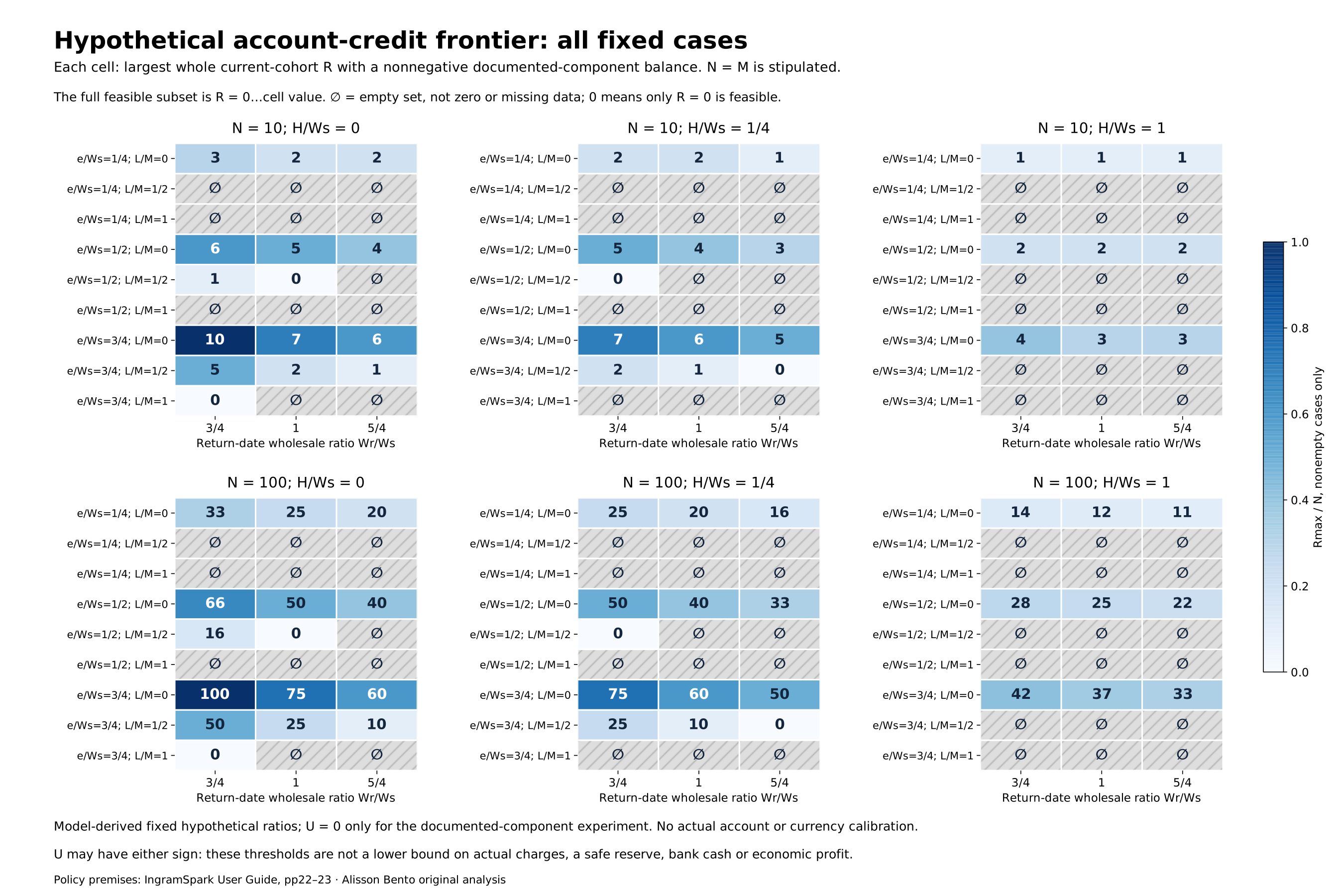
If legacy debits already exceed C, even R=0 fails the nonnegative-balance condition. The feasible set is then empty. This is different from a valid maximum of zero, where R=0 satisfies the condition but the next whole current return does not. The frontier figure marks empty sets with a hatched ∅ and real zero limits with a numerical 0. Neither state is a missing observation or an omitted case.
Across this deliberately fixed design, 88 cases have empty feasible sets and 74 are nonempty; eight of the latter allow only R=0. These are design counts, not frequencies among publishers or probabilities of financial difficulty. The accompanying tables retain the full classification, including equality information. A reader should not turn the number of constructed cases in a category into a statement about how commonly that condition occurs outside the model.
What the two-date contrast actually compares
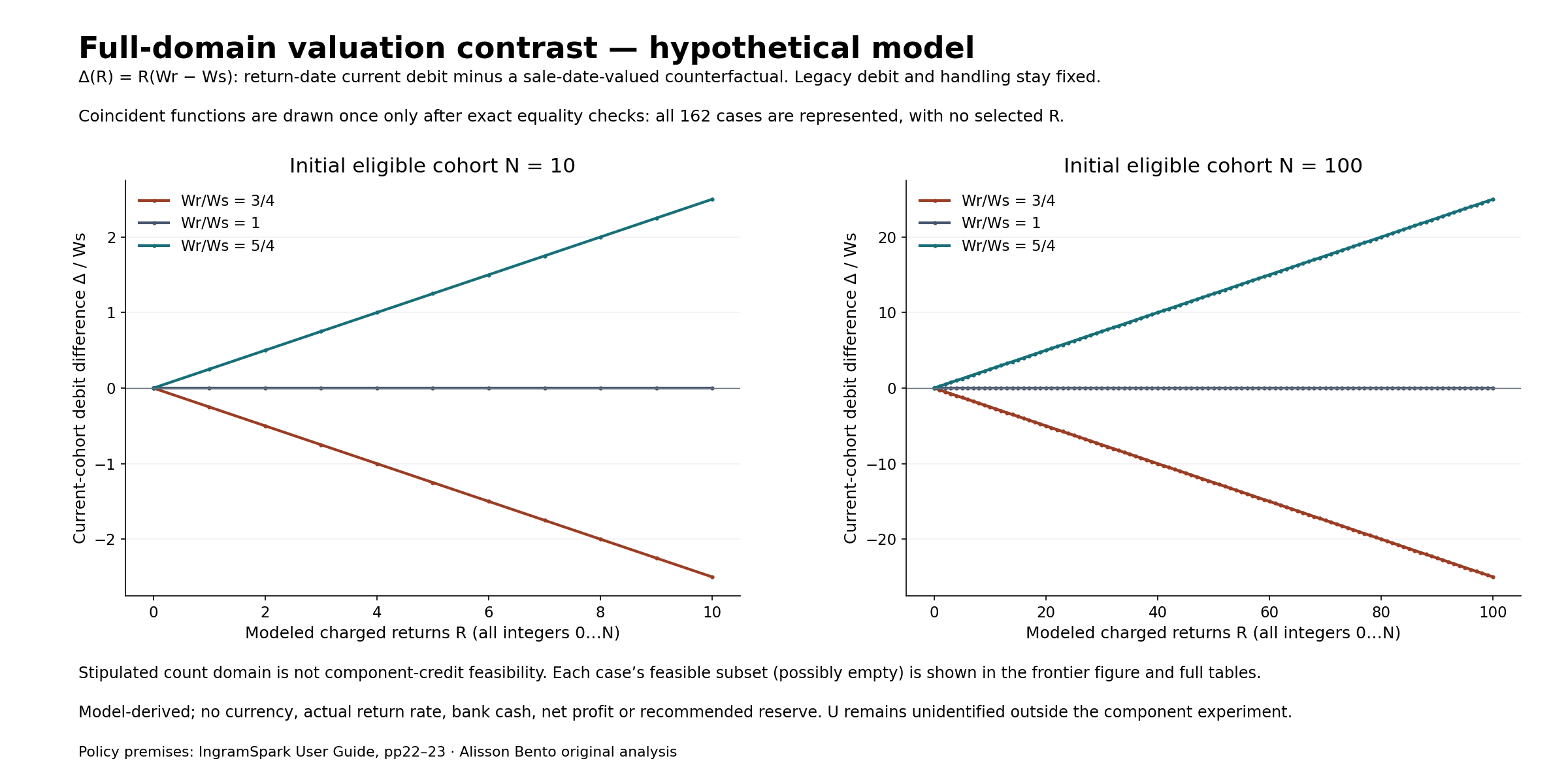
The paired contrast isolates the current cohort. One side charges its R returns at W_r+H; an expressly hypothetical comparator charges those same returns at W_s+H. Handling and the legacy debit amount stay fixed within the pair. The debit difference is therefore Δ(R)=R×(W_r−W_s). This is a controlled valuation contrast, not a measured effect of a price change on sales or a revaluation of all historical credits.
A negative Δ means the return-date current-cohort debit is below the sale-date-valued comparator. It does not mean the return itself creates a credit or makes a book profitable. A positive Δ means the opposite comparison, not evidence that a provider has added an unlisted fee. Both signs refer to the difference between two stipulated component calculations. The actual full-settlement effect remains unidentified where additional adjustments or other relevant amounts are unknown.
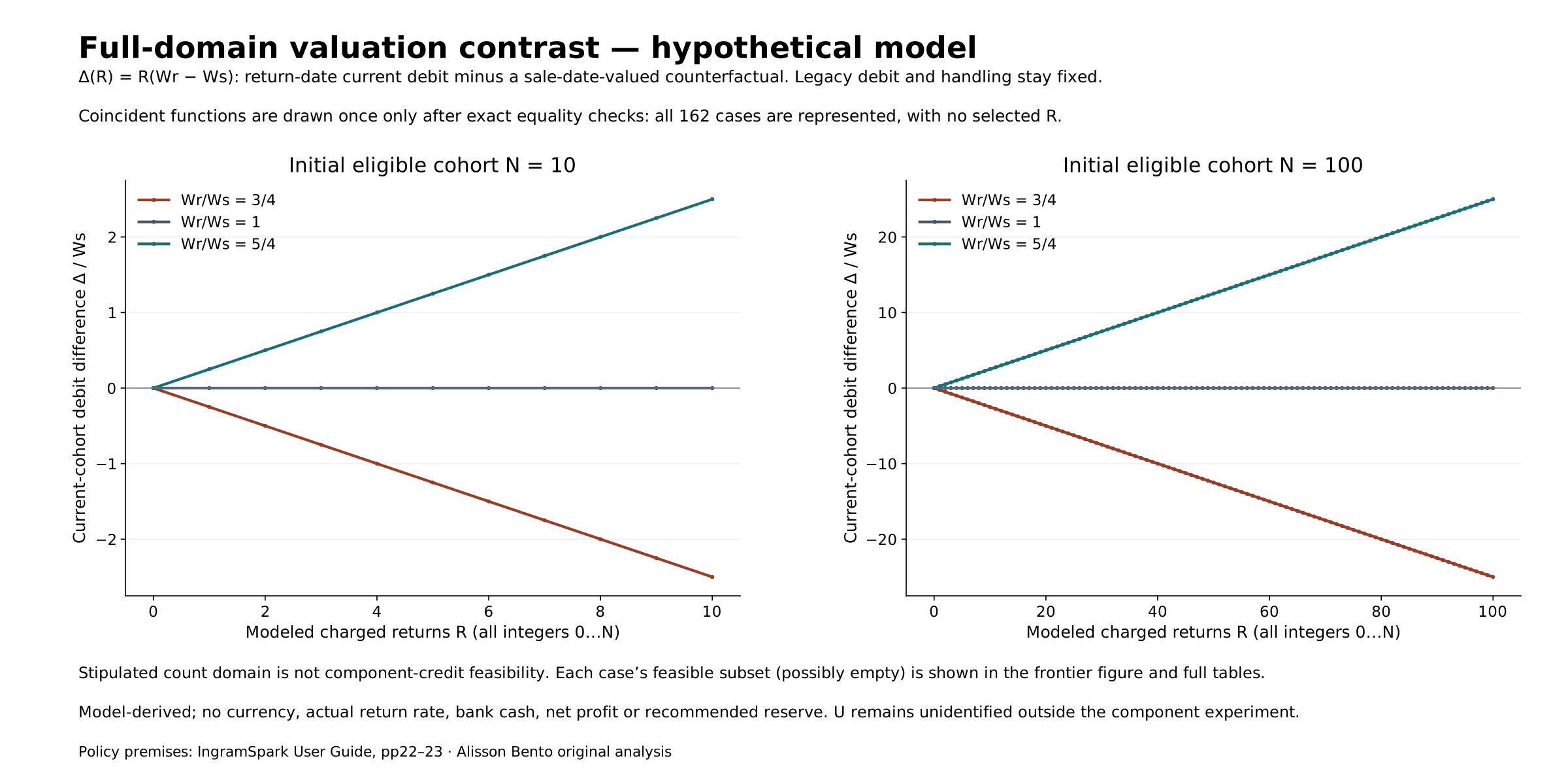
The contrast figure retains the complete integer R domain for both cohort sizes. Its coincident functions are drawn once only after exact equality checks: fixing N and W_r/W_s fixes this normalized contrast function, even though credit feasibility still varies with e, H and L. The separate frontier figure and full table identify every case’s feasible subset. Restricting the line to favorable return counts would conceal that distinction; all counts remain available here.
Why legacy eligibility changes the denominator
The closed current cohort deliberately imposes R≤N. Legacy transactions have their own declared bound, L≤M. Those are inventory assumptions, not consequences of the current month’s sales total. A monthly return count can include transactions originating elsewhere in time, so dividing it by current sales does not automatically produce a matched-cohort return probability. The public policy’s eligibility transitions make that distinction relevant, but do not reveal an actual publisher’s eligible legacy inventory.
Within the model, legacy debits are deducted from the designated pool before the remaining current-return allowance is assessed. A title can therefore have a nonempty no-legacy frontier but an empty frontier after the stipulated legacy draw. That is an accounting consequence of the pool definition and declared units, not proof that historical sales were unprofitable. It also does not establish that an actual publisher has no separate funds against which those debits could be settled.
The full frontier matrix keeps the legacy fractions alongside return-date wholesale ratios and handling ratios. This connects the two mechanisms rather than publishing separate price and eligibility anecdotes. A valuation change affects the debit being compared with the remaining credit, while the legacy input changes which earlier transactions draw on that credit. The model exposes both simplifications explicitly; it supplies no estimate of how much legacy stock exists or how likely it is to return.
Whole-unit boundaries and exact equality
The two N values do not merely change the labels on a continuous percentage. A whole-unit threshold has discrete steps. With the same dimensionless ratios, multiplying the cohort size changes the number of available integer positions around a fractional boundary. The detailed output therefore retains both the exact balance and the largest feasible whole return count, rather than reporting a rounded percentage as if it were an operational allowance.
Exact zero balance is checked separately from a nonnegative result. There are 17 parameter cases with an equality point at N=10 and 24 at N=100. Together, the 41 cases identify exact modeled boundaries, not near-zero balances inferred from display rounding. Equality is included on the nonnegative side. The next integer is the first return count that produces a negative component balance only when it lies inside the declared current cohort; no extra physical transaction is invented beyond N.
Exact rational arithmetic supports that distinction throughout. Ratios such as one-quarter are fractions in the reproducer, not binary floating-point approximations. The numerical model does not borrow a provider-specific cent-rounding rule that has not been qualified. A synthetic zero-debit check verifies the generic formula’s edge behavior, but it is not an extra fixed-grid market scenario. The fixed grid and every detailed return count remain unchanged by those mathematical checks.
Eligibility, charging and payment are different clocks
IngramSpark’s guide describes a 180-day return-eligibility tail after notice to sellers when returnable terms change to nonreturnable. That is not simply 180 days from an author editing a setting. It also describes Deliver-to-No tail returns being handled under Destroy, and older purchases becoming eligible when nonreturnable terms change to returnable. These provisions explain why a present designation alone does not identify the relevant historical transaction pool.
The guide separately permits Deliver returns to be held without charging until an economical shipment quantity is reached. Physical arrival can therefore precede charging. The model counts recognized charged returns, not every copy sitting in a warehouse. A tail’s eligibility endpoint does not establish that every debit has been posted, every invoice paid or all obligations cleared. No numerical holding duration or bank-payment date is assigned to any scenario.
These timing qualifications do useful work without becoming a cash forecast. They tell a reader why seller notice, processing-date valuation, shipment, monthly netting and payment should not be collapsed into one date. The frontier answers a defined-credit question once the modeled debits are specified. It cannot tell an author when money will leave an account, whether a particular invoice will be issued or what cash must be available on a particular calendar day.
What a reader would need to supply
Using this structure for a separately defined situation would first require a clearly bounded credit pool and transaction inventory. The all-in credit input would need a meaning consistent with the deductions already included. The return-side wholesale terms and any applicable handling component would need their own qualified scope. A source example that shows wholesale value and printing cost is not, by itself, verification of every charge or refund needed for a complete settlement calculation.
Legacy eligibility is an input requiring evidence, not a gap to fill with zero. If the eligible inventory or recognized return count cannot be established, the corresponding account conclusion remains unknown. The same applies to U and to any attempt to assign an actual currency or handling tariff. This study does not ask readers to treat its hypothetical ratios as a substitute for those facts, or to assume that a mathematically feasible count is policy-permitted.
The downloads make the limited exercise inspectable without supplying private account data. They include the fixed design, every parameter case, the full integer return domain, exact formulas and a clean-folder reproducer. Model plots are calculated from those files. Their thresholds describe the documented-component experiment only: they are not safe-return limits, adequate reserves or guarantees of net compensation, and no result depends on selecting a real book or favorable example after calculation.
What the model adds—and where it stops
The connected result is a way to keep two common shortcuts apart. Historical sale credit need not equal a later wholesale return debit, and current sales need not bound returns from earlier eligible transactions. The whole-unit frontier shows how those distinct quantities meet within one explicitly defined pool. The full-domain contrast shows which part comes from changing the valuation date while holding the other specified amounts fixed, without claiming a novel accounting identity.
The interpretation depends on keeping those definitions visible. Empty feasibility is not a zero allowance; zero allowance is not a market prediction; a negative contrast is not a profitable return; and a component threshold is not a bank balance. Delivered inventory and legacy credits outside the designated pool have not been assigned a zero economic value. Unknown additional credits or charges remain capable of changing a fuller settlement in either direction.
This is consequently a reproducible hypothetical model grounded in public policy structure, not an empirical market study or endorsement by IngramSpark. It neither estimates the sales benefit of returnability nor recommends an option, price, discount or reserve. Its useful boundary is more precise: it shows what the stated component debits can consume under declared credit and eligibility assumptions, while leaving unqualified settlement facts, real-world prevalence and individual financial decisions outside the answer.
Hypothetical account-credit frontier: all fixed cases
All 162 fixed cases · Modeled charged-return counts
Full chart and source

Scroll horizontally to inspect the chart. ↔
Chart and values
Scroll horizontally to see all columns.
| Case | N = M | e / W_s | W_r / W_s | H / W_s | L / M | L | Maximum R | Equality R |
|---|---|---|---|---|---|---|---|---|
| s0001 | 10 | 1/4 | 3/4 | 0 | 0 | 0 | 3 | — |
| s0002 | 10 | 1/4 | 3/4 | 0 | 1/2 | 5 | ∅ | — |
| s0003 | 10 | 1/4 | 3/4 | 0 | 1 | 10 | ∅ | — |
| s0004 | 10 | 1/4 | 3/4 | 1/4 | 0 | 0 | 2 | — |
| s0005 | 10 | 1/4 | 3/4 | 1/4 | 1/2 | 5 | ∅ | — |
| s0006 | 10 | 1/4 | 3/4 | 1/4 | 1 | 10 | ∅ | — |
| s0007 | 10 | 1/4 | 3/4 | 1 | 0 | 0 | 1 | — |
| s0008 | 10 | 1/4 | 3/4 | 1 | 1/2 | 5 | ∅ | — |
| s0009 | 10 | 1/4 | 3/4 | 1 | 1 | 10 | ∅ | — |
| s0010 | 10 | 1/4 | 1 | 0 | 0 | 0 | 2 | — |
| s0011 | 10 | 1/4 | 1 | 0 | 1/2 | 5 | ∅ | — |
| s0012 | 10 | 1/4 | 1 | 0 | 1 | 10 | ∅ | — |
| s0013 | 10 | 1/4 | 1 | 1/4 | 0 | 0 | 2 | 2 |
| s0014 | 10 | 1/4 | 1 | 1/4 | 1/2 | 5 | ∅ | — |
| s0015 | 10 | 1/4 | 1 | 1/4 | 1 | 10 | ∅ | — |
| s0016 | 10 | 1/4 | 1 | 1 | 0 | 0 | 1 | — |
| s0017 | 10 | 1/4 | 1 | 1 | 1/2 | 5 | ∅ | — |
| s0018 | 10 | 1/4 | 1 | 1 | 1 | 10 | ∅ | — |
| s0019 | 10 | 1/4 | 5/4 | 0 | 0 | 0 | 2 | 2 |
| s0020 | 10 | 1/4 | 5/4 | 0 | 1/2 | 5 | ∅ | — |
| s0021 | 10 | 1/4 | 5/4 | 0 | 1 | 10 | ∅ | — |
| s0022 | 10 | 1/4 | 5/4 | 1/4 | 0 | 0 | 1 | — |
| s0023 | 10 | 1/4 | 5/4 | 1/4 | 1/2 | 5 | ∅ | — |
| s0024 | 10 | 1/4 | 5/4 | 1/4 | 1 | 10 | ∅ | — |
| s0025 | 10 | 1/4 | 5/4 | 1 | 0 | 0 | 1 | — |
| s0026 | 10 | 1/4 | 5/4 | 1 | 1/2 | 5 | ∅ | — |
| s0027 | 10 | 1/4 | 5/4 | 1 | 1 | 10 | ∅ | — |
| s0028 | 10 | 1/2 | 3/4 | 0 | 0 | 0 | 6 | — |
| s0029 | 10 | 1/2 | 3/4 | 0 | 1/2 | 5 | 1 | — |
| s0030 | 10 | 1/2 | 3/4 | 0 | 1 | 10 | ∅ | — |
| s0031 | 10 | 1/2 | 3/4 | 1/4 | 0 | 0 | 5 | 5 |
| s0032 | 10 | 1/2 | 3/4 | 1/4 | 1/2 | 5 | 0 | 0 |
| s0033 | 10 | 1/2 | 3/4 | 1/4 | 1 | 10 | ∅ | — |
| s0034 | 10 | 1/2 | 3/4 | 1 | 0 | 0 | 2 | — |
| s0035 | 10 | 1/2 | 3/4 | 1 | 1/2 | 5 | ∅ | — |
| s0036 | 10 | 1/2 | 3/4 | 1 | 1 | 10 | ∅ | — |
| s0037 | 10 | 1/2 | 1 | 0 | 0 | 0 | 5 | 5 |
| s0038 | 10 | 1/2 | 1 | 0 | 1/2 | 5 | 0 | 0 |
| s0039 | 10 | 1/2 | 1 | 0 | 1 | 10 | ∅ | — |
| s0040 | 10 | 1/2 | 1 | 1/4 | 0 | 0 | 4 | 4 |
| s0041 | 10 | 1/2 | 1 | 1/4 | 1/2 | 5 | ∅ | — |
| s0042 | 10 | 1/2 | 1 | 1/4 | 1 | 10 | ∅ | — |
| s0043 | 10 | 1/2 | 1 | 1 | 0 | 0 | 2 | — |
| s0044 | 10 | 1/2 | 1 | 1 | 1/2 | 5 | ∅ | — |
| s0045 | 10 | 1/2 | 1 | 1 | 1 | 10 | ∅ | — |
| s0046 | 10 | 1/2 | 5/4 | 0 | 0 | 0 | 4 | 4 |
| s0047 | 10 | 1/2 | 5/4 | 0 | 1/2 | 5 | ∅ | — |
| s0048 | 10 | 1/2 | 5/4 | 0 | 1 | 10 | ∅ | — |
| s0049 | 10 | 1/2 | 5/4 | 1/4 | 0 | 0 | 3 | — |
| s0050 | 10 | 1/2 | 5/4 | 1/4 | 1/2 | 5 | ∅ | — |
| s0051 | 10 | 1/2 | 5/4 | 1/4 | 1 | 10 | ∅ | — |
| s0052 | 10 | 1/2 | 5/4 | 1 | 0 | 0 | 2 | — |
| s0053 | 10 | 1/2 | 5/4 | 1 | 1/2 | 5 | ∅ | — |
| s0054 | 10 | 1/2 | 5/4 | 1 | 1 | 10 | ∅ | — |
| s0055 | 10 | 3/4 | 3/4 | 0 | 0 | 0 | 10 | 10 |
| s0056 | 10 | 3/4 | 3/4 | 0 | 1/2 | 5 | 5 | 5 |
| s0057 | 10 | 3/4 | 3/4 | 0 | 1 | 10 | 0 | 0 |
| s0058 | 10 | 3/4 | 3/4 | 1/4 | 0 | 0 | 7 | — |
| s0059 | 10 | 3/4 | 3/4 | 1/4 | 1/2 | 5 | 2 | — |
| s0060 | 10 | 3/4 | 3/4 | 1/4 | 1 | 10 | ∅ | — |
| s0061 | 10 | 3/4 | 3/4 | 1 | 0 | 0 | 4 | — |
| s0062 | 10 | 3/4 | 3/4 | 1 | 1/2 | 5 | ∅ | — |
| s0063 | 10 | 3/4 | 3/4 | 1 | 1 | 10 | ∅ | — |
| s0064 | 10 | 3/4 | 1 | 0 | 0 | 0 | 7 | — |
| s0065 | 10 | 3/4 | 1 | 0 | 1/2 | 5 | 2 | — |
| s0066 | 10 | 3/4 | 1 | 0 | 1 | 10 | ∅ | — |
| s0067 | 10 | 3/4 | 1 | 1/4 | 0 | 0 | 6 | 6 |
| s0068 | 10 | 3/4 | 1 | 1/4 | 1/2 | 5 | 1 | 1 |
| s0069 | 10 | 3/4 | 1 | 1/4 | 1 | 10 | ∅ | — |
| s0070 | 10 | 3/4 | 1 | 1 | 0 | 0 | 3 | — |
| s0071 | 10 | 3/4 | 1 | 1 | 1/2 | 5 | ∅ | — |
| s0072 | 10 | 3/4 | 1 | 1 | 1 | 10 | ∅ | — |
| s0073 | 10 | 3/4 | 5/4 | 0 | 0 | 0 | 6 | 6 |
| s0074 | 10 | 3/4 | 5/4 | 0 | 1/2 | 5 | 1 | 1 |
| s0075 | 10 | 3/4 | 5/4 | 0 | 1 | 10 | ∅ | — |
| s0076 | 10 | 3/4 | 5/4 | 1/4 | 0 | 0 | 5 | 5 |
| s0077 | 10 | 3/4 | 5/4 | 1/4 | 1/2 | 5 | 0 | 0 |
| s0078 | 10 | 3/4 | 5/4 | 1/4 | 1 | 10 | ∅ | — |
| s0079 | 10 | 3/4 | 5/4 | 1 | 0 | 0 | 3 | — |
| s0080 | 10 | 3/4 | 5/4 | 1 | 1/2 | 5 | ∅ | — |
| s0081 | 10 | 3/4 | 5/4 | 1 | 1 | 10 | ∅ | — |
| s0082 | 100 | 1/4 | 3/4 | 0 | 0 | 0 | 33 | — |
| s0083 | 100 | 1/4 | 3/4 | 0 | 1/2 | 50 | ∅ | — |
| s0084 | 100 | 1/4 | 3/4 | 0 | 1 | 100 | ∅ | — |
| s0085 | 100 | 1/4 | 3/4 | 1/4 | 0 | 0 | 25 | 25 |
| s0086 | 100 | 1/4 | 3/4 | 1/4 | 1/2 | 50 | ∅ | — |
| s0087 | 100 | 1/4 | 3/4 | 1/4 | 1 | 100 | ∅ | — |
| s0088 | 100 | 1/4 | 3/4 | 1 | 0 | 0 | 14 | — |
| s0089 | 100 | 1/4 | 3/4 | 1 | 1/2 | 50 | ∅ | — |
| s0090 | 100 | 1/4 | 3/4 | 1 | 1 | 100 | ∅ | — |
| s0091 | 100 | 1/4 | 1 | 0 | 0 | 0 | 25 | 25 |
| s0092 | 100 | 1/4 | 1 | 0 | 1/2 | 50 | ∅ | — |
| s0093 | 100 | 1/4 | 1 | 0 | 1 | 100 | ∅ | — |
| s0094 | 100 | 1/4 | 1 | 1/4 | 0 | 0 | 20 | 20 |
| s0095 | 100 | 1/4 | 1 | 1/4 | 1/2 | 50 | ∅ | — |
| s0096 | 100 | 1/4 | 1 | 1/4 | 1 | 100 | ∅ | — |
| s0097 | 100 | 1/4 | 1 | 1 | 0 | 0 | 12 | — |
| s0098 | 100 | 1/4 | 1 | 1 | 1/2 | 50 | ∅ | — |
| s0099 | 100 | 1/4 | 1 | 1 | 1 | 100 | ∅ | — |
| s0100 | 100 | 1/4 | 5/4 | 0 | 0 | 0 | 20 | 20 |
| s0101 | 100 | 1/4 | 5/4 | 0 | 1/2 | 50 | ∅ | — |
| s0102 | 100 | 1/4 | 5/4 | 0 | 1 | 100 | ∅ | — |
| s0103 | 100 | 1/4 | 5/4 | 1/4 | 0 | 0 | 16 | — |
| s0104 | 100 | 1/4 | 5/4 | 1/4 | 1/2 | 50 | ∅ | — |
| s0105 | 100 | 1/4 | 5/4 | 1/4 | 1 | 100 | ∅ | — |
| s0106 | 100 | 1/4 | 5/4 | 1 | 0 | 0 | 11 | — |
| s0107 | 100 | 1/4 | 5/4 | 1 | 1/2 | 50 | ∅ | — |
| s0108 | 100 | 1/4 | 5/4 | 1 | 1 | 100 | ∅ | — |
| s0109 | 100 | 1/2 | 3/4 | 0 | 0 | 0 | 66 | — |
| s0110 | 100 | 1/2 | 3/4 | 0 | 1/2 | 50 | 16 | — |
| s0111 | 100 | 1/2 | 3/4 | 0 | 1 | 100 | ∅ | — |
| s0112 | 100 | 1/2 | 3/4 | 1/4 | 0 | 0 | 50 | 50 |
| s0113 | 100 | 1/2 | 3/4 | 1/4 | 1/2 | 50 | 0 | 0 |
| s0114 | 100 | 1/2 | 3/4 | 1/4 | 1 | 100 | ∅ | — |
| s0115 | 100 | 1/2 | 3/4 | 1 | 0 | 0 | 28 | — |
| s0116 | 100 | 1/2 | 3/4 | 1 | 1/2 | 50 | ∅ | — |
| s0117 | 100 | 1/2 | 3/4 | 1 | 1 | 100 | ∅ | — |
| s0118 | 100 | 1/2 | 1 | 0 | 0 | 0 | 50 | 50 |
| s0119 | 100 | 1/2 | 1 | 0 | 1/2 | 50 | 0 | 0 |
| s0120 | 100 | 1/2 | 1 | 0 | 1 | 100 | ∅ | — |
| s0121 | 100 | 1/2 | 1 | 1/4 | 0 | 0 | 40 | 40 |
| s0122 | 100 | 1/2 | 1 | 1/4 | 1/2 | 50 | ∅ | — |
| s0123 | 100 | 1/2 | 1 | 1/4 | 1 | 100 | ∅ | — |
| s0124 | 100 | 1/2 | 1 | 1 | 0 | 0 | 25 | 25 |
| s0125 | 100 | 1/2 | 1 | 1 | 1/2 | 50 | ∅ | — |
| s0126 | 100 | 1/2 | 1 | 1 | 1 | 100 | ∅ | — |
| s0127 | 100 | 1/2 | 5/4 | 0 | 0 | 0 | 40 | 40 |
| s0128 | 100 | 1/2 | 5/4 | 0 | 1/2 | 50 | ∅ | — |
| s0129 | 100 | 1/2 | 5/4 | 0 | 1 | 100 | ∅ | — |
| s0130 | 100 | 1/2 | 5/4 | 1/4 | 0 | 0 | 33 | — |
| s0131 | 100 | 1/2 | 5/4 | 1/4 | 1/2 | 50 | ∅ | — |
| s0132 | 100 | 1/2 | 5/4 | 1/4 | 1 | 100 | ∅ | — |
| s0133 | 100 | 1/2 | 5/4 | 1 | 0 | 0 | 22 | — |
| s0134 | 100 | 1/2 | 5/4 | 1 | 1/2 | 50 | ∅ | — |
| s0135 | 100 | 1/2 | 5/4 | 1 | 1 | 100 | ∅ | — |
| s0136 | 100 | 3/4 | 3/4 | 0 | 0 | 0 | 100 | 100 |
| s0137 | 100 | 3/4 | 3/4 | 0 | 1/2 | 50 | 50 | 50 |
| s0138 | 100 | 3/4 | 3/4 | 0 | 1 | 100 | 0 | 0 |
| s0139 | 100 | 3/4 | 3/4 | 1/4 | 0 | 0 | 75 | 75 |
| s0140 | 100 | 3/4 | 3/4 | 1/4 | 1/2 | 50 | 25 | 25 |
| s0141 | 100 | 3/4 | 3/4 | 1/4 | 1 | 100 | ∅ | — |
| s0142 | 100 | 3/4 | 3/4 | 1 | 0 | 0 | 42 | — |
| s0143 | 100 | 3/4 | 3/4 | 1 | 1/2 | 50 | ∅ | — |
| s0144 | 100 | 3/4 | 3/4 | 1 | 1 | 100 | ∅ | — |
| s0145 | 100 | 3/4 | 1 | 0 | 0 | 0 | 75 | 75 |
| s0146 | 100 | 3/4 | 1 | 0 | 1/2 | 50 | 25 | 25 |
| s0147 | 100 | 3/4 | 1 | 0 | 1 | 100 | ∅ | — |
| s0148 | 100 | 3/4 | 1 | 1/4 | 0 | 0 | 60 | 60 |
| s0149 | 100 | 3/4 | 1 | 1/4 | 1/2 | 50 | 10 | 10 |
| s0150 | 100 | 3/4 | 1 | 1/4 | 1 | 100 | ∅ | — |
| s0151 | 100 | 3/4 | 1 | 1 | 0 | 0 | 37 | — |
| s0152 | 100 | 3/4 | 1 | 1 | 1/2 | 50 | ∅ | — |
| s0153 | 100 | 3/4 | 1 | 1 | 1 | 100 | ∅ | — |
| s0154 | 100 | 3/4 | 5/4 | 0 | 0 | 0 | 60 | 60 |
| s0155 | 100 | 3/4 | 5/4 | 0 | 1/2 | 50 | 10 | 10 |
| s0156 | 100 | 3/4 | 5/4 | 0 | 1 | 100 | ∅ | — |
| s0157 | 100 | 3/4 | 5/4 | 1/4 | 0 | 0 | 50 | 50 |
| s0158 | 100 | 3/4 | 5/4 | 1/4 | 1/2 | 50 | 0 | 0 |
| s0159 | 100 | 3/4 | 5/4 | 1/4 | 1 | 100 | ∅ | — |
| s0160 | 100 | 3/4 | 5/4 | 1 | 0 | 0 | 33 | — |
| s0161 | 100 | 3/4 | 5/4 | 1 | 1/2 | 50 | ∅ | — |
| s0162 | 100 | 3/4 | 5/4 | 1 | 1 | 100 | ∅ | — |
All 162 cases, not observed books or accounts. Monetary ratios are relative to sale-date wholesale value W_s; M=N is stipulated. Maximum R refers only to documented-component credit feasibility with U=0 stipulated. ∅ means no feasible R; 0 is a valid maximum; — means no exact equality point in 0…N. Case IDs identify scenarios. No tariff, currency, policy permission, safe reserve or net-profit interpretation is supplied.

Full-domain valuation contrast — hypothetical model
Hypothetical model · Every integer R from 0 through N
Full chart and source

Scroll horizontally to inspect the chart. ↔
Chart and values
Scroll horizontally to see all columns.
| N | W_r / W_s | Coefficient per R | Full integer R domain | Fixed cases represented |
|---|---|---|---|---|
| 10 | 3/4 | -1/4 | 0…10 | 27 |
| 10 | 1 | 0 | 0…10 | 27 |
| 10 | 5/4 | 1/4 | 0…10 | 27 |
| 100 | 3/4 | -1/4 | 0…100 | 27 |
| 100 | 1 | 0 | 0…100 | 27 |
| 100 | 5/4 | 1/4 | 0…100 | 27 |
All fixed cases are represented. Δ/W_s=R×(W_r/W_s−1); current-cohort handling and the legacy debit stay fixed in each pair. These domains include counts outside component-credit-feasible subsets, which the 162-case table identifies separately. A zero or negative contrast is not a zero or negative return charge.

Data & downloads

Scroll horizontally to see all columns.
| Case | N = M | e / W_s | W_r / W_s | H / W_s | L / M | L | Maximum R | Equality R |
|---|---|---|---|---|---|---|---|---|
| s0001 | 10 | 1/4 | 3/4 | 0 | 0 | 0 | 3 | — |
| s0002 | 10 | 1/4 | 3/4 | 0 | 1/2 | 5 | ∅ | — |
| s0003 | 10 | 1/4 | 3/4 | 0 | 1 | 10 | ∅ | — |
| s0004 | 10 | 1/4 | 3/4 | 1/4 | 0 | 0 | 2 | — |
| s0005 | 10 | 1/4 | 3/4 | 1/4 | 1/2 | 5 | ∅ | — |
| s0006 | 10 | 1/4 | 3/4 | 1/4 | 1 | 10 | ∅ | — |
| s0007 | 10 | 1/4 | 3/4 | 1 | 0 | 0 | 1 | — |
| s0008 | 10 | 1/4 | 3/4 | 1 | 1/2 | 5 | ∅ | — |
| s0009 | 10 | 1/4 | 3/4 | 1 | 1 | 10 | ∅ | — |
| s0010 | 10 | 1/4 | 1 | 0 | 0 | 0 | 2 | — |
| s0011 | 10 | 1/4 | 1 | 0 | 1/2 | 5 | ∅ | — |
| s0012 | 10 | 1/4 | 1 | 0 | 1 | 10 | ∅ | — |
| s0013 | 10 | 1/4 | 1 | 1/4 | 0 | 0 | 2 | 2 |
| s0014 | 10 | 1/4 | 1 | 1/4 | 1/2 | 5 | ∅ | — |
| s0015 | 10 | 1/4 | 1 | 1/4 | 1 | 10 | ∅ | — |
| s0016 | 10 | 1/4 | 1 | 1 | 0 | 0 | 1 | — |
| s0017 | 10 | 1/4 | 1 | 1 | 1/2 | 5 | ∅ | — |
| s0018 | 10 | 1/4 | 1 | 1 | 1 | 10 | ∅ | — |
| s0019 | 10 | 1/4 | 5/4 | 0 | 0 | 0 | 2 | 2 |
| s0020 | 10 | 1/4 | 5/4 | 0 | 1/2 | 5 | ∅ | — |
| s0021 | 10 | 1/4 | 5/4 | 0 | 1 | 10 | ∅ | — |
| s0022 | 10 | 1/4 | 5/4 | 1/4 | 0 | 0 | 1 | — |
| s0023 | 10 | 1/4 | 5/4 | 1/4 | 1/2 | 5 | ∅ | — |
| s0024 | 10 | 1/4 | 5/4 | 1/4 | 1 | 10 | ∅ | — |
| s0025 | 10 | 1/4 | 5/4 | 1 | 0 | 0 | 1 | — |
| s0026 | 10 | 1/4 | 5/4 | 1 | 1/2 | 5 | ∅ | — |
| s0027 | 10 | 1/4 | 5/4 | 1 | 1 | 10 | ∅ | — |
| s0028 | 10 | 1/2 | 3/4 | 0 | 0 | 0 | 6 | — |
| s0029 | 10 | 1/2 | 3/4 | 0 | 1/2 | 5 | 1 | — |
| s0030 | 10 | 1/2 | 3/4 | 0 | 1 | 10 | ∅ | — |
| s0031 | 10 | 1/2 | 3/4 | 1/4 | 0 | 0 | 5 | 5 |
| s0032 | 10 | 1/2 | 3/4 | 1/4 | 1/2 | 5 | 0 | 0 |
| s0033 | 10 | 1/2 | 3/4 | 1/4 | 1 | 10 | ∅ | — |
| s0034 | 10 | 1/2 | 3/4 | 1 | 0 | 0 | 2 | — |
| s0035 | 10 | 1/2 | 3/4 | 1 | 1/2 | 5 | ∅ | — |
| s0036 | 10 | 1/2 | 3/4 | 1 | 1 | 10 | ∅ | — |
| s0037 | 10 | 1/2 | 1 | 0 | 0 | 0 | 5 | 5 |
| s0038 | 10 | 1/2 | 1 | 0 | 1/2 | 5 | 0 | 0 |
| s0039 | 10 | 1/2 | 1 | 0 | 1 | 10 | ∅ | — |
| s0040 | 10 | 1/2 | 1 | 1/4 | 0 | 0 | 4 | 4 |
| s0041 | 10 | 1/2 | 1 | 1/4 | 1/2 | 5 | ∅ | — |
| s0042 | 10 | 1/2 | 1 | 1/4 | 1 | 10 | ∅ | — |
| s0043 | 10 | 1/2 | 1 | 1 | 0 | 0 | 2 | — |
| s0044 | 10 | 1/2 | 1 | 1 | 1/2 | 5 | ∅ | — |
| s0045 | 10 | 1/2 | 1 | 1 | 1 | 10 | ∅ | — |
| s0046 | 10 | 1/2 | 5/4 | 0 | 0 | 0 | 4 | 4 |
| s0047 | 10 | 1/2 | 5/4 | 0 | 1/2 | 5 | ∅ | — |
| s0048 | 10 | 1/2 | 5/4 | 0 | 1 | 10 | ∅ | — |
| s0049 | 10 | 1/2 | 5/4 | 1/4 | 0 | 0 | 3 | — |
| s0050 | 10 | 1/2 | 5/4 | 1/4 | 1/2 | 5 | ∅ | — |
| s0051 | 10 | 1/2 | 5/4 | 1/4 | 1 | 10 | ∅ | — |
| s0052 | 10 | 1/2 | 5/4 | 1 | 0 | 0 | 2 | — |
| s0053 | 10 | 1/2 | 5/4 | 1 | 1/2 | 5 | ∅ | — |
| s0054 | 10 | 1/2 | 5/4 | 1 | 1 | 10 | ∅ | — |
| s0055 | 10 | 3/4 | 3/4 | 0 | 0 | 0 | 10 | 10 |
| s0056 | 10 | 3/4 | 3/4 | 0 | 1/2 | 5 | 5 | 5 |
| s0057 | 10 | 3/4 | 3/4 | 0 | 1 | 10 | 0 | 0 |
| s0058 | 10 | 3/4 | 3/4 | 1/4 | 0 | 0 | 7 | — |
| s0059 | 10 | 3/4 | 3/4 | 1/4 | 1/2 | 5 | 2 | — |
| s0060 | 10 | 3/4 | 3/4 | 1/4 | 1 | 10 | ∅ | — |
| s0061 | 10 | 3/4 | 3/4 | 1 | 0 | 0 | 4 | — |
| s0062 | 10 | 3/4 | 3/4 | 1 | 1/2 | 5 | ∅ | — |
| s0063 | 10 | 3/4 | 3/4 | 1 | 1 | 10 | ∅ | — |
| s0064 | 10 | 3/4 | 1 | 0 | 0 | 0 | 7 | — |
| s0065 | 10 | 3/4 | 1 | 0 | 1/2 | 5 | 2 | — |
| s0066 | 10 | 3/4 | 1 | 0 | 1 | 10 | ∅ | — |
| s0067 | 10 | 3/4 | 1 | 1/4 | 0 | 0 | 6 | 6 |
| s0068 | 10 | 3/4 | 1 | 1/4 | 1/2 | 5 | 1 | 1 |
| s0069 | 10 | 3/4 | 1 | 1/4 | 1 | 10 | ∅ | — |
| s0070 | 10 | 3/4 | 1 | 1 | 0 | 0 | 3 | — |
| s0071 | 10 | 3/4 | 1 | 1 | 1/2 | 5 | ∅ | — |
| s0072 | 10 | 3/4 | 1 | 1 | 1 | 10 | ∅ | — |
| s0073 | 10 | 3/4 | 5/4 | 0 | 0 | 0 | 6 | 6 |
| s0074 | 10 | 3/4 | 5/4 | 0 | 1/2 | 5 | 1 | 1 |
| s0075 | 10 | 3/4 | 5/4 | 0 | 1 | 10 | ∅ | — |
| s0076 | 10 | 3/4 | 5/4 | 1/4 | 0 | 0 | 5 | 5 |
| s0077 | 10 | 3/4 | 5/4 | 1/4 | 1/2 | 5 | 0 | 0 |
| s0078 | 10 | 3/4 | 5/4 | 1/4 | 1 | 10 | ∅ | — |
| s0079 | 10 | 3/4 | 5/4 | 1 | 0 | 0 | 3 | — |
| s0080 | 10 | 3/4 | 5/4 | 1 | 1/2 | 5 | ∅ | — |
| s0081 | 10 | 3/4 | 5/4 | 1 | 1 | 10 | ∅ | — |
| s0082 | 100 | 1/4 | 3/4 | 0 | 0 | 0 | 33 | — |
| s0083 | 100 | 1/4 | 3/4 | 0 | 1/2 | 50 | ∅ | — |
| s0084 | 100 | 1/4 | 3/4 | 0 | 1 | 100 | ∅ | — |
| s0085 | 100 | 1/4 | 3/4 | 1/4 | 0 | 0 | 25 | 25 |
| s0086 | 100 | 1/4 | 3/4 | 1/4 | 1/2 | 50 | ∅ | — |
| s0087 | 100 | 1/4 | 3/4 | 1/4 | 1 | 100 | ∅ | — |
| s0088 | 100 | 1/4 | 3/4 | 1 | 0 | 0 | 14 | — |
| s0089 | 100 | 1/4 | 3/4 | 1 | 1/2 | 50 | ∅ | — |
| s0090 | 100 | 1/4 | 3/4 | 1 | 1 | 100 | ∅ | — |
| s0091 | 100 | 1/4 | 1 | 0 | 0 | 0 | 25 | 25 |
| s0092 | 100 | 1/4 | 1 | 0 | 1/2 | 50 | ∅ | — |
| s0093 | 100 | 1/4 | 1 | 0 | 1 | 100 | ∅ | — |
| s0094 | 100 | 1/4 | 1 | 1/4 | 0 | 0 | 20 | 20 |
| s0095 | 100 | 1/4 | 1 | 1/4 | 1/2 | 50 | ∅ | — |
| s0096 | 100 | 1/4 | 1 | 1/4 | 1 | 100 | ∅ | — |
| s0097 | 100 | 1/4 | 1 | 1 | 0 | 0 | 12 | — |
| s0098 | 100 | 1/4 | 1 | 1 | 1/2 | 50 | ∅ | — |
| s0099 | 100 | 1/4 | 1 | 1 | 1 | 100 | ∅ | — |
| s0100 | 100 | 1/4 | 5/4 | 0 | 0 | 0 | 20 | 20 |
| s0101 | 100 | 1/4 | 5/4 | 0 | 1/2 | 50 | ∅ | — |
| s0102 | 100 | 1/4 | 5/4 | 0 | 1 | 100 | ∅ | — |
| s0103 | 100 | 1/4 | 5/4 | 1/4 | 0 | 0 | 16 | — |
| s0104 | 100 | 1/4 | 5/4 | 1/4 | 1/2 | 50 | ∅ | — |
| s0105 | 100 | 1/4 | 5/4 | 1/4 | 1 | 100 | ∅ | — |
| s0106 | 100 | 1/4 | 5/4 | 1 | 0 | 0 | 11 | — |
| s0107 | 100 | 1/4 | 5/4 | 1 | 1/2 | 50 | ∅ | — |
| s0108 | 100 | 1/4 | 5/4 | 1 | 1 | 100 | ∅ | — |
| s0109 | 100 | 1/2 | 3/4 | 0 | 0 | 0 | 66 | — |
| s0110 | 100 | 1/2 | 3/4 | 0 | 1/2 | 50 | 16 | — |
| s0111 | 100 | 1/2 | 3/4 | 0 | 1 | 100 | ∅ | — |
| s0112 | 100 | 1/2 | 3/4 | 1/4 | 0 | 0 | 50 | 50 |
| s0113 | 100 | 1/2 | 3/4 | 1/4 | 1/2 | 50 | 0 | 0 |
| s0114 | 100 | 1/2 | 3/4 | 1/4 | 1 | 100 | ∅ | — |
| s0115 | 100 | 1/2 | 3/4 | 1 | 0 | 0 | 28 | — |
| s0116 | 100 | 1/2 | 3/4 | 1 | 1/2 | 50 | ∅ | — |
| s0117 | 100 | 1/2 | 3/4 | 1 | 1 | 100 | ∅ | — |
| s0118 | 100 | 1/2 | 1 | 0 | 0 | 0 | 50 | 50 |
| s0119 | 100 | 1/2 | 1 | 0 | 1/2 | 50 | 0 | 0 |
| s0120 | 100 | 1/2 | 1 | 0 | 1 | 100 | ∅ | — |
| s0121 | 100 | 1/2 | 1 | 1/4 | 0 | 0 | 40 | 40 |
| s0122 | 100 | 1/2 | 1 | 1/4 | 1/2 | 50 | ∅ | — |
| s0123 | 100 | 1/2 | 1 | 1/4 | 1 | 100 | ∅ | — |
| s0124 | 100 | 1/2 | 1 | 1 | 0 | 0 | 25 | 25 |
| s0125 | 100 | 1/2 | 1 | 1 | 1/2 | 50 | ∅ | — |
| s0126 | 100 | 1/2 | 1 | 1 | 1 | 100 | ∅ | — |
| s0127 | 100 | 1/2 | 5/4 | 0 | 0 | 0 | 40 | 40 |
| s0128 | 100 | 1/2 | 5/4 | 0 | 1/2 | 50 | ∅ | — |
| s0129 | 100 | 1/2 | 5/4 | 0 | 1 | 100 | ∅ | — |
| s0130 | 100 | 1/2 | 5/4 | 1/4 | 0 | 0 | 33 | — |
| s0131 | 100 | 1/2 | 5/4 | 1/4 | 1/2 | 50 | ∅ | — |
| s0132 | 100 | 1/2 | 5/4 | 1/4 | 1 | 100 | ∅ | — |
| s0133 | 100 | 1/2 | 5/4 | 1 | 0 | 0 | 22 | — |
| s0134 | 100 | 1/2 | 5/4 | 1 | 1/2 | 50 | ∅ | — |
| s0135 | 100 | 1/2 | 5/4 | 1 | 1 | 100 | ∅ | — |
| s0136 | 100 | 3/4 | 3/4 | 0 | 0 | 0 | 100 | 100 |
| s0137 | 100 | 3/4 | 3/4 | 0 | 1/2 | 50 | 50 | 50 |
| s0138 | 100 | 3/4 | 3/4 | 0 | 1 | 100 | 0 | 0 |
| s0139 | 100 | 3/4 | 3/4 | 1/4 | 0 | 0 | 75 | 75 |
| s0140 | 100 | 3/4 | 3/4 | 1/4 | 1/2 | 50 | 25 | 25 |
| s0141 | 100 | 3/4 | 3/4 | 1/4 | 1 | 100 | ∅ | — |
| s0142 | 100 | 3/4 | 3/4 | 1 | 0 | 0 | 42 | — |
| s0143 | 100 | 3/4 | 3/4 | 1 | 1/2 | 50 | ∅ | — |
| s0144 | 100 | 3/4 | 3/4 | 1 | 1 | 100 | ∅ | — |
| s0145 | 100 | 3/4 | 1 | 0 | 0 | 0 | 75 | 75 |
| s0146 | 100 | 3/4 | 1 | 0 | 1/2 | 50 | 25 | 25 |
| s0147 | 100 | 3/4 | 1 | 0 | 1 | 100 | ∅ | — |
| s0148 | 100 | 3/4 | 1 | 1/4 | 0 | 0 | 60 | 60 |
| s0149 | 100 | 3/4 | 1 | 1/4 | 1/2 | 50 | 10 | 10 |
| s0150 | 100 | 3/4 | 1 | 1/4 | 1 | 100 | ∅ | — |
| s0151 | 100 | 3/4 | 1 | 1 | 0 | 0 | 37 | — |
| s0152 | 100 | 3/4 | 1 | 1 | 1/2 | 50 | ∅ | — |
| s0153 | 100 | 3/4 | 1 | 1 | 1 | 100 | ∅ | — |
| s0154 | 100 | 3/4 | 5/4 | 0 | 0 | 0 | 60 | 60 |
| s0155 | 100 | 3/4 | 5/4 | 0 | 1/2 | 50 | 10 | 10 |
| s0156 | 100 | 3/4 | 5/4 | 0 | 1 | 100 | ∅ | — |
| s0157 | 100 | 3/4 | 5/4 | 1/4 | 0 | 0 | 50 | 50 |
| s0158 | 100 | 3/4 | 5/4 | 1/4 | 1/2 | 50 | 0 | 0 |
| s0159 | 100 | 3/4 | 5/4 | 1/4 | 1 | 100 | ∅ | — |
| s0160 | 100 | 3/4 | 5/4 | 1 | 0 | 0 | 33 | — |
| s0161 | 100 | 3/4 | 5/4 | 1 | 1/2 | 50 | ∅ | — |
| s0162 | 100 | 3/4 | 5/4 | 1 | 1 | 100 | ∅ | — |
All 162 cases, not observed books or accounts. Monetary ratios are relative to sale-date wholesale value W_s; M=N is stipulated. Maximum R refers only to documented-component credit feasibility with U=0 stipulated. ∅ means no feasible R; 0 is a valid maximum; — means no exact equality point in 0…N. Case IDs identify scenarios. No tariff, currency, policy permission, safe reserve or net-profit interpretation is supplied.
Scroll horizontally to see all columns.
| N | W_r / W_s | Coefficient per R | Full integer R domain | Fixed cases represented |
|---|---|---|---|---|
| 10 | 3/4 | -1/4 | 0…10 | 27 |
| 10 | 1 | 0 | 0…10 | 27 |
| 10 | 5/4 | 1/4 | 0…10 | 27 |
| 100 | 3/4 | -1/4 | 0…100 | 27 |
| 100 | 1 | 0 | 0…100 | 27 |
| 100 | 5/4 | 1/4 | 0…100 | 27 |
All fixed cases are represented. Δ/W_s=R×(W_r/W_s−1); current-cohort handling and the legacy debit stay fixed in each pair. These domains include counts outside component-credit-feasible subsets, which the 162-case table identifies separately. A zero or negative contrast is not a zero or negative return charge.
Scroll horizontally to see all columns.
| N | Parameter cases | Full R rows | Empty sets | Nonempty sets | Nonempty maximum R = 0 | Cases with equality |
|---|---|---|---|---|---|---|
| 10 | 81 | 891 | 44 | 37 | 4 | 17 |
| 100 | 81 | 8,181 | 44 | 37 | 4 | 24 |
| All | 162 | 9,072 | 88 | 74 | 8 | 41 |
Counts describe this hypothetical grid only. Nonempty cases with maximum R=0 and cases with an equality point are nested diagnostics, not extra mutually exclusive categories. Equality means exact zero component balance at an integer R, not display-rounded zero.
Evidence & method
How we calculated it
- Use the official IngramSpark User Guide, Distribution Channel Wholesale Returns, pp22–23, and its public returns explanation for the rule structure, not for hypothetical credit inputs or a numerical tariff calibration.
- Fix the declared dimensionless grid: N=10 or 100, M=N, e/W_s=1/4,1/2,3/4; W_r/W_s=3/4,1,5/4; H/W_s=0,1/4,1; and L/M=0,1/2,1. Retain all 162 combinations.
- Define C=N×e using an all-in hypothetical prior account credit; do not subtract printing again. Calculate the documented return component W_r+H. U=0 defines this component experiment only; full-settlement adjustments remain unidentified.
- Enumerate every integer current-cohort R from 0 to N for every case. Enforce the separately declared legacy bound L≤M, without treating current-month sales as a matched legacy denominator.
- Calculate exact component balances, the largest nonnegative-balance whole R, the first in-domain R that produces a negative component balance and any exact equality point. Distinguish an empty feasible set from a nonempty set containing only R=0.
- Retain Δ(R)=R(W_r−W_s) across the full integer domain, holding handling and legacy debit fixed. The comparator changes current-cohort valuation only; it does not revalue historical legacy credits.
- Use exact rational arithmetic; convert to floating-point only for plot geometry. Do not assume an unverified provider cent-rounding rule. Synthetic boundary tests cover zero credit/debit, noninteger thresholds, equality, domain caps and empty legacy feasibility.
- Keep account credit/debit, physical return receipt, eligibility notice, processing, shipment and bank payment distinct. No empirical rates, actual currency calibration, cash forecast, reserve recommendation or delivered-inventory valuation is inferred.
What the data cannot tell us
- All numerical inputs are hypothetical dimensionless ratios and transaction counts, not sampled books, observed author accounts, actual margins, costs or return probabilities. Counts of grid cases are not population prevalence.
- This is documented-component credit exhaustion with U=0 stipulated for that component experiment. Unknown actual additional credits or charges can have either sign; the documented component charge is not a lower bound on actual charges, and the frontier is not a safe or adequate reserve.
- An all-in prior credit is a defined input. Its inclusion of original-sale deductions does not verify actual future refunds, taxes, market-access fees, conversion charges or other settlement adjustments.
- Component-credit-feasible does not mean policy-permitted returns, available liquidity, complete account balance, net compensation, net economic profit or financial safety.
- The closed hypothetical cohorts impose at most one modeled charged return per eligible transaction. Actual monthly reports need not identify matching cohorts; no current-sales denominator is used to bound unknown real legacy eligibility.
- Legacy original-sale credits are outside the designated pool by definition, not asserted nonexistent, spent or unavailable. Other assets and funding are not reconstructed.
- Delivered inventory excluded from this account-credit measure is not assigned zero value or guaranteed resale or condition. No economic ranking of return options follows.
- Positive hypothetical H ratios are not geographic tariffs or Deliver-to-No tail charges. Sales market, manufacturing location, return destination and currency remain distinct, with no numerical currency conversion or calibration.
- The source’s notice-based eligibility tail is not a posting or payment deadline. Deliver holding can postpone charging; no actual invoice decision, holding duration or bank-cash calendar is modeled.
- Policy structures and source materials are a dated retrieval snapshot. The model makes no claim that every future source term is unchanged, that a simplified source example identifies all fees, or that the formulas are a first-ever method.
Original sources
- IngramSpark User Guide, v3.3 (24 August 2026), Distribution Channel Wholesale Returns, pp22–23
IngramSpark User Guide, v3.3 (24 August 2026), Distribution Channel Wholesale Returns, pp22–23: defines the wholesale return component, separate sale/return pricing and eligibility and charging distinctions. It is policy context, not an observed author-account dataset or a numerical fee calibration. https://www.ingramspark.com/hubfs/downloads/user-guide.pdf
Accessed October 31, 2026
- IngramSpark, Understanding Book Returns with IngramSpark
IngramSpark, Understanding Book Returns with IngramSpark, dated 16 November 2021: corroborating explanation of return options, return-date wholesale valuation and status changes. Retrieval date is not an asserted fee-effective date or a guarantee that future terms remain unchanged. https://www.ingramspark.com/blog/making-your-book-returnable
Accessed October 31, 2026
Cite & reuse this study
Alisson Bento. Book Returns and the Credits They Can Exhaust. 2026, original research. https://alissonbento.com/research/book-returns-credit-exhaustion-model/
Public IngramSpark policy facts inform the model; no blanket open-data licence or permission to redistribute source guides, tables, prose, trademarks or branding is claimed. Downloads contain deliberately hypothetical inputs, original calculations and reproducible code, not source books or private publisher accounts. Original analysis: Alisson Bento. No IngramSpark endorsement or individual financial recommendation is implied.
Corrections or editorial questions