
One file size, several different measurements
An EPUB download has a single file size, but that number combines materials that behave differently inside the archive. Reading documents, encoded image files, navigation, stylesheets and packaging all contribute bytes. Their shares depend on whether the measurement counts the received archive or its uncompressed members. A statement such as “most of this ebook is images” therefore needs both a defined image inventory and a denominator. Without them, two correct calculations can appear to contradict each other while answering different questions about exactly the same file.
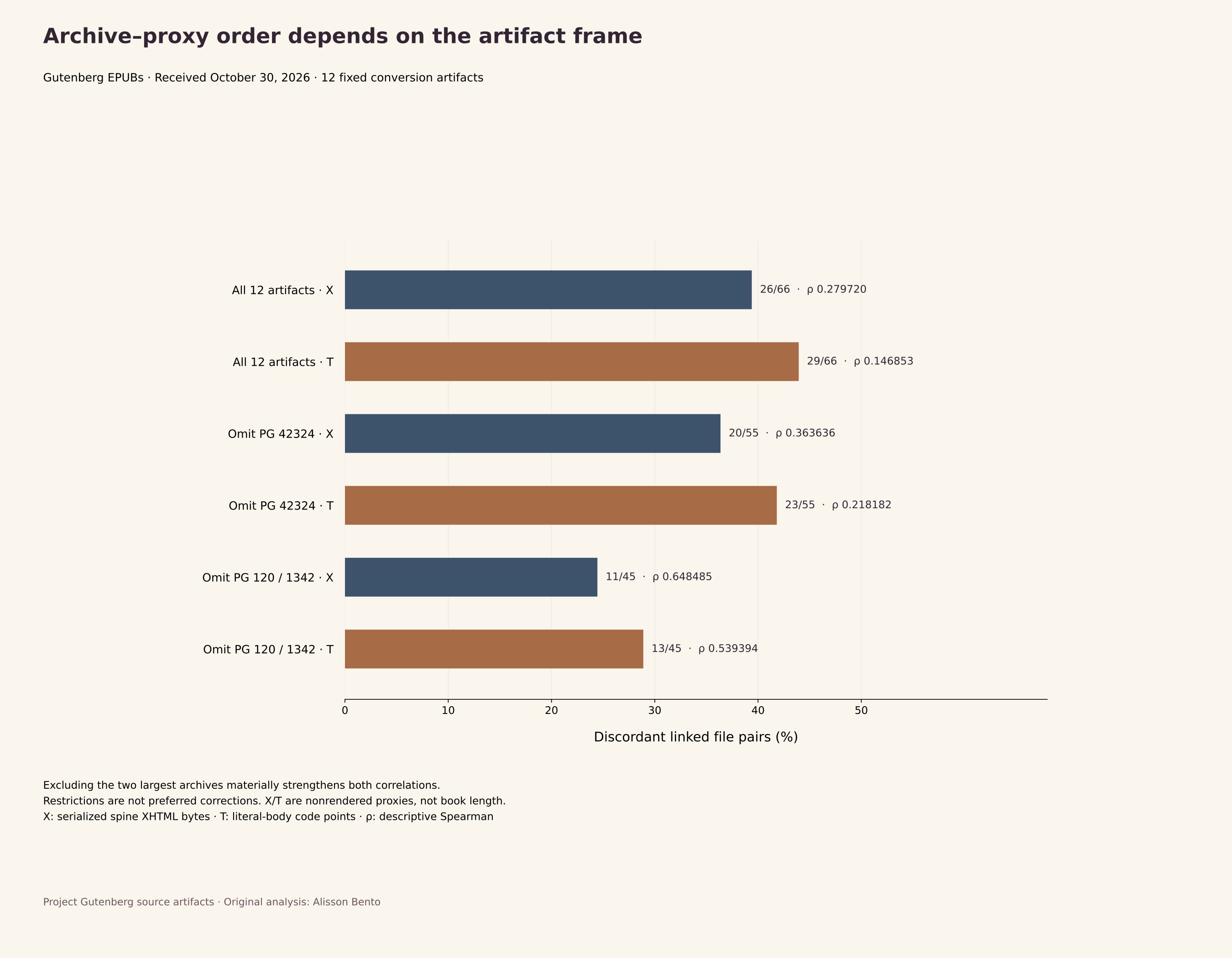
This analysis measures twelve fixed Project Gutenberg EPUB3 image-variant artifacts received on October 30, 2026. Two files cross the image-majority threshold when the denominator changes: declared images exceed half of received archive bytes but occupy less than half of uncompressed member bytes. Separately, received archive order disagrees with the order of two explicit, nonrendered text proxies in 26 and 29 of the 66 file pairs. These are finite accounting results for conversion artifacts, not estimates about ebooks or independent literary works generally.
The connected lesson is to label the object being compared before interpreting size. A reader checking a download can distinguish the actual archive body from its internal components. An ebook author or catalog analyst can distinguish an asset inventory from a text proxy. Neither exercise measures displayed pages, validated prose length or reading effort. The results provide reproducible examples of measurement choices; they do not establish that any edition is wasteful, badly illustrated, difficult to read or suitable for deleting assets.
Keep the received artifact frame intact
The twelve files carry Gutenberg identifiers 11, 84, 98, 120, 140, 161, 345, 768, 1260, 1342, 2701 and 42324. Their canonical item pages, actual official mirror URLs, received dates, byte sizes and original archive fingerprints are listed in the evidence downloads. The set was inherited unchanged from an earlier structural examination. It was not selected to represent a genre, an author population or the distribution of contemporary EPUB production. Each observation is one exact received conversion artifact, not a timeless property of a title.
The frame includes Alice’s Adventures in Wonderland, A Tale of Two Cities, Treasure Island, The Jungle, Sense and Sensibility, Dracula, Wuthering Heights, Jane Eyre, Pride and Prejudice and Moby Dick, alongside two Frankenstein transcriptions. The two Frankenstein files must remain separate file cases without becoming independent literary works. Differences between them cannot be attributed solely to packaging: their textual and editorial content has not been validated as equivalent. Likewise, the image-variant filenames describe the received files, not a controlled comparison with image-free editions.
These are the same retained binaries used in a navigation audit, but this question is different. That audit found resolved navigation targets and did not support a standalone missing-chapter claim. Navigation-failure and accessibility claims are outside this analysis. Here the observations concern declared member roles, byte accounting, compression states and finite order comparisons. No EPUB was fetched again to obtain a more favorable version. A changed future official file would be another artifact, and its measurements should not silently replace this dated source frame.
Separate archive bytes from member bytes
Let A denote the bytes in the received archive body. Let C be the sum of ZIP members’ compressed sizes, and U the sum of their uncompressed sizes. The container remainder is O=A−C. Across these twelve artifacts, A totals 91,637,973 bytes, C totals 91,486,377, O totals 151,596 and U totals 97,688,762. Container structures are not another content member, and their bytes are not added to U. Keeping the remainder visible prevents role shares from silently renormalizing to a different total.
For a role r, the compressed-archive share is C_r/A. The uncompressed-member share is U_r/U. Both are useful, but they are not interchangeable percentages. The first includes the ZIP container in the denominator; the second concerns members after ZIP decompression and excludes the container. “Uncompressed” here refers only to the ZIP layer. An encoded JPEG or other image file remains an encoded file, not a count of raw pixels. U also does not represent working memory, screen rendering or device resource requirements.
A compression ratio U_r/C_r is reported only when C_r is positive. An observed role with no members has zero members and zero bytes, but its ratio is undefined rather than zero. That differs from an unavailable source, which would stop verification rather than receive an imputed zero. These distinctions matter especially for fonts and miscellaneous roles, which are observed zero throughout this frame. Zero bytes, an undefined quotient and a missing input describe three different states and should remain distinguishable in any reused spreadsheet or chart.
Classify declared members, not visible illustrations
The classification follows each actual package manifest and spine. It separates package control, navigation, declared cover images, other declared images, provider XHTML, eligible spine XHTML, other XHTML, stylesheets, fonts, other declared material and unmanifested other material. Every file retains all eleven role rows, including observed zeros. Cover classification uses the package’s cover declaration rather than a guess from a filename or appearance. Provider header and footer documents and navigation are separated from the eligible spine text measurements instead of being silently counted as literary content.
Across all files, the ledger contains 1,006 ZIP members. There are 398 declared image members: twelve declared covers and 386 other images. Every declared image member is ZIP-stored, so its compressed and uncompressed member-byte counts are equal. By contrast, the 412 eligible spine XHTML documents occupy 8,608,444 uncompressed bytes and 3,520,103 compressed bytes. The different treatment of these recorded member types changes their relative weight when the denominator moves between archive and uncompressed-member accounting. It does not imply a universal rule for all EPUB converters.
Six artifacts have a declared cover and no other declared image members: identifiers 11, 84, 140, 161, 768 and 2701. This is an inventory statement, not proof that their rendered pages contain no other illustrations. Embedded data images, remote references, layout effects and actual image visibility are outside this member inventory. A cover declaration likewise establishes neither an image’s quality nor how a reading application displays it. The analysis deliberately stops before those visual and functional questions, which would require different evidence and methods.
Two image majorities depend on the denominator
For Alice’s Adventures in Wonderland, identifier 11, the declared image member contributes 104,775 bytes. Relative to the 189,249-byte received archive, that is 55.36%. Relative to 314,264 uncompressed member bytes, the same encoded image contributes 33.34%. The image bytes have not disappeared or changed quality between these calculations. Instead, decompressed nonimage members contribute more to the second denominator. “Image-majority archive” and “not image-majority uncompressed members” are therefore simultaneously accurate descriptions, provided each phrase names its own accounting state.
Identifier 84, Frankenstein, shows the second crossing. Its 224,340 declared image bytes are 50.97% of a 440,131-byte received archive, but 31.02% of its 723,302 uncompressed member bytes. Both examples have only a declared cover in this member inventory. Their results consequently do not depend on a large set of separately declared interior images. The paired bars retain every artifact, rather than displaying only the crossings, so the reader can see these examples alongside cases in which both percentages remain on the same side of half.
The other files illustrate substantial variation without requiring a threshold crossing. Moby Dick’s image shares are 31.57% and 14.44%, while Treasure Island’s are 99.41% and 98.74%. These percentages describe the specified artifacts and denominators, not a hierarchy of editorial merit. A high share can coexist with useful illustrations, just as a low share does not certify accessibility or small displayed pages. The sensible interpretation is a precise account of what occupies bytes, not a recommendation that one composition is intrinsically preferable.
Define text proxies without pretending to render
The first proxy, X, is the uncompressed serialized byte count of eligible spine XHTML, excluding navigation and provider header/footer documents. Serialized markup is part of that measurement. So are any front matter, captions and other material present in those documents. X is easy to reproduce from package structure, but it is not a validated novel word count or a measurement of visible text. Differences in markup, character encoding and document construction can affect X even when a reader’s displayed experience might be similar.
The second proxy, T, counts whitespace-normalized literal body code points under an explicit extraction convention. Retained element text and child tails are collected in document order; script and style subtrees are skipped, while each skipped element’s own following tail is retained by its parent. Collected runs are joined with one inserted ASCII space, then Unicode whitespace is collapsed with split-and-join. Counts are summed across documents without adding an interdocument separator. No case folding, hyphen repair, word tokenization or Unicode normalization is performed.
Those inserted node separators are a machine convention, not a claim that the displayed page contains a space at every element boundary. T also does not determine CSS visibility, identify all nonprose content or establish equivalent editions. The exact separator rule was documented after the first T computation to remove ambiguity, without changing the implemented rule or results. It must not be described as an outcome-blind preregistered detail. Using both proxies makes their definitions inspectable; agreement between them would still not transform either into literary length or reading time.
Compare finite orders rather than predict books
For each proxy, every unordered pair of the twelve artifacts is compared with received archive size. A strict discordance occurs when the larger archive has the smaller proxy value, or conversely. Strict concordances and ties are retained separately. There are 66 linked pairs, not 66 independently sampled observations. In the complete frame, X yields 40 concordances and 26 discordances; T yields 37 and 29. Neither archive nor proxy ties occur. The pair ledger preserves the actual cases behind those totals rather than turning a correlation alone into the result.
Descriptive Spearman correlations are 0.279720 for archive size versus X and 0.146853 for archive size versus T, rounded to six decimals. These summarize order association within the fixed panel. They are not prediction accuracy scores, population parameters or evidence that archive size can never be informative elsewhere. Because each artifact participates in multiple comparisons, the pair totals should not be fed into a simple independent-trials model. No significance tests, confidence intervals or general ebook-size model are supplied for this deliberately bounded comparison.
One concrete contrast makes the units easier to inspect. Treasure Island, identifier 120, is the largest received archive at 49,452,703 bytes, but X is 467,048 and T is 359,153. Moby Dick, identifier 2701, has an 814,023-byte archive, yet X is 1,299,019 and T is 1,113,194. The comparison shows an order mismatch between these recorded quantities, not that one novel is longer in a validated literary sense. Nor does it isolate an image-removal effect, since no counterfactual package or content-equivalent reconstruction was produced.
Show how the largest artifacts influence the result
Removing identifiers 120 and 1342, the two largest received archives, materially strengthens the associations. Among the remaining ten artifacts, the correlations rise to 0.648485 for X and 0.539394 for T. Discordances fall to 11 and 13 of 45 pairs, respectively. This is an important qualification, not a footnote that can be summarized as “the outliers do not matter.” They do matter to the strength of these finite associations. The remaining mismatches show that the order difference is not confined entirely to those two files.
A second restriction omits identifier 42324, the higher-identifier Frankenstein transcription. The remaining eleven artifacts produce 20 X discordances and 23 T discordances out of 55 pairs, with correlations of 0.363636 and 0.218182. The two image-majority crossings remain in both restrictions. These calculations expose dependence on a duplicated-work file and on the largest archives without treating either restriction as a corrected or preferred sample. All twelve artifacts remain the main frame, and no literary equivalence between the two Frankenstein transcriptions is asserted.
The two-largest restriction was specified with prior knowledge of archive sizes from the inherited source manifest. The new protocol therefore cannot claim complete outcome blindness. It fixed the accounting and comparison rules before the new role/proxy outcomes, but source and size preview had already occurred. The later T clarification adds another disclosed timing boundary. These restrictions are transparent descriptive sensitivities, not independent validation samples or a license to select whichever coefficient makes the strongest headline. Readers should retain the full panel alongside both restricted views.
Read pooled totals and rounded percentages carefully
The pooled role ledger adds bytes across artifacts; it does not average twelve ebook compositions. A large archive contributes more bytes to that pooled accounting than a small one. Thus a pooled image share would answer a volume-weighted inventory question, not describe the typical artifact or the proportion of titles with an image majority. The file-level table is the appropriate place to inspect that variation. Keeping both levels available avoids silently allowing the two largest packages to define an allegedly typical book.
Percentage-point differences also need their own label. Alice’s two image shares differ by about 22.02 percentage points, computed from the underlying unrounded shares. That is not a measured reduction in image bytes, nor a 22.02% improvement in anything. The numerator is unchanged. A relative percentage change would use another formula and answer another question. The majority flag merely tests whether the defined share exceeds 50%; it does not grade the magnitude or usefulness of the image inventory.
Displayed percentages round to two decimals and correlations to six, while the evidence inputs retain the underlying byte integers and computed values. Majority flags and pair directions are calculated before display rounding. That rule matters because a rounded equality need not be an actual tie in another panel. Here there are no archive or proxy ties, but the comparison ledger still carries separate tie states. Reusing the rounded presentation table for exact recomputation would discard information that the compact machine-readable inputs deliberately preserve.
Use the distinctions in a reader or author workflow
For a reader, the immediate question may be as simple as what an advertised download size actually measures. The received archive-body count is the relevant quantity in this ledger, while member totals answer a different inspection question. Neither number, by itself, establishes how many pages an application will show. Keeping the snapshot date and actual variant URL prevents an edition label from standing in for an exact file. That is particularly useful when a distributor can regenerate an EPUB without changing the familiar title of the underlying work.
For an ebook author or editor, the role ledger provides a way to discuss packaging without mistaking a percentage for a quality verdict. A report can identify declared image files, distinguish covers from other declared images and explain whether percentages use compressed or uncompressed bytes. It can also keep navigation, provider documents and container overhead visible. Those distinctions make a technical conversation reproducible. They do not establish which assets should be deleted, whether images should be recompressed, or whether a change would preserve the intended reading experience.
For a catalog analyst, the order comparison warns against substituting an unlabeled “book size” field for a defined text quantity. The stronger correlations after excluding the largest artifacts also show why the complete panel matters: there is no single coefficient that removes the need to inspect cases. A defensible reuse would name the exact source frame, proxy and accounting state, then reproduce the relevant finite comparisons. It would not export this panel’s coefficients as a prediction rule for another catalog, another format or future Gutenberg conversions.
Reproduce compact facts without redistributing books
The public evidence bundle contains selected role-byte inputs, text-proxy values, source archive references, derived file and role metrics, all finite pair comparisons and a summary. Its aggregate reproducer runs from those compact inputs with explicit input and output directories. A separate optional measurement script can inspect separately obtained exact official EPUBs after checking their archive hashes. It makes no source requests and outputs numeric measurements rather than book content. The public checksum list describes the compact distributed files; original archive fingerprints identify external source artifacts that are not bundled.
The source archives remain private retained inputs. No complete novel text, extracted body text, cover or illustration is included in the public bundle, and the internal member-name ledger is not a download. Source authors and Project Gutenberg are credited separately from Alisson Bento’s original calculations and explanation. Each retained package carries a United States public-domain marking and the Gutenberg licence. Those markings and the cited policy do not establish worldwide copyright clearance, remove trademark conditions or supply a blanket licence for the entire article or every possible downstream use.
The final result is deliberately narrower than a verdict about ebooks. Two majority classifications change with the accounting denominator, and the finite archive orders differ from two explicitly nonrendered proxies. The largest artifacts materially influence the order summaries, while mismatches and majority crossings remain in the stated restrictions. These findings support careful unit labels and inspectable examples, not claims about navigation failures, visual quality, reading time, wire traffic, latency, memory or device performance. Preserving those boundaries is what makes the small fixed panel useful rather than merely a collection of impressive file sizes.
Declared image shares: two accounting states
Gutenberg EPUBs · Received October 30, 2026 · 12 fixed conversion artifacts
Full chart and source

Scroll horizontally to inspect the chart. ↔
Chart and values
Scroll horizontally to see all columns.
| Gutenberg artifact | Received A (bytes) | Declared image C (bytes) | Uncompressed U (bytes) | Image C_img/A (%) | Image U_img/U (%) | Majority crossing (1=yes) |
|---|---|---|---|---|---|---|
| PG 11 | 189,249 | 104,775 | 314,264 | 55.36 | 33.34 | 1 |
| PG 84 | 440,131 | 224,340 | 723,302 | 50.97 | 31.02 | 1 |
| PG 98 | 7,923,060 | 7,512,341 | 8,559,932 | 94.82 | 87.76 | 0 |
| PG 120 | 49,452,703 | 49,162,018 | 49,789,786 | 99.41 | 98.74 | 0 |
| PG 140 | 615,474 | 242,178 | 1,149,729 | 39.35 | 21.06 | 0 |
| PG 161 | 580,103 | 242,125 | 1,036,582 | 41.74 | 23.36 | 0 |
| PG 345 | 602,902 | 209,921 | 1,157,585 | 34.82 | 18.13 | 0 |
| PG 768 | 587,952 | 254,472 | 1,007,298 | 43.28 | 25.26 | 0 |
| PG 1260 | 3,095,830 | 2,574,499 | 3,779,323 | 83.16 | 68.12 | 0 |
| PG 1342 | 24,864,457 | 24,512,383 | 25,607,139 | 98.58 | 95.72 | 0 |
| PG 2701 | 814,023 | 257,017 | 1,780,233 | 31.57 | 14.44 | 0 |
| PG 42324 | 2,472,089 | 2,280,260 | 2,783,589 | 92.24 | 81.92 | 0 |
All twelve fixed artifacts received October 30, 2026. C_img/A uses received archive-body bytes; U_img/U uses uncompressed member bytes. Declared image members only, including declared covers; not rendered or embedded illustration counts. Percentages round to two decimals; majority flags use unrounded shares. Identifiers denote files, not independent literary works.

Archive–proxy order depends on the artifact frame
Gutenberg EPUBs · Received October 30, 2026 · 12 fixed conversion artifacts
Full chart and source
Scroll horizontally to inspect the chart. ↔
Chart and values
Scroll horizontally to see all columns.
| Fixed artifact frame | Proxy | Files | Pairs | Concordant | Discordant | Archive ties | Proxy ties | Both ties | Spearman rho |
|---|---|---|---|---|---|---|---|---|---|
| All fixed artifacts | X | 12 | 66 | 40 | 26 | 0 | 0 | 0 | 0.279720 |
| All fixed artifacts | T | 12 | 66 | 37 | 29 | 0 | 0 | 0 | 0.146853 |
| Omit PG 42324 only | X | 11 | 55 | 35 | 20 | 0 | 0 | 0 | 0.363636 |
| Omit PG 42324 only | T | 11 | 55 | 32 | 23 | 0 | 0 | 0 | 0.218182 |
| Omit PG 120 and 1342 | X | 10 | 45 | 34 | 11 | 0 | 0 | 0 | 0.648485 |
| Omit PG 120 and 1342 | T | 10 | 45 | 32 | 13 | 0 | 0 | 0 | 0.539394 |
X=uncompressed serialized eligible spine XHTML bytes; T=normalized literal-body code points with inserted node-run separators. Neither is displayed length or validated prose length. Every unordered pair is linked within its fixed frame. Spearman is descriptive, rounded to six decimals, with no p-values or confidence intervals. Restrictions are diagnostics, not preferred corrections; known source-size preview preceded their specification.

Data & downloads
Scroll horizontally to see all columns.
| Gutenberg artifact | Received A (bytes) | Declared image C (bytes) | Uncompressed U (bytes) | Image C_img/A (%) | Image U_img/U (%) | Majority crossing (1=yes) |
|---|---|---|---|---|---|---|
| PG 11 | 189,249 | 104,775 | 314,264 | 55.36 | 33.34 | 1 |
| PG 84 | 440,131 | 224,340 | 723,302 | 50.97 | 31.02 | 1 |
| PG 98 | 7,923,060 | 7,512,341 | 8,559,932 | 94.82 | 87.76 | 0 |
| PG 120 | 49,452,703 | 49,162,018 | 49,789,786 | 99.41 | 98.74 | 0 |
| PG 140 | 615,474 | 242,178 | 1,149,729 | 39.35 | 21.06 | 0 |
| PG 161 | 580,103 | 242,125 | 1,036,582 | 41.74 | 23.36 | 0 |
| PG 345 | 602,902 | 209,921 | 1,157,585 | 34.82 | 18.13 | 0 |
| PG 768 | 587,952 | 254,472 | 1,007,298 | 43.28 | 25.26 | 0 |
| PG 1260 | 3,095,830 | 2,574,499 | 3,779,323 | 83.16 | 68.12 | 0 |
| PG 1342 | 24,864,457 | 24,512,383 | 25,607,139 | 98.58 | 95.72 | 0 |
| PG 2701 | 814,023 | 257,017 | 1,780,233 | 31.57 | 14.44 | 0 |
| PG 42324 | 2,472,089 | 2,280,260 | 2,783,589 | 92.24 | 81.92 | 0 |
All twelve fixed artifacts received October 30, 2026. C_img/A uses received archive-body bytes; U_img/U uses uncompressed member bytes. Declared image members only, including declared covers; not rendered or embedded illustration counts. Percentages round to two decimals; majority flags use unrounded shares. Identifiers denote files, not independent literary works.
Scroll horizontally to see all columns.
| Fixed artifact frame | Proxy | Files | Pairs | Concordant | Discordant | Archive ties | Proxy ties | Both ties | Spearman rho |
|---|---|---|---|---|---|---|---|---|---|
| All fixed artifacts | X | 12 | 66 | 40 | 26 | 0 | 0 | 0 | 0.279720 |
| All fixed artifacts | T | 12 | 66 | 37 | 29 | 0 | 0 | 0 | 0.146853 |
| Omit PG 42324 only | X | 11 | 55 | 35 | 20 | 0 | 0 | 0 | 0.363636 |
| Omit PG 42324 only | T | 11 | 55 | 32 | 23 | 0 | 0 | 0 | 0.218182 |
| Omit PG 120 and 1342 | X | 10 | 45 | 34 | 11 | 0 | 0 | 0 | 0.648485 |
| Omit PG 120 and 1342 | T | 10 | 45 | 32 | 13 | 0 | 0 | 0 | 0.539394 |
X=uncompressed serialized eligible spine XHTML bytes; T=normalized literal-body code points with inserted node-run separators. Neither is displayed length or validated prose length. Every unordered pair is linked within its fixed frame. Spearman is descriptive, rounded to six decimals, with no p-values or confidence intervals. Restrictions are diagnostics, not preferred corrections; known source-size preview preceded their specification.
Scroll horizontally to see all columns.
| Declared/member role | Members | Compressed C_r (bytes) | Uncompressed U_r (bytes) | U_r/C_r |
|---|---|---|---|---|
| Package/control | 36 | 29,306 | 172,397 | 5.882652 |
| Navigation | 24 | 45,659 | 387,227 | 8.480847 |
| Declared cover images | 12 | 2,743,502 | 2,743,502 | 1.000000 |
| Other declared images | 386 | 84,832,827 | 84,832,827 | 1.000000 |
| Provider XHTML | 24 | 270,425 | 771,931 | 2.854510 |
| Eligible spine XHTML | 412 | 3,520,103 | 8,608,444 | 2.445509 |
| Other XHTML | 0 | 0 | 0 | Undefined (zero compressed bytes) |
| Stylesheets | 112 | 44,555 | 172,434 | 3.870138 |
| Fonts | 0 | 0 | 0 | Undefined (zero compressed bytes) |
| Other declared | 0 | 0 | 0 | Undefined (zero compressed bytes) |
| Unmanifested other | 0 | 0 | 0 | Undefined (zero compressed bytes) |
Byte sums across all twelve artifacts, not the average composition of a book. Compressed member bytes sum to C=91,486,377, not A. Container overhead O=151,596 is separately A−C and is not a media member or part of U. Zero-member roles are observed absence; their U/C is undefined, not zero or a missing source. Image-file bytes remain encoded image bytes, not raw pixels.
Scroll horizontally to see all columns.
| Gutenberg artifact | Received A (bytes) | Compressed members C (bytes) | Container O (bytes) | Uncompressed U (bytes) | Serialized spine X (bytes) | Literal body T (code points) |
|---|---|---|---|---|---|---|
| PG 11 | 189,249 | 185,883 | 3,366 | 314,264 | 168,759 | 142,244 |
| PG 84 | 440,131 | 434,011 | 6,120 | 723,302 | 452,075 | 418,114 |
| PG 98 | 7,923,060 | 7,904,510 | 18,550 | 8,559,932 | 949,314 | 751,407 |
| PG 120 | 49,452,703 | 49,408,691 | 44,012 | 49,789,786 | 467,048 | 359,153 |
| PG 140 | 615,474 | 608,964 | 6,510 | 1,149,729 | 855,571 | 805,861 |
| PG 161 | 580,103 | 570,581 | 9,522 | 1,036,582 | 730,802 | 666,929 |
| PG 345 | 602,902 | 596,404 | 6,498 | 1,157,585 | 897,699 | 834,892 |
| PG 768 | 587,952 | 580,950 | 7,002 | 1,007,298 | 703,951 | 642,920 |
| PG 1260 | 3,095,830 | 3,079,104 | 16,726 | 3,779,323 | 1,122,265 | 1,016,740 |
| PG 1342 | 24,864,457 | 24,837,583 | 26,874 | 25,607,139 | 693,662 | 599,785 |
| PG 2701 | 814,023 | 810,935 | 3,088 | 1,780,233 | 1,299,019 | 1,113,194 |
| PG 42324 | 2,472,089 | 2,468,761 | 3,328 | 2,783,589 | 268,279 | 258,014 |
A=C+O. U is the sum of uncompressed ZIP members and excludes container overhead O. X is a subset of U, not all text or prose; T is a machine literal-body code-point proxy, not words or pages. Archive-body bytes are not HTTP wire-size; U is not RAM. All counts are exact integers. Title and author attribution appear with exact artifact sources.
Evidence & method
How we calculated it
- Retain exactly the twelve official EPUB3 image-variant archive bodies received October 30, 2026: IDs 11, 84, 98, 120, 140, 161, 345, 768, 1260, 1342, 2701 and 42324. Validate actual original archive hashes, ZIP CRCs, package declarations and spine targets; no source replacement or new fetch.
- Measure received archive bytes A, compressed member sum C, uncompressed member sum U and separate container overhead O=A−C. For each role, use C_r/A for compressed archive share and U_r/U for uncompressed member share. U_r/C_r is defined only for positive C_r; explicit observed zero roles are not missing sources.
- Classify every member once using actual package declarations and spine: package/control, navigation, declared cover image, other declared image, provider XHTML, eligible spine XHTML, other XHTML, stylesheet, font, other declared and unmanifested other. Count declared image MEMBERS only, not rendered, embedded or remote illustrations.
- Define X as uncompressed serialized eligible spine XHTML bytes excluding navigation and provider header/footer. Define T per body by collecting retained .text/.tail in document order, skipping script/style interiors but retaining their own following tails, inserting one ASCII space between runs, collapsing Unicode whitespace with split-and-join, counting code points and summing documents without interdocument separators. No rendering, words or pages are measured.
- Compare all unordered file pairs for A versus X and A versus T. Retain strict concordances, discordances and separate tie states. Calculate descriptive Spearman correlations with average ranks for ties. Do not treat linked pairs as independent trials or supply inferential intervals or predictive claims.
- Keep all twelve main artifacts. Separately recompute after omitting higher-identifier Frankenstein PG 42324 and after omitting the two largest archives PG 120/1342. These are disclosed, nonpreferred restrictions. Source/size preview preceded the protocol; the unchanged T separator convention was clarified after its first computation, not preregistered blindly.
- Reproduce all four derived aggregate outputs from compact selected factual inputs in a clean folder. Optional original measurement uses separately obtained exact official EPUBs with hash and CRC checks. Display percentages to two decimals and correlations/factors to six; compute flags/orders before rounding. No source text, cover, illustration or private member-name ledger is distributed.
What the data cannot tell us
- Twelve purposively retained conversion artifacts, including two Frankenstein transcriptions, are not twelve independent works or a representative sample of Gutenberg, ebooks, authors or formats. Content equivalence between versions is unverified.
- A counts received archive-body bytes, not HTTP headers or transfer-layer wire-size. U counts decompressed ZIP member bytes, not RAM, rendered pages, reading time, latency, device performance or delivery charges. Encoded image files are not raw pixels.
- Image and cover roles describe declared package members. They do not inventory rendered or embedded illustrations, certify image/cover quality, establish illustration absence or support deleting or recompressing assets.
- X includes serialized markup and possible nonprose content. T is a literal-body code-point convention with inserted node-run spaces, not CSS visibility, validated words, literary length or rendered content equivalence.
- Excluding PG 120/1342 materially increases correlations and lowers discordant-pair counts. Remaining mismatches do not establish general prediction failure; all twelve remain main, and neither restriction is a preferred corrected frame.
- The source manifest and archive sizes were already known before the new protocol. T node separators were explicitly clarified after the first computation without tuning or result changes. No fully outcome-blind preregistration or first-method claim is made.
- File pairs are linked observations within a finite purposive panel. Correlations and order counts are descriptive only, with no p-values, confidence intervals, quality ranking or general population estimate.
- Observed zero roles have zero counts/bytes and undefined compression ratios. They are not missing inputs. Future regenerated official files with different hashes would be different artifacts, not silent substitutes for this snapshot.
- Embedded United States public-domain markings and the full Gutenberg licence do not establish worldwide clearance or a blanket licence for this article. Trademark and jurisdictional conditions remain; no book content or original visual assets are redistributed. Navigation-failure and accessibility claims are outside this analysis.
Original sources
- Project Gutenberg: official generated-content mirroring
Project Gutenberg: official generated-content mirroring: Previously inspected documentation identifies gutenberg.pglaf.org as an alternate generated collection source. The twelve actual received file URLs, UTC dates and real official archive SHA-256 fingerprints appear in source-archives.json; no new requests are made by these scripts. https://www.gutenberg.org/help/mirroring.html
Accessed October 30, 2026
- Project Gutenberg: licence and rights guidance
Project Gutenberg: licence and rights guidance: Previously inspected policy and each retained package’s embedded full licence/US public-domain marking delimit source rights. They do not establish worldwide clearance or license the entire analysis. No ebook text, illustration, cover or logo is redistributed. https://www.gutenberg.org/policy/license.html
Accessed October 30, 2026
- Project Gutenberg EPUB artifact 11: Alice's Adventures in Wonderland
Project Gutenberg EPUB artifact 11: Alice's Adventures in Wonderland: Lewis Carroll. Exact received EPUB3 image variant, 189,249 archive-body bytes; canonical item https://www.gutenberg.org/ebooks/11. Real official archive fingerprint in source-archives.json identifies the separately obtained original, not a distributed ebook. US public-domain marking and embedded Gutenberg licence; no worldwide clearance or content-equivalence claim. https://gutenberg.pglaf.org/cache/epub/11/pg11-images-3.epub
Accessed October 30, 2026
- Project Gutenberg EPUB artifact 84: Frankenstein; or, The modern Prometheus
Project Gutenberg EPUB artifact 84: Frankenstein; or, The modern Prometheus: Mary Wollstonecraft Shelley. Exact received EPUB3 image variant, 440,131 archive-body bytes; canonical item https://www.gutenberg.org/ebooks/84. Real official archive fingerprint in source-archives.json identifies the separately obtained original, not a distributed ebook. US public-domain marking and embedded Gutenberg licence; no worldwide clearance or content-equivalence claim. https://gutenberg.pglaf.org/cache/epub/84/pg84-images-3.epub
Accessed October 30, 2026
- Project Gutenberg EPUB artifact 98: A Tale of Two Cities
Project Gutenberg EPUB artifact 98: A Tale of Two Cities: Charles Dickens. Exact received EPUB3 image variant, 7,923,060 archive-body bytes; canonical item https://www.gutenberg.org/ebooks/98. Real official archive fingerprint in source-archives.json identifies the separately obtained original, not a distributed ebook. US public-domain marking and embedded Gutenberg licence; no worldwide clearance or content-equivalence claim. https://gutenberg.pglaf.org/cache/epub/98/pg98-images-3.epub
Accessed October 30, 2026
- Project Gutenberg EPUB artifact 120: Treasure Island
Project Gutenberg EPUB artifact 120: Treasure Island: Robert Louis Stevenson. Exact received EPUB3 image variant, 49,452,703 archive-body bytes; canonical item https://www.gutenberg.org/ebooks/120. Real official archive fingerprint in source-archives.json identifies the separately obtained original, not a distributed ebook. US public-domain marking and embedded Gutenberg licence; no worldwide clearance or content-equivalence claim. https://gutenberg.pglaf.org/cache/epub/120/pg120-images-3.epub
Accessed October 30, 2026
- Project Gutenberg EPUB artifact 140: The Jungle
Project Gutenberg EPUB artifact 140: The Jungle: Upton Sinclair. Exact received EPUB3 image variant, 615,474 archive-body bytes; canonical item https://www.gutenberg.org/ebooks/140. Real official archive fingerprint in source-archives.json identifies the separately obtained original, not a distributed ebook. US public-domain marking and embedded Gutenberg licence; no worldwide clearance or content-equivalence claim. https://gutenberg.pglaf.org/cache/epub/140/pg140-images-3.epub
Accessed October 30, 2026
- Project Gutenberg EPUB artifact 161: Sense and Sensibility
Project Gutenberg EPUB artifact 161: Sense and Sensibility: Jane Austen. Exact received EPUB3 image variant, 580,103 archive-body bytes; canonical item https://www.gutenberg.org/ebooks/161. Real official archive fingerprint in source-archives.json identifies the separately obtained original, not a distributed ebook. US public-domain marking and embedded Gutenberg licence; no worldwide clearance or content-equivalence claim. https://gutenberg.pglaf.org/cache/epub/161/pg161-images-3.epub
Accessed October 30, 2026
- Project Gutenberg EPUB artifact 345: Dracula
Project Gutenberg EPUB artifact 345: Dracula: Bram Stoker. Exact received EPUB3 image variant, 602,902 archive-body bytes; canonical item https://www.gutenberg.org/ebooks/345. Real official archive fingerprint in source-archives.json identifies the separately obtained original, not a distributed ebook. US public-domain marking and embedded Gutenberg licence; no worldwide clearance or content-equivalence claim. https://gutenberg.pglaf.org/cache/epub/345/pg345-images-3.epub
Accessed October 30, 2026
- Project Gutenberg EPUB artifact 768: Wuthering Heights
Project Gutenberg EPUB artifact 768: Wuthering Heights: Emily Brontë. Exact received EPUB3 image variant, 587,952 archive-body bytes; canonical item https://www.gutenberg.org/ebooks/768. Real official archive fingerprint in source-archives.json identifies the separately obtained original, not a distributed ebook. US public-domain marking and embedded Gutenberg licence; no worldwide clearance or content-equivalence claim. https://gutenberg.pglaf.org/cache/epub/768/pg768-images-3.epub
Accessed October 30, 2026
- Project Gutenberg EPUB artifact 1260: Jane Eyre: An Autobiography
Project Gutenberg EPUB artifact 1260: Jane Eyre: An Autobiography: Charlotte Brontë. Exact received EPUB3 image variant, 3,095,830 archive-body bytes; canonical item https://www.gutenberg.org/ebooks/1260. Real official archive fingerprint in source-archives.json identifies the separately obtained original, not a distributed ebook. US public-domain marking and embedded Gutenberg licence; no worldwide clearance or content-equivalence claim. https://gutenberg.pglaf.org/cache/epub/1260/pg1260-images-3.epub
Accessed October 30, 2026
- Project Gutenberg EPUB artifact 1342: Pride and Prejudice
Project Gutenberg EPUB artifact 1342: Pride and Prejudice: Jane Austen. Exact received EPUB3 image variant, 24,864,457 archive-body bytes; canonical item https://www.gutenberg.org/ebooks/1342. Real official archive fingerprint in source-archives.json identifies the separately obtained original, not a distributed ebook. US public-domain marking and embedded Gutenberg licence; no worldwide clearance or content-equivalence claim. https://gutenberg.pglaf.org/cache/epub/1342/pg1342-images-3.epub
Accessed October 30, 2026
- Project Gutenberg EPUB artifact 2701: Moby Dick; Or, The Whale
Project Gutenberg EPUB artifact 2701: Moby Dick; Or, The Whale: Herman Melville. Exact received EPUB3 image variant, 814,023 archive-body bytes; canonical item https://www.gutenberg.org/ebooks/2701. Real official archive fingerprint in source-archives.json identifies the separately obtained original, not a distributed ebook. US public-domain marking and embedded Gutenberg licence; no worldwide clearance or content-equivalence claim. https://gutenberg.pglaf.org/cache/epub/2701/pg2701-images-3.epub
Accessed October 30, 2026
- Project Gutenberg EPUB artifact 42324: Frankenstein; or, The modern Prometheus
Project Gutenberg EPUB artifact 42324: Frankenstein; or, The modern Prometheus: Mary Wollstonecraft Shelley. Exact received EPUB3 image variant, 2,472,089 archive-body bytes; canonical item https://www.gutenberg.org/ebooks/42324. Real official archive fingerprint in source-archives.json identifies the separately obtained original, not a distributed ebook. US public-domain marking and embedded Gutenberg licence; no worldwide clearance or content-equivalence claim. https://gutenberg.pglaf.org/cache/epub/42324/pg42324-images-3.epub
Accessed October 30, 2026
Cite & reuse this study
Alisson Bento. Inside 12 EPUB Files: Bytes and Text Proxies. 2026, original research. https://alissonbento.com/research/gutenberg-epub-payload-composition-12-artifacts/
Source authors and Project Gutenberg are credited for the exact received EPUB artifacts. Public downloads contain compact factual byte/proxy inputs, original numeric outputs/code, canonical source references and real official archive fingerprints, not ebook text, covers, illustrations or the private member-name ledger. Archive fingerprints identify separately obtained originals; SHA256SUMS.txt hashes the compact files actually distributed. United States public-domain markings and the Gutenberg licence remain subject to jurisdictional and trademark limits; no worldwide clearance, endorsement or blanket article licence is asserted. Original analysis and explanation: Alisson Bento.
Corrections or editorial questions