The answer before the diagram
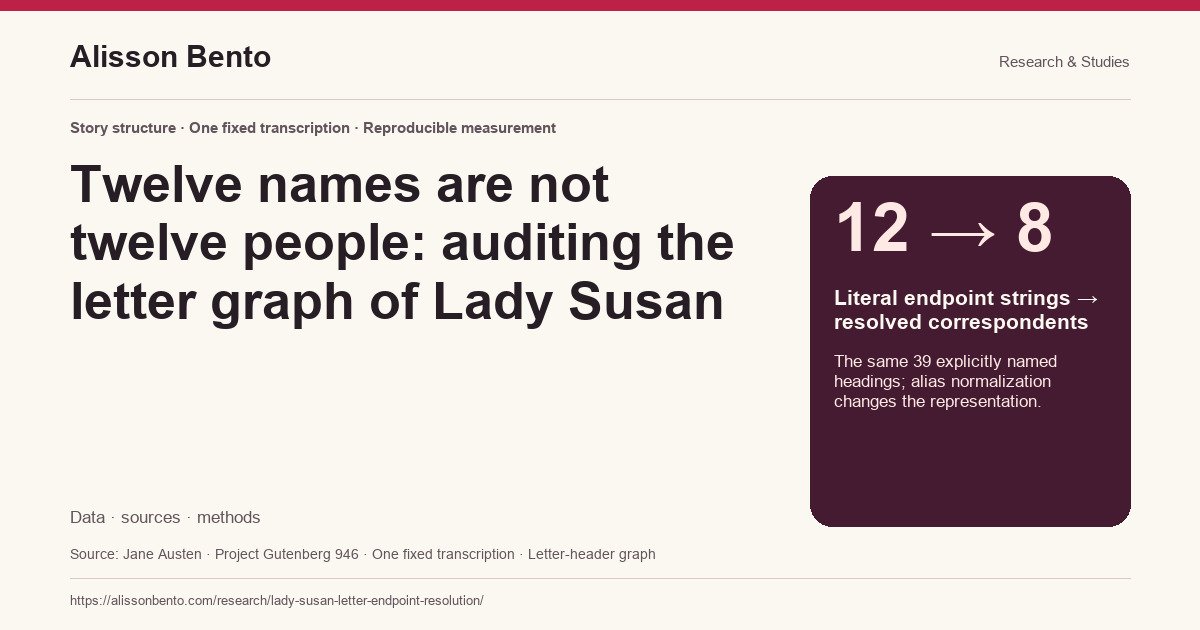
A graph of a novel can look persuasive before its labels have been checked. In one exact digital transcription of Jane Austen’s Lady Susan, taking the explicit letter headings literally produces twelve endpoint strings, sixteen directed connections and two disconnected groups. Applying a declared identity map to the same thirty-nine explicit headings produces eight correspondents, twelve directed connections and one connected group. Nothing in the story has changed. The change comes from how titles, shortened names and a family relationship are represented.
Two further headings replace names with a reference to the previous letter. Resolving those local references restores all forty-one numbered letters, without adding a correspondent or connection. Those two records both belong to the same sender–recipient pair. Omitting them therefore changes the weight attached to that pair, even though a diagram showing only whether a connection exists would look identical.
This is a small, reproducible measurement study for readers, teachers and editors who use diagrams to explain narrative structure. It is not a ranking of Austen’s characters, a test of their influence, or a measurement of all relationships in the fictional world. Its contribution is an inspectable record of what three graph conventions retain, merge and omit in one fixed source.
What the diagram actually represents
The input is Project Gutenberg item 946, Lady Susan, retrieved from an officially listed Project Gutenberg mirror. The catalogue identifies Jane Austen as the author and marks the work public domain in the United States. The downloaded file identifies its most recent update as 8 August 2024. The source fingerprint in the download package identifies the exact bytes used here; a future download with a different fingerprint must not silently replace it.
The unit is a numbered letter heading. A heading supplies a sender and a recipient, or explicitly refers back to the preceding heading. The graph follows that evidence. It does not count every letter mentioned inside the prose, every conversation, everyone who reads another person’s correspondence, or every character who appears in the novella. The prose conclusion is outside the graph because it is not another numbered letter with those endpoints.
The direction runs from the named sender to the named recipient. A weight records how many retained headings share that ordered pair. Three letters from one person to another therefore form one directed connection with weight three. A reverse letter creates a second directed connection. Collapsing those directions instead produces one undirected pair. These are different descriptions of the same table, rather than competing claims about which interpretation of the novel is correct.
This definition also explains the apparent absences. Charles Vernon receives a numbered letter but sends none in this table. Frederica Vernon sends one and receives none. Those zeros concern the retained headings. They do not establish that Charles never writes or Frederica never receives a letter within the fictional world. Reading them as claims about all communication would extend the measurement beyond its evidence.
The first comparison holds the records constant
The literal explicit-only convention retains thirty-nine headings that contain explicit endpoints. It removes the final punctuation mark and otherwise preserves the endpoint strings. For example, a full name, a shorter titled name and an initialed name remain separate labels. This convention is useful as a diagnostic: it shows what happens before identity resolution. It is not presented as a plausible cast list.
The normalized explicit-only convention uses precisely the same thirty-nine records. It merges declared aliases. The three forms referring to Lady Susan are assigned to Lady Susan Vernon. The abbreviated title for Sir Reginald is joined to his fuller title, and the relational recipient in his letter is assigned to Reginald De Courcy, the son. Father and son remain separate people. Other named endpoints receive consistent display names without changing their identities.
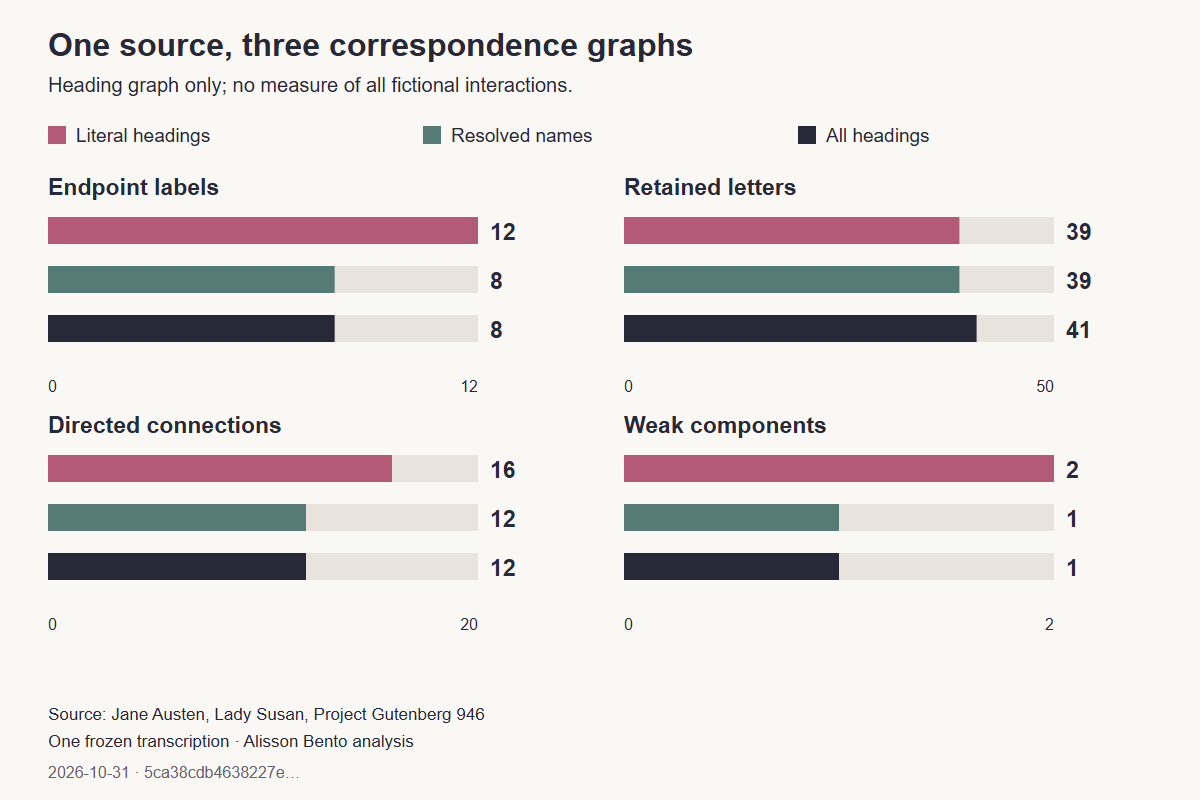
This comparison reduces twelve distinct endpoint strings to eight correspondents. Distinct directed connections fall from sixteen to twelve, while undirected pairs fall from eleven to seven. The literal graph contains two weakly connected components; the normalized graph contains one. A weak component is a group connected by some path after direction is temporarily ignored. It is a property of this encoding, not a claim that the people in one group are socially isolated from the people in another.
The second literal component is especially instructive. The fuller paternal title and the relational label for his son form their own two-label group. Elsewhere, shorter titles refer to those same people. Until the labels are joined, the graph treats those references as separate endpoints. A reader might interpret a disconnected diagram as an intentional narrative division when the division actually comes from inconsistent naming.
No probabilistic name matcher was required for this small dataset. Every alias assignment is listed explicitly and tied to the heading context. That transparency is preferable to hiding a merge inside a software package. In a longer or less explicit work, some identities would remain uncertain, and a responsible table could preserve alternatives rather than forcing all labels into a single cast.
Restoring the two inherited headings changes a different thing
Letters XVIII and XXIV use a heading that points back to the same sender and recipient. The complete convention inherits the immediately preceding resolved endpoints. In both cases, the pair is Catherine Vernon writing to Lady De Courcy. The inherited status and the preceding letter number remain visible in the downloadable table, so the reconstruction can be inspected rather than accepted on trust.
The normalized explicit-only graph contains thirty-nine letters; the complete graph contains forty-one. Both have eight correspondents and twelve directed connections. Both have seven undirected pairs and one weakly connected component. Those unchanged counts do not mean the omitted records are unimportant. The pair from Catherine to Lady De Courcy rises from nine retained letters to eleven. Catherine’s total rises from ten to twelve.
This is the difference between missing an observation and missing a connection. The two inherited headings repeat an existing pair, so a binary network cannot reveal their omission. A weighted network can. The accompanying record table provides the check: all numbered letters must be accounted for before the researcher interprets either diagram.
The complete graph therefore retains two kinds of provenance. Explicit headings retain their literal spellings alongside their normalized endpoints. Inherited headings retain the resolved endpoints and the number of the record from which they inherit. That distinction would be lost if the table contained only a final sender and recipient. A clean display should simplify navigation without erasing the information needed to audit it.
Repetition and range tell different stories
Lady Susan sends sixteen of the forty-one retained letters. Reginald, the son, sends four. Yet each writes to three distinct recipients in this graph. One measure counts repeated acts of writing; the other counts the range of outgoing endpoints. They answer different questions, and neither can automatically replace the other.
The contrast becomes clearer in the underlying pairs. Twelve of Lady Susan’s letters go to Alicia Johnson, one goes to Charles Vernon and three go to Reginald. Reginald’s four outgoing letters are distributed across Catherine Vernon, Lady Susan and his father. Counting each recipient once gives the two characters the same outgoing degree, despite their different letter totals.
Catherine sends twelve letters to two recipients. Eleven go to her mother and one to her brother. A chart that ranks characters by distinct outgoing partners places her below Lady Susan and Reginald. A chart of outgoing letter counts places her between Lady Susan and Alicia Johnson. This is not evidence that one ranking captures her narrative importance more accurately. It is evidence that the charts measure different features of the retained correspondence.
An undirected diagram discards another distinction. Twelve directed connections become seven undirected pairs. Five of those pairs contain letters in both directions; two contain a letter in only one retained direction. A line without arrows can be useful for a readable overview, but its legend should not imply that both participants write to each other in every pair.
The most helpful visual presentation therefore keeps measures separate. One figure compares coverage and graph structure across the three conventions. A second shows outgoing letter counts alongside the number of outgoing partners for every correspondent, including zeros. Neither chart uses node size as an unexplained shorthand for importance. Readers can see the unit of each panel and trace a highlighted value back to the table.
Why network density needs its denominator
Directed density divides the number of distinct directed connections by the number possible among the retained nodes, excluding self-connections. With twelve literal endpoint strings, there are 132 possible ordered pairs; sixteen are observed. With eight normalized correspondents, there are 56 possible ordered pairs; twelve are observed.
The resulting densities are approximately 0.1212 and 0.2143. The second value is larger even though the count of observed connections is smaller. Identity resolution changes both parts of the ratio. Calling the normalized graph “more sociable,” “more cohesive” or “more communicative” would therefore confuse a change in representation with a change in the fictional world.
Density can still be a legitimate descriptive quantity when its construction is visible. Here it helps demonstrate why graph statistics cannot be compared independently of node definitions. The denominator is not a background detail. It is part of the result. The complete convention has the same density as the normalized explicit-only convention because adding the two inherited letters changes weights but adds neither nodes nor distinct connections.
No confidence interval or significance test is attached to these values. This is a complete enumeration of the selected headings in a single frozen transcription, not a random sample of all Austen correspondence, epistolary novels or historical letter-writing. Sampling uncertainty would not address the central issue. The relevant uncertainties concern source identity, unit definition and the declared resolution rules.
What earlier work already establishes
The novella’s epistolary form is established literary knowledge. Suzanne Speidel’s 2020 discussion in Persuasions On-Line describes its forty-one letters and third-person conclusion, examines the relationships between letter writers, and considers how adaptation changes narrative voice. This study does not claim to discover those features or replace that interpretation with counts.
More broadly, Vincent Labatut and Xavier Bost’s survey of fictional character networks describes a mature research field in which extraction choices and interpretation matter. Treating every name as a unique person is not a new methodological problem. Nor is distinguishing weighted, directed and undirected networks a new invention. The purpose here is to make those familiar problems concrete through a complete, downloadable case whose intermediate decisions remain visible.
That boundary matters for reuse. A teacher can use the table to show how a seemingly technical cleaning decision changes a literary diagram. An editor can use it to explain why a graph requires a unit statement and a legend. A researcher can test a parser against the exact source. None should describe the package as a newly discovered account of Austen’s social world or as validated evidence that letter frequency measures agency.
A reproducible workflow that stops on changed inputs
The downloadable program takes a local copy of the exact source file. It makes no network requests. Before parsing, it checks the source’s SHA-256 fingerprint. A mismatch stops the run. This avoids treating a later correction, different transcription or changed line-ending serialization as the same input without review.
For parsing only, the program normalizes line endings. It then identifies consecutively numbered Roman-numeral sections immediately followed by the source’s underscore-wrapped sender-to-recipient headings. It requires the sequence I through XLI. A missing heading, duplicate number or unexpected endpoint spelling stops the calculation rather than silently reducing the dataset.
The output includes the full forty-one-row table, a three-convention summary, the complete directed edge list and correspondent-level counts. The source heading and its normalized character position are retained for checking. That position refers to the normalized retained body, not a print page, a raw byte offset or a location in every edition. The package states this explicitly because a coordinate is only useful when its reference system is known.
The original source file is not redistributed in the public analysis package. Its official locator, fingerprint, byte length and retrieval date are supplied so users can obtain and verify it through a permitted source route. Project Gutenberg’s United States public-domain designation does not establish worldwide permission for every edition or added material. No modern edition’s introduction, annotations or illustrations are needed for the analysis.
How to use the result without overstating it
The practical question is simple: before a character diagram is used to support an argument, what does each node and connection stand for? In this case, a node can be a literal endpoint string or a normalized correspondent. A connection can be an ordered pair of letter headings or a pair without direction. A weight can count repeated letters. Those choices should be stated beside the figure, not left for the reader to guess.
The full table makes the distinction usable. Start with the three conventions, inspect the inherited rows, then compare Lady Susan and Reginald’s outgoing letters with their outgoing partners. The point is not to select the most dramatic statistic. It is to choose a representation that matches the question and retains enough evidence for another reader to challenge it.
Within this single transcription, the difference is substantial enough to see: twelve strings become eight correspondents, a spurious disconnected group disappears, and two omitted records alter a repeated pair without altering the binary graph. Those are measured consequences of explicit rules. The interpretation of Austen’s characters remains a task for reading the novella, its literary context and the arguments of its critics.
One source, three correspondence graphs
Separate panels compare each convention’s labels or correspondents, retained letters, directed dyads and weak components.
Full chart and source

Scroll horizontally to inspect the chart. ↔
Chart and values
Scroll horizontally to see all columns.
| Convention | Letters | Labels / correspondents | Directed dyads | Undirected pairs | Weak components | Directed density |
|---|---|---|---|---|---|---|
| Literal explicit-only | 39 | 12 | 16 | 11 | 2 | 0.1212 |
| Normalized explicit-only | 39 | 8 | 12 | 7 | 1 | 0.2143 |
| Normalized complete | 41 | 8 | 12 | 7 | 1 | 0.2143 |
Literal strings are not persons. Explicit-only conventions omit XVIII and XXIV. Complete convention resolves them locally. Density uses each convention’s own node denominator.
Letters sent and distinct recipients
Each resolved correspondent remains, including Charles’s zero. Two separately scaled columns show letter counts and outgoing partners.
Full chart and source

Scroll horizontally to inspect the chart. ↔
Chart and values
Scroll horizontally to see all columns.
| Correspondent | Sent letters | Received letters | Outgoing partners | Incoming partners |
|---|---|---|---|---|
| Alicia Johnson | 5 | 12 | 1 | 1 |
| Catherine Vernon | 12 | 3 | 2 | 2 |
| Charles Vernon | 0 | 1 | 0 | 1 |
| Frederica Vernon | 1 | 0 | 1 | 0 |
| Lady De Courcy | 2 | 11 | 1 | 1 |
| Lady Susan Vernon | 16 | 7 | 3 | 2 |
| Reginald De Courcy (son) | 4 | 6 | 3 | 4 |
| Sir Reginald De Courcy (father) | 1 | 1 | 1 | 1 |
Counts concern the 41 numbered headings only. Zero does not establish absence from all fictional communication. Father and son remain separate.

Data & downloads
Scroll horizontally to see all columns.
| Convention | Letters | Labels / correspondents | Directed dyads | Undirected pairs | Weak components | Directed density |
|---|---|---|---|---|---|---|
| Literal explicit-only | 39 | 12 | 16 | 11 | 2 | 0.1212 |
| Normalized explicit-only | 39 | 8 | 12 | 7 | 1 | 0.2143 |
| Normalized complete | 41 | 8 | 12 | 7 | 1 | 0.2143 |
Literal strings are not persons. Explicit-only conventions omit XVIII and XXIV. Complete convention resolves them locally. Density uses each convention’s own node denominator.
Scroll horizontally to see all columns.
| Correspondent | Sent letters | Received letters | Outgoing partners | Incoming partners |
|---|---|---|---|---|
| Alicia Johnson | 5 | 12 | 1 | 1 |
| Catherine Vernon | 12 | 3 | 2 | 2 |
| Charles Vernon | 0 | 1 | 0 | 1 |
| Frederica Vernon | 1 | 0 | 1 | 0 |
| Lady De Courcy | 2 | 11 | 1 | 1 |
| Lady Susan Vernon | 16 | 7 | 3 | 2 |
| Reginald De Courcy (son) | 4 | 6 | 3 | 4 |
| Sir Reginald De Courcy (father) | 1 | 1 | 1 | 1 |
Counts concern the 41 numbered headings only. Zero does not establish absence from all fictional communication. Father and son remain separate.
Scroll horizontally to see all columns.
| Letter | Source heading | Resolved sender | Resolved recipient | Inherited from letter |
|---|---|---|---|---|
| I | Lady Susan Vernon to Mr. Vernon. | Lady Susan Vernon | Charles Vernon | — |
| II | Lady Susan Vernon to Mrs. Johnson. | Lady Susan Vernon | Alicia Johnson | — |
| III | Mrs. Vernon to Lady De Courcy. | Catherine Vernon | Lady De Courcy | — |
| IV | Mr. De Courcy to Mrs. Vernon. | Reginald De Courcy (son) | Catherine Vernon | — |
| V | Lady Susan Vernon to Mrs. Johnson. | Lady Susan Vernon | Alicia Johnson | — |
| VI | Mrs. Vernon to Mr. De Courcy. | Catherine Vernon | Reginald De Courcy (son) | — |
| VII | Lady Susan Vernon to Mrs. Johnson. | Lady Susan Vernon | Alicia Johnson | — |
| VIII | Mrs. Vernon to Lady De Courcy. | Catherine Vernon | Lady De Courcy | — |
| IX | Mrs. Johnson to Lady S. Vernon. | Alicia Johnson | Lady Susan Vernon | — |
| X | Lady Susan Vernon to Mrs. Johnson. | Lady Susan Vernon | Alicia Johnson | — |
| XI | Mrs. Vernon to Lady De Courcy. | Catherine Vernon | Lady De Courcy | — |
| XII | Sir Reginald De Courcy to his Son. | Sir Reginald De Courcy (father) | Reginald De Courcy (son) | — |
| XIII | Lady De Courcy to Mrs. Vernon. | Lady De Courcy | Catherine Vernon | — |
| XIV | Mr. De Courcy to Sir Reginald. | Reginald De Courcy (son) | Sir Reginald De Courcy (father) | — |
| XV | Mrs. Vernon to Lady De Courcy. | Catherine Vernon | Lady De Courcy | — |
| XVI | Lady Susan to Mrs. Johnson. | Lady Susan Vernon | Alicia Johnson | — |
| XVII | Mrs. Vernon to Lady De Courcy. | Catherine Vernon | Lady De Courcy | — |
| XVIII | From the same to the same. | Catherine Vernon | Lady De Courcy | 17 |
| XIX | Lady Susan to Mrs. Johnson. | Lady Susan Vernon | Alicia Johnson | — |
| XX | Mrs. Vernon to Lady De Courcy. | Catherine Vernon | Lady De Courcy | — |
| XXI | Miss Vernon to Mr. De Courcy. | Frederica Vernon | Reginald De Courcy (son) | — |
| XXII | Lady Susan to Mrs. Johnson. | Lady Susan Vernon | Alicia Johnson | — |
| XXIII | Mrs. Vernon to Lady De Courcy. | Catherine Vernon | Lady De Courcy | — |
| XXIV | From the same to the same. | Catherine Vernon | Lady De Courcy | 23 |
| XXV | Lady Susan to Mrs. Johnson. | Lady Susan Vernon | Alicia Johnson | — |
| XXVI | Mrs. Johnson to Lady Susan. | Alicia Johnson | Lady Susan Vernon | — |
| XXVII | Mrs. Vernon to Lady De Courcy. | Catherine Vernon | Lady De Courcy | — |
| XXVIII | Mrs. Johnson to Lady Susan. | Alicia Johnson | Lady Susan Vernon | — |
| XXIX | Lady Susan Vernon to Mrs. Johnson. | Lady Susan Vernon | Alicia Johnson | — |
| XXX | Lady Susan Vernon to Mr. De Courcy. | Lady Susan Vernon | Reginald De Courcy (son) | — |
| XXXI | Lady Susan to Mrs. Johnson. | Lady Susan Vernon | Alicia Johnson | — |
| XXXII | Mrs. Johnson to Lady Susan. | Alicia Johnson | Lady Susan Vernon | — |
| XXXIII | Lady Susan to Mrs. Johnson. | Lady Susan Vernon | Alicia Johnson | — |
| XXXIV | Mr. De Courcy to Lady Susan. | Reginald De Courcy (son) | Lady Susan Vernon | — |
| XXXV | Lady Susan to Mr. De Courcy. | Lady Susan Vernon | Reginald De Courcy (son) | — |
| XXXVI | Mr. De Courcy to Lady Susan. | Reginald De Courcy (son) | Lady Susan Vernon | — |
| XXXVII | Lady Susan to Mr. De Courcy. | Lady Susan Vernon | Reginald De Courcy (son) | — |
| XXXVIII | Mrs. Johnson to Lady Susan Vernon. | Alicia Johnson | Lady Susan Vernon | — |
| XXXIX | Lady Susan to Mrs. Johnson. | Lady Susan Vernon | Alicia Johnson | — |
| XL | Lady De Courcy to Mrs. Vernon. | Lady De Courcy | Catherine Vernon | — |
| XLI | Mrs. Vernon to Lady De Courcy. | Catherine Vernon | Lady De Courcy | — |
Original heading spellings remain. XVIII and XXIV inherit the immediately preceding resolved sender and recipient. Exact normalized body coordinates are in the downloadable CSV.
Evidence & method
How we calculated it
- Use the exact Project Gutenberg 946 TXT fingerprint supplied in the source manifest. Parse consecutive Roman-numeral sections I–XLI after newline normalization; exclude the prose conclusion from the heading graph.
- The protocol and alias map were frozen after source identity and heading-format inspection but before graph metrics. Unknown endpoint spellings, a changed source or an unexpected heading sequence stop the run.
- Compare literal explicit-only, normalized explicit-only and normalized complete conventions. The first two use exactly the same 39 observations. The third resolves XVIII and XXIV from the immediately preceding heading.
- Count each ordered sender-recipient pair once for binary directed connections, and retain repeated-letter frequency as its weight. For undirected pairs, collapse direction. Weak components ignore direction when testing paths.
- Directed density is distinct directed dyads divided by n*(n-1), excluding self-connections. No inferential tests or confidence intervals are attached to this finite enumeration.
- Retain literal spellings, resolved endpoints, inherited status and normalized retained-body character coordinates for every letter. Run the supplied standard-library program against the exact local input; no network is needed.
What the data cannot tell us
- One fixed digital transcription, not every print edition, all Austen writing, epistolary fiction generally, or a historical population.
- The input’s exact print-edition identity is not independently established. The update and retrieval dates are not the novella’s original publication date.
- Letter headings are not all letters mentioned, proof of dispatch or delivery, everyone who reads letters, dialogue, all characters, or the complete fictional relationship network.
- The declared alias map distinguishes father and son, and inherited headings use a local preceding-heading convention. It is an explicit interpretation, not a universal automatic entity-resolution standard.
- Letter counts, degree, density and connectedness depend on definitions. None establishes literary importance, agency, sociability, causation, authorial intent or reader comprehension.
- A binary graph conceals the two missing repeated records because they add no new connection. Unchanged topology does not establish complete data.
- Project Gutenberg’s US public-domain designation does not establish worldwide rights for every edition or added material. The public recipe contains derived data and code, not the full novel.
Original sources
- Lady Susan by Jane Austen
The official catalogue identifies the author, item number, 8 August 2024 update and public-domain status in the USA. Its automated summary and reading-level field are not used as evidence in this analysis.
Accessed October 31, 2026
- Exact Lady Susan TXT input
The exact individual TXT file is bound by raw SHA-256 and byte length. The file header update agrees with the catalogue; no exact print-edition match is asserted.
Accessed October 31, 2026
- Project Gutenberg official mirrors
The official mirror list names the PGLAF endpoint used for one individual text acquisition; no website crawl or recursive download was performed.
Accessed October 31, 2026
- Project Gutenberg robot access policy
Project Gutenberg’s access policy distinguishes supported acquisition routes and warns that generated files can change; the analysis preserves exact input fingerprints.
Accessed October 31, 2026
- Project Gutenberg permission how-to
The permission guidance explains jurisdictional and transcription limits. The input designation does not certify permission in every country.
Accessed October 31, 2026
- Project Gutenberg licence
The source licence and trademark conditions remain separate from this original analysis. The complete novel is not redistributed in the public recipe.
Accessed October 31, 2026
- Letters from Page to Screen and Back Again: Jane Austen’s Lady Susan and Whit Stillman’s Two Versions of Love and Friendship
Speidel’s 2020 Persuasions On-Line article supplies prior literary discussion of the established forty-one-letter form, conclusion, correspondents and adaptations; no claim to discover these features is made.
Accessed October 31, 2026
- Extraction and Analysis of Fictional Character Networks: A Survey
Labatut and Bost’s fictional-network survey documents the established extraction and interpretation field. The present contribution is a bounded, fully inspectable case, not invention of name resolution or graph conventions.
Accessed October 31, 2026
Cite & reuse this study
Alisson Bento. 2026. Twelve names are not twelve people: auditing the letter graph of Lady Susan. Original analysis of one exact Project Gutenberg 946 transcription. https://alissonbento.com/research/lady-susan-letter-endpoint-resolution/
Original novel: Jane Austen. Source transcription and catalogue: Project Gutenberg. Original calculations, tables and figure design: Alisson Bento. Retain source identity and the declared scope when citing the analysis. No blanket worldwide licence, source endorsement or licence for third-party scholarship is inferred.
Corrections or editorial questions