What the ranking alone cannot show
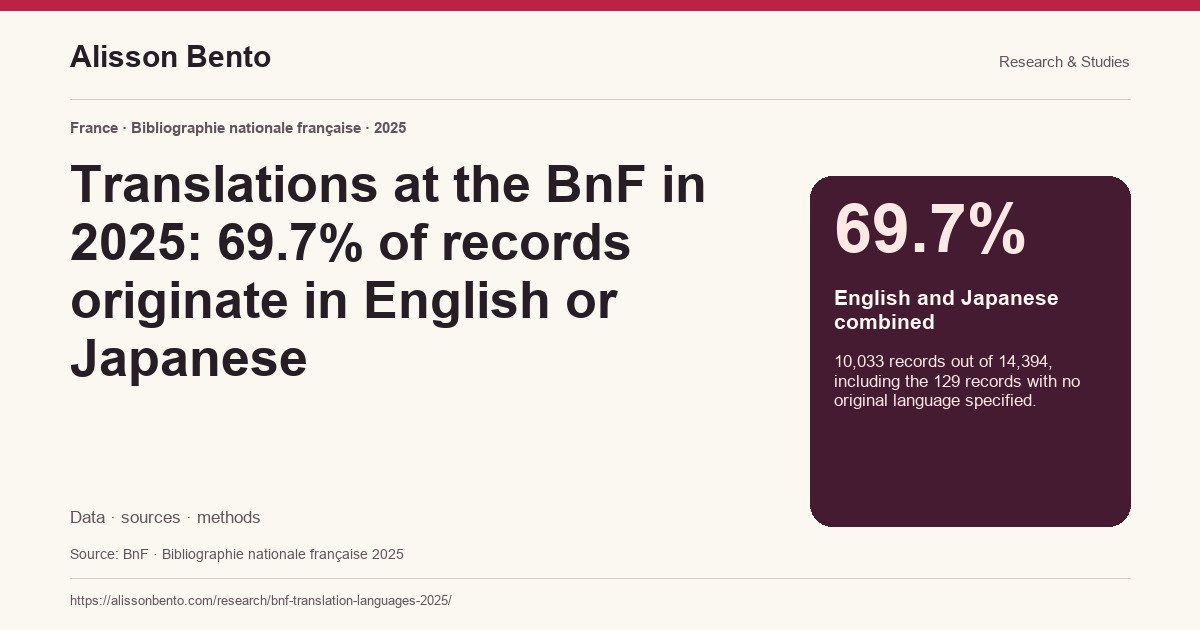
A ranking identifies the most represented languages. It says less about the space left for all the others, or about differences between types of books. We therefore returned to the BnF’s complete bibliographic dataset rather than recalculating shares from the top 15 alone. The file contains 67,498 distinct records published in the Bibliographie nationale française – Livres for 2025; exactly 14,394 carry translation code 1.
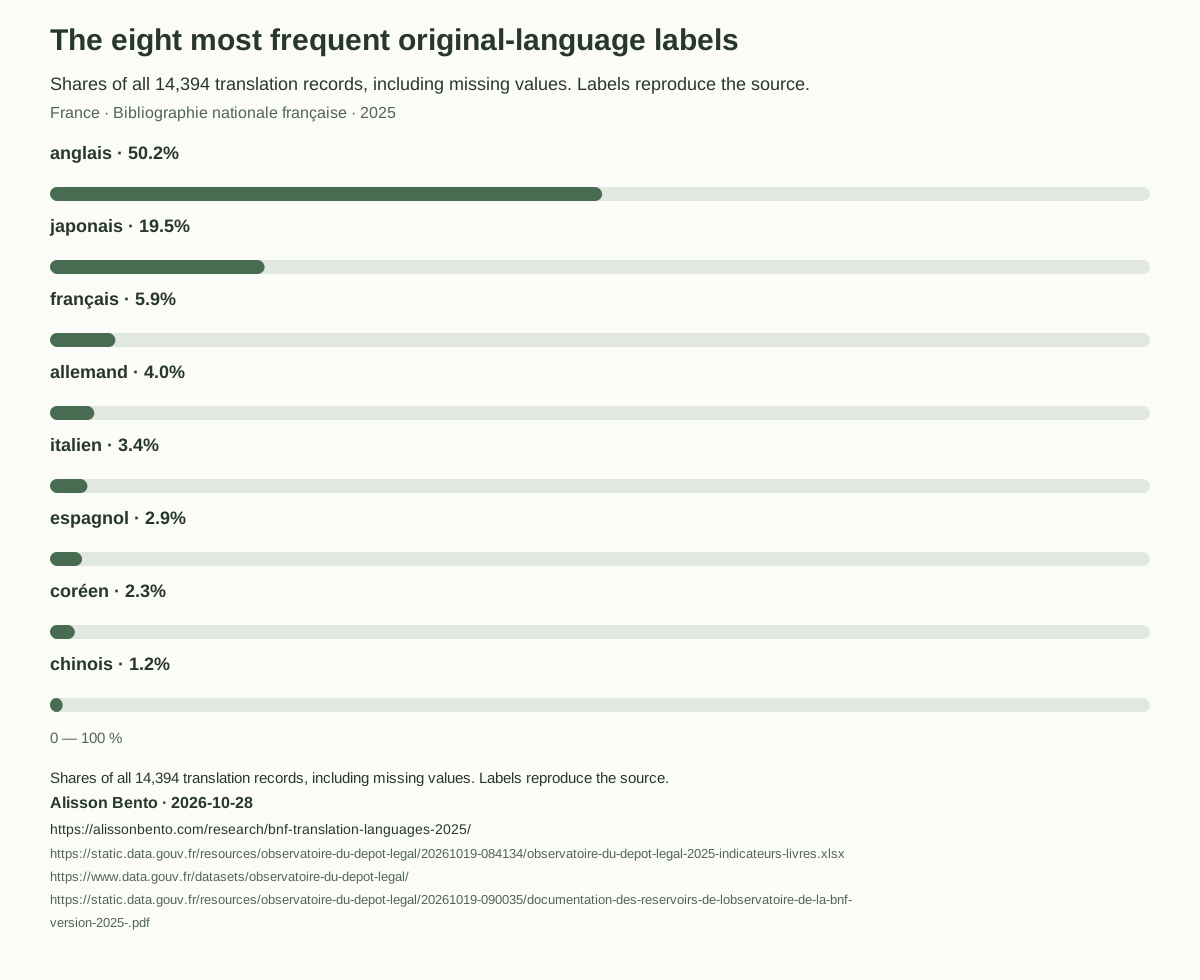
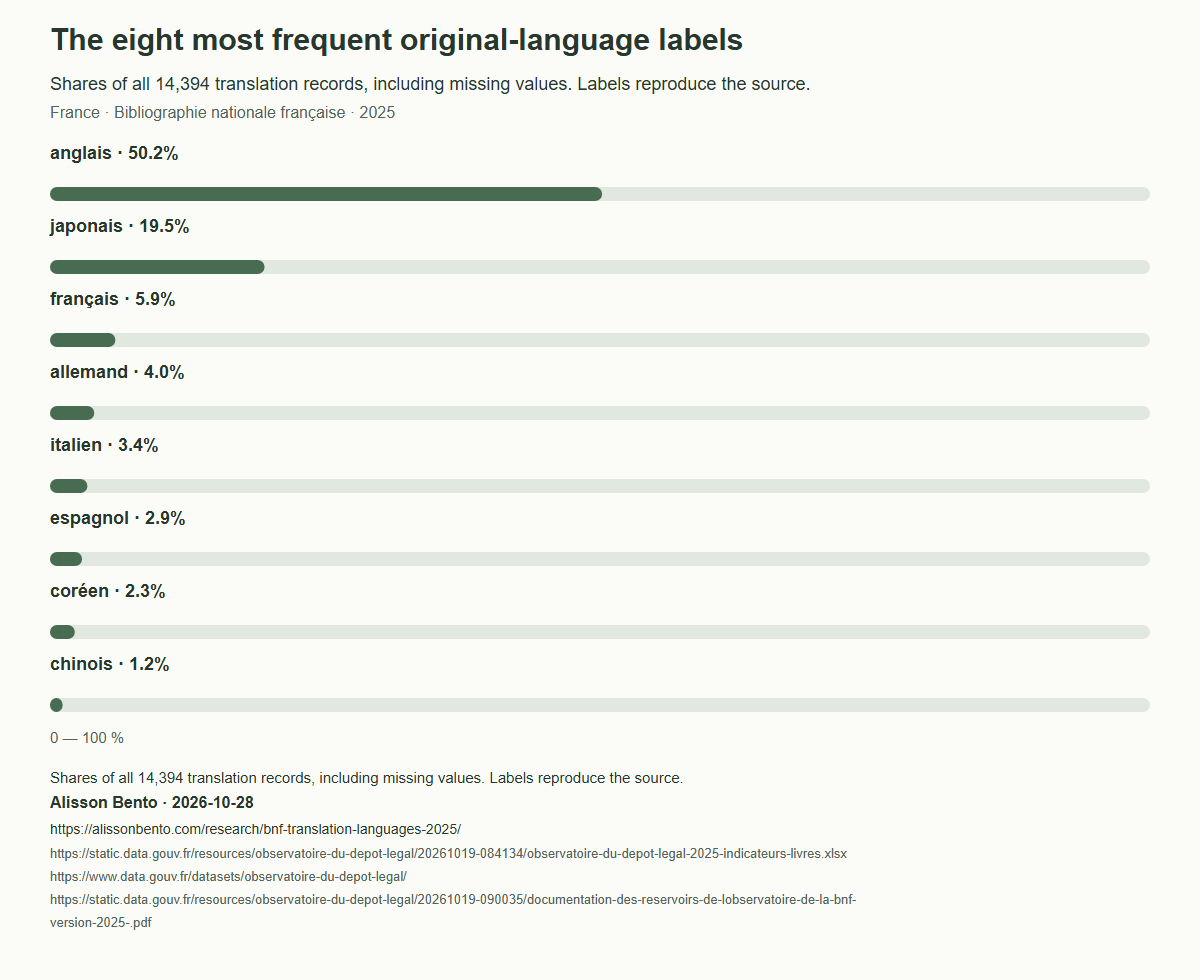
English accounts for 7,225 records in this group and Japanese for 2,808. Their combined total of 10,033 leaves 4,361 records for all other original-language categories and missing values. This is concentration in bibliographic reporting. These figures describe neither sales, library purchases, reading time nor the diversity of books actually read.
Fiction and nonfiction present different pictures
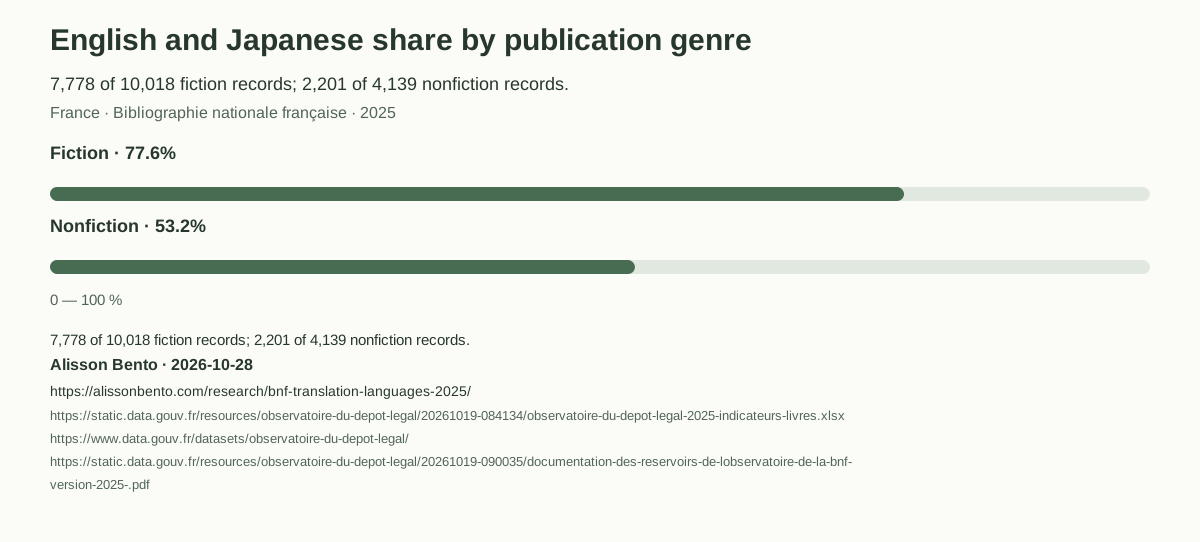
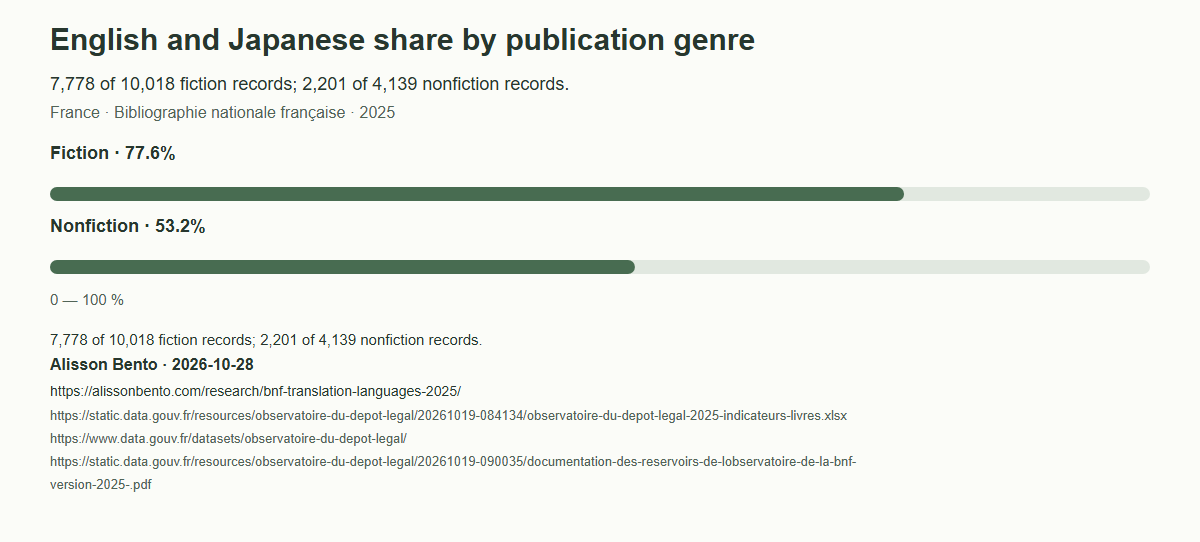
The BnF classifies 10,018 translation records as fiction and 4,139 as nonfiction. English and Japanese together account for 7,778 fiction records: 77.6% of that group. In nonfiction, they account for 2,201 records, or 53.2%. The descriptive difference is therefore 24.5 percentage points. Mixed or unspecified categories are not forced into either group.
This result makes concentration easier to understand than a single national percentage. It does not demonstrate that publishers deliberately favor particular languages, and it does not measure demand. The fiction category extends beyond novels: a share for romance, manga or adult literature cannot be inferred without an additional, verified classification. No such commercial category has been invented here.
98 populated labels do not mean 98 precisely identified languages
The translation records contain 98 nonempty original-language labels. Some are collective categories, such as multilingual or multiple language; others distinguish historical forms or linguistic variants. We retain the source labels in the downloadable table rather than merging these different situations into an artificial measure of diversity.
Portuguese appears in 110 records, or approximately 0.8% of all selected translations. The original language does not establish whether these books belong to Brazil, Portugal or any author nationality. Similarly, a record for an already known book or a new edition does not represent a new work. The 129 missing values remain visible and are retained in all main shares.
Not every translation in this dataset is published in French
The main scope covers all publication languages in the BnF’s translation records. It therefore includes multilingual editions and translations from French, among others. Presenting 69.7% as the share of all translations into French would be inaccurate.
To check the effect of this choice, we separately calculated the subset whose publication language is exactly français: 12,857 records, including 9,844 originating in English or Japanese, or 76.6%. This second percentage uses a narrower population and excludes editions labeled multilingual, even when they may contain French. It serves as a comparison of scope, rather than a correction to the main result.
Using this analysis to discover other reading
For a book club, this overview can open a conversation about the original languages represented in its selection. The table offers starting points for finding translations from languages less represented in the dataset, without turning a small bibliographic count into a judgment of quality. A language that occurs infrequently in this file is not necessarily little read elsewhere, and a country can publish in several languages.
For a newsroom or library, the main contribution is the explicit cross-tabulation of original language and publication genre, accompanied by every denominator. Each table row and chart can be checked using the script and aggregated data. This independent analysis was prepared for Alisson Bento’s website from a public BnF source; it is not a study commissioned or endorsed by the BnF.
English and Japanese share by publication genre
7,778 of 10,018 fiction records; 2,201 of 4,139 nonfiction records.
Scroll horizontally to inspect the chart. ↔
Chart values as text
The eight most frequent original-language labels
Shares of all 14,394 translation records, including missing values. Labels reproduce the source.
Scroll horizontally to inspect the chart. ↔
Chart values as text
English and Japanese shares under two publication scopes
The French-publication group is a subset of all translation records; the two bars are not independent populations.
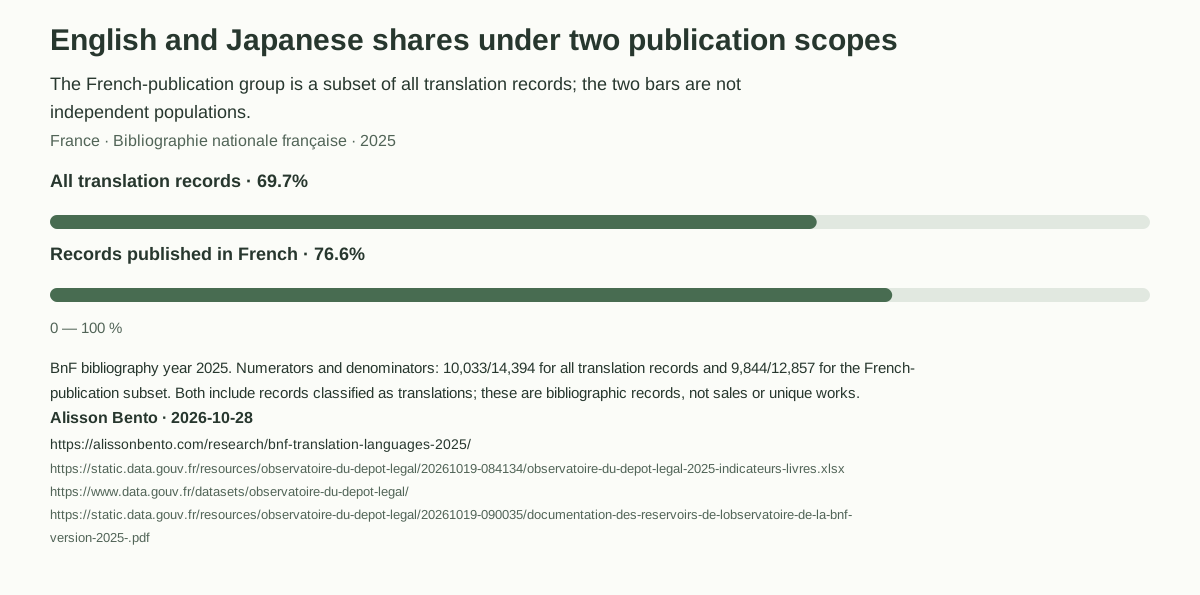
Scroll horizontally to inspect the chart. ↔
Chart values as text
Data & downloads
Scroll horizontally to see all columns.
| Original BnF label | Translation records | Share of total (%) | Fiction | Nonfiction | Published in French |
|---|---|---|---|---|---|
| anglais | 7225 | 50.2 | 5062 | 2114 | 7058 |
| japonais | 2808 | 19.5 | 2716 | 87 | 2786 |
| français | 856 | 5.9 | 161 | 679 | 38 |
| allemand | 580 | 4.0 | 290 | 269 | 544 |
| italien | 490 | 3.4 | 264 | 221 | 459 |
| espagnol | 420 | 2.9 | 256 | 156 | 365 |
| coréen | 325 | 2.3 | 315 | 10 | 318 |
| chinois | 166 | 1.2 | 93 | 68 | 150 |
| [non renseigné] | 129 | 0.9 | 50 | 74 | 36 |
| arabe | 129 | 0.9 | 36 | 91 | 86 |
| latin | 110 | 0.8 | 18 | 50 | 77 |
| portugais | 110 | 0.8 | 59 | 50 | 94 |
| russe | 100 | 0.7 | 68 | 31 | 86 |
| néerlandais | 98 | 0.7 | 57 | 41 | 93 |
| suédois | 94 | 0.7 | 87 | 6 | 94 |
| grec ancien | 78 | 0.5 | 25 | 9 | 56 |
| polonais | 61 | 0.4 | 44 | 16 | 58 |
| norvégien | 56 | 0.4 | 52 | 4 | 56 |
| grec moderne | 44 | 0.3 | 36 | 8 | 34 |
| hébreu | 40 | 0.3 | 13 | 11 | 36 |
| occitan | 30 | 0.2 | 17 | 12 | 4 |
| danois | 29 | 0.2 | 25 | 4 | 28 |
| finnois | 29 | 0.2 | 28 | 1 | 28 |
| tibétain | 24 | 0.2 | 0 | 24 | 14 |
| turc | 23 | 0.2 | 12 | 11 | 20 |
| islandais | 22 | 0.2 | 21 | 1 | 22 |
| catalan | 20 | 0.1 | 15 | 5 | 15 |
| persan | 20 | 0.1 | 16 | 4 | 17 |
| roumain | 20 | 0.1 | 15 | 5 | 18 |
| hongrois | 18 | 0.1 | 12 | 6 | 17 |
| tchèque | 18 | 0.1 | 10 | 7 | 16 |
| français ancien | 17 | 0.1 | 15 | 1 | 12 |
| sanskrit | 15 | 0.1 | 1 | 13 | 4 |
| multilingue | 10 | 0.1 | 5 | 4 | 2 |
| serbe | 10 | 0.1 | 9 | 1 | 10 |
| croate | 9 | 0.1 | 8 | 1 | 9 |
| dialecte français | 9 | 0.1 | 3 | 6 | 0 |
| ukrainien | 9 | 0.1 | 8 | 1 | 8 |
| bulgare | 8 | 0.1 | 7 | 1 | 6 |
| yiddish | 7 | 0.0 | 6 | 0 | 6 |
| albanais | 6 | 0.0 | 5 | 1 | 5 |
| slovène | 6 | 0.0 | 5 | 1 | 5 |
| tamoul | 6 | 0.0 | 3 | 3 | 6 |
| arménien | 5 | 0.0 | 3 | 2 | 4 |
| breton | 5 | 0.0 | 0 | 3 | 2 |
| lituanien | 5 | 0.0 | 4 | 1 | 5 |
| malgache | 5 | 0.0 | 2 | 3 | 0 |
| slovaque | 5 | 0.0 | 3 | 2 | 4 |
| dialecte italien | 4 | 0.0 | 4 | 0 | 0 |
| irlandais | 4 | 0.0 | 4 | 0 | 1 |
| langue austronésienne | 4 | 0.0 | 3 | 1 | 0 |
| corse | 3 | 0.0 | 2 | 1 | 0 |
| langue multiple | 3 | 0.0 | 1 | 0 | 0 |
| pali | 3 | 0.0 | 0 | 3 | 3 |
| afrikaans | 2 | 0.0 | 2 | 0 | 1 |
| basque | 2 | 0.0 | 0 | 2 | 1 |
| bengali | 2 | 0.0 | 1 | 1 | 2 |
| birman | 2 | 0.0 | 0 | 2 | 2 |
| estonien | 2 | 0.0 | 1 | 0 | 2 |
| géorgien | 2 | 0.0 | 2 | 0 | 2 |
| kazakh | 2 | 0.0 | 2 | 0 | 2 |
| langue nigéro-kordofanienne | 2 | 0.0 | 2 | 0 | 0 |
| marathe | 2 | 0.0 | 0 | 2 | 2 |
| mongol | 2 | 0.0 | 1 | 1 | 1 |
| moyen haut allemand | 2 | 0.0 | 1 | 1 | 2 |
| ourdou | 2 | 0.0 | 2 | 0 | 2 |
| peul | 2 | 0.0 | 1 | 1 | 0 |
| slavon d'église | 2 | 0.0 | 0 | 1 | 2 |
| somali | 2 | 0.0 | 2 | 0 | 0 |
| thaï | 2 | 0.0 | 2 | 0 | 1 |
| vietnamien | 2 | 0.0 | 0 | 1 | 2 |
| wolof | 2 | 0.0 | 2 | 0 | 0 |
| égyptien | 2 | 0.0 | 0 | 1 | 0 |
| akkadien | 1 | 0.0 | 1 | 0 | 1 |
| anglo-saxon | 1 | 0.0 | 1 | 0 | 1 |
| avestique | 1 | 0.0 | 0 | 1 | 0 |
| azéri | 1 | 0.0 | 1 | 0 | 1 |
| biélorusse | 1 | 0.0 | 1 | 0 | 0 |
| bosniaque | 1 | 0.0 | 1 | 0 | 1 |
| créole ou pidgin anglais | 1 | 0.0 | 0 | 1 | 0 |
| créole ou pidgin français | 1 | 0.0 | 1 | 0 | 0 |
| dialecte allemand | 1 | 0.0 | 1 | 0 | 1 |
| dialecte grec | 1 | 0.0 | 1 | 0 | 1 |
| hindi | 1 | 0.0 | 1 | 0 | 1 |
| indonésien | 1 | 0.0 | 1 | 0 | 0 |
| kurde | 1 | 0.0 | 1 | 0 | 1 |
| langue otomi | 1 | 0.0 | 1 | 0 | 1 |
| langue philippine | 1 | 0.0 | 1 | 0 | 1 |
| luxembourgeois | 1 | 0.0 | 1 | 0 | 1 |
| macédonien | 1 | 0.0 | 1 | 0 | 1 |
| maltais | 1 | 0.0 | 1 | 0 | 1 |
| mandingue | 1 | 0.0 | 1 | 0 | 0 |
| norvégien nynorsk | 1 | 0.0 | 1 | 0 | 1 |
| népalais | 1 | 0.0 | 1 | 0 | 1 |
| sami du Nord | 1 | 0.0 | 1 | 0 | 1 |
| suisse alémanique | 1 | 0.0 | 1 | 0 | 0 |
| syriaque | 1 | 0.0 | 0 | 0 | 1 |
| tamacheq | 1 | 0.0 | 1 | 0 | 1 |
| tatar de Crimée | 1 | 0.0 | 1 | 0 | 0 |
99 rows:98 nonempty labels and one missing category. BnF labels retained in French; total14,394. Fiction, nonfiction and French publication are overlapping subsets.
Evidence & method
How we calculated it
- Source: the BnF’s Observatoire du dépôt légal, Books 2025 dataset, a public resource uploaded to data.gouv.fr on October 19, 2026 and accessed on October 28, 2026. The protocol and SHA-256 fingerprint are included in the downloads.
- Unit: one bibliographic record, identified by NNB. We checked 67,498 rows and 67,498 distinct NNB identifiers; the Année de parution BNF field is 25 for every row. This is the year the record appeared in the Bibliography, not necessarily the book’s publication year or the year it was received for legal deposit.
- Exact selection of code 1 - Traduction (avec ou sans texte original), after trimming leading and trailing spaces. Codes 0, 2 and 3, and blank values, are excluded from the 14,394 selected translations.
- Counts use the exact Langue originale label after trimming leading and trailing spaces. The 129 missing values remain a visible category. Source labels are kept in French in the tables to enable direct reconciliation.
- Main share = number of records in the category / 14,394 × 100. Genre-specific shares use 10,018 fiction records and 4,139 nonfiction records respectively. Displayed values are rounded to one decimal place; CSV files retain calculation precision. Gap calculated before rounding.
- Scope check: repeat the calculation only for records whose Langue de publication is exactly français. The complete table reconciles to 14,394 records; the main rows were also checked against the ranking supplied in the source workbook.
What the data cannot tell us
- This administrative extract describes records appearing in the Bibliographie nationale française – Livres in 2025. Cataloging delays, new editions and differences between deposits, volumes, records and works prevent it from being equated with all new publishing output in 2025.
- The main scope includes all publication languages and is not equivalent to all translations into French. Imported editions, multilingual editions and translations from French may be included.
- Language and genre fields come from the catalog. We have not examined the contents of every book; collective categories, variants and missing values are not resolved through assumptions.
- Comparisons are descriptive. They support no conclusions about sales, readership, preferences, literary quality, the number of unique authors or causality.
- The analysis independently reuses public data; it is not an original reader survey. It does not claim to be the first observation ever published on linguistic concentration.
Original sources
- Bibliothèque nationale de France — Observatoire du dépôt légal 2025, Livres
Public BnF workbook released on October 19, 2026. Bibliographic records, not received deposits or sales. Source licence: fr-lo.
Accessed October 28, 2026
- BnF / data.gouv.fr — Observatoire du dépôt légal metadata
Official BnF dataset metadata and Licence Ouverte designation.
Accessed October 28, 2026
- BnF — Documentation des réservoirs 2025
Sections 5.2.3.1–5.2.3.3 define bibliographic year, translation code, original language and publication genre.
Accessed October 28, 2026
Cite & reuse this study
Alisson Bento. Translations at the BnF in 2025: concentration by original language and publication genre. October 28, 2026. Independent analysis of data from the BnF’s Observatoire du dépôt légal. https://alissonbento.com/research/bnf-translation-languages-2025/
Derived tables and calculations may be reused with attribution to this analysis and to the Bibliothèque nationale de France. Respect the Licence Ouverte identified by data.gouv.fr for the BnF data; do not imply BnF endorsement.
Corrections or editorial questions